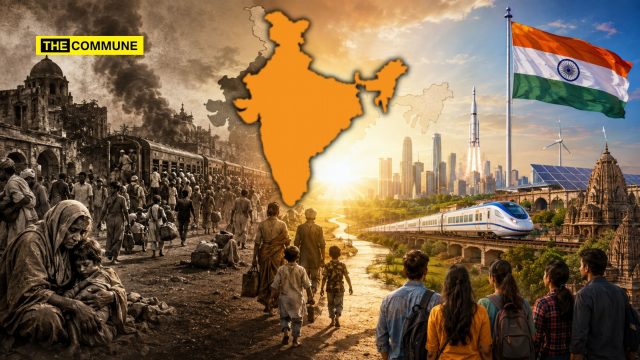
Partition was not merely an event of drawing a boundary line across a map. It was the devastating tearing of a nation’s social fabric, marked by homes being uprooted, memories shattering, relationships breaking, and centuries-old shared culture being wounded. On August 15, 1947, India welcomed the dawn of freedom, but for millions, that moment was inextricably linked with an agonizing darkness whose shadows persisted across generations. Millions were displaced overnight, cast into refugee camps, and forced to rebuild their lives from scratch amid unprecedented violence and loss.
Some dates in history do not stay on calendars; they live in the collective memory of a society. August 14, 1947, is one such date. To forget it is dangerous because oblivion does not end history; it merely turns unaddressed wounds into unspoken questions for future generations. For decades, the sheer scale of human tragedy that accompanied India’s independence was treated almost as a footnote, an awkward chapter to be glossed over in favor of a sanitized narrative. Yet, an authentic self-aware nation cannot march confidently into the future if it remains in denial about its foundational trauma.
Preserving this history is not an exercise in generating hatred against any community. On the contrary, remembering Partition honestly is about understanding a profound human tragedy in which ordinary people from Hindu, Sikh, Jain, and other communities became the biggest victims. It is about honoring the resilience of those who survived, acknowledging the sacrifices of those who perished, and ensuring that our collective consciousness remains guarded against the forces of division that enabled such a tragedy in the first place.
Historical Introspection: A Divided Past, a Fractured Destiny
Could India’s Partition have been averted? This question remains one of the most difficult and lingering debates in modern history. If one seeks answers with impartiality, a glimpse of the truth emerges through the complex web of colonial strategy and domestic political choices.
Many historians differ on whether Partition was inevitable or whether different political decisions could have preserved the possibility of a united India. The British empire’s classic policy of divide-and-rule deliberately amplified religious and political fault lines to secure its administrative grip. However, domestic appeasement, strategic miscalculations, and an eagerness to secure an immediate transfer of power also allowed religious separatism to gain violent momentum.
When a nation allows its core identity to be fragmented for short-term political expediency, the ultimate price is paid by its people. The partition of the Indian subcontinent stripped the nation of its geographical continuity, fractured its civilizational heritage, and created an enduring geopolitical fault line that has drained regional resources for decades. Understanding these missteps is not about assigning retrospective blame; it is an essential lesson in governance, unity, and national interest.
From Historical Trauma to National Resurgence
For decades after independence, India’s approach to its economic and geopolitical realities was constrained by a mindset of survival. Rebuilding from colonial exploitation required massive efforts to achieve basic self-sufficiency. However, as time moved forward, a fundamental shift occurred in the national ethos. India transitioned from a nation managing the consequences of its past fragmentation to a sovereign global power determined to shape its own future.
The recognition of Partition Horrors Remembrance Day marked a pivotal cultural and political turning point. It signaled that India was no longer afraid to confront its history in its entirety. Instead of suppressing painful memories, the nation chose to integrate them into its national narrative as a reminder of the cost of disunity.
A nation’s strength is tested by how it recovers from catastrophic setbacks. The millions of refugees who arrived in 1947 did not remain perpetual victims; through sheer grit, enterprise, and faith in their homeland, they built businesses, revitalized communities, and contributed immensely to India’s post-independence growth. Their spirit exemplifies the core ethos of India: resilience in the face of tragedy, and an unyielding commitment to rebuild.
Aligning Memorialization with the Vision of Viksit Bharat 2047
As India marches through its Amrit Kaal, the 25 years leading up to the centenary of its independence in 2047, the vision of Viksit Bharat (Developed India) serves as our overarching guiding beacon. Viksit Bharat is not merely an economic goal measured by Gross Domestic Product, infrastructure corridors, or technological milestones. It is a holistic civilizational reaffirmation. It represents a confident, self-reliant, and united nation that honors its past while fearlessly building its future.
The link between remembering Partition and building a developed India by 2047 is direct and profound:
- National Unity as an Economic and Strategic Prerequisite: Economic development cannot occur in an environment of social friction or division. The lessons of 1947 remind us that internal cohesion (Ek Bharat, Shreshtha Bharat) is the foundation upon which all physical and economic infrastructure rests.
- Self-Reliance (Atmanirbharata): A key pillar of Viksit Bharat is ending strategic and economic dependencies. The tragedy of 1947 was facilitated by foreign rulers dictating the fate of millions. True independence requires complete self-reliance in defense, technology, energy, and food security.
- Cultural and Civilizational Pride (Pran): A developed nation must be rooted in its own identity. Remembering our history ensures that progress is accompanied by a strong sense of national consciousness, preventing cultural erosion in an increasingly globalized world.
- Empowering the Youth (Yuva Shakti): For the generation born decades after 1947, understanding the sacrifices of the past provides purpose to their contemporary efforts. Channeling youth energy into innovation, entrepreneurship, and public service turns historical awareness into active nation-building.
The Path Ahead: A Century of Sovereignty and Progress
The journey toward 2047 demands an unwavering commitment to national interest above all else. As India rapidly scales up its digital public infrastructure, expands its manufacturing capabilities, strengthens its modern defense systems, and asserts its voice as a leader of the Global South, it carries forward the memory of what it lost and what it rebuilt.
Viksit Bharat by 2047 will stand as the ultimate tribute to every individual whose life was disrupted or cut short in 1947. It will prove that while history can fracture land, it cannot break the spirit of a civilizational state. By turning the wounds of Partition into a collective pledge for absolute unity, security, and prosperity, India ensures that its dark chapters never repeat and that its bright future remains firmly in its own hands.
Dr. Prosenjit Nath is a techie, political analyst, and author.
Subscribe to our channels on WhatsApp, Telegram, Instagram and YouTube to get the best stories of the day delivered to you personally.