Home Blog Page 588

‘Waqf Board is India’s Most Corrupt Institution’, ‘Waqf Board Is A Museebat (Trouble/problem)’: TNTJ Chief Jainulabdeen’s Video Supporting Waqf Amendment Bill Goes Viral
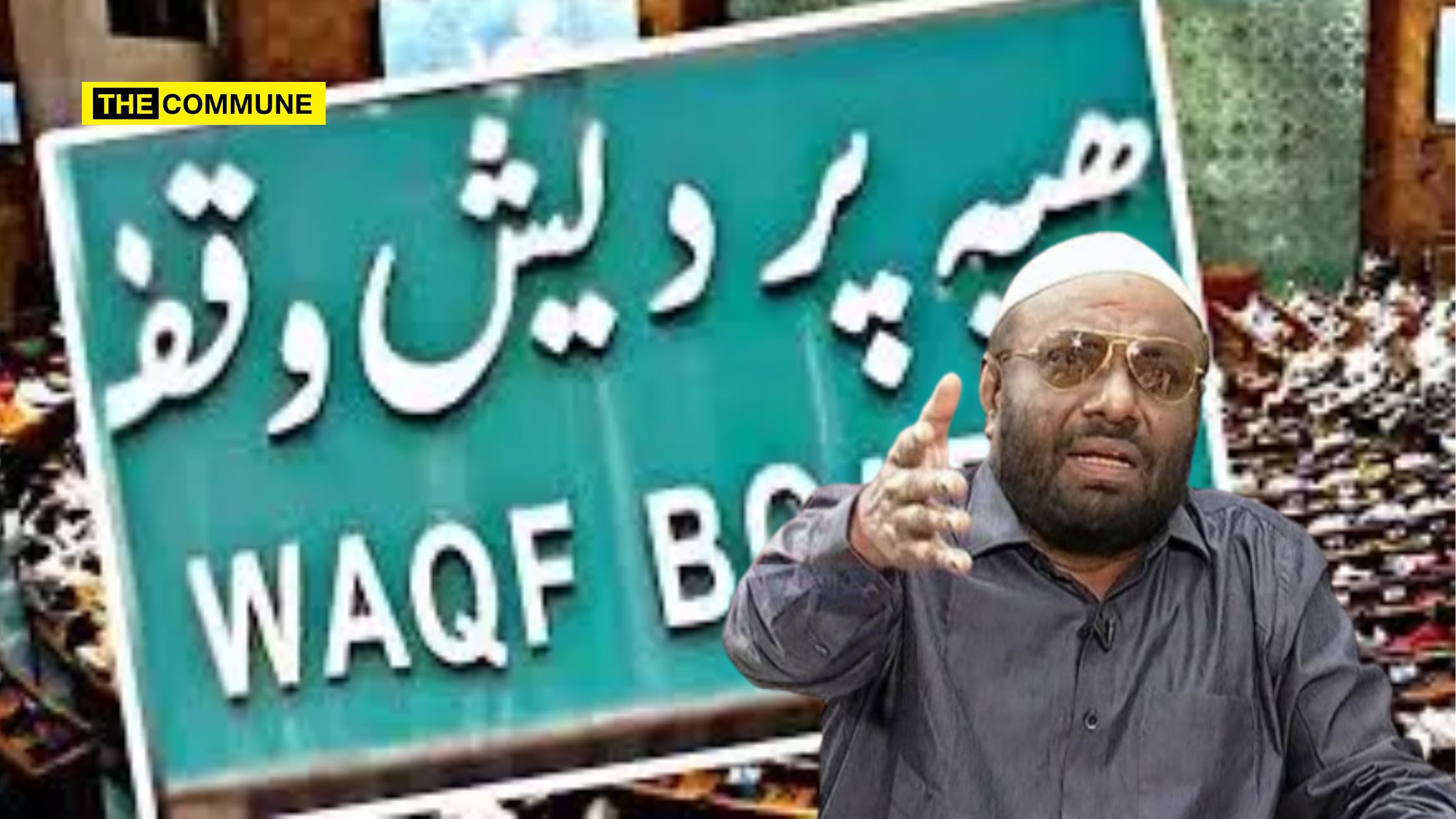
Tamil Nadu Thowheed Jamath (TNTJ) founder P Jainulabdeen’s video supporting the Waqf Amendment Bill has gone viral on social media.

In a video that seems to be from his channel, he is seen saying, “Why was Waqf Board created. These Waqf Board officials are corrupt – the Waqf member, Chairman, other officials, they take bribe, they appoint corrupt officials in positions, they chase out the good ones. If you consider the corruption in the country, Waqf is where the highest corruption is taking place. We knew this was happening for a very long time. We have been stressing on the need to remove the Waqf Board. They are doing us no good. Do you know what these people have done? They have transferred the Waqf properties to have party offices. If it was with us people, we wouldn’t have done that. But with the help of these Waqf Board officials and giving land to the DMK or ADMK people. So many party officers are in Waqf land and Waqf properties are with people with money. If you ask who is responsible for this – it is the gang that was selected to protect Waqf properties. They include an MP, MLA – all to share the loot. There are some conditions that the officials must include a Muslim MP or MLA. But the BJP has brought in a bill to change this. So if this comes, then we will be able to take care of our Waqf properties in our locality. Take for example in a village, a Muthawali has looted several crores worth of property and the village is furious over this and want him to be removed. But what he will do is get an extension for his tenure. If that happens, no one can do anything. Then they will bring the police and claim the people cannot do anything. So because of this Waqf Board, corruption is at its peak. They are just giving away properties to whoever they want, especially to the people in power.”

In another clipping he is seen saying, “We are thinking that it will be nice if this Waqf is removed. So the BJP brought in the Amendment Bill as a private bill. Now the ones who are against this are boiling! They are pretending as if this is against the Muslim community. They claim 500 acres of Waqf land is lying unretrieved in Coimbatore. But who is responsible for that? Is it because of you who did all that corruption or the private people who got fooled? They also claim 1000 acres got lost in Trichy. How did it happen – when the Waqf Board was there or when it didn’t exist? They are spinning stories like this, they make a list like this and call to retrieve Waqf Board. It is the same people who gave away Waqf properties to the politicians and they are saying this – the Waqf officials. They are enjoying the wealth of the Waqf. They claim they lost 1000 acres in Trichy, 300 acres in Sanghaghiri, 100 acres in Satyamangalam, 100 acres in Dindigul, 200 acres in Nilgiris, 80 cent land in Main Bazaar area, 1000s of acres in Ramnad, Tirunelveli. They claim the government, the bill is trying to take away all this land. You say the law is responsible for the loss, but it is you who is responsible for it – the Waqf Board. You gave away the land by giving the patta to all those who you need, you gave them permission to sell. You are hand in glove with the corruption hat took place. Who is responsible for the destruction of Waqf wealth – the Waqf Board itself! So it will be a good thing if this ‘museebat’ is undone. Why are you jumping so much for the bill? You say you are going to retrieve everything. It was you who lost all the wealth in the first place. This is for your information. This is not a communal problem. If the problem of Waqf goes away, it is beneficial for the Muslim community. It is not a thing to worry about.”

Subscribe to our channels on Telegram, WhatsApp, and Instagram and get the best stories of the day delivered to you personally.
DMK’s ‘Financial Injustice’ Myth Busted: TN Got 4.3X More Funds Under Modi Than UPA

In recent years, the DMK-led government in Tamil Nadu has repeatedly accused the Central Government, particularly under Prime Minister Narendra Modi’s leadership, of financial discrimination. These claims, often echoed in political speeches and media narratives, suggest that Tamil Nadu is being short-changed—receiving only a fraction of what it contributes to the nation’s tax pool, and being denied its fair share of developmental funds. However, a closer look at data spanning the UPA and NDA regimes reveals a very different picture. This report, backed by research and analysis from JVC Sreeram, aims to dismantle the misinformation propagated by the DMK using verifiable figures, inflation-adjusted comparisons, and fiscal realities. The objective is simple: to let facts, not political rhetoric, guide public understanding. Let’s delve deeper into the lies and facts.

DMK’s Lie No 1

Central Government gives only 30 paisa for every 1 rupee collected as taxes from the state of Tamil Nadu and injustice is committed is another infamous fake narrative by DMK.

Fact

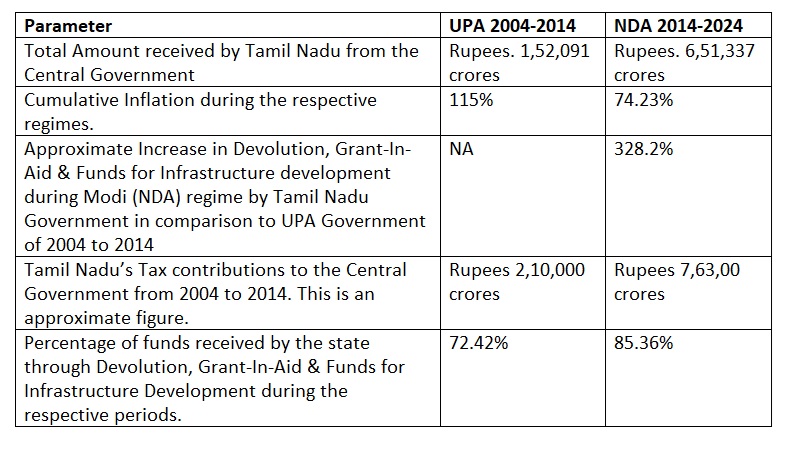
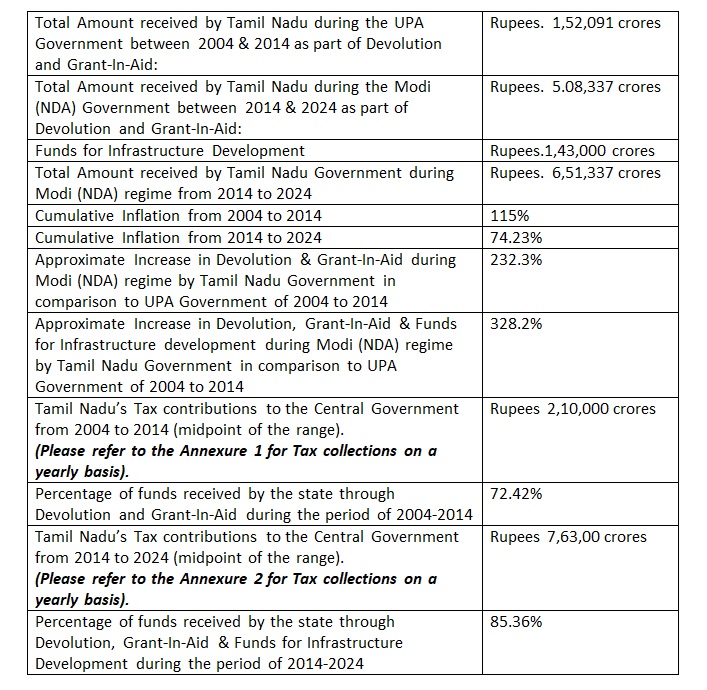
Shri Narendra Modi’s NDA Government provided Rupees 5,08,337 crores to Tamil Nadu as Devolution and Grant-In-Aid apart from providing Rupees 1,43,000 crores for Infrastructure Development from 2014 to 2024.

Under Shri Manmohan Singh’s UPA’s Government from 2004 to 2014 the state of Tamil Nadu received Rupees 1,52,091 crores. It is pertinent to note that DMK was part of UPA Ministry and a Minister of State of Finance was a DMK MP and it is also important to note that during the 10 years of UPA regime Shri. P. Chidambaram who was MP from Sivaganga was the Union Finance Minister for a period of 6 years.

DMK’s Lie No 2

Modi Led NDA Government in the Centre, collects taxes from TN and distributes it to other Bimaru states.

Fact

The Direct Tax collections from the state of Tamil Nadu during the UPA regime of 10 years from 2004 to 2014 was approximately Rupees 2,10,000 crores of which 72.42% was given back to the state by the Central Government which amounts to Rupees 1,52,091 crores.

Approximate Direct Tax collections from the state of Tamil Nadu during the NDA regime from 2014 to 2024 was Rupees 7,63,000 crores and the Central Government led by Shri Narendra Modi ensured that the state received 85.36% in the form of Devolution, Grants-In-Aid and Infrastructure funds totaling to Rupees 6,51,337 crores.

Hence this fake narrative of DMK is also busted through facts, data and figures.

DMK’s Lie No 3

Someone should tell BJP that there is a concept of Inflation and hence there is a jump in the funds provided by the Central Government.

Fact

The cumulative inflation during the period of 2014 and 2024 in India was 74.23% but the increase in Devolution and Grant-In-Aid provided during the same time saw a jump of 232.3% (this is 3.35 times more than what the state received under UPA regime) and if we include the Funds for Infrastructure Development then the jump in fund allocation to Tamil Nadu shoots up to 328.2% (this is 4.3 times more than what the state received under UPA regime.

Taking the argument further the cumulative inflation, which prevailed during the 10 years of UPA regime was a whopping 115%. Hence the increase of fund allocation has nothing to do with Inflation and there is proper justice in allocating resources to the state of Tamil Nadu.

The very fact that Tax collections have grown up by over 3.6 times in the period of 2014 to 2024 compared to 2004 to 2014 and also the fact that Inflation has been cumulative inflation of the period of 10 years of Modi Government has been controlled and brought down from an alarming 115% to that of a reasonable and acceptable 74.23% is the testimony to the fact that economy has been handled in a far more prudent manner in spite of a once in a century Global Pandemic attacking the world. Considering all these things the DMK Government should be happy about the economic progress that India is making and the center is supporting the state of Tamil Nadu in the best possible manner and should not be cribbing and complaining all the time.

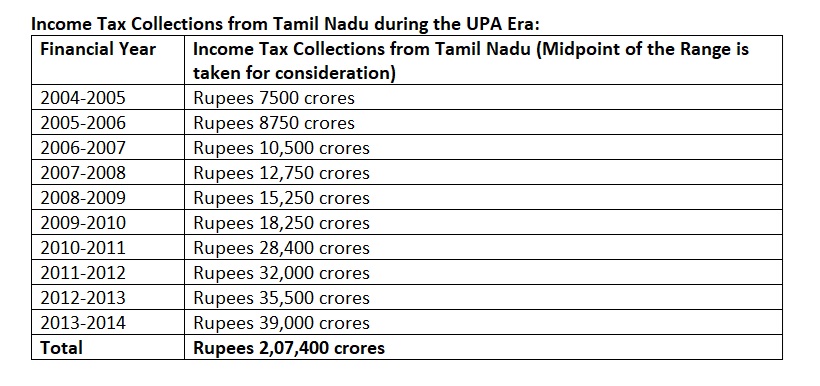
Annexure 1

Please note that in the absence of granular, state-specific annual reports from the CBDT these figures remain estimates grounded in broader trends and known data points. These estimates are calculated based on growth rates, consistent 6% to 7% of national direct tax collections (this was later confirmed in 2022-2023 where Tamil Nadu contributed 6.52% of total national tax collections.

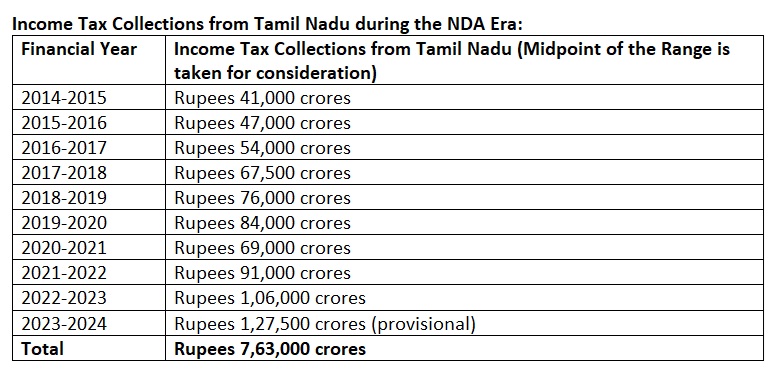
Annexure 2

Please note:

  • FY 2017-2018 saw a surge due to demonetization surge.
  • FY 2018-2019 saw Karnataka overtake Tamil Nadu
  • FY 2020-2021 saw stagnation due to COVID 19 pandemic
  • FY 2021-2022 saw a bounce back due to swift recovery from pandemic
  • FY 2023-2024 is based on national surge and trends in Tamil Nadu

Now let’s compare the allocation of funds by UPA Government from 2004-2014 and NDA Government from 2014-2024 along with other financial data.

The narrative pushed by the DMK alleging financial injustice by the Central Government fails to hold up under scrutiny. From 2014 to 2024, Tamil Nadu has received a significantly higher share of funds compared to the UPA decade, with an increase of over 328% when infrastructure allocations are included. Not only has the Modi-led NDA government returned a higher percentage of Tamil Nadu’s tax contributions, but it has also done so while maintaining lower inflation and steering the country through major global disruptions like the COVID-19 pandemic. Far from being short-changed, Tamil Nadu has been a major beneficiary of central support. It is time to move beyond politically motivated claims and acknowledge the substantial fiscal backing provided by the Centre—support that reflects fairness, growth, and national responsibility.

Sreeram JVC is a political strategist, author and a public speaker.

Subscribe to our channels on Telegram, WhatsApp, and Instagram and get the best stories of the day delivered to you personally.
Speaker Or DMK Spokesman? Bias Alleged As TN Speaker Appavu Repeatedly Stifles Debate In Assembly

The conduct of Tamil Nadu Assembly Speaker M. Appavu has come under intense scrutiny after a series of viral video clips on social media showed him repeatedly interrupting opposition MLAs, answering questions on behalf of ministers, and allegedly stifling debate in the House.

In multiple clips stitched together and circulated widely, Speaker Appavu appears to be actively intervening during the Question Hour, frequently cutting off members mid-sentence and discouraging them from elaborating on issues concerning their constituencies.

Speaker Turns Spokesperson?

In one instance, when an MLA attempted to raise an issue related to the power sector, Appavu interjected before the member could complete his question. “Please ask only your question, you will get the answer. You can ask the flood-related questions to the Water Minister. What do you want from the Electricity Department?” he said, while continuing to interrupt the member and not allowing him to complete his statement.

In another clip, a member raising concerns about sewage maintenance was repeatedly interrupted by the Speaker. Similarly, a question on public transportation was met with the same treatment.

A particularly contentious exchange occurred when ADMK MLA Amman Arjunan tried to raise a point. Before he could even finish a sentence, Appavu rebuked him sharply, “Amman Arjunan, you are not the only ADMK MLA, there are 66 members. I cannot give additional questions to all 66 of you. Do not threaten by sitting there. It is my wish. Sit down.”

Another video shows a woman MLA attempting to highlight the issue of slow broadband connectivity in hilly areas. Before she could elaborate, the Speaker cut her off, saying dismissively, “You want broadband only, right?”

In a separate incident, when an MLA began describing how people were migrating from his constituency to Tirupur and Erode for work, Appavu interrupted him, “What do you want – livelihood or water? Please ask the question properly.” When the MLA justified that the context was necessary, Appavu candidly admitted, “If you ask in one word, they will reject. If you elaborate, I will reject.”

Yet another clip captures a member mentioning a Coimbatore-related matter when the bell rang. Appavu jumped in, interpreting the query on his own and concluding, “Everyone knows about the jobs and industries in Coimbatore. Finish your statement.”

Opposition Denied Floor, Broadcast Cut

Criticism of the Speaker’s style has intensified in recent months, especially after multiple opposition attempts to raise law and order issues were shut down. A few days ago, AIADMK members staged a walkout after Leader of the Opposition Edappadi K. Palaniswami was not allowed to raise a law and order matter. Appavu rejected a prior notice from AIADMK Deputy Leader R. B. Udayakumar and declined to hear Palaniswami.

Further controversy erupted in March 2025, when all AIADMK MLAs were evicted en masse from the Assembly after a dramatic protest. The disruption began when Palaniswami once again sought to raise an issue post-Question Hour. The Speaker, reiterating that prior permission had not been granted, refused to yield the floor.

The situation escalated when Deputy Chief Minister Udhayanidhi Stalin rose to speak, prompting protests from AIADMK members. Despite repeated warnings from the Chair, the opposition persisted, leading Appavu to summon marshals and have them removed from the House.

Opposition Cries Foul, Demands Accountability

Opposition leaders have slammed the Speaker’s conduct, accusing him of partisanship and suppressing dissent. AIADMK members have alleged that live broadcasts are cut off when the Opposition Leader speaks, and that the Speaker frequently assumes the role of ministers by responding to questions himself.

The Assembly is a temple of democracy, and it appears that the Speaker is turning it into a platform for one-sided monologues. Opposition members argue that it was impossible to function effectively when the Speaker acted more like a ruling party whip than a neutral chair.

Political observers noted that by repeatedly overriding MLAs and responding in place of ministers, the Speaker was undermining the purpose of legislative debate.

Subscribe to our channels on Telegram, WhatsApp, and Instagram and get the best stories of the day delivered to you personally.
Kochi Firm’s Shocking ‘Employee Punishment’ Video Sparks Outrage; Management Claims Footage Fabricated

Disturbing visuals of alleged employee abuse at Kochi-based marketing firm Hindustan Power Links (operating under Keltra Marketing) have triggered widespread condemnation, with authorities launching probes into the matter. The viral video, which surfaced over the weekend, purportedly shows workers being subjected to extreme humiliation and physical abuse as “punishment” for failing to meet sales targets. However, the authenticity of the footage has now been disputed, with one featured individual claiming it was staged as part of an internal vendetta.

Graphic Allegations Of Abuse

The video, widely circulated on social media, depicts employees being:

  • Paraded with belts tied around their necks like dogs, forced to crawl on all fours.
  • Made to drink water from bowls placed on the floor.
  • Forced to remove their pants and hold each other’s private parts.
  • Punished by having salt stuffed into their mouths.
  • Compelled to lick coins off the floor while mimicking a dog urinating in corners.

According to Mathrubhumi, these acts were allegedly routine for staff who missed daily sales quotas. Employees, many earning between ₹6,000–₹8,000 monthly, reportedly stayed silent due to fear of retaliation. The firm’s Kaloor Janatha Road branch, operational for over 20 years, allegedly confiscated phones to prevent leaks.

Management Denies Claims; Video Allegedly “Fabricated”

In a dramatic twist, a person seen in the video claimed it was “staged months ago” during an internal managerial dispute. He alleged a former manager, later fired, edited and leaked the footage to malign the company.

“I am still working there… the visuals were forcefully recorded and are now being misused,” he told police and labour officials.

Hindustan Power Links denied all accusations, stating it adheres to labour laws and provides employee benefits. It clarified Keltra Marketing acts only as its agent and bears no direct responsibility for the video’s claims.

Government And Police Response

Kerala Labour Minister V. Sivankutty ordered an urgent probe, calling the acts “unacceptable in a civilized society.” The district labour officer will submit a report.

Kerala State Human Rights Commission registered a case based on a complaint by lawyer Kulathoor Jaisingh.

Kerala State Youth Commission took suo moto cognizance, directing police to investigate and submit findings.

Police are verifying the video’s origins. Initial reports suggested the incident occurred in Perumbavoor, not Kaloor. Perumbavoor police noted the firm’s owner was earlier arrested in a sexual harassment case (now out on bail).

As the investigation continues, the district labor officer is preparing a detailed report for the labor minister, while police are preparing to question those who initially raised the allegations. The case has drawn significant public attention, with Youth Congress activists staging protests outside the company’s Kaloor office.

Minister Sivankutty has emphasized that such alleged practices have no place in a civilized society and has assured that the government will take appropriate action once all facts are established.

Subscribe to our channels on Telegram, WhatsApp, and Instagram and get the best stories of the day delivered to you personally.

BBC Caught Pushing Islamic Supremacy – How It Legitimizes Islamist Dogma Through Language

The British “Bullshit” Corporation (BBC) has once again proven itself to be nothing more than a propaganda arm for Islamic supremacism. In a recent article, the BBC shamelessly used the term “revert” instead of “convert” to describe those who adopt Islam—before quietly editing it after being called out. This is not just a matter of semantics; it is a deliberate endorsement of the Islamist narrative that everyone is “born Muslim” and must “return” to the faith.

The ‘Revert’ Controversy: Islam’s Supremacist Dogma

The BBC’s original article stated, “Some Muslims refer to ‘revert’ when talking about people who have converted to the Muslim faith. This is based on the belief that everyone is born as a Muslim and those who embrace Islam are returning to their ‘natural state.’”

This is not neutral journalism—it is uncritical amplification of Islamic theological imperialism. The term “revert” is a dogmatic assertion that Islam is the default state of humanity, implying that all non-Muslims—Hindus, Christians, atheists—are deviants who must “return” to the “true faith.”

This is the same supremacist logic used by Islamists to justify:

  • Forced conversions (“They were always Muslims, just unaware”).
  • Denial of apostasy rights (“Leaving Islam is unnatural”).
  • Cultural erasure (“Hinduism/Buddhism/Christianity are corruptions”).

By using this language, the BBC legitimized a dangerous theological claim—one that has been used to justify centuries of Islamic conquest, persecution, and dawah aggression.

BBC’s Cowardly Edit: No Apology, Just Gaslighting

When this usage was called out, the BBC didn’t offer a real apology.

The BBC surreptitiously changed “revert” to “convert”—but instead of admitting their bias, they lied in their “correction note,” claiming:

“Updated on 5 April 2025: Changes language used in the piece to help with understanding.”

No, BBC. You didn’t change it for “clarity.” You changed it because you got caught pushing Islamic dogma as fact. You were caught parroting the dogma of religious exclusivism in a country that claims to stand for secularism and liberty.

This is the same BBC that:

  • Whitewashes jihadist terror as “radicalization” (never “Islamic terrorism”).
  • Defends Islamist hate preachers while smearing Hindu nationalists.
  • Parrots Pakistani propaganda on Kashmir while ignoring Hindu genocide.
  • Whitewashed grooming gangs for fear of “Islamophobia”
  • Routinely demonizes Hindus, now slips in supremacist terms from the Islamic lexicon like it’s just another day in the newsroom.

Let’s flip this for a second. Imagine if an Indian news outlet called a Christian convert to Hinduism a “revert”. The BBC and its ideological cousins would explode with outrage, calling it “Hindutva propaganda,” “exclusionary nationalism,” or worse, “fascism.” But when Islamists say it? The BBC nods along.

The Desert Dogma Behind the Word

“Revert” is not a benign alternative to “convert.” It is based on the Islamic doctrine of fitrah, the belief that every human is born a Muslim. Anyone who isn’t Muslim has deviated, and anyone who embraces Islam is simply returning to their rightful path. This isn’t just theology—it’s the ideological foundation behind Islamic conquest and da’wah movements. It’s the same logic used to justify religious conversion drives and silence dissent in Muslim-majority societies.

And now the BBC, the British Bullshit Corporation, is laundering that supremacist logic into mainstream discourse—without debate, without disclaimer, without shame.

Why Does This Matter?

Because the BBC is not just a news outlet—it is a state-funded broadcaster shaping global opinion. When it uncritically adopts Islamist terminology, it normalizes the idea that:

  • Islam is the default human religion (a claim with zero scientific or historical basis).
  • Conversion to Islam is a “return” (implying other faiths are illegitimate).
  • Criticism of Islam is “unnatural” (since everyone is “supposed” to be Muslim).

This is soft jihad—the cultural Islamization of the West through language manipulation, media bias, and psychological conditioning.

Why This Matters to Hindus—and Everyone Else

The BBC’s sneaky edit proves it knows it was wrong—but lacks the integrity to admit it. Instead, it gaslights the public, pretending the change was for “understanding” rather than covering up its Islamic bias.

When the BBC casually uses “revert” for Islam and pretends it’s just another word, it’s not just a Hindu issue. It’s a warning for anyone who values their freedom of belief. If media outlets normalize the language of supremacy, they normalize the ideology behind it. And once that happens, your silence becomes complicity.

Subscribe to our channels on Telegram, WhatsApp, and Instagram and get the best stories of the day delivered to you personally.

Srivilliputhur Andal Temple Staff Allegedly Collects Money For Free Restrooms, Viral Video Sparks Outrage

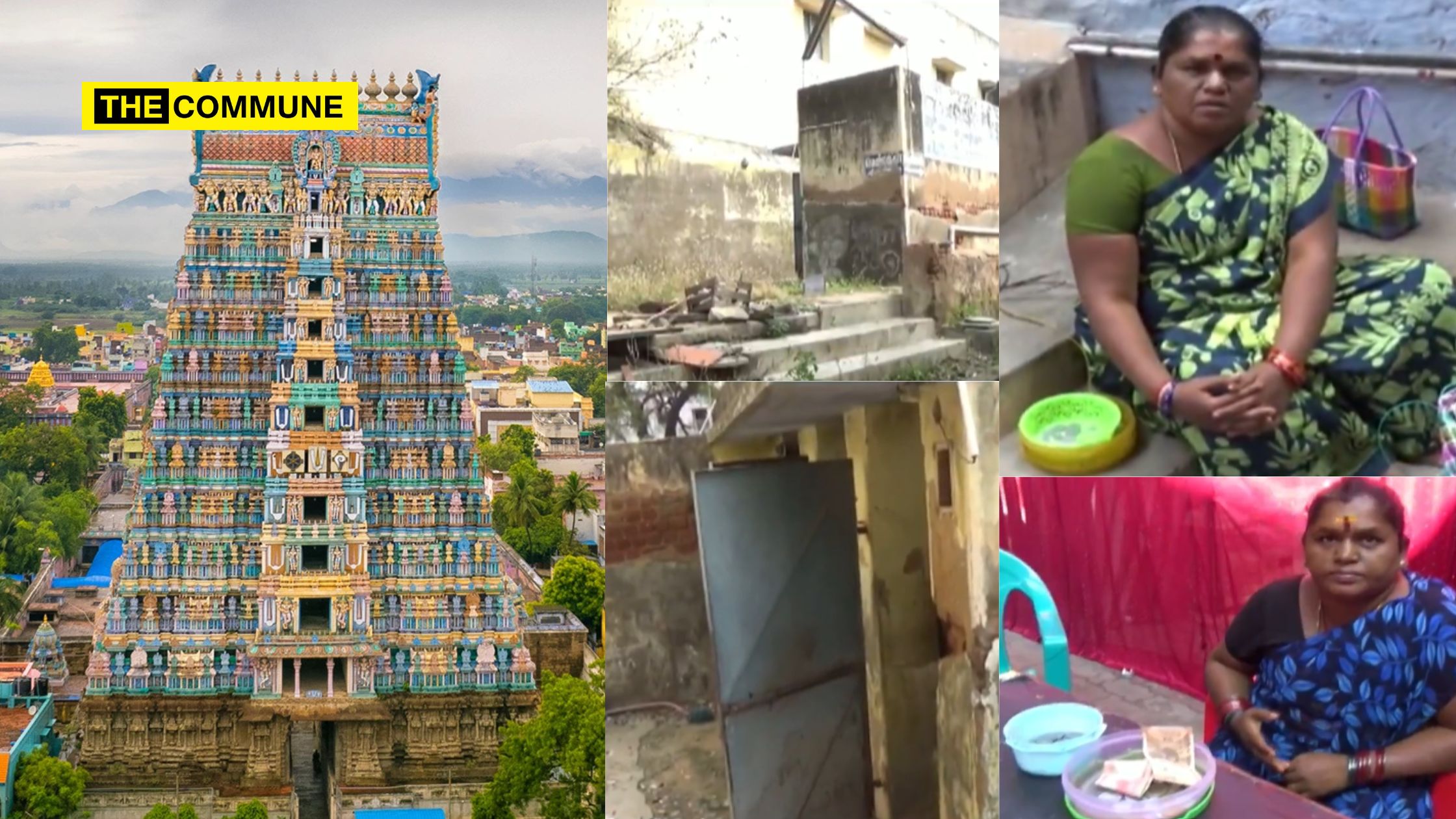
Devotees at the Srivilliputhur Andal Temple have expressed outrage after reports surfaced that temple staff were demanding money to use restrooms and bathrooms that were originally provided for free. These facilities were philanthropically donated by a private college for the benefit of devotees, making the alleged fee collection even more controversial.

A viral video shows two women employees sitting near the temple restrooms, allegedly collecting money from visitors. A devotee, noticing the transaction, recorded the exchange and questioned them, asking, “They say you are demanding money?” One of the employees responded, “Yes, sir, the Executive Officer (EO) has said so.”

Perplexed, the devotee asked again, “Did the EO say that?” The woman reaffirmed, “the EO instructed us to charge ₹2 to keep the restrooms clean. We are only collecting the amount because he told us to.”

The devotee then pointed out, “But they said it was are free.” To this, the employee replied, “Yes, they was displayed free for two months, but we were not given a salary. When we asked about it, the EO told us to collect ₹2 and maintain cleanliness.”

When he approached another woman collecting money and asked whether the amount was for the temple administration or for personal use, she responded, “It is for cleaning.”

It is said that the current restrooms were built after four years of inadequate sanitation facilities. The temple administration and the Hindu Religious & Charitable Endowments Department neglected, and a philanthropist funded the construction of the bathrooms for the benefit of devotees.

The video has since gone viral, sparking criticism and demands for accountability from temple authorities under the Hindu Religious & Charitable Endowments Department.

Subscribe to our channels on TelegramWhatsApp, and Instagram and get the best stories of the day delivered to you personally.

Faye D’Souza Whitewashes Waqf Board’s Land-Grabbing Powers Under Section 40 Brought By Congress To Peddle Biased Narrative Against Modi Govt’s Waqf Amendment Act

Congress-buttressing journalist Faye D’Souza recently weighed in on the controversial Waqf (Amendment) Bill 2025, using her YouTube channel to explain the ongoing buzz surrounding the legislation. In her video, titled “Waqf Bill Explained,” D’Souza carefully crafted her narrative, focusing on the Waqf Board as the victim, while omitting key aspects of the bill, such as Section 40. This provision, widely criticized for its authoritarian nature, allows the Waqf Board to act as both the accuser and investigator. Under this section, once the Board claims a piece of land as Waqf property, the burden shifts to the property owner to prove it isn’t. However, D’Souza made no mention of this critical detail, instead focusing on other misleading claims from the Congress and its minority-appeasing allies.

In her video, which aired on 4 April 2025, D’Souza presented her explanation of the Waqf Amendment Bill, offering a breakdown of the bill’s contents, alleged its contentious nature, and the events surrounding its passage in Parliament. She described the bill as a source of tension between the government and the opposition, further fueling the ongoing narrative.

Faye D’Souza carefully narrates the opposition’s stance on the Waqf (Amendment) Bill, carefully highlighting key concerns. She notes that the bill proposes empowering an officer of the rank of District Collector or higher to investigate government properties that are being claimed as Waqf. Additionally, she discusses the inclusion of non-Muslim members in both the Central and State Waqf Boards. On the matter of dispute resolution, she explains that government officials are appointed to resolve conflicts between the Waqf Board and the government, with the concern that these officials will ultimately side with the government. In cases where there is a dispute over whether a property is government-owned or Waqf property, a government officer would make the final decision.

She said, “The bill proposes that an officer of the rank of Collector, District Collector, or above investigate government properties that are being claimed as Waqf properties. It also proposes non-Muslim members to be included in central and state Waqf boards for inclusivity. Now, here are the controversy points: the council and boards, including non-Muslims as well, is something that has raised eyebrows and made people frown. Dispute resolution – government officials have been appointed to sort out disputes between the board and the government. So, if the government says no, this is government property, and the board says no, this is the Waqf property, the person who makes that final decision is a government officer. The argument is that a government officer will never decide against the government.”

D’Souza quotes the opposition parties, who argue that the bill is an attempt to weaken the governance of Waqf properties and undermine the rights of Muslims by increasing government oversight. They claim that the law essentially interferes with the community’s ability to manage its own affairs. Furthermore, the bill addresses the lack of judicial oversight by allowing individuals to approach the courts if they are dissatisfied with a decision made by the Waqf Tribunal, which was previously managed by the community.

However, D’Souza fails to mention the reason the amendment was proposed in the first place. The issue arose from the arbitrary classification of villages, households, and even temples as Waqf properties, despite families having lived there for generations. Under the previous law, these families could only contest such claims in the Waqf Tribunal, not in civil courts, and the decisions made by the tribunal were final. This system created what many viewed as a draconian process.

But D’Souza now criticizes the idea that a government official, sitting as the final authority, would inherently favor the government, dismissing the possibility of an impartial review. However, her argument ignores the context of the previous law, which considered an overreach, leaving Hindu communities with limited recourse and no judicial oversight is irony.

What Is Section 40 Of Waqf Act, 1995, And Why Is No One Talking About It?

Section 40 of the original Waqf Act, 1995, grants the Waqf Board the power to determine whether a property is classified as Waqf property. Under this provision, the final authority to decide the status of a property lies with the Waqf Board itself.

Sub-section 1 allows the Waqf Board to gather information about any property it believes might be Waqf property. If a dispute arises regarding a property’s status, the Board can conduct an inquiry and make a decision on its own.

Sub-section 2 ensures that the Board’s decision is not subject to challenge by any executive body, stating that the decision is final unless altered by the Waqf Tribunal. This provision does not include the involvement of the central or state government in the decision-making process, effectively granting the Board full authority.

Sub-section 3 addresses properties that are not originally Waqf properties but are registered under other trusts or societies. If the Board suspects that such properties are Waqf properties, it can initiate an inquiry. If, after the inquiry, the Board determines that the property is indeed Waqf, it can require the trust or society to either register the property under the Waqf Act or justify why it should not be registered.

Sub-section 4 further strengthens the Board’s authority by stating that after considering any response from the trust or society, the Board can issue an order that is final unless modified by the Waqf Tribunal.

The Waqf (Amendment) Bill, 2025, removes this provision entirely. Section 20 of the Bill explicitly states that “Section 40 of the principal Act shall be omitted.”

Subscribe to our channels on TelegramWhatsApp, and Instagram and get the best stories of the day delivered to you personally.

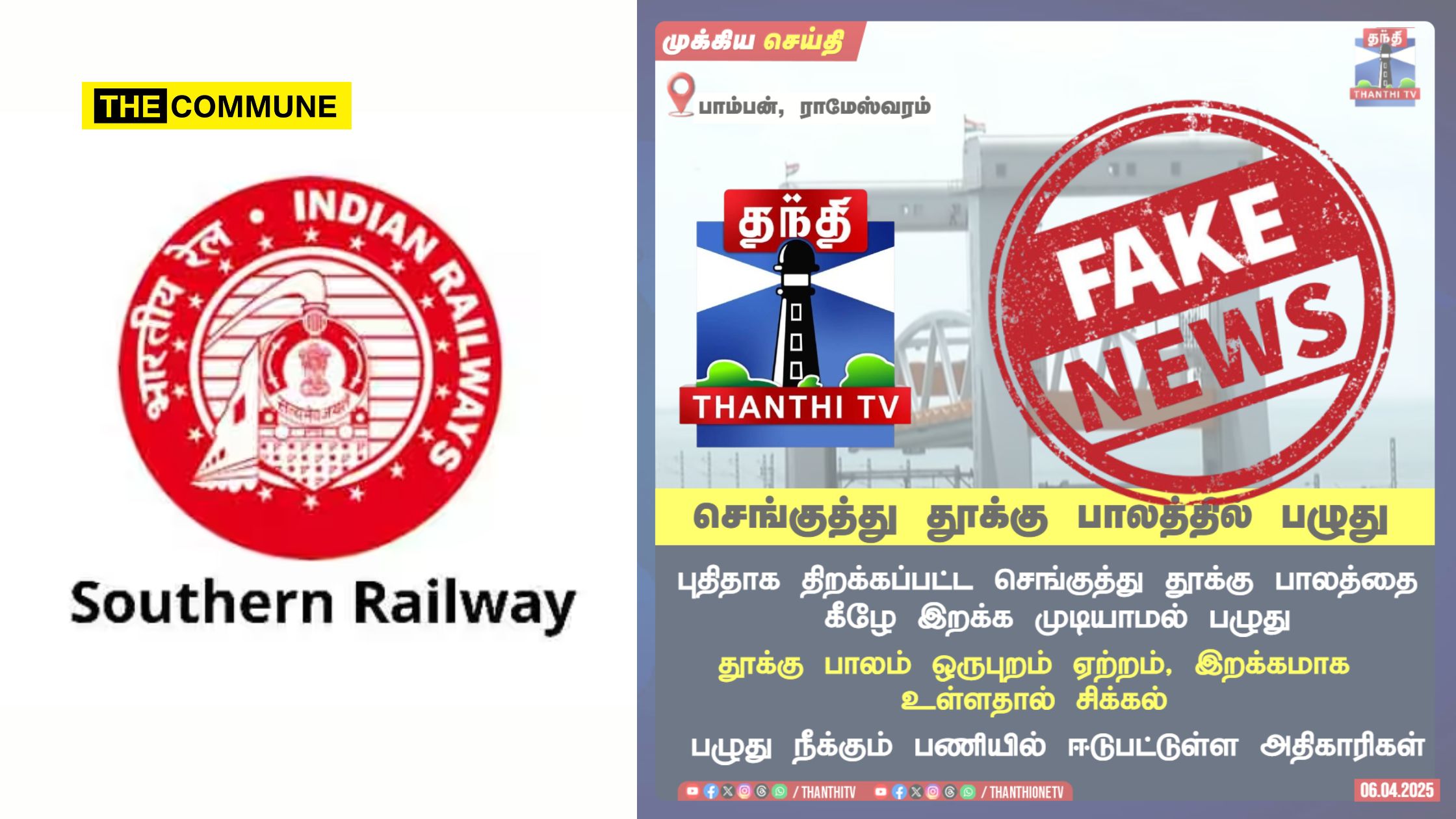
Dravidianist Media Thanthi TV Gets Fact-Checked By Indian Railways For Peddling Rumours About New Pamban Bridge

Indian Railways has issued a stern fact-check against Dravidianist media outlet Thanthi TV, accusing the channel of peddling baseless rumors about the newly inaugurated Pamban Bridge, India’s first vertical-lift railway sea bridge.

The controversy stems from a Thanthi TV report posted on X at 08:39 AM IST on April 6, 2025, which claimed that the newly opened vertical-lift Pamban Bridge had encountered a malfunction. The post, under the handle @ThanthiTV, stated in Tamil: “செங்குத்து தூக்கு பாலத்தில் பழுது” (Translation: “Fault in the vertical-lift bridge”). It further alleged that the bridge, which had just been inaugurated, couldn’t be lowered due to a defect, with one side remaining uneven, causing operational issues. The report added that officials were working to fix the problem

The post’s narrative fueled a wave of skepticism, with some users mocking the project’s execution.

However, Indian Railways was quick to counter the claims. At 6:27 PM IST, the Madurai Division of Southern Railway posted an official statement on X, directly addressing Thanthi TV’s report. Divisional Railway Manager (DRM) Madurai stated, “The New Pamban Bridge was successfully inaugurated and train services have commenced. It is receiving an enthusiastic response. We request not to spread rumours. The bridge is strong and safe—please avoid carrying false or misleading information.” The post tagged Thanthi TV, making it clear that the Railways viewed the channel’s report as a deliberate attempt to mislead the public.

The New Pamban Bridge, a 2.07-kilometer marvel constructed by Rail Vikas Nigam Limited (RVNL) at a cost of over Rs 550 crore, replaces the 110-year-old Pamban Bridge, which was decommissioned in December 2022 due to structural issues. Inaugurated on Ram Navami, the new bridge features a 72.5-meter vertical-lift span, allowing ships to pass underneath while supporting train speeds of up to 80 kmph. The launch event saw the first run of the Rameswaram-Tambaram Express, marking a significant step in restoring rail connectivity to the pilgrimage hub of Rameswaram.

Thanthi TV, a leading Tamil news outlet often linked to Dravidianist ideologies, has not yet issued a retraction or response to the Railways’ statement. This isn’t the first time the channel has faced criticism for unverified reporting, but the direct intervention by a public institution like Indian Railways has brought the issue into sharper focus. Critics on X have pointed to a pattern, with one user noting, “Thanthi TV thrives on half-truths—this bridge rumor is just the latest in a long line of questionable stories.”

Railway officials further clarified that the bridge underwent extensive testing before its inauguration. The Commissioner of Railway Safety (CRS) conducted inspections in November 2024, followed by successful trial runs at speeds up to 90 kmph. While a CRS report had flagged minor design deviations—later addressed by Southern Railway—the bridge was fully cleared for operations. “This project is a pinnacle of Indian engineering, not a rushed job. Claims of malfunctions are completely unfounded,” a Southern Railway spokesperson told reporters.

Subscribe to our channels on TelegramWhatsApp, and Instagram and get the best stories of the day delivered to you personally.

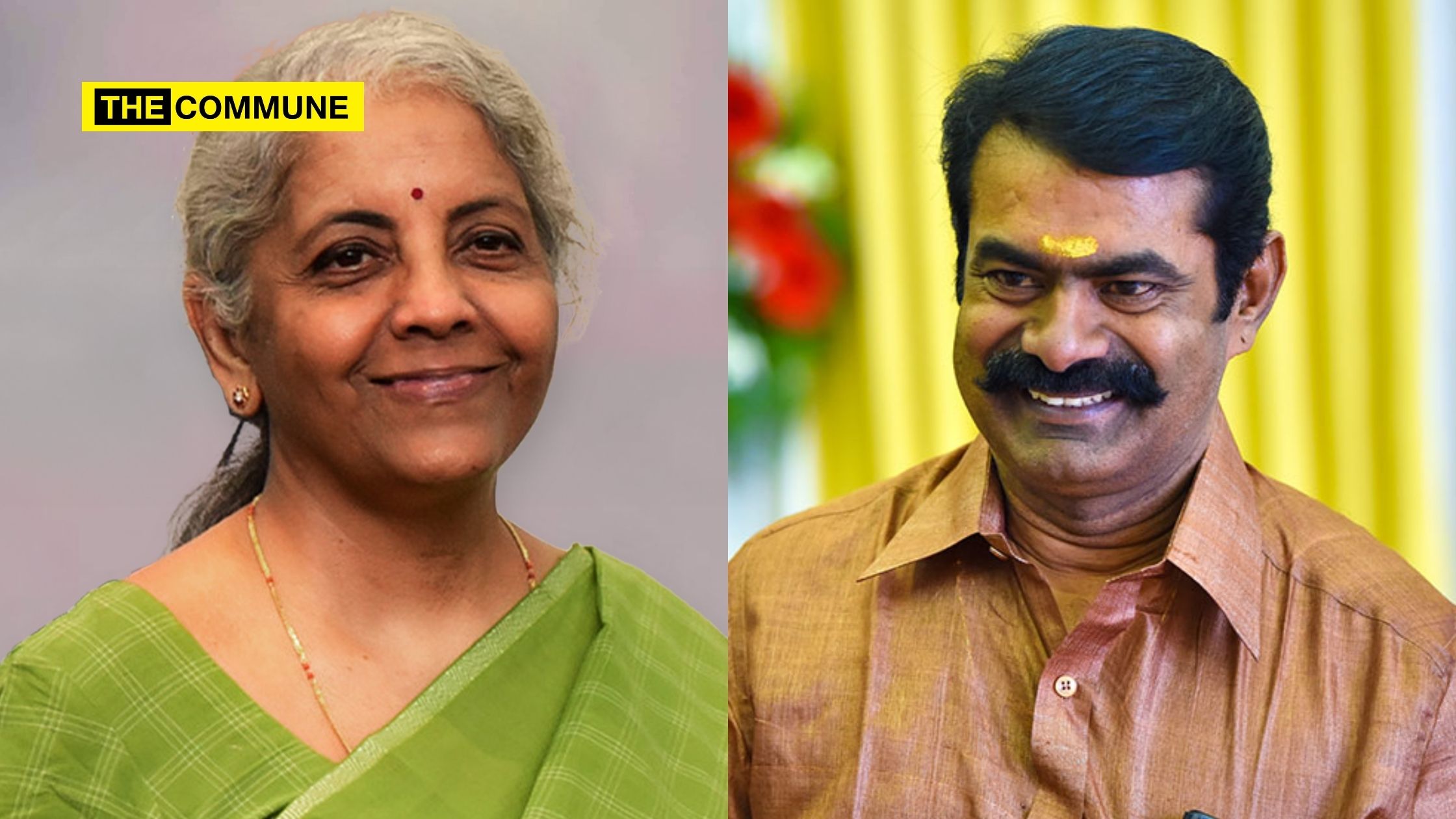
Did NTK Chief Seeman Meet Union Finance Minister Nirmala Sitharaman?

Was there a meeting between Seeman and Nirmala Sitharaman? The leader of Naam Tamilar Katchi (NTK), Seeman, firmly dismissed rumors swirling in the media that he had a rendezvous with Union Finance Minister and prominent BJP figure Nirmala Sitharaman during her recent trip to Chennai.

Seeman brushed off the claims as baseless and deceptive, explaining, “I was at a private hotel in Guindy for a family event—a wedding reception. I had no clue the Finance Minister was even there, and I certainly didn’t meet her. There’s no reason for me to sneak around for some secret chat.” His tone was sharp, aiming to put the speculation to rest once and for all.

He also poured cold water on whispers about a possible alliance with the AIADMK as the 2026 Tamil Nadu Assembly elections loom on the horizon. Calling it pure guesswork, Seeman argued, “Some folks think NTK should team up with AIADMK to take on the DMK juggernaut. But if I hitched my wagon to any big player, our voter base would tank. For the sake of Tamil Nadu’s progress and to keep NTK’s principles intact, we’re going it alone.”

Adding a fresh twist, he revealed NTK’s plan to petition the Election Commission of India for a new symbol—one tied to agriculture—to replace the current microphone emblem, signaling a potential rebrand rooted in rural identity.

On the flip side, senior BJP voices have backed Seeman’s denial, asserting that no such meeting happened with either him or AIADMK stalwart Sengottaiyan. One BJP insider told DT Next, “Nirmala Sitharaman posted official snaps of everyone she met. If you’re not in those pictures, you didn’t meet her—simple as that. No cloak-and-dagger stuff here.”

Subscribe to our channels on TelegramWhatsApp, and Instagram and get the best stories of the day delivered to you personally.

Centre Set To Surpass FY25 Capex Target Of ₹10.18 Lakh Crore

GCCs Projected To Create Up To 28 Lakh Jobs In India By 2030

The government is poised to surpass its revised capital expenditure (capex) target of Rs 10.18 lakh crore for FY25 by a modest margin. According to an NDTV Profit report on Sunday, citing a top official, “The data received so far indicates that we are likely to exceed the revised target by a significant margin in absolute terms”. The capex target was lowered to Rs 10.18 lakh crore (revised estimates) in the Union Budget 2025-26, from Rs 11.1 lakh crore.

For current fiscal (FY26), a capex allocation of Rs 11.21 lakh crore has been set by the government. According to Union Finance Minister Nirmala Sitharaman, the Indian economy will continue to be the world’s fastest-growing economy backed by the increase in the government’s capital expenditure in the Budget for 2025-26 and rising consumption levels, especially in the rural areas. The effective capital expenditure works out to 4.3 per cent of the GDP in the Budget for 2025-26 while the fiscal deficit is 4.4 per cent. “This indicates that the government is using the entire borrowed resources for financing effective capital expenditure, creating capital assets,” she pointed out.

The Indian economy is expected to clock 6.5 per cent growth in 2025-26, driven by government investment in big infrastructure projects, and an acceleration in private investment during the year, according to the latest EY Economy Watch report. A Jefferies report said last month that there has been a significant increase in capital expenditure in India, with growth expected to continue in the coming months as several sectors witnessing strong investments.

The government’s focus on railways and road projects has helped achieve significant progress, with around 83-87 per cent of the financial year 2025 revised estimates already completed for these sectors. The government’s commitment to capital expenditure remains strong, with transfers to states rising by approximately 60 per cent.

This financial support is expected to further accelerate infrastructure projects at the state level, boosting overall economic growth. The capital outlay of the country’s top 15 states for FY26 is projected to rebound by 18 per cent (year-on-year) to Rs 7.2 lakh crore, driven by a post-election boost in capital spending, execution of infrastructure projects and continued allocation of Rs 1.50 lakh crore to states through interest-free capex loans in the Union Budget 2025-26, according to a CareEdge Ratings report.

—IANS

Subscribe to our channels on TelegramWhatsApp, and Instagram and get the best stories of the day delivered to you personally.