Tarun Tejpal has been sentenced to 10 years for raping a colleague. That is the story. It should not need dressing up.
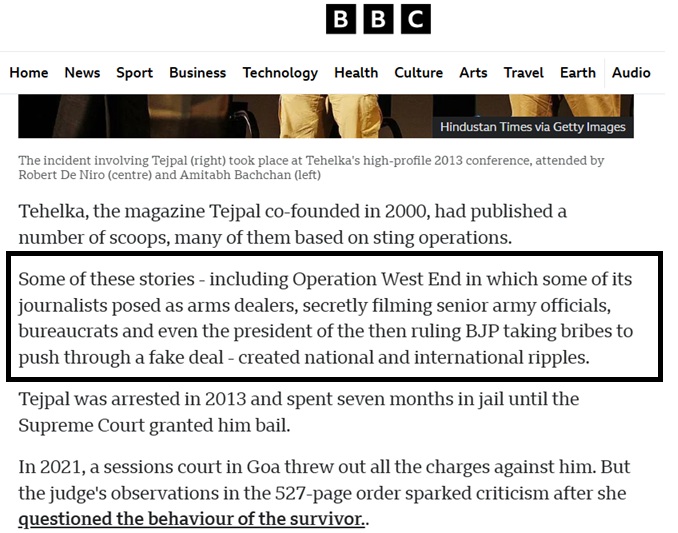
But the BBC’s report on the conviction spends a significant chunk of its word count reminding readers that Tejpal “exposed corruption” through Tehelka’s sting operations, most prominently Operation West End, which caught “senior army officials, bureaucrats and even the president of the then ruling BJP taking bribes.” The framing is unmistakable: here was a fearless journalist who held power to account, now being cut down.
Except the politics don’t work the way the BBC’s framing implies.
Operation West End exposed a BJP Govt, in 2001
Operation West End ran in 2001, under the Vajpayee-led NDA government. Its sting caught the sitting BJP president, Bangaru Laxman, and Defence Minister George Fernandes on camera. Laxman resigned. It was a scandal that damaged the BJP, not Congress.
So, when the BBC’s report nudges readers toward reading Tejpal’s downfall as payback from the party he once exposed, it is building a narrative on a timeline that doesn’t hold up. The sting that made Tejpal’s name was aimed at the BJP two decades ago. His conviction in 2026 has nothing to do with settling that score, because there was never a score for the BJP to settle – Tejpal had already been out of that fight for years by the time the rape case surfaced.
Who Actually Arrested Him, and Under Whose Government
Tejpal was arrested in November 2013. At the Centre, that was the UPA government under Manmohan Singh – a Congress-led coalition, not the BJP. The FIR, the arrest, the chargesheet: all of it unfolded under a Congress-led central government, in the dying months of UPA-II, months before the 2014 general election.
Tejpal himself has tried to claim the case was a “political vendetta,” pointing to the BJP-run Goa state government of the time. That claim is his defence, not an established fact, and courts have twice now ruled against him – first with the 2021 acquittal getting thrown out, and now with a 10-year sentence. But the BBC’s own framing, built around his sting-journalist legacy, ends up doing quiet work to support the version of events Tejpal wants told, rather than interrogating it.
The Bigger Problem: The “Truth to Power” Narrative Was Never Neutral
Tehelka’s founding myth was that Tejpal was a crusader who terrified the establishment. That myth was built, sustained, and defended for years by a media ecosystem that treated him as an icon of fearless journalism – largely the same commentariat that stayed conspicuously quiet, or actively rallied around him, when the rape allegations first broke in 2013. It took eight years, an acquittal, a state government’s appeal, and a High Court reversal to get anywhere close to accountability.
None of that context makes it into the BBC’s report. Instead, readers get a recap of West End’s greatest hits, positioned right alongside coverage of a rape conviction, as if the two are part of the same coherent story about a man who spoke truth to power and paid for it.
He didn’t. He raped a colleague, was protected by a sympathetic media class for a decade and is now facing the consequences a court twice failed to deliver on the first attempt. The BBC had the chance to tell that story cleanly. Instead, it reached for the flattering biography one more time.
Subscribe to our channels on WhatsApp, Telegram, Instagram and YouTube to get the best stories of the day delivered to you personally.