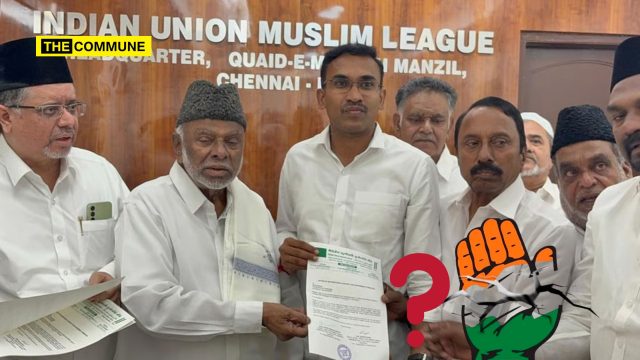
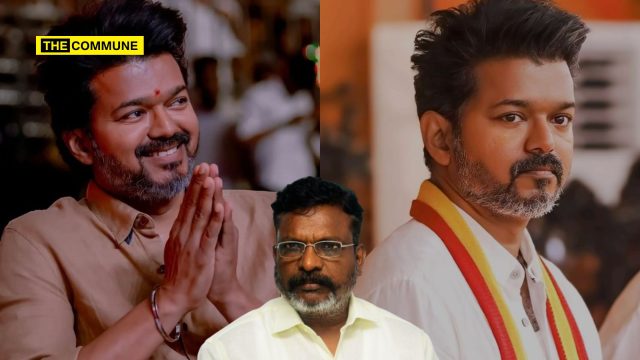
Questions are being raised over the circumstances under which the Indian Union Muslim League (IUML) eventually extended support to Tamilaga Vettri Kazhagam (TVK) during the Tamil Nadu government formation process, with reports alleging that political negotiations involving the Congress may have played a key role behind the scenes.
According to the report, Congress is said to have stepped in and held negotiations with IUML at a crucial stage, attempting to secure the party’s support for TVK in Tamil Nadu. The central claim is that a political assurance may have been offered during these talks: if IUML supported TVK in Tamil Nadu, the party could be accommodated with a place in the Kerala cabinet.
The allegation gains attention because IUML had, in the early phase of the government-formation exercise, publicly maintained distance from TVK and indicated that it was not prepared to immediately extend support. Earlier reports showed IUML leaders signalling reluctance and stressing their existing political alignment, making the later shift in position politically significant.
That abrupt change has now led to sharper questions over what exactly happened behind the scenes. Was the support purely a political decision taken in the interest of Tamil Nadu’s government formation, or was it the result of a wider bargain that linked Tamil Nadu politics with Kerala power-sharing calculations?
The Kerala angle has drawn particular interest because IUML’s role in government formation and ministerial representation in that state was already a live political issue at the time. Reports from Kerala indicated that discussions around cabinet representation for IUML were part of the broader conversation, which has only added weight to speculation that the Tamil Nadu decision may not have been isolated from parallel negotiations elsewhere.
What is clearly established is that IUML first held back, then shifted, and that the shift came at a politically decisive moment. The real question now is not merely why IUML supported TVK, but whether that support was part of a larger inter-state political arrangement brokered through the Congress.
Subscribe to our channels on WhatsApp, Telegram,Instagram and YouTube to get the best stories of the day delivered to you personally.
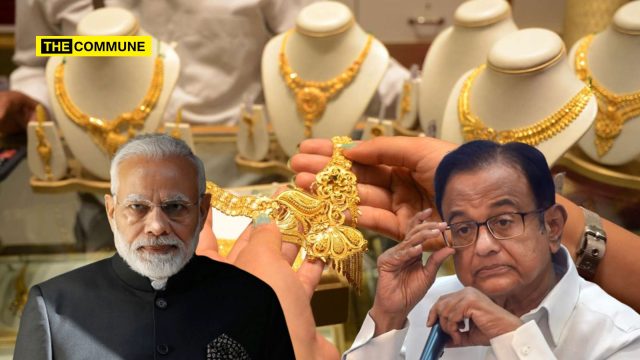
Prime Minister Narendra Modi on Sunday 10 May 2026 urged citizens to avoid buying gold for a year and postpone foreign travel as part of a broader appeal aimed at conserving foreign exchange amid growing global uncertainty.
Addressing a BJP rally in Hyderabad on Sunday, PM Modi called on citizens to reduce non-essential foreign exchange outflows, including gold purchases and overseas travel, while stressing the importance of collective public participation during the ongoing global crisis.
The Prime Minister’s remarks came against the backdrop of escalating tensions in West Asia, rising energy prices and global supply-chain disruptions, developments that are increasing pressure on import-dependent economies such as India.
A day later, the Congress launched a sharp attack on the Prime Minister, accusing him of shifting the burden of economic challenges onto ordinary citizens.
The opposition party said the “compromised PM” was no longer capable of running the country and urged him not to place the responsibility for “12 years of failures” on the shoulders of the Indian public.
Congress leader and Leader of the Opposition in the Lok Sabha Rahul Gandhi said PM Modi’s remarks were “evidence of failure”. “Yesterday, Modi Ji called upon the public to make sacrifices – do not buy gold, do not travel abroad, consume less petrol, cut down on fertilisers and cooking oil, take the metro, and work from home,” Gandhi said in a post on X in Hindi.
मोदी जी ने कल जनता से त्याग मांगे – सोना मत ख़रीदो, विदेश मत जाओ, पेट्रोल कम जलाओ, खाद और खाने का तेल कम करो, मेट्रो में चलो, घर से काम करो।
ये उपदेश नहीं – ये नाकामी के सबूत हैं।
12 साल में देश को इस मुक़ाम पर ला दिया है कि जनता को बताना पड़ रहा है – क्या ख़रीदे, क्या न…
Modi’s argument was rooted in foreign exchange conservation. With oil prices climbing and gold imports adding to dollar outflows, the government has signalled that reducing non-essential imports could help cushion external pressure during a volatile geopolitical and economic period.
The message was framed as a public appeal for restraint during a moment of international uncertainty.
But the Congress forgot something. Just 13 years ago, when the United Progressive Alliance (UPA) was in power, the then-Finance Minister P. Chidambaram made a strikingly similar appeal to Indians – asking them not to buy gold because of the strain gold imports were placing on the economy.
In June 2013, Chidambaram publicly urged citizens to avoid gold purchases and linked excessive imports directly to India’s widening current account deficit and pressure on the rupee. Speaking to the press, he said, “Please resist the temptation to buy gold. And we can have it for six months, one year. Almost minimal gold imports into the country, it will dramatically change the situation of the current account deficit.”
The Times of India quoted him as saying, “If I have one wish which the people of India can fulfill is don’t buy gold,” while other reports noted that he said a one-year reduction in gold imports could dramatically alter the economic situation.
Chidambaram did not stress on this just once. At another event, he said, “Last year’s monthly average was 70 tons of gold. This year in the first two months, the average is 152 tons of gold. How is this sustainable? How can we finance these gold imports? Therefore, both the Reserve Bank and the government have no option but to take stronger measures. The Reserve Bank announced a few measures a couple of days ago. And yesterday, government is obliged to once again increase the import duty. We raised it by 2% in the beginning of the year in February, and we’ve raised it again to 8%. Banks have a role to play in dampening the enthusiasm for gold. I think the Reserve Bank has advised banks that they should not sell gold coins. The Reserve Bank has put in place regulations that gold can only be imported on a consignment basis. It has increased the margins to 100%. And I would urge all banks to please advise their branches that they should not encourage their customers to invest or buy gold. I hope a day will come when we regard gold as any other metal. It just shines a little more than copper or brass.”
“I urge banks not to encourage their customers to buy gold. Gold just shines a little more than copper & brass”.
FM P Chidambaram was asking Indians to not buy gold as economy can’t sustain it.
There was not even any global war or crisis going on but it was centered on the current account deficit and rupee weakness. For this, the Congress kept telling the people to stop buying gold.
But unlike 2013, India in 2026 is facing a far more volatile global environment marked by war-related instability, soaring oil prices and record-high gold prices. The government’s appeal is being framed in the context of protecting India’s economic resilience and reducing external vulnerability during a period of global uncertainty. Despite this, the Congress chose to attack PM Modi’s appeal instead of acknowledging the broader geopolitical and economic pressures confronting the country.
Subscribe to our channels on WhatsApp, Telegram,Instagram and YouTube to get the best stories of the day delivered to you personally.
Actor-turned-politician Vijay’s Tamilaga Vettri Kazhagam (TVK) stunned Tamil Nadu politics after winning 108 of 234 assembly seats in the 2026 election, ending decades of dominance by the DMK and AIADMK and becoming the biggest political disruptor in South India.
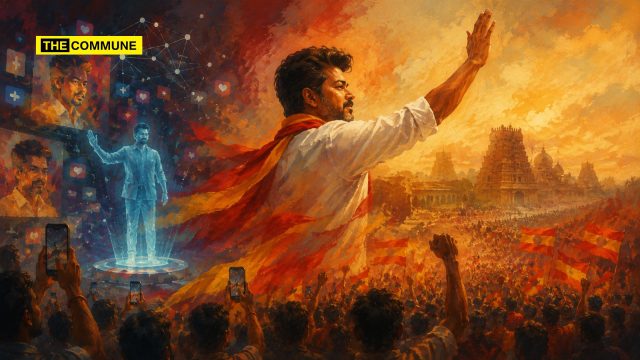
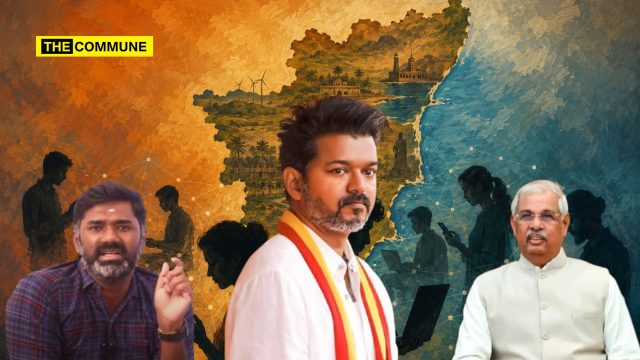
The result can be described as an “algorithm election,” pointing to TVK’s heavy use of digital campaigning, viral short-form content, AI-generated media and online fan mobilisation.
It is reported that TVK’s electoral strategy operated through a three-layer structure combining traditional fan-club networks with modern computational amplification.
Fan Clubs Became Political Distribution Networks
The first layer was built on Vijay’s long-standing fan infrastructure. Vijay has maintained organised fan clubs under the banner of “Vijay Makkal Iyakkam” since 2009. By the time TVK was launched in February 2024, the network reportedly consisted of nearly 85,000 fan clubs spread across Tamil Nadu.
These networks already functioned through local coordinators, WhatsApp groups and neighbourhood-level mobilisation structures. The campaign did not create these systems from scratch but instead transformed an existing cinema fandom network into a political communication machine.
This model can be seen as an evolution of Tamil cinema’s traditional MGR-style fan-club culture, updated with digital tools and social media infrastructure.
AI Images, Holograms And Reels Dominated Online Campaigning
The second layer of the campaign involved generative media and aggressive exploitation of short-form platform algorithms.
AI-generated portraits, edited videos and stylised campaign clips featuring Vijay circulated widely across Instagram, X, WhatsApp and YouTube Shorts during the election period. Much of the content reportedly spread without clear disclosure that it had been digitally generated or manipulated.
One of the campaign’s most widely circulated moments involved a hologram projection of Vijay at a rally in Kumbakonam. The hologram itself was less important than the way clips of it were rapidly remixed into memes, edits and short-form videos that spread across social media platforms.
The campaign also reportedly adopted an intentional scarcity strategy. Unlike traditional Tamil Nadu campaigns centred around nonstop television appearances and large-scale media outreach, Vijay rarely gave extended interviews or appeared frequently on television during the election cycle.
This approach increased the online value of every speech clip, visual appearance or short campaign moment, making each fragment more likely to gain high engagement on algorithm-driven platforms such as Instagram Reels and YouTube Shorts.
Allegations Of Fake Accounts And Inauthentic Activity
The third layer involved allegations of coordinated inauthentic online behaviour.
Reports alleged that supporters of TVK had created fake social media accounts impersonating media organisations and fictitious news outlets in order to spread defamatory or misleading content targeting journalists.
The virtual warriors kept spreading fake covers of Frontline, India Today, and Vikatan.
Such activity fits definitions of “computational propaganda” used by institutions such as the Oxford Internet Institute, particularly where coordinated deceptive behaviour and fake digital identities are involved.
However, these people involved can be described as “supporters” rather than officially linked party operatives. Similar plausible-deniability structures have been observed globally in digitally driven political ecosystems, where unofficial supporter networks carry out aggressive online activity while formal political organisations maintain distance from them.
It remains unresolved whether the activity was centrally coordinated or emerged organically from supporter ecosystems.
A New Political Campaign Model
TVK’s campaign can be increasingly viewed as an example of how synthetic media, fandom culture and algorithmic distribution can reshape electoral politics.
Rather than relying primarily on conventional party machinery or legacy media dominance, the campaign appeared to combine emotional fan loyalty, decentralised digital communities and high-velocity meme circulation to create political momentum.
The TVK experiment may become a case study in how pre-existing entertainment fandoms can rapidly evolve into digitally amplified political movements capable of challenging entrenched party systems.
🗳️ A film star just won the biggest state election in South India using a playbook no political party wrote — but every authoritarian government has.
Here’s how Vijay’s TVK campaign weaponized computational propaganda, AI holograms, and 85,000 fan clubs to shatter Tamil Nadu’s… pic.twitter.com/jFTLDf9mj1
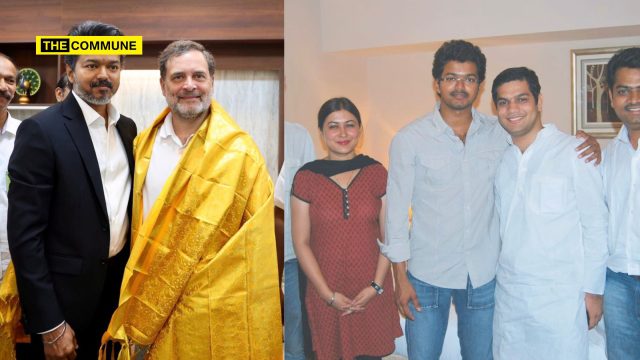
Tamil Nadu Chief Minister C Joseph Vijay had reportedly explored joining the Congress party as early as 2009, but the move did not materialise after Rahul Gandhi advised him to first prove himself by contesting internal Youth Congress elections, according to a report by Hindustan Times. Ironically, today Congress is in an alliance with the TVK in the state.
It is reported that Vijay, accompanied by his father and filmmaker SA Chandrasekhar, had travelled to Delhi along with Congress leader Gopinath Palaniyappan, who was then serving as national secretary of the National Students’ Union of India (NSUI).
When contacted by Hindustan Times, Palaniyappan declined to discuss the matter in detail. The developments reportedly took place shortly after the United Progressive Alliance returned to power in 2009 under then Prime Minister Manmohan Singh, at a time when Rahul Gandhi was focused on restructuring the Youth Congress and NSUI.
According to a Congress leader quoted anonymously in the report, Vijay’s intention at the time was modest and limited to becoming a member of the All India Congress Committee. The leader reportedly said Vijay had neither sought an election ticket nor demanded any political position. The source also claimed that SA Chandrasekhar’s ideological inclination toward the Congress had influenced the actor’s interest in joining the party.
The report further stated that Rahul Gandhi’s emphasis on recruiting and building leadership through the Youth Congress structure did not appeal to Vijay. Some within Congress reportedly believed that the DMK, then an ally of the Congress, had also discouraged Vijay’s induction into the party.
As a result, the actor did not join Congress despite the discussions. The report added that Gandhi and Vijay nevertheless remained in contact over the years through intermediaries.
An aide of Rahul Gandhi was quoted as saying that it may ultimately have worked in Vijay’s favour that he did not join Congress in 2009, arguing that he could otherwise have become “lost in the party” instead of emerging as a major political force independently.
The report also referred to recent remarks made by SA Chandrasekhar after TVK’s electoral performance, in which he reportedly urged Congress to ally with Vijay and claimed that such an alliance could restore the power the party had lost in Tamil Nadu.
Meanwhile, Congress leader Ragini Nayak shared an old photograph on social media showing Vijay alongside former NSUI office-bearers including Hibi Eden, Gopinath Palaniyappan, Ashok Basoya and herself.
✨तेरा मुझसे है पहले का नाता कोई ✨
जो संघी/भाजपायी विलाप कर रहे हैं कि @INCIndia और @TVKVijayHQ का गठबंधन अचानक कैसे हो सकता है…
In her post, Nayak reportedly suggested that those surprised by the present-day proximity between Congress and Vijay should look at the years-old photograph as evidence of earlier political interactions between the actor and the party leadership.
The Hindustan Times report stated that Congress leader Pawan Khera was contacted for comment but had not responded at the time of publication.
Subscribe to our channels on WhatsApp, Telegram,Instagram and YouTube to get the best stories of the day delivered to you personally.
A day after Tamil Nadu Chief Minister C Joseph Vijay declared during his swearing-in speech that he “knew hunger” and came from humble beginnings, journalist and novelist Manu Joseph publicly challenged the narrative, accusing the actor-turned-politician of falsely projecting poverty.
Vijay, who became the first chief minister since 1962 outside the DMK-AIADMK duopoly, had used his inaugural address to position himself as someone who understood deprivation firsthand. Speaking before a massive gathering in Chennai, he said he was not born into privilege or a “royal family,” but was instead the son of an aspiring assistant director who had experienced hardship and hunger.
However, journalist, novelist and screenwriter Manu Joseph, writing in Mint and later posting on X, disputed those claims directly, saying he had studied with Vijay in the third standard at Loyola School and remembered him as a wealthy child from an influential film family.
Joseph described Vijay as someone who stood out among classmates because of his affluence and background. He recalled seeing Vijay at church wearing clothes that appeared “too fancy” for ordinary students and accompanied by a mother who looked “distinguished.” He also wrote that classmates understood Vijay to belong to an important and well-off family.
In his X post, Joseph was even more blunt. He stated that Vijay’s claim about growing up in poverty was “bullshit” because Vijay had studied at Loyola School and came from a filmmaker’s family. Joseph acknowledged that Vijay’s father may have gone through temporary financial struggles, as many in the film industry do, but argued that such phases were not comparable to the kind of structural poverty faced by ordinary Tamil families.
In his first speech as Tamil Nadu chief minister, Vijay said that he grew up in poverty, and that he even knows what hunger is. It’s bullshit because he was my classmate in the third standard in Loyola School.
His father was a filmmaker who set up his son for a career in films.…
Joseph further wrote that Vijay’s rise in cinema was heavily aided by his privileged starting point. According to him, Vijay’s father, filmmaker SA Chandrasekhar, had already planned and built a path for his son’s film career. He argued that Vijay’s success represented the advantage of a “head-start,” not the story of someone who rose from deep deprivation.
He contrasted Vijay’s background with that of many of their former classmates, whom he described as children from modest and even illiterate households struggling through school without guidance or privilege. Joseph wrote that several classmates succeeded despite severe odds, unlike Vijay, who had access to opportunities unavailable to most aspiring actors.
Joseph’s intervention has drawn attention because it directly attacks one of the core emotional themes of Vijay’s early political messaging that he understands the struggles of ordinary people because he personally lived through them.
Subscribe to our channels on WhatsApp, Telegram,Instagram and YouTube to get the best stories of the day delivered to you personally.
The Cyber Crime Wing of the Tamil Nadu Police has issued an urgent notice to social media platform X directing the removal and blocking of 18 specific URLs accused of disseminating “unlawful content.”
The notice, dated 8 May 2026, was issued under Section 79(3)(b) of the Information Technology Act, 2000, read with Rule 3(1)(d) of the Information Technology (Intermediary Guidelines and Digital Media Ethics Code) Rules, 2021.
According to the notice, the identified posts contained “provocative and politically sensitive remarks” that authorities claimed were capable of inciting public unrest and disturbing public tranquility.
The Cyber Crime Wing further stated that the posts could encourage unlawful assemblies, adversely affect the maintenance of law and order, and potentially lead to loss of life and damage to public property.
Police also cited alleged violations relating to “decency or morality” and “defamation” categories under the IT Rules.
Sources indicated that many of the X accounts listed in the notice had been posting short videos, memes, and political commentary critical of Tamilaga Vettri Kazhagam (TVK) and its leaders.
In the notice addressed to X Corp’s Safety and Legal Policy division, authorities directed the platform to immediately remove or disable access to the identified URLs and take proactive measures to prevent further dissemination of the content.
The notice warned that failure to act could result in the loss of intermediary liability protections available under Section 79 of the Information Technology Act.
The Cyber Crime Wing also instructed X Corp to suspend or block the identified accounts and submit a compliance report within three hours of receiving the notice, describing the matter as “urgent.”
Tamil Nadu Police’s Cyber Crime Wing issued a takedown notice to X Corp on May 8, demanding the suspension of more than 20 accounts, including that of YouTuber Maridhas, within three hours, invoking intermediary liability provisions under the IT Act and the IT Rules, 2021. Most… pic.twitter.com/wi5Jw24AD2
— Rajalakshmi sampath (@Rajalakshmi2398) May 11, 2026
What Do These Posts Contain?
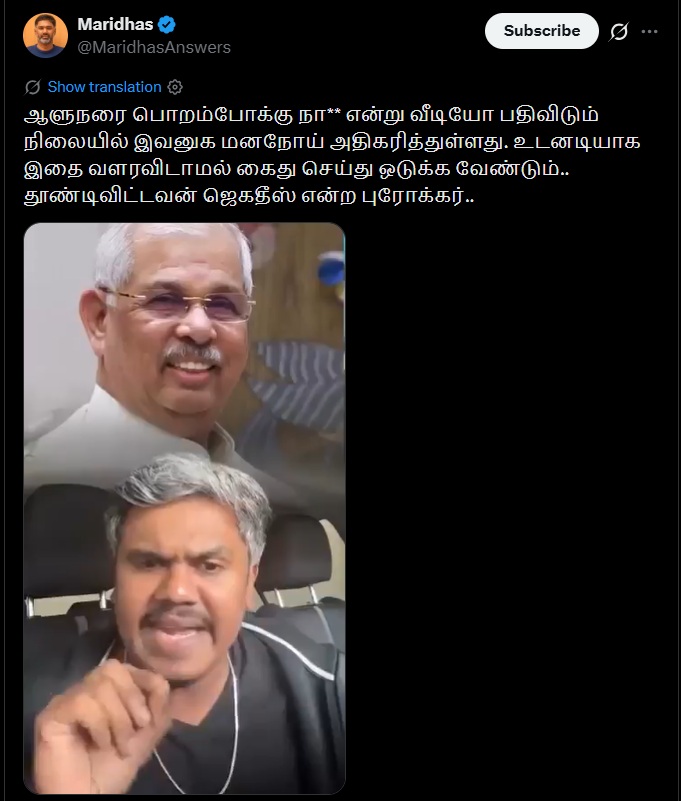
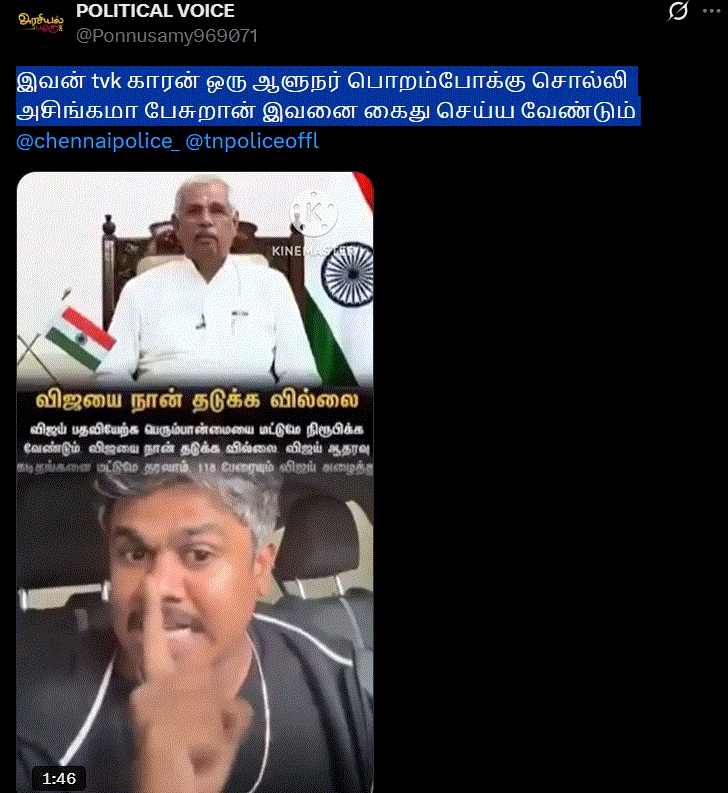
While most of the posts have been deleted, these posts were critical of a TVK supporter who abused and spoke derogatorily against TN governor Rajendra Arlekar.
The person in the video who seems to be a Sri Lankan Tamil said, “Dear Honorable Tamil Nadu Governor Rajendra Vishwanath Arlekar, this video is for you. If I use any disrespectful word toward you in this video, I am really asking your pardon. Friends, please share this video with all the people of Tamil Nadu – share it with everyone. Hey worthless (poramboke) Rajendra Vishwanath Arlekar dog, are you fit to be Governor? If someone is standing as the leader of the majority party, with 113 seats, you should give him the chance and send him to Parliament form the government. You have no ‘hair’ right to control or block that. Why are you doing this? Hey poramboke dog. You are working after taking money from the BJP, poramboke dog. Hey you, do you know the law on this? Do you remember the S.R. Bommai judgment of 1994? I will teach it to you again ‘mayirandi’, put it in your head. Earlier, Governors used to decide on their own whether a state government had a majority or not, and they would dismiss governments. That had happened in the past. Then, in the case filed by former Karnataka Chief Minister SR Bommai challenging this, the Supreme Court delivered a historic judgment. The main point of that judgment is this: the legislative assembly is the proper arena. Whether a party has a majority or not should not be decided from the Governor’s residence. It must be proved on the floor of the Assembly through a floor test and voting. That is one. Second, the Governor is only a referee. He is only a referee, ‘mayirandi’ on this field. A Governor must function like a neutral umpire, not like the leader of a political party. Third, judicial intervention – if the Governor’s decision is wrong, the court can step in and restore the government. So I am asking you poramboke dog: Hey TVK has 113 seats, right? They have the majority. What does anyone else have? What exactly are you trying to do? Just like Stalin and the others, they create some side issue, start a controversy, wave the TVK towel, create a problem there, create another distraction here, and then say, ‘Look, TVK has stirred trouble here, TVK is roaming around there, how will these people run a party, they have not even come to power yet, how will they govern?’ Then they create cases, divert attention, and use this gap to do their work. Hey poramboke dog, hey Governor pannadai (scumbag), what right do you have to reject the decision taken by the people? I am telling the people of Tamil Nadu today: if you come out onto the roads and fight for your rights, and if someone born somewhere else comes here, this poramboke dog sits as Governor in Tamil Nadu, and says that the decision you made is wrong, will you just stand and watch? Think about it carefully. Why was the previous Governor changed? Why was he replaced? All this is the work of the BJP, done together with the DMK. I am telling you – look at Sri Lanka. However strong the lines and fortifications were, they were broken. Gotabaya’s fort was brought down. That is what happened there. What is this hair Governor then?”
Among the links identified are those of YouTuber Maridhas who had shared the said video and captioned it, “Their mental instability has worsened to the point where they are posting videos abusing the Governor with vulgar language. This should not be allowed to grow further; they must be immediately arrested and suppressed. The one who instigated this is the broker Jagadeesh.”
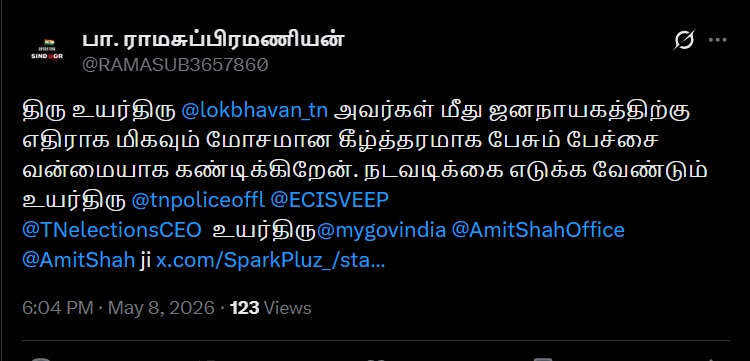
Another handle condemned the person speaking in the video and wrote, “I strongly condemn the extremely vile and derogatory remarks made against Mr. @lokbhavan_tn, which are fundamentally anti-democratic in nature. I urge the concerned authorities—@tnpoliceoffl, @ECISVEEP, @TNelectionsCEO, and @mygovindia—to take appropriate action.”
Another wrote, “This TVK fellow is speaking disgracefully, calling a Governor a “scoundrel”; he must be arrested.”
It is not clear why these handles were targeted for sharing condemnations against the person in the video. Instead of taking action against the person in the video, the cybercrime has instead targeted civilians calling out the person who is derogating the office of the Governor of our country.
Fascism & Payasam
In 2024, when actor Joseph Vijay launched his political party, Tamilaga Vettri Kazhagam (TVK), he positioned himself as a critic of the Dravidian establishment and what he described as fear-based politics. Speaking at a massive rally at V. Salai near Vikravandi in Villupuram district, Vijay not only outlined his party’s ideological direction but also sharply indicated who he saw as his political adversaries.
Targeting the DMK and the larger Dravidian political ecosystem indirectly, Vijay said that there is a “crowd” that tries to assign a colour to anyone entering politics.
“There is a crowd here that for sometime has been singing the same paeans. Anybody who comes into the politics is given ‘one particular colour’. They keep fearmongering people and cheat them. But ‘these people’ (indirect reference to DMK) will put underground dealing with ‘them’ (indirect reference to BJP). During elections, they will give statements and give sounds. For them, it’s always ‘fascism’, ‘fascism’, ‘fascism’. Among the people who are united here, they fearmonger by splitting people as majority-minority and keep putting a full-time scene with it. I’m asking you – If ‘they’re fascism’, are you ‘payasam’? You’re no better than them. You call this anti-people government as a ‘Dravida Model’ government and cheating people”, Vijay blasted the DMK.
Two years later, in the post-result political climate of 2026, one wonders if the TVK is another form of the DMK that cannot resist any criticism and will use state machinery to target civilians for posting content critical of the party.
Subscribe to our channels on WhatsApp, Telegram,Instagram and YouTube to get the best stories of the day delivered to you personally.
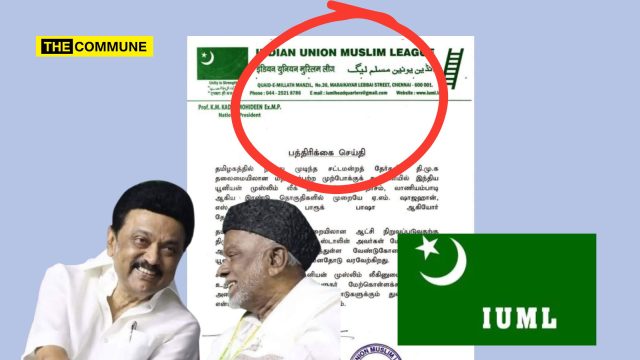
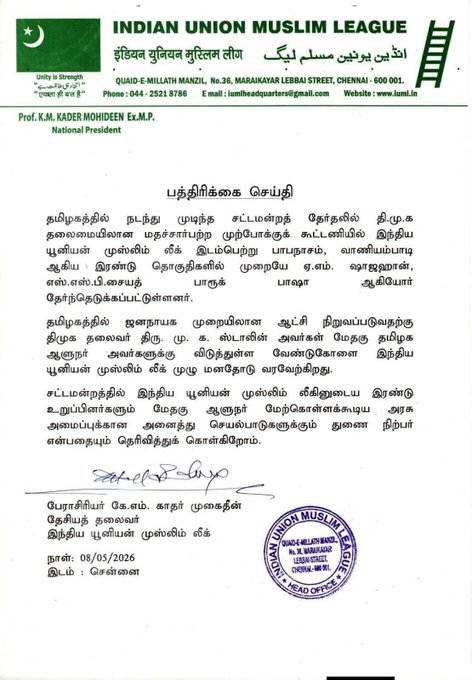
The Indian Union Muslim League (IUML), a key ally of the DMK-led alliance in Tamil Nadu, came under criticism after an official party document surfaced online showing the organisation’s name displayed in three languages viz English, Hindi and Urdu while Tamil was absent from the top banner.
The document, issued as a press release by IUML national president Prof. KM Kader Mohideen, quickly went viral on social media and triggered debate because the DMK alliance has consistently opposed the Centre’s three-language formula and projected the issue as a defence of Tamil identity.
Former CM Stalin and DMK leaders over the past 5 years have repeatedly declared that the state would never accept the three-language policy, accusing the Union government of attempting Hindi imposition through the National Education Policy.
Against that backdrop, one wonders how an alliance partner opposing the three-language formula could itself officially operate with a three-language masthead featuring English, Hindi and Urdu.
Several social media users accused the alliance of political hypocrisy, arguing that multilingual representation appeared acceptable in practice while being attacked politically during election campaigns and public speeches.
Subscribe to our channels on WhatsApp, Telegram,Instagram and YouTube to get the best stories of the day delivered to you personally.
Hours after the new Tamil Nadu government assumed office, Viduthalai Chiruthaigal Katchi (VCK) president and Chidambaram MP Thol. Thirumavalavan said the state’s debt burden should be reduced through stronger economic growth, while cautioning against creating unnecessary fear over the financial situation.
Speaking to reporters in Delhi on Sunday, Thirumavalavan said Tamil Nadu’s economic policy should focus on increasing domestic production and overall state output in order to gradually reduce the debt burden.
“To achieve this, domestic production, the state’s economic output must be correspondingly enhanced,” he said.
“I express my hope and offer my best wishes that this government will prioritize the development of Tamil Nadu and work with earnest determination toward that end,” he added.
His remarks came after Chief Minister Joseph Vijay stated that the Tamil Nadu treasury had been left “empty” and that the state was burdened with debt of nearly ₹10 lakh crore. Vijay had also announced that the government would release a white paper on the financial situation.
Responding to those remarks, Thirumavalavan said the issue should be viewed in the proper economic context and not merely through the absolute debt figure.
“The Chief Minister has announced that the Tamil Nadu government treasury has been left empty and that they have been left with a debt burden of Rs 10 lakh crore, and that a white paper on it will be released transparently. But merely stating that Tamil Nadu’s debt is Rs 10 lakh crore will create a wrong impression among the people of Tamil Nadu.”
He added, “Debt should always be assessed in comparison with a specific benchmark. The correct way to assess debt is to compare it with the state’s Gross State Domestic Product, the GSDP. Tamil Nadu’s debt level is still within the limit fixed by the 15th Finance Commission. There is a prescribed limit up to which debt can be borrowed. That is a boundary defined by the Finance Commission, a ceiling fixed by the 15th Finance Commission. So, it is not appropriate to create fear by pointing only to the absolute size of the debt.”
Referring to the response from the DMK, Thirumavalavan noted that the previous government had not denied the existence of debt but had argued that it remained within permissible limits.
“In this regard, the former Chief Minister has given an explanation. He did not deny the claim that there is a debt burden of Rs 10 lakh crore. He only pointed out that the debt remains within the limit fixed by the Finance Commission. Therefore, the debt burden must be reduced, and accordingly the domestic output must be increased. Our economic policy must be framed in line with that. So, I hope and wish that this government will work with commitment, keeping Tamil Nadu’s development in mind.”
During the interaction, a reporter questioned whether Vijay’s statement about an “empty treasury” reflected a misunderstanding of the issue or an attempt by the new government to begin its administration by blaming the previous regime.
Responding to that question, Thirumavalavan said the Chief Minister may have relied on information provided by officials and stressed the responsibility of the bureaucracy in furnishing accurate data.
“I believe he would have made that statement based on the statistics given by officials. If officials provide incorrect information or mislead the government, that would not be good for governance and administration. Therefore, when such information is given, officials must act with great responsibility, that is my request.”
Another reporter pointed out that the VCK had supported the previous DMK-led government and asked whether the party had been unaware of the alleged financial condition of the state treasury.
Replying to the question, Thirumavalavan reiterated that while the state did carry debt, it remained within the borrowing limits prescribed by the Finance Commission.
“It is true that there is debt. But it is within a defined limit. The debt burden is within the limit fixed by the 15th Finance Commission. It is also being said from the DMK side that they reduced the earlier debt burden and paid both interest and principal.”
The Viduthalai Chiruthaigal Katchi (VCK) has extended support to Tamilaga Vettri Kazhagam (TVK) at a crucial stage in Tamil Nadu’s post-election political developments, helping Vijay move closer to forming the government. However, even after announcing support, VCK leader Thol. Thirumavalavan made it clear that his party has not withdrawn its earlier criticism of TVK and continues to view the party as aligned with the “RSS-BJP”, as reported in OneIndia Tamil.
Tamil Nadu had witnessed political uncertainty for nearly six days after the Assembly election results, with TVK emerging as the single largest party but falling short of the numbers required to independently form the government.
In this situation, both the VCK and the Indian Union Muslim League (IUML) extended support to TVK, helping Vijay cross the majority mark required to stake claim to form the government.
Despite extending support, Thirumavalavan clarified that the decision should not be interpreted as a political endorsement of TVK or a withdrawal of earlier criticisms made against the party during the election campaign.
During the campaign, VCK had sharply criticized TVK and described the party as the “children of the RSS-BJP.” When asked whether supporting TVK after making such allegations was contradictory, Thirumavalavan defended the decision by describing the present political situation as exceptional.
“This is a confusing political situation. That is why we took this decision. There are no conditions in this. No bargaining took place. We did not make any effort to hold negotiations with him. Based on a decision already taken by the Left parties, we took our decision. I had already said earlier that we would take decisions together with the Left parties.”
He further argued that the overall vote share in the election reflected significant anti-TVK sentiment across Tamil Nadu, despite TVK emerging as the largest party.
“We contested the election under the leadership of the DMK. Our campaign was aimed at making Stalin the Chief Minister. The people who accepted our campaign gave more than 1.5 crore votes to our alliance. Those are also significant votes. Those votes were against TVK. Similarly, the one crore votes that went to the AIADMK were also against TVK. So more than 60 percent of the votes that went to the DMK and AIADMK alliances were anti-TVK votes. Even then, TVK has won 108 seats and is short by only 10 seats. That is why Vijay is struggling to form the government.”
Explaining the rationale behind VCK’s support, Thirumavalavan said the party’s decision was aimed at preventing the possibility of President’s Rule in Tamil Nadu.
“If Vijay is unable to form the government, President’s Rule will come. President’s Rule is almost equivalent to BJP rule. We are firm that such a situation should not come to Tamil Nadu. It is only on that basis that we have taken this decision. At the same time, we have not changed our criticism against them. There is no connection between our criticism and this support.”
He also emphasized that the support extended by VCK was limited strictly to enabling government formation and did not amount to a long-term alliance or political partnership with TVK.
“As of now, we have only extended support for forming the government. I did not say that we will run the government with them or travel together politically or maintain a political relationship with them. I repeat – our criticism of them and our assessment of them are separate matters. They are in a crisis situation and we are helping them. If we do not support them, the BJP will bring President’s Rule here. We are giving support only to prevent that.”
Subscribe to our channels on WhatsApp, Telegram,Instagram and YouTube to get the best stories of the day delivered to you personally.
Joseph Vijay was sworn in as the Chief Minister of Tamil Nadu on 10 May 2026. Immediately after the swearing in, he executed the ‘first signature’ – signalling the fulfilment of a promise made during the election campaign through the manifesto.
One of Chief Minister Joseph Vijay’s first signatures after taking office in Tamil Nadu was an order granting 200 units of free electricity to domestic consumers. But the benefit, as implemented, applies on a bimonthly basis and is available only to households whose total consumption does not exceed 500 units during that two-month billing cycle.
What did TVK promise?
200 units of electricity free every month to all eligible households.
What did TVK deliver?
200 units of electricity for 2 months upto 500 units of bimonthly consumption. 🤷♂️ pic.twitter.com/ER7vHf5bUj
— Krishna Kumar Murugan (@ikkmurugan) May 10, 2026
During the election campaign, however, TVK’s manifesto and campaign messaging prominently highlighted the promise of “200 units free” electricity for households. Several campaign materials and public descriptions framed the announcement as a monthly benefit, leading many voters to interpret the promise as 200 free units every month.
That distinction has now become the centre of the controversy. Yes, it was mentioned that only eligible people will be given this benefit.
A promise understood as “200 units free every month” implies a significantly larger subsidy over a two-month period than a scheme granting 200 free units only once per billing cycle.
Because electricity bills in Tamil Nadu are generally issued every two months, opponents say the difference between “monthly” and “bimonthly” is not merely technical but fundamentally changes the value of the scheme.
The structure of the scheme excludes a significant section of middle-class households, particularly families using appliances such as refrigerators, washing machines, and air conditioners, whose consumption could easily exceed the 500-unit bi-monthly ceiling.
The government has maintained that the scheme is aimed at reducing the burden of rising living costs and inflation on ordinary households. The order above also estimated that the subsidy would impose a significant annual financial burden on the state exchequer.
Still, the issue has quickly evolved into one of the first major political controversies facing the new TVK government, with the party being accused of using expansive campaign messaging while implementing a more restricted version after assuming power.
The dispute is not simply about electricity billing terminology, but about whether the promise presented to voters during the election campaign matches the benefit ultimately delivered after the formation of the government.
Subscribe to our channels on WhatsApp, Telegram,Instagram and YouTube to get the best stories of the day delivered to you personally.