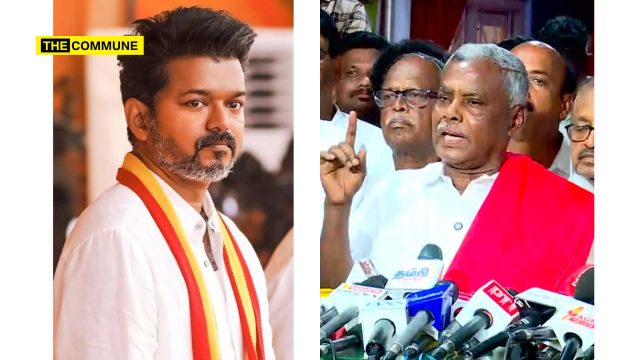
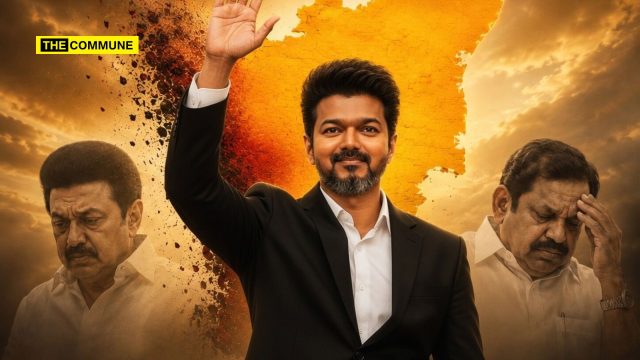
Before the 2026 Tamil Nadu Assembly election, leaders of the CPI(M) repeatedly dismissed actor-politician Vijay and his party, Tamilaga Vettri Kazhagam (TVK), as politically irrelevant, arguing that votes cast for him would be “wasted” and would only help split the anti-BJP vote.
Now, following an election that produced a fractured Assembly, both CPI and CPI(M) have extended external support to TVK, helping Vijay move closer to the majority mark required to form the government – a sharp reversal from their campaign-time attacks.
A campaign speech by CPI(M) Tamil Nadu State Committee Secretary P. Shanmugam, which is now being widely circulated again on social media, showed the Left party’s earlier position on Vijay in stark terms.
During a campaign, he said, “A new party called Tamilaga Vettri Kazhagam has not emerged as a real force in Tamil Nadu. He says that the contest is between him and the DMK. But the DMK has built a massive alliance with more than 20 parties, while he is standing alone. In fact, right from the time he started the party, he offered a share in power and a share in governance. He said, ‘If you join me, I will give you a share in government, a share in authority.’ But even after Vijay made such offers, not even small parties have gone with him so far. Why has no one joined him? Even after he said there would be a share in power and authority, if nobody went with him, what does that mean? It means he cannot win. First he himself has to win before he can give others a share. When there is doubt about whether he can even win, how can he give a share to others, and how can others trust that and join him? That is exactly why no party has gone with Vijay. Therefore, apart from splitting votes, Vijay’s political activity will achieve nothing. I want to bring to the attention of the people of Tamil Nadu that this party will not be able to win even a single seat in this election. So, a vote for NOTA and a vote for Vijay are the same. Just as a vote for NOTA is of no use, a vote cast for Vijay too will go without any value. In Tamil Nadu, the contest is only between two fronts. One is the secular progressive alliance led by the DMK. The other is the BJP-AIADMK alliance. These are the only two fronts standing in the electoral field in Tamil Nadu today, and the contest is taking place only between them. Today, some youngsters and children from our homes are trying to vote for this new party simply because it is new. I want to appeal to them with affection: your vote should help create the possibility of forming a new government. You must think deeply about what kind of candidate this is, what he will do if elected, and what kind of person should represent your constituency, and then cast your vote.”
However, after the election produced a hung Assembly and TVK emerged as the single largest party without crossing the majority mark on its own, both CPI and CPI(M) announced support for Vijay to enable government formation.
The two Left parties ‘clarified’ that their backing was limited to external support for forming the government and did not amount to a formal political alliance or participation in the cabinet.
Subscribe to our channels on WhatsApp, Telegram,Instagram and YouTube to get the best stories of the day delivered to you personally.
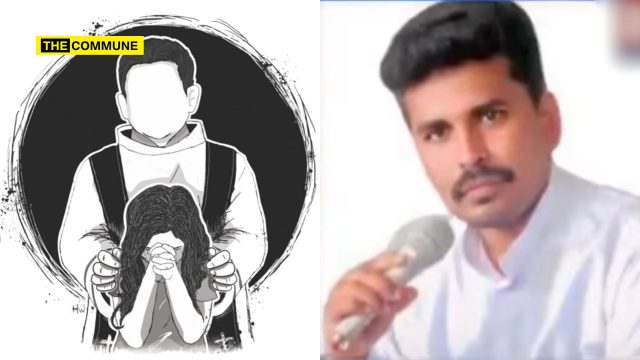
In a disturbing incident reported from Eluru district in Andhra Pradesh, a 14-year-old girl was allegedly sexually assaulted on multiple occasions by a pastor who regularly visited her family’s home to conduct prayers. The minor is currently undergoing treatment at the Government General Hospital (GGH) in Eluru after complaining of bleeding. Her condition is stated to be stable, as reported in Times of India.
According to police, the accused has been identified as Choutupalli Rambabu (35), a pastor from a village in Kamavarapukota mandal. He had frequent access to the survivor’s family, visiting their residence regularly for prayers, and allegedly gained their trust over time.
Police further stated that taking advantage of the absence of the girl’s parents, the accused allegedly assaulted the minor on at least four occasions in February this year. The matter came to light after the girl developed health complications, prompting her mother to take her to the hospital. During the medical examination, the minor disclosed the abuse to the doctors, who in turn alerted the family.
A complaint was lodged by the victim’s mother, following which the Thadikalapudi police registered a case under the Protection of Children from Sexual Offences (POCSO) Act. The accused remains absconding, and police have formed special teams to trace and apprehend him.
Subscribe to our channels on WhatsApp, Telegram,Instagram and YouTube to get the best stories of the day delivered to you personally.
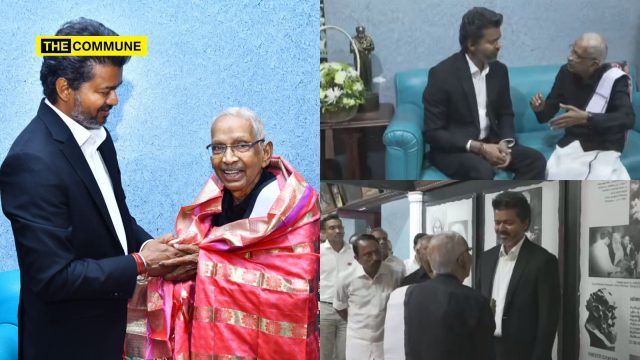
time in signaling where his ideological loyalties truly lie. Within hours of taking oath, Vijay visited Periyar Thidal in Vepery to meet K. Veeramani, the long-time chief of the openly anti-Hindu Dravidar Kazhagam. The visit included floral tributes to E.V. Ramasamy — a figure whose political legacy has long been associated with relentless attacks on Hindu beliefs, deities, scriptures, temple traditions, and Brahmin communities. Far from projecting a “new politics,” Vijay’s very first symbolic act as Chief Minister appeared to cement what critics have warned all along: TVK is merely a repackaged continuation of the DMK-Dravidian ideological ecosystem.
The optics are politically explosive because Veeramani is not just another Dravidian veteran. He was among the loudest voices at the controversial 2023 “Eradicate Sanatana Dharma” conference — the same platform where Udhayanidhi Stalin compared Sanatana Dharma to diseases that must be eliminated. Veeramani went even further by explicitly declaring that “Hindu religion” and “Sanatana Dharma” are one and the same, thereby removing any pretence that the campaign was merely against caste discrimination rather than Hinduism itself. Quoting from the 1916 text Sanatana Dharma: An Elementary Textbook published by Central Hindu College, Benares, Veeramani argued that the very identity of Hinduism was the intended target. His remarks, later reproduced in DK’s mouthpiece Viduthalai, left little room for reinterpretation.
Madam, how long will you fool people? Remember, this is SM age. Every utterance is recorded. FYI, this is the same stage where Udhayanidhi spoke about eradication of Sanatana Dharma. https://t.co/7rNleqGqrlpic.twitter.com/pBg3x89tvv
For years, Vijay attempted to cultivate the image of a political outsider — someone distinct from the entrenched Dravidian order represented by the DMK and AIADMK. His supporters projected him as a cultural nationalist-friendly figure capable of transcending ideological extremes. But the speed with which he rushed to seek the blessings of Veeramani has shattered much of that carefully managed ambiguity. Critics argue that Vijay’s first major political outreach was not toward spiritual leaders, farmers, industrial workers, or ordinary citizens, but toward the ideological custodian of a movement infamous for mocking Hindu rituals, desecrating religious symbols, and framing Hindu traditions as obstacles to social progress.
The meeting also reinforces a growing perception that TVK’s “change” narrative was always cosmetic. Beneath the cinematic branding, emotional speeches, and anti-corruption rhetoric lies the same old Dravidian ideological framework — one that selectively targets Hindu faith and practices while demanding immunity from criticism itself. To many observers, Vijay’s actions suggest that TVK is not challenging the Dravidian establishment at all, but inheriting and repackaging it for a younger audience.
Supporters of Vijay may attempt to dismiss the visit as a routine courtesy call or an effort to acknowledge senior Dravidian figures. But politics is driven as much by symbolism as by policy. And Vijay’s symbolism on day one of his chief ministership was unmistakable. Instead of distancing himself from anti-Hindu rhetoric, he chose to publicly align with one of its most unapologetic champions. For many voters who believed TVK would mark a departure from divisive identity politics and ideological hostility toward Hindu traditions, the message could not have been clearer: TVK = DMK, only with a different face at the top.
Subscribe to our channels on WhatsApp, Telegram,Instagram and YouTube to get the best stories of the day delivered to you personally.
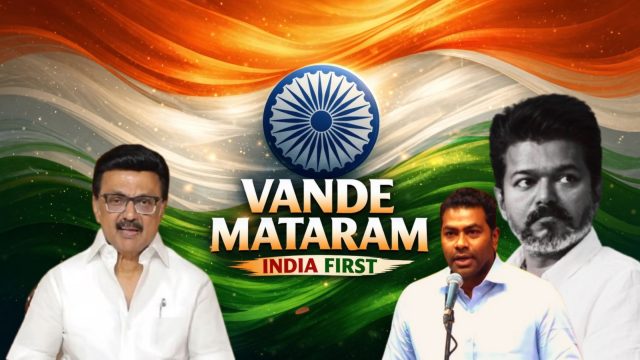
Barely hours after taking oath in a grand ceremony laced with star power and hype, Chief Minister Joseph Vijay’s Tamilaga Vettri Kazhagam (TVK) has already revealed its true colours. Far from the “new era” of governance promised to voters tired of Dravidian politics, the fledgling regime has caved in to familiar separatist pressures, rushing to object to the national song Vande Mataram being accorded its due place at the swearing-in.
In a clear echo of the old DMK playbook, TVK Minister Aadhav Arjuna issued a statement criticising the sequence where Vande Mataram (full version) led, followed by the national anthem Jana Gana Mana, with Tamilthai Vaazhthu relegated to third. The party protested to the Governor on the spot but has now publicly declared it will disregard the Centre’s protocol in future functions and revert to starting with the state song — a long-standing convention that often carried undertones of prioritising regional identity over national unity.
“At the swearing-in ceremony of the Chief Minister and other ministers, held under the leadership of the Acting Governor of Tamil Nadu, Mr. Rajendra Viswanath Arlekar, first Vande Mataram, then the national anthem, and thirdly Tamil greeting was played. This new practice is not suitable for Tamil Nadu. The Tamil Nadu government, led by the Tamil Nadu Victory Party, does not agree with the Tamil Thai congratulatory song being played as the third song in the motherlandof Tamil Nadu.“, he said.
‘நீராரும் கடலுடுத்த…’ எனத் தொடங்கும் தமிழ்த்தாய் வாழ்த்துப் பாடலுக்கு நூற்றாண்டு கடந்த வரலாற்றுப் பெருமிதம் உள்ளது. இந்தப் பாடல் ‘உலகெங்கும் பரவ வேண்டும்…’ என்ற இலட்சியத்தின் தொடர்ச்சியாகவே, தமிழ்நாடு அரசு மாநிலப் பாடலாக அதை அறிவித்தது. இத்தகைய பெருமைமிக்க தமிழ்த்தாய்…
The swift backtrack came after immediate flak from CPI allies and DMK ecosystem voices, who criticized TVK for allowing Vande Mataram to be played first.
TVK And DMK: Same Separatist Streak, Different Packaging
TVK is proving to be DMK 2.0 with a glamourized actor as its face.
TVK, which rode to power on anti-incumbency and promises of change, has shown it lacks the spine to stand firm on national symbols when faced with pressure from left-leaning and Dravidianists within the party.
Playing Vande Mataram first aligned with the Union Home Ministry’s updated guidelines emphasising full rendition of the national song. Yet, one day in, the new government is signalling it will defy that.
This is not mere protocol nitpicking. It fits a dangerous pattern: elevating state-specific songs and sentiments above unifying national ones.
For a party that positioned itself as a fresh alternative, bending on Day One to demands reminiscent of DMK’s cultural separatism once again proves that the TVK will be no different than DMK.
While the TVK can give word salads in the name of “Tamil pride”, it simmers with separatist undertones.
National integrity comes above everything. Tamil Nadu is very much within India. It is as equal as any other state and no exception will be granted. The Union Home Ministry’s guidelines apply uniformly across the country. Other states follow them without fuss. Why should Tamil Nadu alone demand special treatment? Demanding an exemption weakens national unity and promotes divisive exceptionalism.
Subscribe to our channels on WhatsApp, Telegram,Instagram and YouTube to get the best stories of the day delivered to you personally.
May 4th, 2026 went down in India’s political history as a day that was marked with a lot of key turning points that will move some states into an altogether new trajectory that would prove very significant and transformational. It marked the permanent end of an era and a fresh new beginning. With Kerala going towards the Congress, this day also marked an end to the Left but knowing Congress’s track record and infighting, this might not be permanent and Left might come back to power again next time.
Bengal chose to permanently end the Left and semi-Left kind of politics and ushered in a fresh Hindutva driven development-oriented politics. Tamil Nadu also decided to move permanently away from the age old Dravidam politics but unlike Bengal, has chosen a brand new party that doesn’t have any proven experience of governance. Bengal will have a very stable government for several years to come but we’ll have to wait and watch for Tamil Nadu.
Actor Joseph Vijay’s TVK has formed the government in Tamil Nadu. TVK has taken the help of those parties to form the government who might pull in different directions as it is an alliance of convenience and desperation rather than any commonality of ideology. With the two Dravidian parties not being the popular choice anymore of the Tamil public, BJP has an excellent opportunity to take the space of a serious contender to TVK after five years. They can make the 2031 election absolutely bipolar.
People are comparing Joseph Vijay’s advent to the advent of the great MGR but it will take a lot of time for Vijay to acquire the political acumen that MGR had when he started his new party. Vijay’s regime will almost be similar to that of Jagan Reddy in Andhra Pradesh who also stormed to power. TVK’s policies sound like an old wine in a new bottle. If BJP can get its act together quickly, it can actually form the next government in Tamil Nadu on its own with K. Annamalai holding the key to this door of opportunity.
What should BJP do in the next five year? Here are my two cents. BJP must make Annamalai as the President of Tamil Nadu BJP. It must get some veterans to retire or make them redundant. This will stop all the counterproductive forces from pulling the party and Annamalai two steps back. It must give Annamalai total independence to run the party on his own terms and form his own team with young leaders like Vinoj Selvam, SG Suryah etc. who will bring in the energy and will to ramp up the party. BJP has to transform itself into a party of the youth if it has to fight TVK’s image and push narratives that the public will relate to.
BJP should take a year to reorganize itself by which time the blind attraction towards TVK will go down a bit as public will start comparing actual implementation versus the lofty promises made. This will be the time for Annamalai and team to step up and go full throttle talking about the gaps and raising issues pertinent to common man. They will have a lot of issues to talk about especially on the performance of some allies of TVK that are vying for ministerial berths. Annamalai should restart his padayatra two years before the next assembly elections and garner support for himself and the party. People would have seen TVK and if they start looking for who else, they will starting thinking about BJP. There has been a generational shift in Tamil Nadu now and we’ve officially entered the post-Dravidam era.
It all depends on how seriously BJP works on this Tamil Nadu blueprint with Annamalai at the helm. They should not make the mistake of again doing the traditional politics of passive alliance and consensus etc. This is the time to go bold and alone without carrying any baggage of the past. They don’t have any dependency on any other party now. They should latch on to this golden opportunity now and I don’t see why Tamil Nadu will not go the way Bengal has gone now. Otherwise, their dream of forming a government on their own in Tamil Nadu will just remain a dream and they will allow the old Dravidam politics to creep back pushing Tamil Nadu back into the past.
Ananth Narayan is a political commentator.
Subscribe to our channels on WhatsApp, Telegram,Instagram and YouTube to get the best stories of the day delivered to you personally.
For years, Vijay’s public image was projected as something organic – a spontaneous wave of mass affection powered by cinema charisma, youthful energy, and anti-establishment sentiment. But after TVK’s dramatic electoral breakthrough in 2026, a different question began circulating across Tamil Nadu’s political and media ecosystem: was this really an organic movement, or was it one of the most sophisticated perception-management operations the state has ever witnessed?
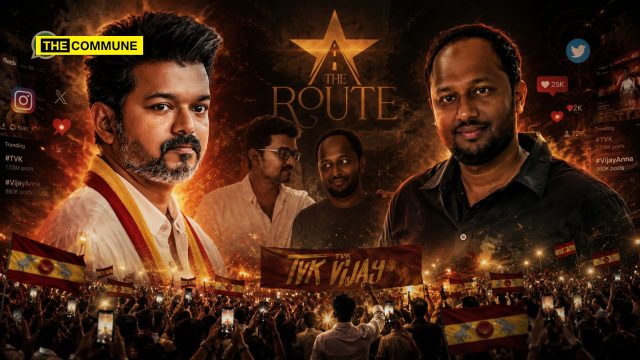
At the centre of that question stands Jagadish Palanisamy and his company, The Route.
Who Is Jagadish? What Is The Route?
Officially, The Route is a celebrity management and film production company. Publicly available material identifies Jagadish Palanisamy as Vijay’s longtime manager and founder of the company in 2020. The Route’s client roster reportedly includes some of the biggest names in South Indian cinema – Samantha, Lokesh Kanagaraj, Atlee, Rashmika Mandanna, Keerthy Suresh, Priyanka Mohan, Kalyani Priyadarshan, Samyuktha Menon, Kathir, and Arjun Das among others.
On the surface, that appears to be standard celebrity management. But it is increasingly alleged that The Route evolved into something much larger: a centralised digital ecosystem capable of manufacturing narratives, coordinating fan behaviour, amplifying propaganda, suppressing criticism, and converting cinematic fandom into political mobilisation.
The allegation is not merely that Vijay had strong publicity. Every major actor has publicity machinery. The allegation is that publicity itself was industrialised into a coordinated influence network.
The Blueprint: A Social Media Operation At Massive Scale
The scale being discussed online is staggering.
According to allegations circulating in political and social-media circles, the operation allegedly involved more than 4,000 coordinated accounts functioning through six digital hubs, with Chennai operating as the headquarters. Each account reportedly maintained at least 250 followers, collectively targeting nearly 70 million minds every day during the election cycle.
The brief blueprint of the biggest social media scam in human history:
4000+ accounts spread across 6 hubs with Chennai as HQ. Each with 250+ followers targeting every single day 70 million minds for a period of 5 months.
The Reach: 1 million+++ daily impressions building…
The ecosystem generated over one million daily impressions through relentless meme circulation, fan edits, emotional narratives, district-level targeting, and outrage amplification.
The strategy was simple but devastatingly effective:
Use cinema as the delivery mechanism
Use emotional attachment as the hook
Use politics as the payload
Film clips, songs, emotional scenes, punch dialogues, celebrity aesthetics, fan edits, and “underdog” storytelling were allegedly fused with political messaging until the line between entertainment and propaganda effectively disappeared.
This was not conventional campaigning. It was behavioural conditioning through repetition, emotional saturation, and algorithmic visibility.
Cinema As Political Weapon
Vijay’s greatest advantage was not merely popularity – it was the ability to weaponise cinema culture itself.
Unlike traditional political propaganda, the messaging allegedly travelled socially and invisibly:
Through fan edits
Meme pages
Women-centric fandom pages
Instagram reels
WhatsApp groups
TikTok-style short-form content
Hyper-local district pages
Cinema nostalgia clips
Influencer collaborations
Emotional “Anna” narratives
By the time audiences realised they were consuming political persuasion, emotional loyalty had already formed.
Even mainstream media indirectly acknowledged the scale of Vijay’s digital ecosystem.
An NDTV report after TVK’s breakthrough noted that Vijay’s Instagram audience showed unusually high engagement authenticity and interaction levels despite having fewer followers than celebrities like Virat Kohli. The report also highlighted that Vijay’s account avoided sponsored content entirely, helping cultivate trust and authenticity among followers.
According to the report, nearly 64% of Vijay’s Instagram audience was female, while over 71% belonged to the politically crucial 25–34 age group – precisely the demographic where TVK made its biggest gains.
With this strategy, Vijay may have rewritten Tamil Nadu politics for the social-media age: followers became volunteers, engagement became mobilisation, and viral reach became votes.
S.A. Chandrasekhar’s Explosive Allegation
One of the most politically damaging observations came not from rivals but from Vijay’s own father, filmmaker S.A. Chandrasekhar.
In a 2024 interview, Chandrasekhar openly described what he alleged was a highly organised online ecosystem operating around Vijay. According to him, groups allegedly fabricated narratives in the morning, amplified them through coordinated Twitter accounts, and repeated them relentlessly throughout the day until the narrative became accepted as truth.
He said, “They form a group like this – an online group, say a Twitter group. Vijay is also in that group. They have kept Vijay inside an iron enclosure where he does not even know what is happening outside. So what they do in that group is, in the morning they create a news item. Suppose, for example, take Chennai. They make someone put out a post saying, “Yesterday, so-and-so spoke wrongly in this place and damaged your image.” They are creating a false issue. It would not have actually happened, but they make a false thing get posted. Once one person posts it, from morning till evening they use around 100 people to keep sharing it again and again, tweeting it, and making others like it. That is what they do. So, Vijay sees that. If a lie is told ten times, it becomes the truth. These people say it 50 times, 100 times. That is what one person does.”
This is probably one of the clearest descriptions of how modern digital propaganda ecosystems function.
From Fan Clubs To Digital War Rooms
Vijay’s fan infrastructure gradually evolved into a digitally disciplined political mobilisation network.
According to allegations circulating online, tens of thousands of WhatsApp groups were allegedly created to coordinate messaging, trends, hashtags, emotional narratives, and political amplification.
These were not random fan communities anymore. They allegedly functioned like decentralised propaganda cells capable of:
Flooding comment sections
Coordinating hashtags
Manipulating visibility
Manufacturing consensus
Intimidating dissenters
Amplifying rumours
Swarming critics
Even small cultural spaces including local WhatsApp groups and women-centric hobby groups such as kolams and rangoli, suddenly became flooded with TVK-coded visual messaging during polling week.
Personally confirmed. Spouse is there in some pulli kolam group (very small, not big, popular) – but said group was flooded with “Drawing Whistle as Kolam” content during the week of polling.
— Srikanth.CashlessConsumer | ஸ்ரீகாந்த் (@logic) May 8, 2026
This hyper-local penetration is what made the operation so effective. Twitter alone could never achieve this scale. The messaging allegedly moved through ordinary social relationships and community spaces.
Allegations Of Troll Campaigns & Industry Intimidation
The ecosystem surrounding Vijay came under greater scrutiny after multiple controversies within Tamil cinema.
During the release of Parasakthi, actor and creative producer Dev Ramnath accused a section of Vijay’s fans of attempting to sabotage the film through coordinated negative reviews, manipulated ratings, old videos, and organised hostility online.
Director Sudha Kongara later alleged that Parasakthi faced targeted online attacks involving anonymous handles, intimidation, and bullying campaigns. That the film itself was a poorly made utter disaster is another story.
The pattern is consistent – Identify rivals, then flood social media, manufacture outrage, create emotional tribalism, isolate dissenters, and reward loyalty.
Here is an example of how the ecosystem started barking when VCK was hesitating to join the TVK alliance.
Another controversy that intensified scrutiny around The Route involved actress Priyanka Mohan. Online discussions claimed that after Priyanka reportedly moved away from The Route’s PR ecosystem, she suddenly became the target of disproportionate trolling, meme attacks, body-shaming, and negative narratives across social media. Critics cited this as an example of how powerful digital influence networks can allegedly shape not just celebrity promotion, but also public perception against those who exit the ecosystem. While these claims remain unproven and largely speculative, the episode strengthened the growing perception within Tamil cinema circles that The Route operates as far more than a conventional celebrity management agency.
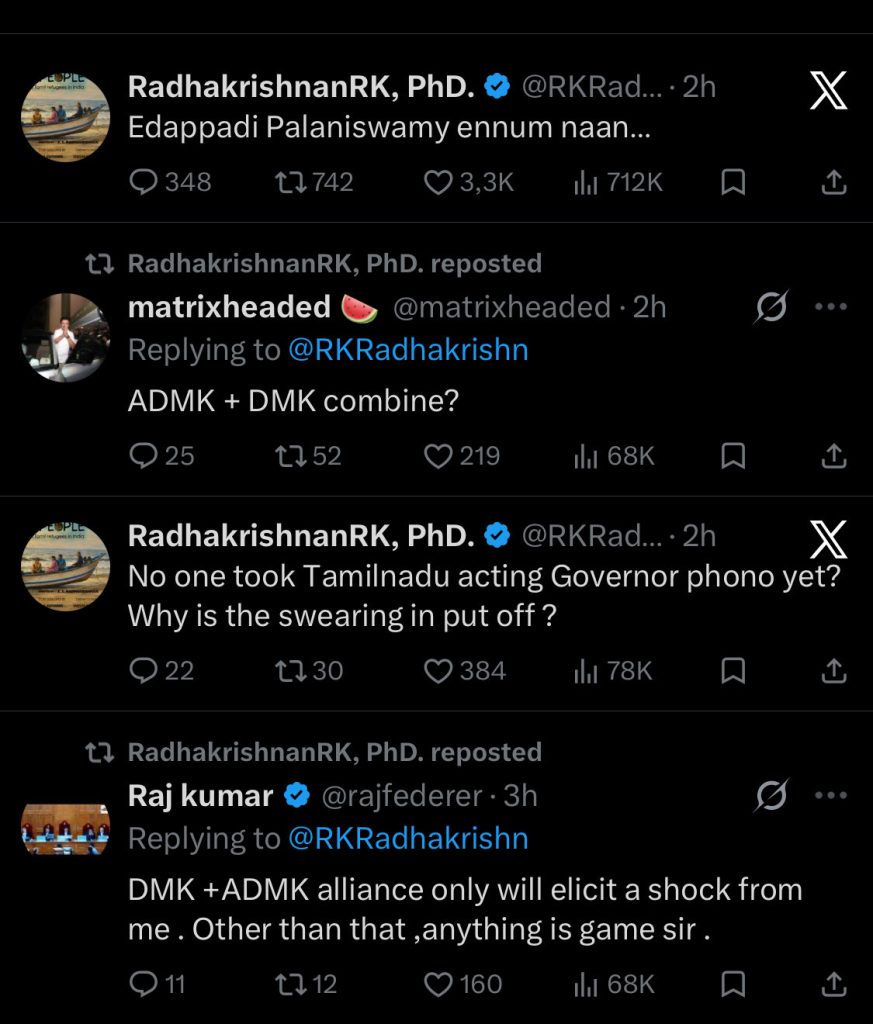
Another example is when the rumours about ADMK and DMK coming together to form an alliance broke. This was also orchestrated.
Overall, The Route became a powerful influence structure within Tamil cinema itself. Aspiring actors, actresses, influencers, and creators increasingly found themselves dependent on this ecosystem for visibility and opportunity.
ஜெகதீஸ் என்ற புரோக்கர் ஜெகதீஸ் ஏன் முதல் குறி?
Fan club control:
ஜெகதீஸ் இவன் விஜய் மேனேஜர்.. இவன் தான் மொத்த சோசியல் மீடியாவில் என்ன எழுத வேண்டும் என்ன பரப்ப வேண்டும் என விஜய் ரசிகர் மன்றம் வழியாக ஆணைகள் கொடுப்பது. அது அரசியலுக்கு வருவதற்கு முன்பே ஆரம்பிக்கப்பட்டுவிட்டது.
இதை… pic.twitter.com/0oYg9lXDmt
It is alleged that producers, distributors, and theatre owners became reluctant to antagonise Vijay’s network because of its fan mobilisation power and online influence.
The Psychological Dimension
Now, Vijay’s rise through campaigning is not just ordinary political campaigning. It is psychological conditioning.
One can compare the ecosystem to parasocial manipulation – emotional attachment to Vijay was systematically deepened until fans began treating criticism of Vijay as a personal attack on themselves.
The “Anna” narrative became central to the strategy:
Vijay as protector
Vijay as victim
Vijay as saviour
Vijay as misunderstood outsider
Vijay as moral alternative
This emotional framework transformed ordinary fandom into emotional dependency.
Politics was no longer being discussed rationally. It is being experienced emotionally through identity, loyalty, and protective attachment.
Here are some ways the psychological conditioning manifested, especially among children.
Vijay and his Route mafia encouraging kids to get emotionally involved in election campaigns. What if some of these kids end up taking an extreme step if Vijay loses? Will TVK blame Vijay, or will they say DMK is the reason? pic.twitter.com/1gnjGmMIKF
During the elections, we were witness to several videos where children were abusing parents verbally and physically, they would also threaten the parents and elders in the home to vote for Vijay. All this happened after Vijay called out to them to make them vote for him. It did not happen overnight, it was all planned.
⚠️TVK is targeting children with their Propaganda – FULL STORY
A political + social media firestorm around kids being used in aggressive pro-Vijay campaign content during the Tamil Nadu elections.
Reels started circulating, of children saying the following:
— SambhavāmiYugeYuge – Healthmaxxing🌞 (@Windsofchange72) May 9, 2026
#TVK distributing whistles to kids in several localities as a strategy. On several pockets of #Trichy, party cadres focusing on kids distributing shawls and whistles, also these kids go with them for few streets sloganeering #TVK Vijay’s name.
While comparatively less children… https://t.co/rzfxDYOpqSpic.twitter.com/wHv6MNKDSc
— Pearson abraham/பியர்சன் (@pearsonlenekar) April 18, 2026
This emotional blackmail & weaponising innocent children to blackmail their family members to vote played its role largely. Vijay literally begged for votes using children, those family members that voted succumbed are the brainless, this is demagoguery at its peak. pic.twitter.com/uc4iYjX13U
Perhaps the most important allegation surrounding Jagadish and The Route concerns the “underdog” image itself.
Vijay’s anti-establishment image was never entirely organic. Instead, it was carefully engineered through saturation campaigns, emotional reinforcement, selective victimhood narratives, and relentless digital amplification.
Rumours, speculative narratives, emotional claims, outrage cycles, and sympathy narratives allegedly became recurring political tools.
Even after TVK emerged as the single largest party, waves of rumours spread online regarding alliances, Governor meetings, MLA shifts, and political conspiracies – many later debunked, but not before shaping public perception.
This is the defining power of digital propaganda: the correction never travels as fast as the emotional claim.
The Real Political Question
The concern now being raised in Tamil Nadu is no longer simply about Vijay as an individual politician.
The deeper fear is about the emergence of a completely new political model:
In this model, Jagadish and The Route are no longer merely celebrity managers.
They increasingly appear as architects of a new political machinery where entertainment, fandom, digital influence, emotional dependency, and political messaging merge into a single self-reinforcing system.
And that is why the debate around Jagadish matters far beyond cinema gossip.
Because if a tightly coordinated digital ecosystem could shape public discourse so effectively before power, Tamil Nadu must now confront a far larger question:
What happens when such a machine operates from within power itself?
The Danger That
The deeper concern surrounding Vijay’s political ecosystem is no longer limited to online propaganda or election-time narrative management. Critics increasingly fear what could happen if such a highly coordinated digital machine is used to emotionally mobilise people beyond the ballot box itself. These concerns intensified after TVK functionary Aadhav Arjuna publicly invoked the idea of a “Gen-Z revolution” similar to the youth-driven unrest seen in countries like Nepal and Sri Lanka.
While the remarks triggered backlash and legal scrutiny, they also revealed something far more significant: the emergence of a political imagination built not around ideology or governance, but around emotionally charged mass mobilisation driven through social media ecosystems.
In environments where millions are already conditioned through fan culture, emotional narratives, viral content loops, influencer amplification, and algorithmic reinforcement, politics can rapidly transform into a form of collective emotional behaviour rather than rational civic engagement. Nepal’s recent youth-led protests demonstrated how meme culture, digital outrage, influencer networks, short-form video virality, and anti-establishment sentiment can spill from online spaces into real-world instability within weeks.
The fear among critics is that a digitally conditioned fandom – one that already treats criticism of Vijay as a personal attack – could become dangerously susceptible to narratives portraying institutions, media, elections, or political opponents as enemies of the people. At that point, social media stops functioning merely as a campaigning platform and begins operating as an emotional mobilisation infrastructure. The danger is not simply propaganda. Democracies have always had propaganda. The danger emerges when fandom, political identity, emotional dependency, and revolutionary rhetoric merge into a single self-reinforcing ecosystem where confrontation itself becomes a form of collective entertainment and moral duty.
Subscribe to our channels on WhatsApp, Telegram,Instagram and YouTube to get the best stories of the day delivered to you personally.
In October 2024, TVK chief Joseph Vijay challenged that he would remove the Governor’s post if the party came to power in Tamil Nadu. Now, as TVK struggles to prove a majority after the 2026 Assembly election, Vijay has had to repeatedly approach Governor Rajendra Arlekar to stake claim to form the government.
When Vijay positioned himself against the Governor’s office, the argument was blunt and populist. He said the Governor’s post should be discontinued, portraying it as a constitutional office that often acts in unconstitutional ways and as an instrument used to obstruct elected state governments.
That line fit neatly into the larger Dravidian-federalist rhetoric of resisting central interference. It also helped Vijay signal that TVK stood with state rights and against unelected power centres that could frustrate the popular mandate.
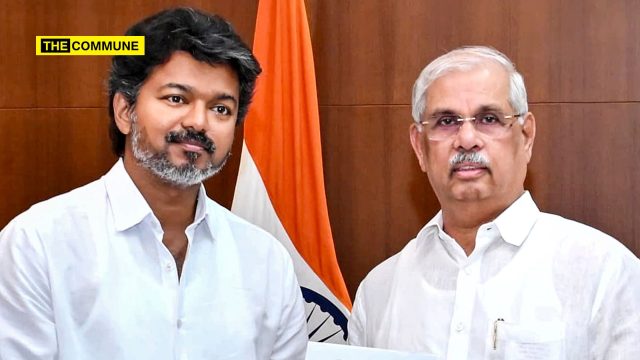
But politics has a cruel way of exposing the distance between rhetoric and reality. After the 2026 Tamil Nadu Assembly election left TVK as the single largest party with 108 seats but short of the 118 needed for a majority, Vijay found himself dependent on the very office he had once treated as dispensable. He went there not once, not twice but 4 times!
5 May 2026: A day after TVK emerged as the single largest party. he met the Governor to stake claim to form the government. It is reported that he submitted support from 112 MLAs – 5 from the Congress, but the Governor asked him to return with proof of support from 118 MLAs, the majority mark in the 234-member Assembly.
6 May 2026: Vijay met the Governor again for a second consecutive day. He was turned back once more because TVK still had not produced signatures or written support from 118 MLAs, and the Governor said the required majority had not yet been established.
8 May 2026: Vijay made a third visit as TVK continued trying to gather support from other parties. It was told that he had the support of 118 MLAs. However, it came to be known that he went with 116 MLAs only. The Governor once again pointed out that the numbers needed to form the government had not been conclusively established, and no invitation was issued
When Vijay gathers the remaining MLAs, he will make one more and probably the final visit to the Governor’s residence to stake claim to form the government.
Vijay squandered his opportunity to get approval the first time by initiating discussion as if he was looking to form a coalition government instead of staking claim as the single largest party.
The irony is telling: He once claimed he would remove the Governor post but has made multiple trips to Lok Bhavan already – Tharkuri Vijay Kazhagam for a reason?
Subscribe to our channels on WhatsApp, Telegram,Instagram and YouTube to get the best stories of the day delivered to you personally.
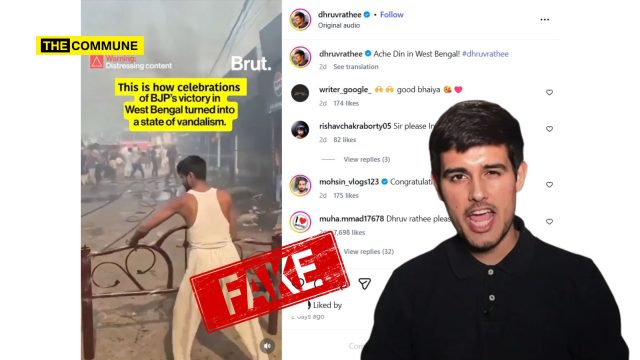
Yet again, YouTuber and propagandist Dhruv Rathee has come under fire for sharing an old video of violence in West Bengal and labelling the BJP as the perpetrators.
In the video he shares a clipping of violence and claimed that it was the BJP’s style of ‘celebrating’ with violence. Opening the video, he said, “Congratulations friends, good days have arrived in West Bengal”.
However, what he will not tell you is that the video is from 26 April 2026 when Mamata Banerjee was very much in power. The video clipping was not even related to violence. It was a video of a fire incident in Metiabruz in South Kolkata near the rail line.
Dhruv Rathee has once again been caught spreading misinformation/fake news in his new video blaming BJP for violence in West Bengal.
In the very first video he shares discussing post-poll violence in the state, he shared an old, unrelated fire incident from Metiabruz — an area… pic.twitter.com/XMQ7TfryTC
As Mamata Banerjee has lost the 2026 polls humiliatingly and the BJP set to form its first government in the state, propagandists have been activated. Dhruv Rathee sits at the top of that list and all he does is pick random videos that are unconnected to the topic he is going to discuss and frame the BJP, Hindus as the perpetrator, every single time.
Subscribe to our channels on WhatsApp, Telegram,Instagram and YouTube to get the best stories of the day delivered to you personally.
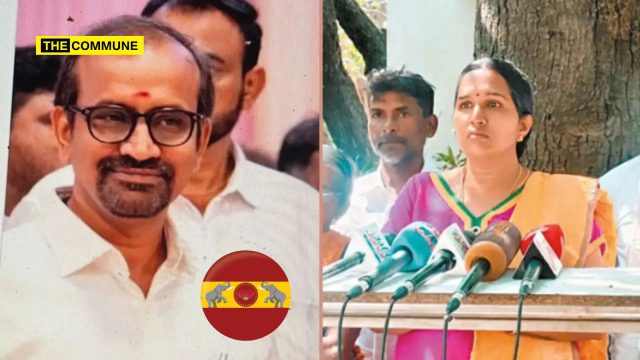
Tamilaga Vettri Kazhagam (TVK) Mylapore winning candidate and party state treasurer Venkatraman came under controversy after his wife Meenakshi filed a harassment complaint against him at the Chennai Police Commissioner’s office back in April 2026, as reported in Tamil Times Now.
Venkatraman contested from the Mylapore Assembly constituency in Chennai on behalf of TVK in the recently concluded Tamil Nadu Assembly elections. The complaint filed by his wife became viral now that TVK is in the news after they came out as the single largest party in Tamil Nadu following the polls.
According to the complaint submitted by Meenakshi, she married Venkatraman, son of Padmanaban from the Pammal area of Chennai, on 19 February 2012. The couple later had a daughter in 2016. However, marital disputes reportedly emerged between them, following which they began living separately.
Meenakshi stated in her petition that a divorce case had earlier been filed before the Family Welfare Court. However, according to her, the court declined to grant divorce and instead directed both of them to continue living together.
Despite the court’s direction, Meenakshi alleged that Venkatraman was not living with her and had continued to stay separately. She further accused him of forcibly separating their daughter from her custody and preventing her from meeting the child.
A complaint was filed by the Mylapore TVK party candidate Venkataraman’s wife to the Chennai city police commissioner’s office against her husband pic.twitter.com/8S3FgrC2Vt
In the complaint, Meenakshi alleged that her daughter was being kept under Venkatraman’s custody without being shown to her and accused him of threatening and misleading her regarding access to the child. She requested the police to rescue the child from his custody and take appropriate action against him.
Police officials reportedly acknowledged the complaint and directed that appropriate action be initiated based on the petition.
After submitting the complaint at the Commissioner’s office, Meenakshi also spoke to media persons regarding the allegations made against her husband.
The controversy has gained attention once again because the complaint surfaced during the Assembly election campaign, with TVK being the centre of attention in the news now and public scrutiny of TVK MLAs is increasing.
Subscribe to our channels on WhatsApp, Telegram,Instagram and YouTube to get the best stories of the day delivered to you personally.
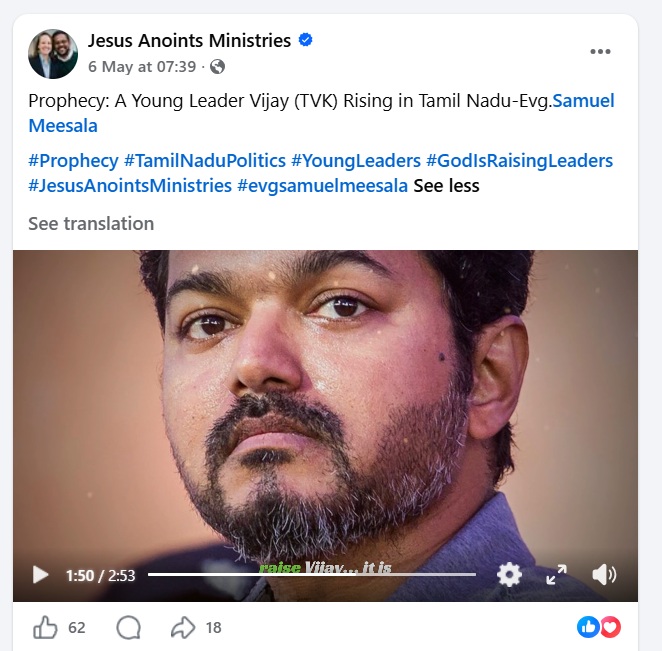
A US-based Christian missionary ministry page has openly rooted for Vijay and framed his political rise in spiritual terms. Search results show that Jesus Anoints Ministries, a Jackson, Missouri-based Christian ministry associated with evangelist Samuel Meesala, posted a video titled “Prophecy: A Young Leader Vijay (TVK) Rising in Tamil Nadu,” using hashtags such as #Prophecy and #GodIsRaisingLeaders.
What makes this significant is that the ministry page appears to mirror Vijay’s own biblical messaging. In December 2025, Vijay publicly invoked the story of Joseph at a Christmas gathering, presenting it as a story of betrayal, endurance, and eventual rise to leadership; now, a missionary-style Christian ministry page in the US is retelling that same frame and recasting it as prophecy.
This therefore does not look random. By describing Vijay’s rise as a “prophecy” and packaging it in Christian revivalist language, the page appears to be rooting for him not merely as a politician but as a Christian figure whose ascent carries spiritual significance – or in other words, a symbol of hope for missionaries to ‘reach the unreached’ a lot easier than before.
This comes in the backdrop of several pastors from Andhra Pradesh reaching Chennai to pray for Vijay and support him and he himself kneeling and praying at a church during the election campaign.
Subscribe to our channels on WhatsApp, Telegram,Instagram and YouTube to get the best stories of the day delivered to you personally.