Vijay entered politics claiming that TVK would be a “thooyasakthi,” a pure force that would stand apart from the corruption, manipulation, and transactional culture of Dravidian power politics. That moral positioning was not a side message; it was central to the way Vijay sold TVK to the public as the only ethical alternative.
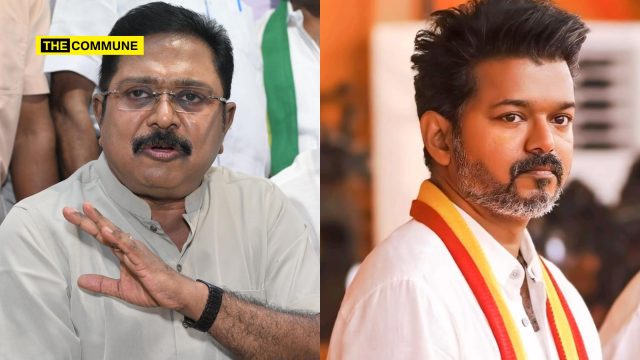
But the current government-formation controversy has made even the supporters think whether their choice was right, whether TVK was indeed a thooyasakthi. AMMK general secretary TTV Dhinakaran has accused TVK of trying to secure the support of AMMK’s lone MLA-elect, S. Kamaraj, through horse-trading, and has further alleged that the support letter shown in Kamaraj’s name was either forged or procured through illegitimate means.
#WATCH | Tamil Nadu | AMMK Party General Secretary TTV Dhinakaran says, “A letter was issued in support of TVK by my MLA Kamaraj. We are all shocked that I got an appointment with the Governor and I showed the real letter that I got from our CM candidate Edappadi Palaniswami… I… https://t.co/pHTPmAOu8wpic.twitter.com/C8NPSXcBXG
Dhinakaran did more than issue a political complaint. He rushed to the Governor, submitted a separate signed letter backing an AIADMK-led government under Edappadi K. Palaniswami, and publicly called the TVK episode “a mockery of democracy,” thereby converting a numbers battle into a question of constitutional propriety.
Then came the most politically damaging twist: TVK itself released a video claiming that Kamaraj had voluntarily extended support. TVK intended that footage as a defence against the forgery allegation, but the same video can also be read in a very different way, as evidence that TVK had managed to obtain the backing of an elected MLA from another party without the clear knowledge, control, or consent of that party’s leadership.
The Governor can treat the video released by the TVK side itself as evidence of poaching and horse trading involving elected MLAs. In fact, TVK may have unintentionally given the Governor a basis to initiate an investigation into the alleged horse trading. @lokbhavan_tn#TVKVijayhttps://t.co/DRMWKQKEgv
If the support of an MLA from another party was obtained in contested and opaque circumstances during an active government-formation struggle, the Governor is not obliged to treat it as routine political paperwork; he can view the material placed before him, including the video released by TVK’s own side, as raising serious questions about poaching, inducement, and possible horse-trading.
In fact, TVK may have unintentionally deepened the suspicion around itself. A video meant to rebut Dhinakaran’s charge also serves to establish that direct contact took place with AMMK’s lone MLA at the very moment when party chief Dhinakaran was saying he was unable to reach him and was shocked to see support being claimed for Vijay.
This is the political irony Vijay cannot easily escape. A party that branded itself as morally superior is now caught in with allegations of horse-trading, the possible crossing over of an elected representative outside the visible authority of his own party leadership.
TVK may have thought it was releasing a defence, but politically it released an exhibit. By publishing video of Kamaraj reportedly extending support while AMMK leadership was denying any such authorised move, Vijay’s party may have handed the Governor a ready-made basis to suspect poaching, question the legitimacy of the claim, and consider whether a deeper inquiry into alleged horse-trading is warranted. Thus, with each day, TVK keeps falling to new lows with regard to its claims of being a ‘thooyasakthi’.
Subscribe to our channels on WhatsApp, Telegram,Instagram and YouTube to get the best stories of the day delivered to you personally.
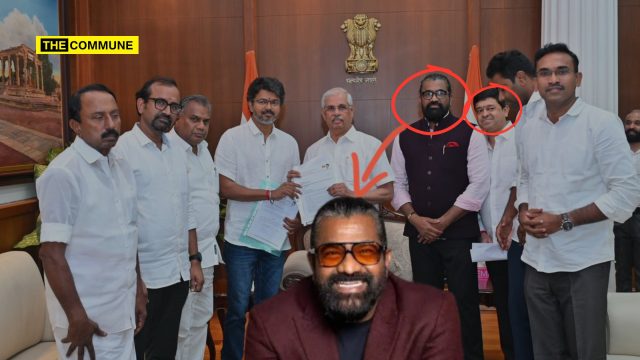
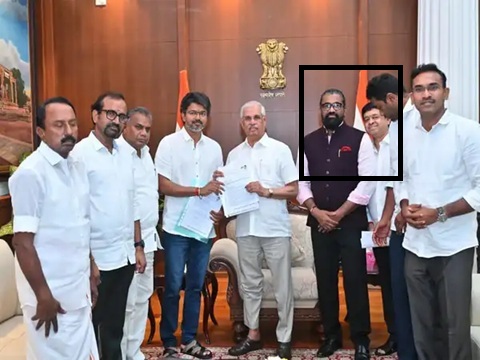
Tamilaga Vettri Kazhagam (TVK) chief Joseph Vijay’s visit to Lok Bhavan to meet the Governor on 8 May 2026 has sparked a political debate after filmmaker K. Venkata Narayana and businessman Vishnu Reddy were seen in the high-profile meeting linked to government-formation discussions. Their presence has drawn scrutiny because neither man is publicly known to hold any formal party post in TVK, yet both appear to enjoy unusual access to Vijay during politically sensitive moments.
The two men are not anonymous faces. K. Venkata Narayana is the chairman of KVN Group and founder of KVN Productions, the banner producing Vijay’s upcoming film Jana Nayagan. KVN’s own company profile says Narayana previously served as CEO of Prestige Group and later expanded into film production, financing, and distribution, making him a major business associate of Vijay through cinema rather than through party organisation.
Vijay took a Karnataka film producer (KVN Venkat) & an Andhra granite & mining businessman (Vishnu Reddy) along with him to the Governor to stake claim for government formation.
What role do these two outsiders have in Tamil Nadu?
Are they going to run the Tamil Nadu… https://t.co/BAXBxxNNzn
— Saikiran Kannan | 赛基兰坎南 (@saikirankannan) May 8, 2026
Some say he is a real estate billionaire himself apart from being a producer.
KVN is not just a film producer. He is righthand man of India’s biggest real estate billionaire & he himself is real estate billionaire
Its clear who funded Vijay’s election & who will benefit from his CM-ship.
Vijay being too novice in showing them publicly in such situtation https://t.co/aVRoy9TzWh
Vishnu Reddy is more opaque, but available records indicate he is an Andhra-linked businessman with granite-related business traces and company links in Chennai and Bengaluru. Public business-record aggregators identify a Vishnu Reddy Yerradoddi connected to firms including Indo Rocks LLP and Mytri Housing LLP, while GST data for M/S Vishnu Granites in Chittoor also lists the same name.
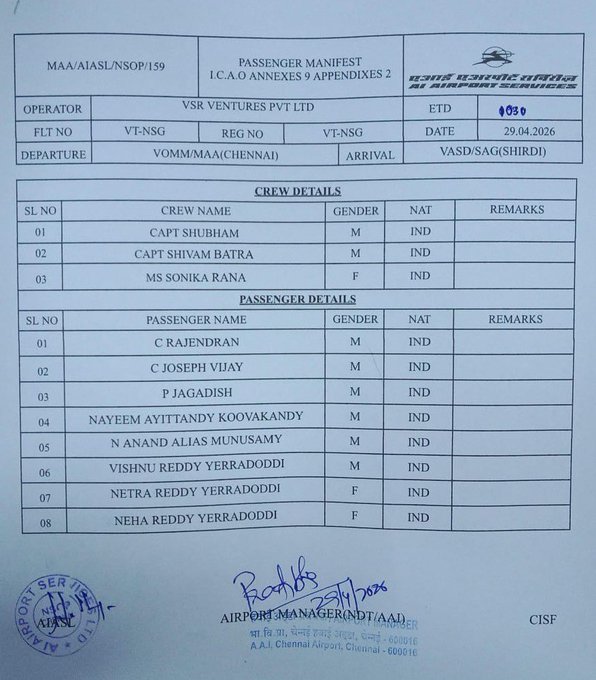
The mystery around Reddy deepened after a passenger manifest image linked to Vijay’s 29 April 2026 Chennai-to-Shirdi trip surfaced online. The document lists C. Joseph Vijay, P. Jagadish, C. Rajendran, and Vishnu Reddy Yerradoddi on the same flight, suggesting that Reddy is not a distant acquaintance but someone with access to Vijay’s immediate travel circle.
That is why the Lok Bhavan optics have become politically awkward for TVK. Observers have openly asked why a film producer and a businessman with no declared party responsibility should be present around a meeting tied to government formation, alliance arithmetic, and constitutional process. So far, there is no official confirmation that either Narayana or Reddy holds a formal position in TVK. A report in Times of India suggests that on 7 May 2026, TVK General Secretary Bussy Anand and “Vijay’s friend Vishnu Reddy met Velumani and held discussions with him for about an hour”. So, the duo has possibly been involved in the political discussions.
One can possibly explain that both men belong to Vijay’s personal circle rather than the party’s organisational chain and hence are involved. But that defence itself raises another question: if the occasion was political and constitutional, why should unelected private associates be visible anywhere near the process?
The political problem for TVK is not that Vijay has friends in business or cinema; every major leader does. The problem is the absence of transparency. When businessmen and producers appear beside a party chief at a moment tied to government formation, the public is entitled to ask whether formal politics is being mediated by an informal private network with influence but no accountability.
Tamil Nadu voters may well ask a blunt question: if two businessmen with no declared TVK role, no public electoral accountability, and no visible grounding in Tamil Nadu’s party structure are standing beside Vijay at critical moments, who exactly will shape access to power tomorrow? Narayana’s Bengaluru corporate profile and Vishnu Reddy’s Andhra-linked business background only deepen that unease. In a state fiercely protective of political self-respect and regional agency, even the appearance of unelected outside influence can become combustible.
Subscribe to our channels on WhatsApp, Telegram,Instagram and YouTube to get the best stories of the day delivered to you personally.
Five days after emerging as the single largest party in Tamil Nadu with 108 seats, Vijay’s TVK still remains unable to form the government, exposing the gap between electoral momentum and actual legislative majority. The Election Commission’s results show that TVK fell short of the 118-seat mark needed in the 234-member Assembly, and the Governor’s office has made it clear that Vijay has not yet established the numbers required to be invited to take oath.
What was projected as a historic breakthrough has now turned into a test of political management, alliance-building, and constitutional credibility. Despite repeated visits to Governor Rajendra Arlekar and efforts to gather outside support, TVK has so far failed to convert its status as the largest party into a viable claim to power, leaving Tamil Nadu in an extended post-result suspense.
In this melee, as the numbers game started turning murky, AMMK MLA-elect S. Kamaraj briefly became unreachable. Sensing the situation could spiral, TTV Dhinakaran moved quickly – his next set of moves prove why a newbie politician is no match for a seasoned politician like TTV Dhinakaran, despite Vijay having a propaganda machinery backing him.
As soon as the news of Kamaraj came to be known, TTV Dhinakaran went straight to Governor Rajendra Arlekar, and alleged that TVK was trying to manufacture support through either horse-trading or forgery.
That first move mattered because it changed the frame of the story. Instead of allowing Vijay’s camp to present the support claim as a fait accompli, Dhinakaran forced the issue into a legitimacy battle, asking the Governor to investigate whether the letter in Kamaraj’s name was genuine at all.
AMMK chief Dhinakaran accuses TVK of filing ‘forged’ support letter with Governor https://t.co/lkHVu8QkM7
The second move was even more decisive. Dhinakaran submitted a signed letter from Kamaraj backing an AIADMK-led government under Edappadi K. Palaniswami, making AMMK’s official line unambiguous and shutting down the impression that his party had shifted toward TVK.
Then came the public offensive. Dhinakaran called the episode “a mockery of democracy” and said either horse-trading had taken place or a forged letter had been used, directly attacking the moral basis of Vijay’s attempt to gather support for government formation.
This is where Dhinakaran’s political instinct showed. He did not merely deny TVK’s claim; he escalated it into a question of constitutional credibility, making it harder for the Governor to accept any disputed support at face value while the numbers remained unstable.
#WATCH | Tamil Nadu | AMMK Party General Secretary TTV Dhinakaran says, “A letter was issued in support of TVK by my MLA Kamaraj. We are all shocked that I got an appointment with the Governor and I showed the real letter that I got from our CM candidate Edappadi Palaniswami… I… https://t.co/pHTPmAOu8wpic.twitter.com/C8NPSXcBXG
The turning point came when TVK pushed back and released a video that it said showed Kamaraj voluntarily writing a support letter for Vijay’s party. TVK presented that footage as proof against Dhinakaran’s forgery claim, but politically it also confirmed that a direct poaching battle over AMMK’s lone MLA had in fact taken place.
*Tamil Nadu Political Drama*
AMMK chief Dhinakaran and MLA Kamaraj met the Governor and complained against Vijay and TVK.
They claimed that a fake support letter was sent in AMMK’s name.
-Now TVK has released a video of AMMK MLA Kamaraj allegedly drafting the support letter… pic.twitter.com/fFZ1ejxU4g
That is why Dhinakaran’s counterattack landed so hard. By the time the video surfaced, he had already met the Governor, placed AMMK’s official support on record for EPS, appeared before the media with Kamaraj, and announced plans for a police complaint, leaving Vijay’s camp to fight on terrain Dhinakaran had already defined.
In raw political terms, Dhinakaran outplayed Vijay on speed, clarity, and optics. Vijay’s camp may have tried to show momentum, but Dhinakaran used timing and institutional escalation to make TVK’s move look desperate, controversial, and tainted by allegations of illegitimacy.
The immediate outcome was that TVK’s path to forming the government remained blocked, with the majority question unresolved and no swearing-in taking place on schedule. In that sense, Dhinakaran did not just defend one MLA; he disrupted Vijay’s narrative of inevitability at the most crucial moment.
Step‑by‑step – How TTV turned the tables:
Step 1 – Swift alarm :
As soon as Kamaraj became unreachable, TTV Dhinakaran rushed to the Governor and formally accused TVK of “horse‑trading” and “forgery.”
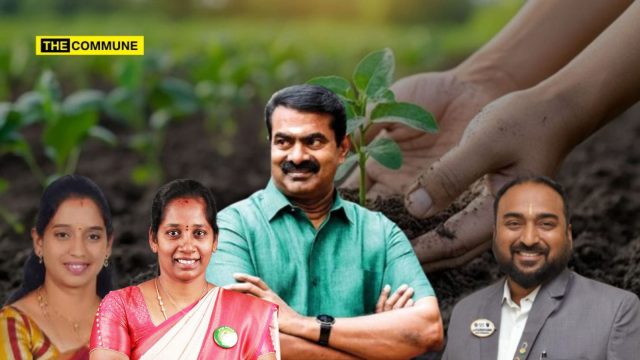
The Naam Tamilar Katchi seems to be the party in Tamil Nadu whose voteshare greatly reduced in the recent election, thanks to TVK and Vijay. But even after failing to secure a single victory in any of the 11 Assembly constituencies in Salem district and losing deposits across all seats, several Naam Tamilar Katchi (NTK) candidates have launched an environmental initiative by deciding to plant saplings corresponding to the number of votes they received in the recently concluded Tamil Nadu Assembly elections, as reported in The New Indian Express.
The move has been presented by party candidates as an attempt to remain connected with the public while also contributing to environmental protection and nature conservation.
NTK had contested in all 11 constituencies in Salem district but failed to win any seat. Collectively, the party secured 77,596 votes across the district. Among the candidates, Edappadi constituency candidate A Priyadharshini secured the highest number of votes for the party in Salem with 8,450 votes.
Following the election results, Salem North candidate M Gunaseela, Salem West candidate R Sureshkumar and Edappadi candidate A Priyadharshini decided to undertake plantation drives matching the exact number of votes polled in their respective constituencies. Gunaseela secured 6,450 votes in Salem North, while Sureshkumar received 6,820 votes in Salem West.
Party sources stated that the initiative undertaken by the three candidates had also inspired a few other NTK candidates in Salem district to consider carrying out similar plantation drives in their own constituencies.
Speaking about the initiative, Priyadharshini said the party fully accepted the people’s electoral verdict but did not believe political engagement with the constituency should end after elections. She stated that environmental protection and creating awareness about nature conservation had always been among the party’s key ideological positions and described the plantation drive as an opportunity to give back both to the people and to the environment.
She further stated that she planned to plant 8,450 saplings matching the number of votes she received and intended to personally ensure their maintenance. According to her, party cadres and volunteers would participate in the plantation drive in and around Edappadi, adding that the initiative was meant to benefit all residents of the constituency, irrespective of whether they had voted for the party.
Salem North candidate Gunaseela said the election campaign had given her direct exposure to the difficulties faced by residents in several parts of the constituency. She stated that she had campaigned continuously for around 96 days through extensive door-to-door outreach and had encountered areas where even basic civic facilities remained inadequate. She also noted that many women had raised longstanding grievances and unresolved local issues during the campaign period. Gunaseela said the plantation initiative in her constituency would focus on areas surrounding Mookaneri Lake.
Meanwhile, Salem West candidate Sureshkumar stated that although the party had expected a stronger vote share, the election outcome would not distance its candidates from the public. He said the party intended to continue working among the people and maintained that addressing public needs should not be seen as the responsibility of elected MLAs and MPs alone, adding that political workers could continue contributing to society in other meaningful ways as well.
Subscribe to our channels on WhatsApp, Telegram,Instagram and YouTube to get the best stories of the day delivered to you personally.
Just as Tamilaga Vettri Kazhagam chief tries to find the numbers to stake claim to form a government in Tamil Nadu, support from Christian quarters are growing louder by the day.
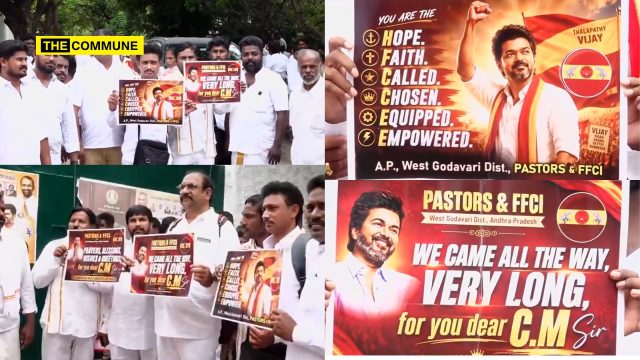
A video now circulating online has added to the growing discussion around his visible religious positioning in Tamil Nadu politics. In the clip, a speaker says a group of 12 pastors from West Godavari district in Andhra Pradesh travelled to meet Vijay, offer their wishes, and pray for him. This suggests that support for the TVK leader is not confined to ordinary party workers but is also drawing organised attention from Christian clergy outside Tamil Nadu.
This comes weeks after Vijay drew attention for a widely shared appearance at St. Anthony’s Church in Trichy in April 2026. Viral footage from the visit showed Vijay praying at the church and walking on his knees, a gesture that generated significant online debate ahead of the Assembly election campaign. The church visit triggered mixed political reactions at the time. Supporters viewed it as a personal act of devotion, while it was also under scrutiny for the public nature and timing of the gesture, especially during an election season.
This only seems to drive the point that Vijay and his TVK are a Christutva project of the church and they seem to have succeeded in their attempt at power. In a matter of a few days, the state will see its first Christian CM and one has to wait and watch if this will lead to sprouting of churches and missionary activity across the state.
Subscribe to our channels on WhatsApp, Telegram,Instagram and YouTube to get the best stories of the day delivered to you personally.
On 4 May 2026, Tamil Nadu spoke. They knew who they did not want to see in power, the DMK. And they spoke decisively.
It was loud and clear, that five years of arrogance, hatred, corruption, and intimidation have a price. We all saw it on counting/results day.
This is not merely a political win for Vijay. This is a collective exhale from a state that was slowly being suffocated.
Dynastic Politics
It is a well-known fact that the Karunanidhi family – he himself, his son, MK Stalin, the grandson Udhayanidhi Stalin, his daughter Kanimozhi and all the nephews and nieces are the ones controlling power and repeatedly get to sit in the corridors of power. After becoming Chief Minister, within a short time, MK Stalin made Udhayanidhi Stalin, a film producer with zero administrative experience, as Deputy Chief Minister. Stalin’s son-in-law V Sabareesan reportedly ran shadow networks of influence across state machinery. The party that once championed EVR’s egalitarianism had quietly become a royal court, with the Stalin family at its throne. Tamil Nadu was being handed to the inheritors of Karunanidhi.
This was not just limited to the top family, this exact same scenario was replicated with ministers, their sons/family members, other party post holders as well.
505 Promises, Endless Excuses
The DMK marched into the 2021 election with 505 promises in their manifesto. Five years later hardly a couple of 100 promises were fulfilled. Women’s safety was nowhere to be seen. All their promises on TASMAC regulation went bust. Law and order at its absolute worst. Drugs and ganja became even easily available than any other state, any other government – TN topped the drugs list. To shut the people up, they came up with a welfare scheme for women but limited the number of recipients after promising it for every woman in the state.
Hate Speech Dressed as Ideology
This is where the DMK’s poison was the most toxic.
In September 2023, Deputy CM Udhayanidhi Stalin stood at a public stage and declared that Sanatana Dharma should be “eradicated” the way one eradicates dengue and malaria. The Supreme Court of India criticised him, holding that he had abused his constitutional right to free speech. The Madras High Court went further, ruling in January 2026 that his remarks constituted hate speech, and that the phrase “Sanatana Ozhippu” implied nothing short of culturicide.
They still continue making such statements and hurting sentiments of crores of Hindus.
This was not an isolated moment of poor judgment. It was policy. DMK’s official social media handles routinely run anti-Brahmin cartoons. Senior party leaders openly made casteist remarks targeting Brahmin communities at public forums.
DMK leaders stated that learning Hindi would “make us shudras, slaves”, weaponising caste language against an entire linguistic community. DMK and its allies compared Lord Rama to a perpetrator of honour killing.
For five years, Hindus, Brahmins, and Hindi speakers in the state and outside were open targets – mocked, slandered, and threatened by ministers and party leaders who faced zero accountability. This was Dravidian politics, hatred with a government stamp on it.
Corruption Without Consequence
Right from the times of Karunanidhi who was known for his scientific corruption till the ministers, MLAs, councillors and DMK members in any official post, corruption runs deep in their arteris and veins. It is a part of their DNA.
2G scam that rocked the nation – DMK was involved
Illegal mining and sand smuggling – DMK ministers are named
Cash for jobs scam – DMK ministers/MLAs are involved
Loot through TASMAC – DMK members involved
Toilet scam, textile scam – you name it, it will have a DMK link somewhere or the other.
Once these scams are out, and then what? Nothing, zilch, nada.
Dissent? Expect a Midnight Knock
The DMK and its coterie ensured the police also was part of this team – they did not just ignore criticism. They would hound dissenters and critics for it.
Independent Tamil YouTubers, journalists who spoke about government corruption or their failures had their homes raided, taken away at odd times, some even had their equipment seized, family harassed. They had false cases hoisted on them – some even landed Goondas Act. Social media users, ordinary citizens, were arrested for posts that mocked Stalin or Udhayanidhi or anyone in the DMK and their family, under provisions so broadly applied they amounted to a digital sedition law. Political opponents were buried under FIRs and notices – not to seek justice, but to exhaust, intimidate, and silence.
The message the DMK sent to every critic for five years was simple and unambiguous: speak, and the state will come for you.
The Fall They Earned
And so, the DMK government fell – one by one, constituency by constituency, in ways that felt less like election results and more like long-overdue verdicts.
MK Stalin, who had won Kolathur three consecutive times, lost to TVK’s VS Babu by 8,795 votes. After nine assembly contests, the Chief Minister tasted defeat in his own backyard. PTR Palanivel Thiagarajan, who never missed a chance to lecture Tamil Nadu, lost Madurai Central by 19,128 votes. Health Minister Ma. Subramanian was routed in Saidapet by 28,514 votes. S. M. Nasar lost Avadi by a staggering 74,829 votes. And K. R. Periyakaruppan lost Tiruppattur by exactly one vote – democracy’s most precise and poetic rebuke.
DMK lost and it was cathartic to watch several sitting MLAs and ministers trail all day and lose.
Tamil Nadu knew who it did not want – they did not want the DMK back in power. And the results speak for itself.
Subscribe to our channels on WhatsApp, Telegram,Instagram and YouTube to get the best stories of the day delivered to you personally.
The defeat of the Dravida Munnetra Kazhagam government in the recently concluded TN polls has triggered an extraordinary outpouring from journalists and political commentators, many of whom are now openly accusing the regime’s media machinery of running a coordinated intimidation ecosystem for the past five years.
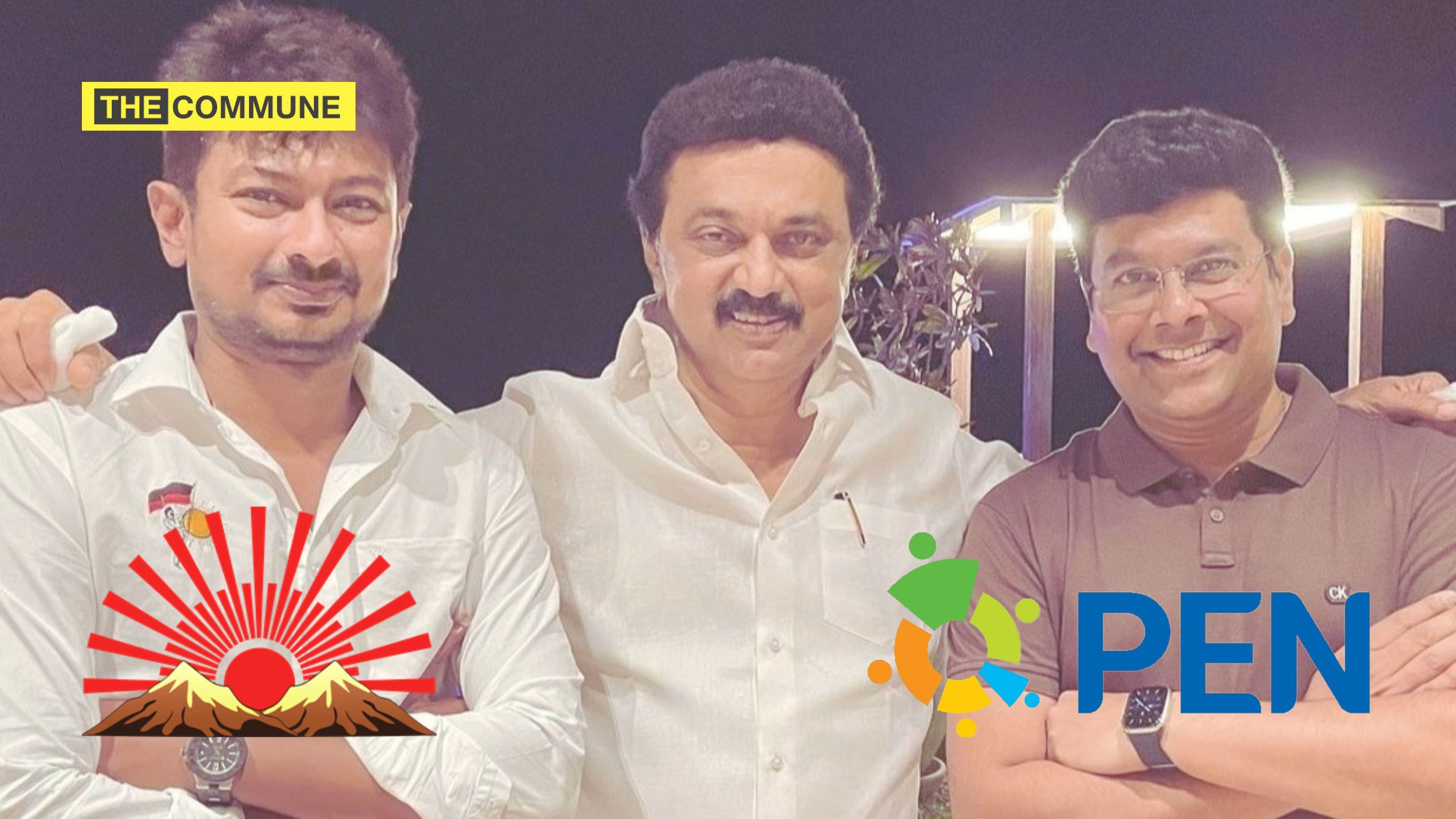
At the centre of the allegations is PEN, said to be controlled by V Sabareesan, son-in-law of MK Stalin along with the DMK’s IT wing leadership under PTR Palanivel Thiaga Rajan and later TRB Rajaa.
For years, the DMK projected itself as a “pro-people” government through aggressive public relations campaigns, carefully staged optics, and tightly controlled media management. But behind that image, journalists allege, operated a shadow ecosystem of online abuse, newsroom pressure, surveillance, and intimidation designed to silence criticism and enforce narrative discipline.
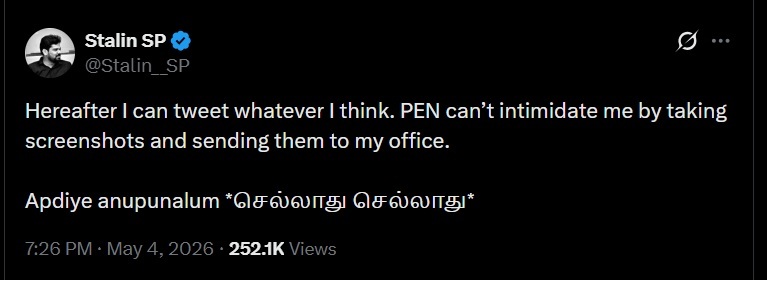
According to multiple journalists and commentators, PEN functioned less like a media platform and more like a political enforcement network. The method, they allege, was simple: if a journalist posted criticism of the government or questioned official narratives online, PEN-linked operatives would take screenshots and send them directly to editors, newsroom managements, or employers in an attempt to pressure, isolate, or discipline the individual.
The allegations burst into public view after Puthiya Thalaimurai Chief of Bureau, Stalin SP posted on X following the election defeat of the DMK: “Hereafter I can tweet whatever I think. PEN can’t intimidate me by taking screenshots and sending them to my office.”
The post quickly went viral and was widely interpreted as confirmation of long-rumoured pressure tactics inside Tamil media circles.
Times of India journalist Omjasvin M.D. alleged that the “constant abuse and target of journalists writing critically against the govt” represented one of the “worst downgrades” of the DMK IT wing in recent years. He claimed that beyond routine trolling, dedicated online spaces had allegedly been created specifically to discuss, target, and tarnish journalists critical of the regime, and that many involved in those attacks operated with political backing from the party leadership.
The constant abuse and target of journalists writing critically against the govt was one of the worst downgrades of the #DMK IT wing in the last few years. Beyond comments, spaces were created for discussions to tarnish journalists. Many involved in these trolls and targeted… https://t.co/63XLJ6tW6A
Another journalist Vinodh Arulappan went further, alleging that “under PTR, abuse became organised,” and claiming that teams existed solely to target critics using slurs and threats. “Earlier they were loafers, now, under TRB Raja they become thugs,” he wrote in a viral post reacting to the election results.
Under PTR, abuse became organised. A team existed solely to go after critics with slurs and threats. I know exactly who they are. Earlier they were loafers, now, under TRB Raja they become thugs. https://t.co/P4HsOsE18K
Vinodh Arulappan was also abused by PTR during the campaign period.
Casteist abuse was also targeted at journalists from the Brahmin community. PTR Palanivel Thiagarajan was adept at it. A journalist reminded people of the abuse she received from him on X.
— Reality Check India (@realitycheckind) May 5, 2026
The state’s Fact Checking Unit under former alleged fact-checker Iyan Karthikeyan also functioned as an unofficial censorship mechanism during the DMK’s tenure. According to several media insiders, access journalism, selective invitations, advertising pressure, and controlled information flows ensured that large sections of Tamil media remained dependent on the government’s goodwill. Stories embarrassing to the regime were buried, softened, or discouraged, while favourable coverage was amplified. So, what was shown to the public was a pretense that everything was rosy and shiny in Dravidian Model Tamil Nadu under the DMK.
The result was a media ecosystem where fear became institutionalised. Journalists who questioned the government risked online abuse, professional complaints, loss of access, coordinated smear campaigns, or pressure from management. Tamil Nadu’s media environment during the DMK’s rule was less an open press system and more a tightly supervised information order built around protecting the image of the ruling family and its political machinery.
With the DMK now removed from power after the 2026 Tamil Nadu Legislative Assembly election, journalists and commentators who remained silent for years are beginning to speak publicly. For many critics of the previous regime, the election result is not merely a political defeat for the DMK, but the collapse of what they describe as a carefully manufactured “photoshoot model, advertisement model government” sustained by intimidation, propaganda, and media control.
Subscribe to our channels on WhatsApp, Telegram,Instagram and YouTube to get the best stories of the day delivered to you personally.
The DMK has lost and its supporters are still in denial mode. One cannot change the fact that the defeat is written in stone. So, what do the mouthpieces do? Whitewash everything about the DMK and make it look so polished that even a non-DMK supporter might want to think the Dravidian Model rule was rosy and shining like paradise.
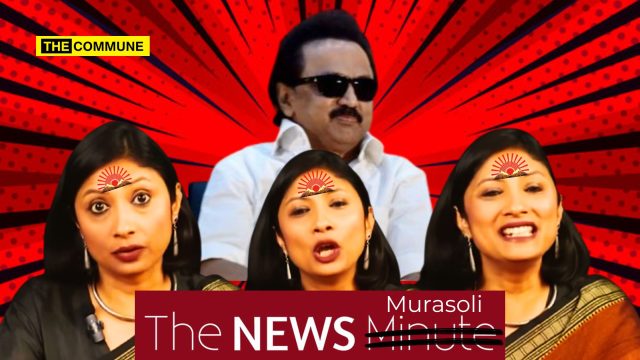
The News Minute and its anchor Pooja Prasanna try exactly that in their episode of Let Me Explain. What she does is not post-mortem of the DMK’s defeat but heavy damage control.
“This Was Not Anti-Incumbency” – The Core Premise Collapses Immediately
Pooja opens the episode claiming the loss was not a ‘straight forward anti-incumbency’. The reasoning behind this she said was “There was no single dominant issue or a wave of anger strong enough to produce this scale of outcome.”
After hearing these words, you begin to wonder if Pooja is a card-carrying member of DMK masquerading as a ‘journalist’. Did TNM not report any of the law and order issues plaguing the state for the past 5 years? Did TNM choose to turn a blind eye to the innumberable sexual assault cases that kept cropping every single day. Okay, let us not go too far to 2021, did she forget the Anna University sexual assault case, did she forget how they handled the FIR leaking victim details? Did they miss reporting the most recent Thoothukudi rape and murder of a school girl who went to attend nature’s call? Did they miss reporting or never heard of the toddler who was raped and murdered by a DMK cadre?
Did they miss the Kallakurichi hooch tragedy that took scores of lives? Did they miss the honour killings over the past 5 years? Did they miss the lock-up deaths that peaked in Dravidian Model regime? Did they forget Ajith Kumar who was mercilessly lynched to death by the police officers who come directly under MK Stalin?
Did they forget the atrocities against Dalits increased under Stalin rule and there is concrete data for it?
All these questions makes the viewer wonder if TNM is an ‘independent’ news organisation or if they are DMK members who function as a mouthpiece, much like Murasoli and Sun News.
Instead of addressing these issues, Pooja claims “The result instead reflects a shift in how the election was contested and how the voters responded.”
Vijay’s Rise Is Treated Like A Psychological Accident, Not A Political Verdict
One of the most revealing aspects of Pooja’s word salad is its inability to treat Vijay’s rise as a legitimate political phenomenon driven by genuine dissatisfaction. Instead, TVK is repeatedly described as star power, a mobilization, a gang, group, or club, emotionally driven supporters, social media amplification, and simplified messaging. Here is what is missing from her vocabulary – ideological dissatisfaction with Dravidian politics, frustration with corruption, resentment against dynastic control, collapse of trust in traditional parties, aspirational politics, youth anger, anti-elite sentiment, and genuine desire for regime change.
She lays the blame for the loss squarely on DMK’s inability to ‘communicate its success’ and not fine-tuning it to Vijay’s messaging. According to TNM, people didn’t consciously reject the DMK, they were merely “captured” by digital repetition and celebrity charisma.
She does acknowledge that the DMK underestimated Vijay,
mocked him, dismissed him, failed to engage him, delayed response, were too overconfident, and assumed old methods would work.
But every one of these points is presented as a campaign-management error instead of DMK’s failed model of governance.
The truth is harsher. The DMK ecosystem had become so insulated within its own media, intellectual, and political bubble that it genuinely believed Vijay was a joke until the ground shifted beneath them.
Corruption Is Minimized Through Careful Linguistic Cushioning
Here’s where things get even interesting. TNM seems to be on a mission to whitewash Stalin’s Dravidian Model as one of the exemplary non-corrupt models ever. She says, “…corruption became a recurring theme in the campaign. Though there were no big scandals like the 2G, there was a steady flow of allegations and perceptions. Some of these allegations were unverified. Others may have had some basis. In elections, perception matters and repeated exposure to these claims can create a broader impression that is hard to counter.”
She fails to confront why corruption narratives resonated so strongly with the public. Why did those allegations feel believable to people? Because years of political culture had already eroded trust and there was one scam or the other cropping up each day. Did she miss reading about KN Nehru’s MAWS scam? Did the TASMAC scam not reach her ears? Or are these ‘too miniscule’ a scam according to the ‘scale of corruption’ of TNM’s political masters?
Instead of examining whether the DMK had acquired a reputation for entitlement, patronage politics, opaque networks, or concentration of influence, she reduces the issue to “circulation” and “perception.” Again, the emphasis is not on whether DMK indulged in corruption, but on how narratives spread digitally. This is deflection at best.
DMK Delivered On Governance According To Pooja Prasanna
Pooja repeatedly insists that welfare schemes were implemented,
administrative continuity existed, and governance delivery happened. She also claims the implementation was not properly communicated. Is she selectively blind or does she not read newspapers? Has she not seen how media in TN works and how many advertisements were regularly published by the DMK government?
She also says, “There were also gaps in governance. There were localized grievances and all this led to some anger. Could some of these voters have been retained if their concerns were acknowledged or solved?”
What Pooja fails to spout from her mouth is the people-establishment disconnect! The DMK government was unempathetic to the people, refused to treat people even humanly, leave alone addressing grievances.
Also, governance is not a spreadsheet exercise.
A government can deliver schemes and still lose public trust if voters are met with arrogance from their leaders, corruption,
disconnect, selective governance, ideological fatigue,
suppression of dissent, breakdown of law and order, lack of employment, inability for a layman to lead a normal life.
Pooja treats governance as though electoral rejection becomes irrational unless measurable administrative collapse occurs. But voters are not auditors. They are political beings reacting emotionally, culturally, socially, and psychologically to power.
The video never truly accepts that the electorate may simply have wanted the DMK removed.
The “Digital Shift” Explanation Conveniently Avoids Political Accountability
Once again, DMK’s loss is squarely blamed on TVK’s social media game. She claims the DMK remained ‘conventional’. Basic 101 of marketing – you have a worthy product, it will sell. But if you have a hopeless and shitty one, you cannot package it in gold and sell it as diamond to the people.
Why did TVK’s social media game win and why did it resonate with the public? Social media cannot manufacture mass anger out of thin air for an entire state. Digital amplification works only when underlying dissatisfaction already exists. She treats technology as though it independently created political reality. In truth, digital media merely accelerated and reflected sentiments already brewing on the ground. The messenger succeeded because the message resonated.
For once, DMK got a taste of its own medicine, going by her words.
In this short 9 minute video also, she does not forget one thing – to sing paens of the paymaster. She says, “MK Stalin’s leadership style has been consistent. It’s been marked by gradual political growth and administrative focus.”
Being oblivious to the people’s grievances is called consistent leadership?
Once again she repeats that anti-incumbency was not the original issue. She says, “His (Stalin’s) defeat in Kolathur is significant and it should be seen in the context of wider losses across the party. This was not solely a referendum on his leadership. It reflected a broader shift in voter behavior and campaign dynamics. The 2026 verdict does not fit the pattern of strong anti-incumbency driven by clear public anger. Instead, it reflects a more diffused sentiment.”
Therefore ultimately, social media marketing aced the game and DMK lost because of it ‘despite’ the glorious 5 years.
The Biggest Omission: No Serious Examination Of DMK Political Culture
Perhaps the most glaring omission in the entire analysis is what it refuses to deeply interrogate cadre excesses, ecosystem arrogance, ideological fatigue, media patronage networks,
dynasty fatigue, suppression narratives, corruption perception,
intolerance toward criticism, and the growing perception that the DMK system had become too entrenched and self-referential.
These are not minor issues. They were central to the election mood.
But confronting them honestly would require abandoning the comforting narrative that the DMK merely lost a “communications battle.”
Ignoring Public Anger, Explaining Away Electoral Rejection
What makes the omission even more glaring is that some of the most politically damaging issues faced by the DMK government are almost entirely absent from the analysis. There is barely any serious discussion on th real problems such as crimes against women and children, rising law-and-order anxieties, the drug menace, caste violence, custodial deaths, or the growing perception that the state had become increasingly unsafe under the DMK’s watch. Every single crime was erased. Any honest political post-mortem would have treated these as central factors behind public anger. Instead, Pooja replaces real governance failures with abstract jargon about “structures,” “narratives,” and “communication shifts,” while the lived anxieties of ordinary voters disappear entirely.
Even towards the end, she attempts to describe the verdict as merely “anti-establishment” instead of anti-incumbency, this just feels like rhetorical cushioning. In 2026 Tamil Nadu, the establishment was the incumbent DMK government. Voters were not hypnotised by social media clips or celebrity charisma alone; they were responding to accumulated frustration, distrust, and fatigue with the ruling dispensation. By refusing to confront that directly, Pooja Prasanna just vomited a passage written by a PRO for narrative management of a defeated political establishment.
Please Change Your Names And Profession To TN Murasoli & PR Agency Of DMK
One word of advice to The News Minute. Just change your names to TN Murasoli, become the official PR of the DMK, enroll yourselves officially as cadre/party members. Then, people will not question you. Acting like bootlicking cheerleaders for a political party while claiming to be ‘independent journalists’ is hypocrisy at its highest. Atleast be truthful to yourselves and to the people who pay you.
Subscribe to our channels on WhatsApp, Telegram,Instagram and YouTube to get the best stories of the day delivered to you personally.
Dravidianist political hypocrisy is often exposed very quickly. Here is yet another example.
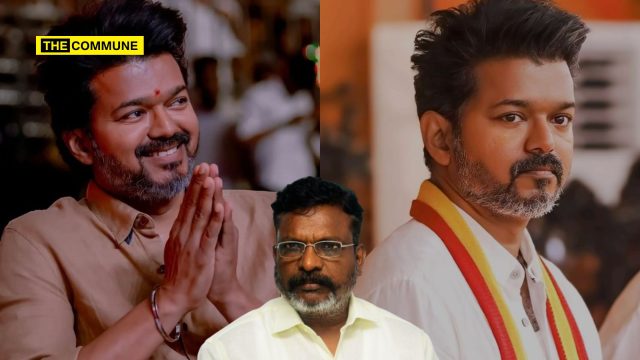
A while back, they thundered that Vijay was an RSS creation. DMK ally Thirumavalavan in a speech said, “It has now been exposed that younger brother Seeman and younger brother Vijay are, today, children brought forth by the RSS. It has been exposed that they are children of the BJP.”
Even a couple of days ago, when the TVK members went to meet the governor to stake claim to form the government, Dravidianists claimed all the members were somehow linked to the RSS.
These are the people @INCIndia wants to support in Tamilnadu to keep “BJP away from entering Tamilnadu”. 😂😂
fools, they have already entered Tamilnadu and you are enabling them further. 🤦♂️
1 RSS, 1 Brahmin, 1 ADMK corrupt local caste leader veteran, 1 IRS (as bad as RSS), 1 Lottery multi-millionare, 1 cinema multi millionaire, 1 Wine shop multi millionaire. Beautiful change in power to these casteless secular poor people. https://t.co/N2mYrF81I4
So, which is it? Was Vijay an RSS project yesterday, or is he an RSS victim today?
If Vijay was truly the creation of RSS-BJP forces, then the current delay in government formation should logically be the easiest moment for that establishment to install him in office.
Instead, Governor Rajendra Arlekar is reported to have told Vijay to return only with letters of support from 118 MLAs before any swearing-in can happen. That means the hold-up, at least on the public record, is not ideology but numbers.
Former Solicitor General Harish Salve has also defended that position, saying there is “nothing unconstitutional” in the Governor asking for something more than Vijay’s word and that the Constitution does not automatically entitle the single largest party to be invited first. In Salve’s view, asking for written support in a fractured mandate is within the Governor’s discretion.
So what are we watching here? A familiar Dravidianist political trick. When Vijay needed to be discredited, he was branded an RSS man. When Vijay could not immediately cross the constitutional hurdle to form the government, the same side suddenly discovered that RSS forces were blocking him.
Whatever be the case, make RSS the villain – this is the narrative laundering that is being done.
Subscribe to our channels on WhatsApp, Telegram,Instagram and YouTube to get the best stories of the day delivered to you personally.
Back in 2024, the year Joseph Vijay launched his party, the Tamilaga Vettri Kazhagam (TVK), he made several punch dialogues in his speeches. During his speech at a massive rally at V. Salai near Vikravandi in Vizhupuram district, Tamil Nadu, he addressed the huge crowd of his supporters, not only elaborated on his party’s ideologies but also fixed who his political enemies were.
Taking potshots at the DMK/Dravidianists indirectly, Vijay said that there is a “crowd” that tries to paint a colour to anyone who makes a political entry.
“There is a crowd here that for sometime has been singing the same paeans. Anybody who comes into the politics is given ‘one particular colour’. They keep fearmongering people and cheat them. But ‘these people’ (indirect reference to DMK) will put underground dealing with ‘them’ (indirect reference to BJP). During elections, they will give statements and give sounds. For them, it’s always ‘fascism’, ‘fascism’, ‘fascism’. Among the people who are united here, they fearmonger by splitting people as majority-minority and keep putting a full-time scene with it. I’m asking you – If ‘they’re fascism’, are you ‘payasam’?. You’re no better than them. You call this anti-people government as a ‘Dravida Model’ government and cheating people.“, Vijay blasted the DMK.
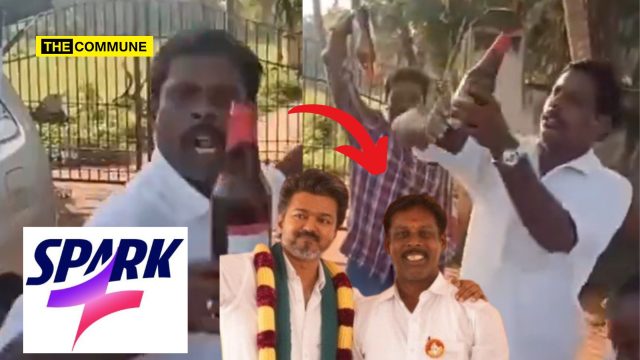
Cut to 2026, post-result scenario. Social media was abuzz with videos of a recently elected TVK MLA from Thanjavur who was reportedly drunk and was dancing to a Tamil film song with a bottle of alcohol.
The video was shared by a handle named @SparkPluz_ and several other news channels also reported. However, the handle stated that they received a notice from the police department issued by the Cyber Crime Police Station, Thanjavur District, on 6 May 2026 and addressed to Twitter, Inc. According to the notice, a complaint from a Thanjavur resident alleged that the account @SparkPluz_ had shared a video concerning Vijay Saravanan with the intention of defaming and demoralizing him, prompting police to seek IP logs and activity details from the platform.
There were a few handles claiming the video was 5 years old.
This was the same modus operandi of the DMK and its IT Wing – both official and unofficial. Several people across the spectrum have been targeted and cases dumped on them in the past 5 years.
For a party that rose by attacking “fascism,” political intimidation, and fear-driven politics, TVK seems to be doing exactly what it accused the DMK of doing – being ‘fascist’ and not permitting freedom of speech. When criticism or embarrassing content is immediately met with cyber crime complaints and attempts to trace anonymous users, the optics begin to resemble the very political culture Vijay once mocked on stage. The issue is no longer just about one video. It is about whether TVK can truly handle criticism differently from the parties it promised to replace.
So, does this mean that TVK is DMK 2.0?
Subscribe to our channels on WhatsApp, Telegram,Instagram and YouTube to get the best stories of the day delivered to you personally.