Home Blog Page 546

Chhaava: The Tale Of Sambhaji Maharaj – A Heroic Story Lost In Poor Filmmaking

First, this movie needed to be made. Chhatrapati Sambhaji Maharaj was a Sanatani hero, a man who did not give up on his faith to save his life. What little I had heard of him earlier made him out, unfairly, to be a wastrel and not a patch on his illustrious father. That needs to be rewritten and disseminated to the upcoming generations.

Vicky Kaushal IS Sambhaji. He exudes that confidence and aura that one would expect from a king.

The man who really does steal the show is Akshaye Khanna, as Aurangzeb. If you didn’t know that he had played the role, you wouldn’t have figured it out. His transformation is stark and that brooding menace, malevolent, yet turning increasingly defeatist, is well done.

The costumes are well made and seem pretty authentic. The sarees worn by the women are gorgeous and, as my wife assures me, are reflective of those likely worn by Marathi women of that day and age with Benaras silks and Paithani sarees predominating.

Now for the bits that bothered me.

Every historical depiction I see on screen in India, I automatically compare to the serial from the 80s, Chanakya. And EVERY single one of them falls short, including this one.

The screenplay is very amateurish. The dialogues are stilted. The fights all appear the same after a while. The repeated screaming by Vicky Kaushal with closeups of his clenched jaws or wide-open mouth can only be appreciated so many times.

The characters all seem to be caricatures, barring Sambhaji and Aurangzeb, maybe. The guy who is seditious, is shown with nervous, shifty eyes. It seems more like theatre with the exaggerated facial contortions than cinema.

Continuity is another problem. The story spans a number of years, but you wouldn’t know it from looking at the actors. Rashmika Mandana looks pretty but never seems to age even as her kids miraculously seem to grow up, with Rajaram growing up to become a 7-8 year old. Even Shambhaji doesn’t seem to age during that time. These are simple issues, and I am not sure why our filmmakers do not pay attention to them.

And the music. Oh God, the music. Loud, jarring, insistent, incessant. Orchestral hits are great for key moments. But if the entirety of the music is a never-ending stream of clashing cymbals and loud brass sections, it gets very annoying. I just looked it up, and am stunned that the music director is AR Rahman. I mean, what????!!!!! It was as amateurish an attempt as me playing on the keyboards with the “orchestral hit” setting.

Actually, if anyone wants to make a historical film, please just give it to Ilaiyaraaja Ayya. He would have done a fabulous job. If you couldn’t him, then give it to Atul-Ajay.

ARR perhaps forgot that pauses are good. EVERY SINGLE scene has music. Whether it is Sambhaji or Aurangzeb or any other character speaking. They all appear unspeakably noble or unspeakably villainish and the music will beat you over the head to make sure that you understand who is depicting what aspect!

Overall, I expected better. I am glad the story has been told, and that people will now dig deeper to understand who Chatrapati Shambhaji was and about his courage and valour. For that I am grateful.

But just as a movie? Disappointed.

Arun Krishnan is the author of Battle of Vathapi: Nandi’s Charge.

Subscribe to our channels on TelegramWhatsApp, and Instagram and get the best stories of the day delivered to you personally.

Union Home Minister Amit Shah & Karnataka Deputy CM D.K. Shivakumar To Attend Isha Mahashivratri Celebrations On February 26

Isha Yoga Center in Coimbatore is set to host an electrifying Mahashivratri celebration on February 26, bringing together millions for a night of profound spiritual energy and cultural vibrance. The event will be graced by Union Home Minister Shri Amit Shah and Karnataka Deputy Chief Minister Shri D.K. Shivakumar as special guests, making this year’s gathering even more momentous.

At a press conference held today (February 22, 2025) at the Coimbatore Press Club, Swami Paaraga, regional coordinator of Isha Foundation, addressed the media alongside Isha volunteers Ganesh Ravindran and Saravanan.

Speaking at the event, Swami Paaraga said, “In India’s spiritual tradition, the Shivratri in the Tamil month of Maasi is celebrated as Mahashivratri. On this night, due to planetary alignments, human energies naturally move upward. To harness this possibility, our culture has observed Mahashivratri as a night of wakefulness for thousands of years.”

He further stated, “The 31st Mahashivratri celebration at Isha will be a grand affair, featuring Union Home Minister Amit Shah and Karnataka Deputy Chief Minister D.K. Shivakumar as esteemed guests.”

The festival will take place in front of the iconic Adiyogi statue, beginning at 6 PM on February 26 and continuing until 6 AM the following morning. Under the guidance of Sadhguru, the night will be filled with powerful meditations, mantra chanting, and spellbinding performances by renowned artists.

A major highlight of the event will be Sadhguru’s midnight Mahamantra initiation, an opportunity for participants to experience deep meditative states. Additionally, Sadhguru will unveil a free meditation app, Miracle of the Mind. Featuring a 7-minute guided meditation with Sadhguru, this app aims to empower individuals to establish a daily meditation practice that can easily fit their schedule.

For the convenience of attendees, arrangements have been made for parking, purified drinking water, hygienic restrooms, and emergency medical assistance. Special seating has been prioritised for people of Tamil Nadu.

Those interested can register online at Isha Mahashivratri Website or attend as walk-ins with free entry. As part of the tradition, Maha Annadanam will be offered, ensuring free food for thousands of devotees. The event will be broadcast live from over 100 locations across India, including 50 sites in Tamil Nadu and 25 in Kerala, with streaming available in 22 languages. It will also be aired on 150+ TV channels, digital platforms, and 100+ PVR-INOX theatres, while Jio, Hotstar, ZEE5, and major FM radio stations will carry live coverage.

To keep the energy high through the night, live music performances will feature Satya Prakash, a popular Tamil singer; Subha Raghavendra a Karnataka-based vocalist; hip-hop artist Danish Singh (Paradox); the renowned Marathi music duo Ajay-Atul; Muktidan Gadhvi, a Gujarati folk singer; and Cassandra Mae, a German artist known for Bhartiya devotional songs.

Subscribe to our channels on TelegramWhatsApp, and Instagram and get the best stories of the day delivered to you personally.
UPI Dominates India’s Digital Payments Landscape, Handling 84% Of All Transactions In FY24 And Revolutionizing Financial Inclusion

Amid a surge in digital payments where nearly four out of five payments in the country were conducted on the Unified Payments Interface (UPI) in FY24, UPI has emerged as the dominant force driving financial inclusion, merchant adoption and cross-border transactions.

According to a new industry report, UPI now drives 84 per cent of all digital transactions in India. The report by fintech consulting and advisory firm The Digital Fifth, UPI represents more than just a payment system — it’s an entire financial ecosystem shaping India’s digital-first economy. “With UPI handling 16 billion transactions a month and projected to grow 3x by the end of 2030, the role of robust, high-resilience switching infrastructure becomes paramount,” according to Sameer Singh Jaini, Founder and CEO of The Digital Fifth.

Real-time fraud detection, cloud-native architecture, and scalable, dual-core switches are no longer optional; they are essential to ensuring frictionless, secure, and fail-proof digital payments as India continues its journey toward a truly cashless, globally connected economy, he mentioned. UPI transactions surged 4 times from 2021 to 2024, reaching 172 billion transactions annually. It now dominates digital payments, far outpacing card-based and wallet transactions. With 30 million+ merchants onboarded on UPI, the merchant-to-consumer (P2M) segment is growing at 67 per cent on-year, outpacing peer-to-peer (P2P) transactions and signalling UPI’s transition into the primary retail payment system, the report mentioned.

According to the RBI, digital payments across India recorded a double-digit jump of 11.1 per cent year-on-year (YoY) as on September 2024. According to the report, the share of the UPI in the country’s digital payments has surged from 34 per cent in 2019 to an impressive over 83 per cent in 2024, with a remarkable CAGR (cumulative average growth rate) of 74 per cent over the last five years. At a macro level, the volume of UPI transactions increased from 375 crore in 2018 to 17,221 crore in 2024, whereas the total value of transactions surged from ₹5.86 lakh crore in 2018 to ₹246.83 lakh crore in 2024.

—IANS

Subscribe to our channels on TelegramWhatsApp, and Instagram and get the best stories of the day delivered to you personally.
Mrs. Savita Jha Khan’s Rant About Mahakumbh On Indian Express Shows They’re Terrified About Too Many Hindus Coming Together

I came across an ‘opinion’ piece by Dr Savita Jha Khan on the apparently disturbing trend of Hindus assembling in large numbers. What is put across as a concern looks more like fear when one reads the piece.

At the outset, Mrs Khan wonders whether going to Kumbh means Hindus have started following a codified, performative & mandatory form of Hinduism. This assumption is shocking because Hinduism is not a bunch of random beliefs. It has its codes, its rituals & mandates.

Mrs Khan thinks that Hindus are increasingly adopting Abrahamic characters like centralisation, rigidity, mass mobilisation, etc. She doesn’t give any proof of either centralisation or rigidity of Hindus but uses these words more than once in her opinion.

Mass mobilisation has always been a part of Hinduism. Foreign travellers & Indian historians have mentioned mass events. Bathing rituals were common even in the SSC times. The Great Bath is a proof of that.

The Kumbh Mela is not the ultimate destination even today. It is voluntary. Mrs Khan believes that Kumbh was a journey for oldies nearing their end. This is not true. Yes a lot of elderlies would go on pilgrimage, but does she know why it was so?

It was mostly because yatra was difficult. People would walk or travel in carts for weeks & sleep under trees or in sarais. They were exposed to adverse weather, wild animals, snake bites, dacoits, etc. Making such a hard journey, to & fro was extremely dangerous.

Here, Mrs Khan makes so many assumptions, as if she personally knows everyone going to Kumbh. Of course participation has increased. Because now it is not dangerous to go on a yatra. People do not wait for their children to get married before going on a yatra anymore.

Then out of no where Mrs Khan brings in Kanwar Yatra. Probably because she cannot bring in the Tazia processions or Shab-e-barat anarchy.

Fear of Mrs Khan is evident here. She thinks only Abrahamic faiths have the concept of processions & gatherings. It is sad that despite being a student & a teacher of history she has so little knowledge of Indic faiths.

Faxian in his travel records mentions grand processions at least twice. Once in Hotan & once in Pataliputra. The tradition of grand procession is definitely not a ‘new’ thing as she wants us to believe. Again more Hindus are going on pilgrimage because it is easy to do so now.

Here Mrs Khan has completely lost it. She is scared that Hindus are now participating in ever larger numbers in their festivals, yatras & congregations. She thinks Hindus are better off praying at home than assembling in massive numbers.

Mrs Khan thinks that people bathing at Kumbh is some how a ‘challenge to Hinduism’s foundational essence’. This is typical of Marxist historians who are experts in twisting facts. Rivers & river bathing has been mentioned in Rigveda & Puranas.

The Rigveda has an entire hymn (Nadistuti Sukta RV 10:75) dedicated to praises of rivers. Bhagirath did tapa to bring Ganga down to earth so his ancestors could attain moksha. Rivers & river bathing has always been integral to Hinduism.

Vedas & Puranas are the very foundation of Hinduism & they exalt bathing in rivers. There is a reason Kumbh happens every 12 years & not on a convenient weekend. There is a long history of mass gatherings, processions & yatras, which Mrs Khan conveniently forgot.

Mrs Khan pretends to ‘worry’ about the changes in Hinduism but in fact she is just wants Hindus to not show any sign of cohesiveness. She would rather have them divided on caste & language than come together for peaceful spiritual gatherings.

Vijender Sharma is a history enthusiast and author. He has written two books, Essays on Indic History & The Cusp Years, on the lesser known aspects of Indian history.

Subscribe to our channels on TelegramWhatsApp, and Instagram and get the best stories of the day delivered to you personally.
 

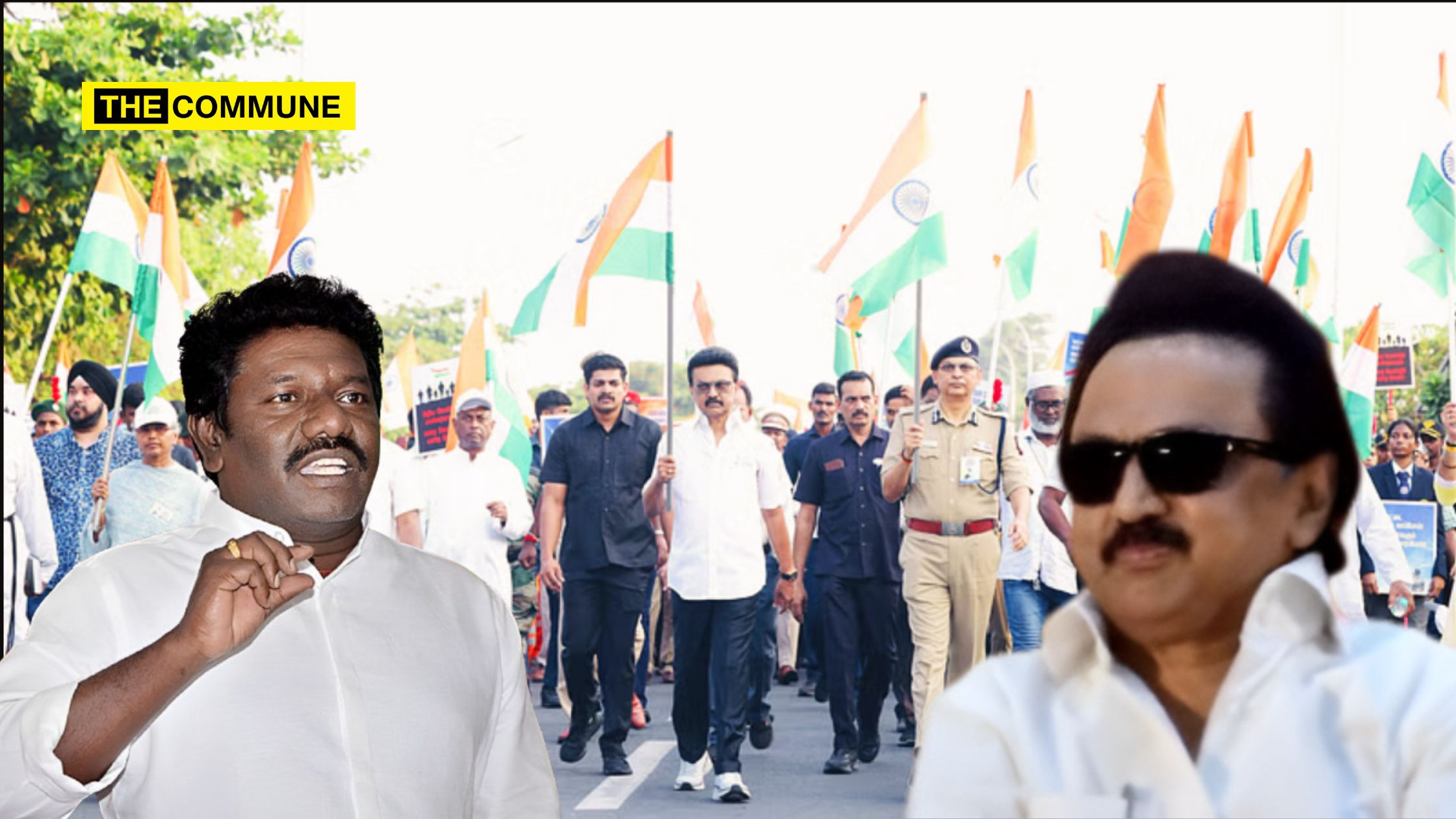
DMK’s New Dravidian Model Of Separatist Politics?: TN CM MK Stalin Threatens To Withhold Taxes To Centre

Tamil Nadu Chief Minister M K Stalin escalated his confrontation with the Modi government on Friday regarding the National Education Policy (NEP) and the distribution of funds. He stated that the DMK could easily refuse to pay taxes collected by the Union government from the state, emphasizing that “federalism is about give-and-take.”

In response to Union Education Minister Dharmendra Pradhan’s claim that Tamil Nadu could lose ₹5,000 crore for not implementing the PM Shri scheme linked to NEP, Stalin accused the Centre of being envious of the states’ progress and attempting to hinder their development.

Stalin also criticized the Centre for withholding states’ rightful share of resources, stating, “After extracting all state taxes through the GST regime, the Union government is now refusing to release the dues owed to states, deny new schemes, or provide funds for joint state-federal projects.”

Warning the Centre not to provoke Tamil pride, Stalin said, “Don’t stir the hornet’s nest. Don’t challenge the unique spirit of Tamil people. As long as I am here, and as long as the DMK is here, no anti-Tamil agenda will succeed.”

Pradhan responded to Stalin’s opposition to the NEP, accusing Tamil Nadu’s stance of being politically motivated and harmful to students. On his X handle, he shared a letter to Stalin, calling the state’s opposition to NEP “highly inappropriate” and “narrow-minded.” He criticized the Tamil Nadu government for using “intimidation for political reasons” and urged the state to focus on students’ well-being instead of politicizing education. Pradhan emphasized that the Modi government was dedicated to promoting Tamil culture globally and clarified that the NEP was designed to modernize the education system while respecting linguistic and cultural diversity, reiterating that no language would be imposed on any state or community.

Stalin, speaking at a gathering in Cuddalore, argued that the true disaster for India was the Union government’s failure to understand federalism. He claimed, “NEP isn’t about improving education; it’s about advancing the agenda of creating a homogeneous India.”

This is not the first time that the DMK has resorted to separatist rhetoric.

Earlier in November 2024, DMK scion Udhayanidhi Stalin received a map of separate South India, which indirectly references the “Dravida Nadu” separatist ideology once propagated by the DMK.

On 10 June 2021, the DMK IT wing’s official Twitter account quoted late former Tamil Nadu Chief Minister Annadurai, saying that the demand for a separate “Dravida Nadu” is still relevant, and has fuelled separatism.

(With Inputs From TOI)

Subscribe to our channels on TelegramWhatsApp, and Instagram and get the best stories of the day delivered to you personally.
Dravidian Model Development: Flyover Projects Stuck In Limbo Cause Chaos In Chennai’s T Nagar, Nolambur, Vyasarpadi, And Kodungaiyur; Traffic, Sewage Issues, And Business Losses Mount

The so-called Dravidian Model of development is once again exposed as a failure, with stalled flyover projects in T Nagar, Nolambur, Vyasarpadi, and Kodungaiyur leaving residents to suffer crippling traffic congestion, sewage overflows, business losses, frequent power cuts, and endless detours. Despite grand claims of progress, these projects have remained incomplete for over two years, turning daily commutes into nightmares and crippling local businesses.

In T Nagar, over 1,000 homes across 25 lanes are trapped due to the prolonged closure of Usman Road, which has been blocked for a year and a half because of delays in the construction of a ₹130-crore flyover connecting Anna Salai with Panagal Park. B Kannan, secretary of the T Nagar Resident Welfare Association, was quoted saying in a Times of India report that even ambulances struggle to reach the area, as residents must navigate narrow lanes to exit through Duraisamy subway. “Our street is completely inaccessible to cars,” he added. Furthermore, the flyover project has caused damage to power lines and Metrowater pipes, leading to sewage backups and up to eight-hour power cuts, according to Kannan.

The flyover, originally scheduled for completion by December 2024, is only 70% complete. The Greater Chennai Corporation (GCC) is facing alignment challenges in connecting the new 1.2 km flyover from CIT Nagar with the existing one at Ranganathan Street. These delays have caused 2 km detours, pushing roughly 10,000 vehicles per hour onto Panagal Park, Venkatnarayana Road, Thandapani Street, and Burkit Road to access Anna Salai, severely impacting local businesses.

In North Chennai, delays in flyover projects have created a chaotic situation. Patients attempting to visit a GCC dialysis center in Vyasarpadi face major difficulties due to the stalled ₹226-crore Vyasarpadi-Pulianthope flyover project, which has seen only 40% of its work completed over two years. The road is completely dug up, with minimal progress and few workers present. Business owners complain of high rent payments but no customers due to the area being blocked off.

GCC officials acknowledged that seven out of 36 piles on railway land remain uninstalled, which has delayed the project. “We have paid ₹9 crore in charges to the railways, but we’re still waiting for necessary permissions,” an official noted.

The situation is equally perilous for pedestrians, as the construction has left walkways damaged and unprotected, forcing people, including women and children, to walk through unsafe work zones. Swathy S, a 38-year-old mother, described the danger, “A small slip could cost our lives.”

The ₹96-crore Korukkupet-Kodungaiyur flyover project has also been stalled for two years, as railways have yet to place girders on piles above the tracks. This delay forces motorists to take a 2 km detour via Basin Bridge. GCC Commissioner J Kumaragurubaran said progress above the railway tracks has been slow, but assured that work would be coordinated with the railways to complete all flyovers by this year.

However, Southern Railway’s Chennai Divisional Railway Manager Vishwanath Eerya denied any delays, stating that all railway-related work is proceeding as scheduled, with all necessary permissions granted to GCC. Deputy Mayor Mahesh Kumar pointed out that councillors are facing criticism due to the delays attributed to the railways.

(With Inputs From TOI)

Subscribe to our channels on TelegramWhatsApp, and Instagram and get the best stories of the day delivered to you personally.
‘TN Was Ready To Implement NEP, But Backed Out For Anti-Delhi Narrative’: Union Minister Dharmendra Pradhan Exposes DMK’s Politically Motivated Backtrack On NEP, Slams ‘False Narrative’ Of Hindi Imposition

Union Education Minister Dharmendra Pradhan has hit back at Tamil Nadu Chief Minister MK Stalin amidst the controversy over the three-language formula in the National Education Policy (NEP), accusing Stalin of creating a “false narrative” of Hindi imposition for political gain. Pradhan argued that Tamil Nadu had initially agreed to implement the NEP but reversed its stance for political reasons.

On 21 February 2025, in an interview with NDTV Pradhan stated that Stalin and the DMK were depriving students of educational progress for their own political agendas.

The three-language policy, a key component of the NEP 2020, mandates that students learn at least three languages. The government has argued that previous education policies failed to adequately promote Indian languages, which led to an over-reliance on foreign languages, and that the NEP aims to elevate languages like Tamil to their rightful place in education.

Stalin had previously written to Prime Minister Narendra Modi, claiming that Pradhan had threatened to withhold funds for the Samagra Shiksha Abhiyan, a centrally sponsored initiative, unless Tamil Nadu adopted the NEP.

Pradhan responded, emphasizing that the three-language formula has been part of India’s educational framework since the mid-1960s, with nearly all states following it. While acknowledging Tamil Nadu’s preference for a two-language formula, Pradhan insisted that the NEP, introduced by Prime Minister Narendra Modi’s government, focuses on the importance of the three-language policy. He refuted claims of Hindi imposition, explaining that the NEP does not mandate the imposition of any language in any specific state.

Pradhan further questioned how students in Tamil Nadu’s border regions, who might need to learn languages like Kannada, Telugu, or Marathi for job prospects, would benefit under the current system. He stressed that in today’s globalized world, learning multiple languages is crucial, and pointed out that many Tamil people are moving across India, making a broader linguistic education valuable. He also noted that Prime Minister Modi has consistently recognized Tamil as an ancient and significant language.

Regarding Stalin’s claims that over ₹2,000 crore in funding for the Samagra Shiksha Abhiyan had been withheld due to the NEP, Pradhan called such language “derogatory” and politically motivated. He criticized Stalin and the DMK for stoking fear about Hindi imposition, asserting that such rhetoric is meant to create a political narrative rather than address the true issues at hand.

Pradhan also pointed out that the PM-Poshan (mid-day meal) scheme and other important educational initiatives had not been stopped in Tamil Nadu, accusing the state government of denying students an additional Rs 2,000 crore under the PM SHRI scheme due to their stance on the NEP.

Pradhan explained that the NEP recommends teaching in the mother tongue until the eighth grade, and that Tamil could continue to be the primary medium of instruction, especially under the PM SHRI program, which includes high-tech features like digital blackboards and Atal Tinkering Labs. He questioned why the Tamil Nadu government was opposed to these modern educational initiatives, which could help students succeed in a technology-driven world.

The minister reiterated that Hindi is not being forced in any state and emphasized the flexibility of the three-language formula across India. He cited Odisha as an example, where students in border regions are taught different languages based on local needs, such as Telugu in areas near Andhra Pradesh, Hindi in the north, and Bengali in the east.

Pradhan also criticized the Tamil Nadu government’s opposition to the NEP, claiming that they had initially agreed to implement it but had backed out due to political motivations. He suggested that the reversal was an attempt to create an anti-Delhi sentiment, which ultimately harms the students and society of Tamil Nadu.

Accusing the DMK of playing a double game, Pradhan stated, “I don’t want to disclose certain classified information, but at one point, they (Tamil Nadu government) were ready to implement NEP. They had agreed. An MoU (Memorandum of Understanding) had been drafted. But they backed out, why? Because they see politics in that, they think they can create an anti-Delhi narrative. It may suit them, but it is hampering the students and society of Tamil Nadu. This fear psychosis of Hindi imposition is uncalled for, unfortunate and politically motivated.”

Pradhan also highlighted that several non-BJP-led states have implemented the policy under similar conditions. He remarked, “Why is a particular government taking such a stand? Because they want to live in a primitive time.” 

Concluding, Pradhan emphasized that the Modi government views these issues from a national perspective, not a political one, and remains committed to promoting the Tamil language and culture beyond party interests.

(With Inputs From NDTV)

Subscribe to our channels on TelegramWhatsApp, and Instagram and get the best stories of the day delivered to you personally.
Madhya Pradesh CM Mohan Yadav Gives Laptops To 89,710 Meritorious Students Of Govt Schools

Madhya Pradesh Chief Minister Mohan Yadav on Friday gave laptops to the meritorious students of the government schools in the state who secured 75 per cent or above marks in Class 12 exams in the academic year 2023-24. Chief Minister Yadav handed over laptops to a few students during an event in Bhopal.

“The state government is determined to ensure that every dream of progress of talented sons and daughters of Madhya Pradesh comes true,” the CM said.

“A total of Rs 224 crore will be transferred into the bank accounts of 89,710 talented students who have passed the Class 12 examination of Madhya Pradesh Board of Secondary Education in the year 2023-24 with 75 per cent or more marks,” he said.

The Chief Minister has also stated that the state government will provide all facilities to encourage students to perform better in their academic careers and to make them skillful. The state government is determined to ensure that the dreams of progress of every talented son and daughter of Madhya Pradesh come true, the Chief Minister said.

Earlier, Chief Minister Yadav said the government has pledged to create job opportunities for youths and make Madhya Pradesh a progressive state.

“The talented students who pass the 12th examination and secure a place in the merit list of government schools will be given an amount of Rs 25,000 for a laptop on February 21, 2025. Best wishes to all the talented kids!” the CM posted on social media platform X. However, Central Board of Secondary Education (CBSE) students will not get the amount.

In July 2023, the scheme was introduced by then Madhya Pradesh Chief Minister Shivraj Singh Chouhan, who now heads the Union Agriculture and Rural Development Ministry.

–IANS

Subscribe to our channels on TelegramWhatsApp, and Instagram and get the best stories of the day delivered to you personally.
Officer’s IAS Academy Or Oopi’s Training Academy? Israel Jebasingh Parrots DMK’s Talking Points On NEP & 3 Language Policy, Peddles Misinformation And Borderline Incites Separatism

For the past three days, the DMK and its ally parties, along with Dravidianist media, have been relentlessly pushing the narrative that the Central Government is imposing “Hindi” on the state. However, the Tamil Nadu BJP chief attempted to clarify that the Central Government’s intention was to introduce a third language, not to force Hindi. Despite this, the same narrative was being repeated and amplified by various stakeholders of the Dravidianist ecosystem. Annamalai, in turn, began exposing the hypocrisy of the DMK and its allies, pointing out that many of their schools already teach Hindi, even as they opposed the idea of a third language. This revelation shifted the conversation, and people at the grassroots level began to realize that the 3 language policy was being implemented in private schools run by Dravidianist politics while kids from government school students have been deprived of the opportunity.

Once this hypocrisy was exposed, the DMK fell silent, with their leaders being questioned about their contradictions during press conferences.

It is in this context that former IAS officer Israel Jebasingh, who also runs an IAS academy, has put a video which seems like an attempt to buttress the ruling DMK with fabricated points and half-truths to defend their stance. Instead of directly quoting or discussing the NEP 2020, he avoided the actual policy altogether, knowing he would be exposed. Instead, he resorted to spinning baseless stories in a desperate attempt to reinforce the DMK’s narrative in a brief 20-minute video.

In his entire video, Israel Jebasingh just sees only the “morning breakfast scheme,” as a positive aspect in the entire NEP 2020, which too he attributes to the DMK government. However, this narrative has already been debunked, as the DMK simply implemented what the NEP suggests.

Misinformation Peddled By Israel Jebasingh About Language Policy In Other Countries

Regarding the three-language policy, Israel Jebasingh, a former IAS officer, simply opposes it. He argues that countries like China, the USA, Germany, and Israel do not have such a policy, and therefore, India does not need one either was his first argument.

And about Germany or Israel following only 2 language policy, Mr. Israel Jebasingh is wrong. He has confidently peddled half-truths thinking that his viewers and students would take it as gospel truth. However, here are some facts about the language policy in some of the countries he mentions.

In Germany, German is the primary language of instruction in most schools. English or French is typically introduced as a compulsory subject in primary or early secondary education. In Gymnasium (academic secondary schools), students are generally required to learn a second foreign language, which can be French, Spanish, Latin, or another language. This is usually mandatory until at least Grade 10. So, Germany in effect follows a 3 language policy.

Same is the case with France where students have the opportunity to learn three languages – French and two other foreign languages.

Israel’s language policy emphasizes multilingual education, with Hebrew as the primary language in Jewish schools and Arabic in Arab and Druze schools, while some bilingual schools teach both. English is mandatory from Grade 3 or 4, becoming a core subject in middle and high school, with standardized exams like the Bagrut. Many schools also offer a second foreign language in high school, such as French, Russian, Spanish, German, or Yiddish, while some Jewish schools make Arabic compulsory to promote cross-cultural communication. This structured approach ensures linguistic diversity, global competitiveness, and national integration, similar to India’s proposed Three-Language Policy under NEP 2020.

Comparing Apples And Oranges

His argument reaches a new level of absurdity when he claims that the preface of the NEP document states its goal is to transform India into a $10 trillion economy. To support this, Jebasingh cleverly points to the USA and China, highlighting that they have only two official languages and still became economic powerhouses.

His argument reaches new heights of absurdity when he quotes the preamble of the NEP document, claiming its goal is to make India a $10 trillion economy. Jebasingh then shamelessly concludes that since the US and China only have two official languages, and yet they are economic powers, India should follow the same model.

If that is the case, China or for that matter USA does not have a multi-party democracy offering more political stability for development. Is it okay for Jebasingh if India replicates this model under the Modi government to achieve faster development like China or USA?

This kind of reasoning about economics is not only shocking, but it’s even more surprising coming from a former IAS officer. He seems to be treating the NEP document as nothing more than another language policy, speaking as if Tamil Nadu has already achieved everything there is to accomplish. How can that be true? He is either overlooking the real objectives of the policy or looking at the issue through a narrow, language-specific lens. The real objective of the NEP is not just introducing a third language; it also focuses on vocational education, skill development, self-sufficiency and an education system that is in tune with India’s needs for the future.

Yet, Jebasingh’s rhetoric appears to distort these true objectives, pushing a narrative that favors the DMK. This kind of thinking perpetuates a parochial mindset, which the NEP is specifically designed to eliminate. The goal of the policy is to empower future generations to make decisions based on what is best for India, rather than waiting for external forces, like China or the USA, to dictate changes. Unfortunately, individuals like Jebasingh, who cling to outdated views, spread misleading ideas that undermine this progress.

DMK Propagandist Mode

In the entire video, Israel Jebasingh was simply making misleading claims. For instance, he questioned his audience, asking, “Did Tamil Nadu lose anything by not implementing Hindi?” His answer will be perplexing. Jebasingh narrated that Tony Blair Foundation, a UK-based institution, recommended Africa follow Tamil Nadu’s model to eradicate poverty. This claim is not just illogical but outright laughable. What does Hindi or Tamil Nadu’s language policy have to do with Africa’s poverty alleviation strategies?

Upon reviewing available information, there is no evidence to support the claim that the Tony Blair Foundation has recommended African nations adopt Tamil Nadu’s model for poverty eradication. The Tony Blair Institute for Global Change has analyzed Tamil Nadu’s inclusive growth, particularly the role of political leadership and governance in the state’s development. This analysis does not constitute a recommendation for African countries to emulate Tamil Nadu’s approach.

However, this analysis does not constitute a recommendation for African countries to emulate Tamil Nadu’s approach. Therefore, the assertion that the Tony Blair Foundation has advised African nations to follow Tamil Nadu’s model lacks factual basis.

By making such claims, he deliberately shifts the focus away from the actual debate—whether Tamil Nadu benefits or loses by rejecting Hindi—and instead injects baseless narratives to reinforce Dravidianist propaganda. If Tamil Nadu’s supposed “anti-Hindi success story” were truly a model for the world, why do many of the state’s top politicians and their families enroll their children in CBSE schools that teach Hindi? This contradiction, much like Jebasingh’s statement, exposes the sheer hypocrisy behind such arguments.

To further support his argument, he cited the Human Development Index (HDI) and claimed Tamil Nadu and Kerala were top-ranking states, which is false.

According to 2022 data, Kerala has an HDI of 0.758 and ranks high, while Tamil Nadu is at 0.670, placing 14th, behind Maharashtra. Uttar Pradesh ranks 35th with an HDI of 0.596. If Jebasingh wanted to make a fair comparison, he should have compared Maharashtra to Tamil Nadu, as they have similar populations. Instead, he chose to compare Kerala, with a population of 34.6 million, to Tamil Nadu (72.1 million) and Uttar Pradesh (241 million). It’s clear he understands this, but his bias is evident as he pushes an agenda in favor of the DMK.

Former IAS Cadre Turns DMK Cadre

At one point, Jebasingh even shifted gears and openly aligned himself with the DMK, claiming the only purpose of the new education policy was to promote Hindi. He mentioned seeing an RTI online (posted by the DMK IT wing), which claimed there were no Tamil teachers in Kendriya Vidyalayas. This was nothing more than parroting the statements made by DMK MLAs in the media. In reality, there are advertisements for Tamil teacher recruitment in Kendriya Vidyalaya even as recent as February 2024, and many teachers have been working in these schools, which Jebasingh conveniently ignored to push his false narrative. Many students in Tamil Nadu who have studied in Kendriya Vidyalaya have vouched that students have the option to choose a third language – Tamil or German. So, this is yet another false propaganda of the DMK parroted by Jebasingh.

Israel Jebasingh also thinks that bringing Telugu, Malayalam, Kannada teachers to Tamil Nadu to teach the respective language is totally unnecessary. The fact that such statements are coming from a former IAS officer who should be promoting national integration is shocking.

He then goes on to say that one can learn functional sentences in any language they want in a span of 10-15 days. But not many will have access to linguistic experts or technology to learn languages in a jiffy. Why should a poor child of a government school be deprived of the opportunity to read and write Hindi or any other Indian language for free? How will someone who doesn’t know how to read and write Hindi figure out what’s the route written in a bus in Pune? It is a given that a Tamil candidate’s resume will standout even if he knows any other Indian language apart from Tamil and English.

Israel Jebasingh claims that Dr. APJ Abdul Kalam never studied Hindi but went on to become President of India. But what he didn’t say was APJ Abdul Kalam was fluent in several languages, including Tamil, English, Hindi, Urdu and French.

He then goes on to cite the Constitution of India saying that Hindi is not a national language but another official language like English. But the same Constitution under Article 351 says that  it shall be the duty of the Union to promote the spread of the Hindi language so that it may serve as a medium of expression between different people of composite culture.

Rather than informing his audience about the true aims of the new education policy, Jebasingh spent his time spreading lies, weaving together illogical stories, and misleading his audience about the three-language policy.

The DMK and its Dravidianist supporters, like Israel Jebasingh, often bring up the 1963 anti-Hindi agitation, presenting it as a haunting chapter of history. They warn that if such a movement were to rise again, it would be a looming threat. However, what they fail to grasp is the context of that time. The 1963 movement was set against the backdrop of India’s recent independence, a time when the public’s anger towards British rule was still fresh and protest was their part of socio-political mileau. The DMK capitalized on this sentiment to oppose the Congress government, and the movement gained momentum rapidly.

He then resorts to fearmongering and incitement, claiming that if the Centre enforces the Three-Language Policy, it will trigger a protest a thousand times more intense than the Jallikattu agitation.

Inciting Separatism?

Jebasingh goes on to mention that after independence, Pakistan followed a 3 Language policy – mother tongue, which is Bengali in East Pakistan, Urdu for official communication between West & East Pakistan and English for global exposure. This he says paved the way for the creation of Bangladesh.

Is Jebasingh saying that implementing NEP would pave the way for a creation of separate Tamil Nadu?

Where Do Israel Jebasingh’s Kids Study?

To sit comfortably in air-conditioned rooms and claim that “people will not allow trilingualism” is not just chauvinistic but also highly arrogant. Jebasingh whose academy charges a minimum of ₹1.5 lakh per student can afford to put his kids in world-class CBSE or international schools where 3 language policy is implemented. Poor parents who have no choice but to put their kids in government schools do not have that privilege. They too deserve to receive an education on par with Jebasingh’s kids.

It is to be noted that all the south Indian states of Kerala, Andhra Pradesh, Telangana and Karnataka along with states like West Bengal, Odisha, Maharashtra, that takes pride in their language as much as Tamil Nadu does, follow the three language policy. Even in Tamil Nadu, most of the private CBSE and matriculation schools offer three languages till 8th grade. However, the political parties in Tamil Nadu – the DMK, AIADMK, VCK and others whip up unwarranted claims of Hindi/Sanskrit imposition.

While the NEP 2020 offers all children in public and private schools the opportunity to learn three languages of their choice, what the political parties and the Tamil Nadu government are doing is disadvantage government school children while the private school children continue to benefit from learning three languages. In essence they ‘impose’ the 2 language policy on underprivileged government school children saying “We will let you study only 2 languages in government schools. If you want to study a third language, you should join a private school”

Vallavaraayan is a political writer.

Subscribe to our channels on TelegramWhatsApp, and Instagram and get the best stories of the day delivered to you personally.
Kash Patel Sworn In As FBI Director On Bhagavad Gita, Marking Historic Moment For Indian-American Representation And Deep-Rooted Heritage Values

In a historic move, Kash Patel was sworn in as the ninth director of the Federal Bureau of Investigation (FBI) by placing his hand on the Bhagavad Gita, a gesture that sparked widespread appreciation from Hindus around the world on 22 February 2025. Attorney General Pam Bondi administered the oath to Patel, instructing, “Place your hand on the Gita and raise your right hand.” Patel’s girlfriend, Alexis Wilkins, held the Bhagavad Gita as he took the oath in the Indian Treaty Room at the Eisenhower Executive Office Building on 21 February 2025, with his family members in attendance.

Patel, at 44, becomes the first Hindu-Indian and Asian descent person to head the FBI. Social media erupted with praise as users celebrated Patel’s decision to take the oath on the Bhagavad Gita, a revered Hindu scripture that has long been a guiding text on righteous leadership, justice, and moral fortitude — qualities seen as essential in restoring trust in the FBI.

A user took to X and wrote, “What a time to be alive. Krishna is now in charge.

Another posted, “Kash Patel sworn in as FBI Director on the Bhagavad Gita — A new era of leadership.”

In a historic moment for both American governance and Hindu representation, Kash Patel takes the oath of office as FBI Director, placing his hand on the Bhagavad Gita — a symbol of duty, integrity, and unwavering resolve,” read another post.

Another user noted, “Kash Patel was sworn in as Director of the FBI on February 21, 2025. During the ceremony, he placed his hand on the Bhagavad Gita, a 700-verse Hindu scripture. This choice reflected his Indian heritage and personal beliefs.

Hindus across the globe expressed pride, with one user posting, “We Hindus love our religion. FBI Director Kash, pray for your success.

Another wrote, “Sanatan values shine at the heart of America’s intelligence! This is more than an oath — it’s a statement!”

Kash Patel is not the first Indian-American to take an oath of office on the Gita. Congressman Suhas Subramanyam also did so, while Tulsi Gabbard, the first Hindu-American elected to the US House of Representatives, set the precedent. Drawing parallels with Gabbard, a user remarked, “The new FBI Director, Kash Patel, took his oath on the Bhagavad Gita, following the example of Tulsi Gabbard.”

Another user highlighted the cultural significance, saying, “Kash Patel, the new FBI Director, took oath on the Bhagavad Gita, a sacred Hindu scripture, following in the footsteps of Tulsi Gabbard, showcasing the significance of Indian culture and spirituality in American politics!”

Some drew comparisons to India, with one user writing, “Kash Patel took oath on the Bhagavad Gita — what’s stopping India from doing the same? India is a Hindu nation. The Bhagavad Gita is sacred to Hindus. This change needs to be initiated by the President of India.”

Social media continued to buzz with excitement, with posts such as, “He has not forgotten his roots & sanskar!!” and “Bhagavad Gita binds the hearts of Hindus together. This is proven once again as Kash Patel is sworn in as the 9th Director of the FBI, taking oath on the sacred Hindu text of Bhagavad Gita.” One emotional post read, “My heart was full seeing Gita,” while another noted, “Very few powerful world leaders remember their roots! Kash Patel is one of them. He took the oath on Bhagavad Gita, honouring his Indian roots, parents, and heritage. So proud of him. He joins the club of Rishi Sunak! Once again, Congrats Kash!”

Another post celebrated the significance of the moment, stating, “His oath on the Bhagavad Gita reflected his Indian heritage, symbolising truth, duty, and justice — values deeply embedded in both Hindu philosophy and law enforcement.”

“This appointment marks a historic moment for Indian-Americans in US law enforcement and governance,” another user added. As Patel took charge of the FBI, voices of support poured in, stating, “Sanatan Hi Satya Hain,”People Respect and Have Faith in Sanatan Dharma,” and “Hindus and Hindutva rising globally.” A user remarked, “Mr Kash Patel took oath as the Director of the Federal Bureau of Investigation (FBI) on the Hindu holy book Bhagavad Gita. Congratulations, Mr Patel. Nothing gives more pride than respecting and celebrating one’s own roots.” “A beautiful reminder that leadership is rooted in values, no matter the book,” another posted. Addressing the gathering after the swearing-in, Patel said that the American dream is alive as a “first-generation Indian kid” is about to take charge of the FBI. “I am living the American dream,” Patel remarked, standing before his sister Nisha Patel, girlfriend Alexis Wilkins, and other relatives. Born to Hindu parents from Gujarat, Patel’s family had immigrated to the United States from Canada after fleeing Uganda to escape ethnic repression. His journey from a first-generation immigrant to the head of America’s premier investigative agency marks a momentous chapter in both American and Indian-American history.

-IANS

Subscribe to our channels on TelegramWhatsApp, and Instagram and get the best stories of the day delivered to you personally.