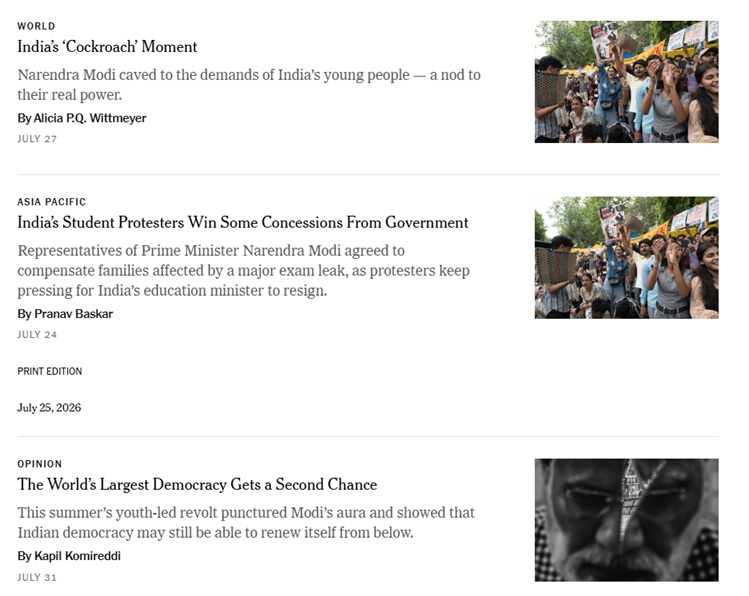
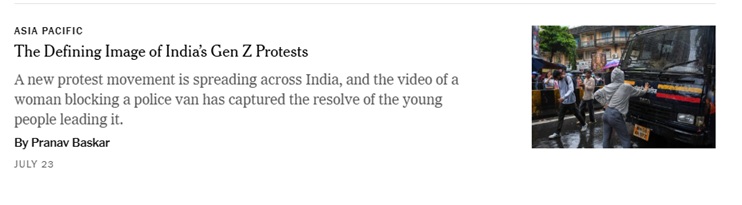
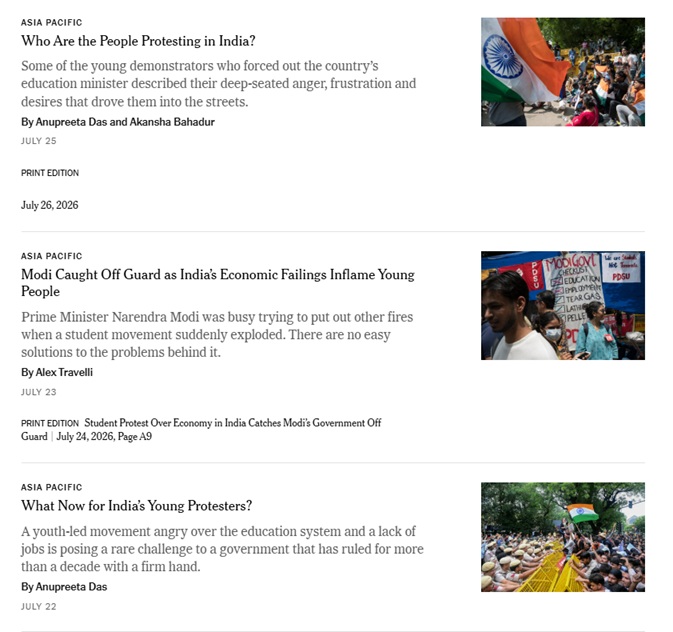
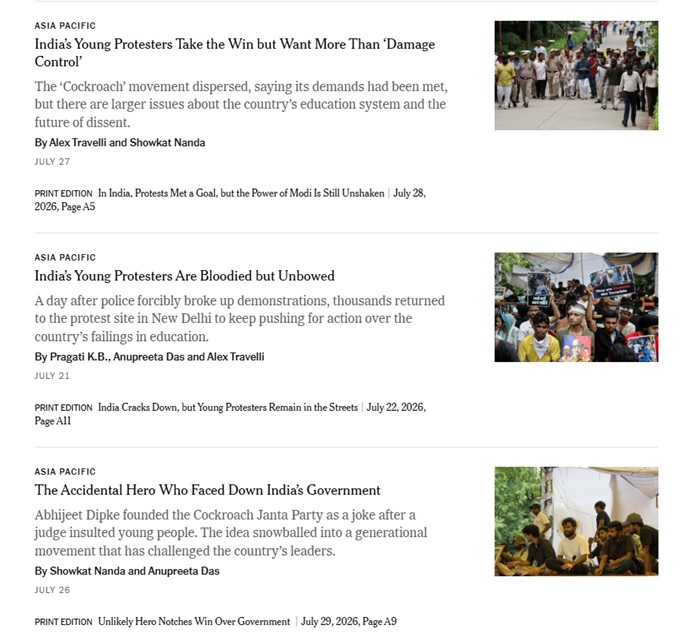
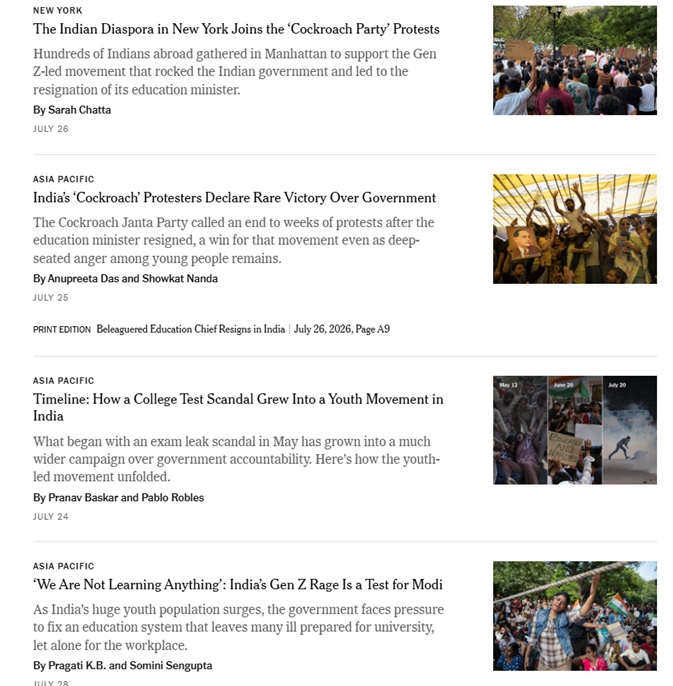
Scroll through the New York Times’ Asia Pacific coverage from the last two weeks of July, and the pattern is impossible to miss. India’s “Cockroach Party” protests – an alleged youth movement over an exam leak that ended with a minister’s resignation and no reported deaths, got at least sixteen separate pieces out of the New York Times. News stories, opinion columns, a diaspora feature from New York, a hero profile, a timeline explainer, even a print-edition tracker following the story day by day.
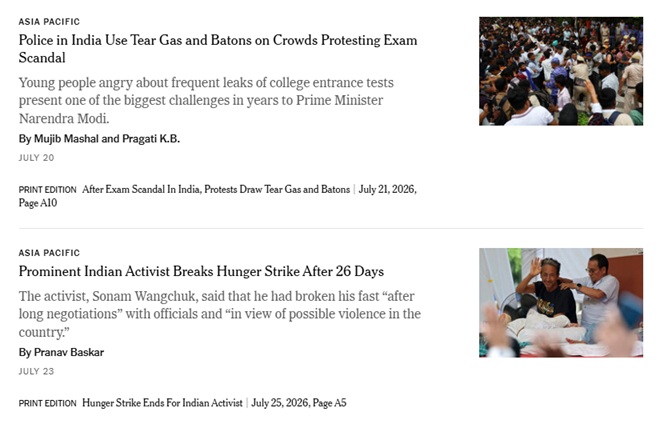
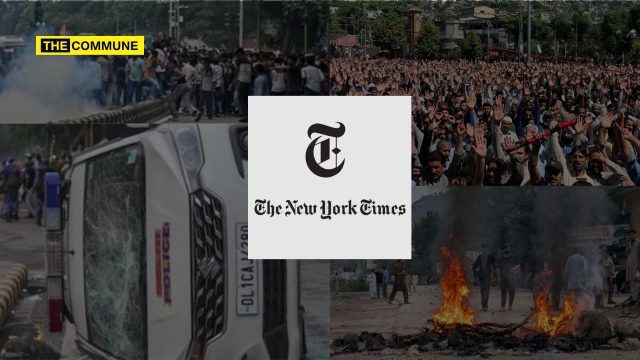
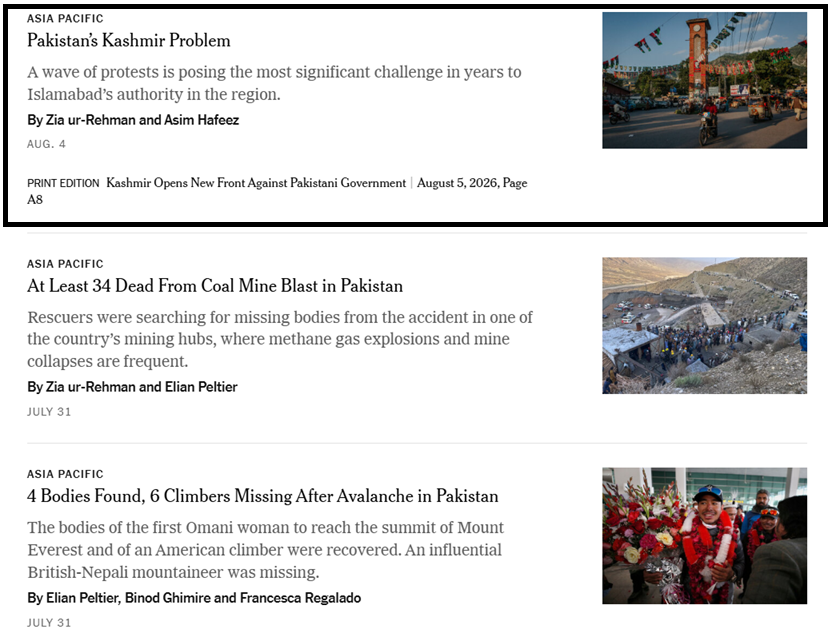
In Pakistan-Occupied Kashmir, where security forces killed dozens of protesters during a disputed election, the New York Times managed exactly one story. Headline: “Pakistan’s Kashmir Problem.” One byline pair. One news cycle. Then nothing.
This is not an accident of editorial judgment. This is the New York Times deciding, in plain sight, that Indian protesters matter and Kashmiri ones under Pakistani occupation don’t.
The Bodies the New York Times Couldn’t Be Bothered to Count
While the New York Times ran headlines like “India’s Young Protesters Are Bloodied but Unbowed”, over a movement that produced zero fatalities, actual corpses were piling up across the Line of Control. The Joint Awami Action Committee says security forces killed roughly 44 protesters since elections began on July 27 alone. The Diplomat put the July 27 death toll at 21 in a single day. Al Jazeera reported over 30 dead. Independent tallies compiled from multiple outlets put the total above 50.
Pakistan didn’t just fail to prevent this bloodshed; it deliberately blacked out communications across the region so the rest of the world couldn’t even confirm how many bodies there were.
And the New York Times’ response to a death toll in the dozens, under an active information blackout, was one dispatch – framed not around the killings, but around a “challenge to Islamabad’s authority,” as though the real story were Pakistan’s political stability rather than the civilians its own forces shot dead.
Even the Headline Does Pakistan’s PR for It
Read that headline again: “Pakistan’s Kashmir Problem.” Not “Pakistan-Occupied Kashmir.” Not even the language Al Jazeera, Bloomberg and The Diplomat all use as a matter of course. The New York Times simply handed Pakistan the possessive, “Pakistan’s Kashmir”, over territory whose status has been disputed since Partition and which India has never recognized as Pakistan’s to claim.
This is not a minor style choice. When the story is Pakistani security forces gunning down Pakistani-occupied subjects, the New York Times drops every qualifier it insists on elsewhere and simply hands Islamabad the territory in its own headline. That is not neutral wire-service language. That is the New York Times doing Pakistan’s messaging for it, free of charge.
India Isn’t the Only One Who Has Noticed
This isn’t a grievance invented in Delhi. Reporting has already flagged this exact pattern internationally – the BBC, CNN, Fox News, France 24 and the New York Times all failing to sustain coverage of a crackdown that left more than 40 civilians dead, this after India itself publicly called for scrutiny of Islamabad’s conduct in the region.
When Indian protesters produce a resignation and a viral clip of a woman blocking a police van which she said was for global media spotlight, the New York Times finds room for sixteen stories, an opinion columnist calling it a hopeful “second chance” for Indian democracy, and a warm profile of the “accidental hero” behind it. When Kashmiris under Pakistani rule are shot in the dozens and cut off from the internet, the New York Times finds room for one story and spends it worrying about Islamabad’s authority, not the dead.
Call This What It Is
India’s protests deserved coverage. Nobody is disputing that. What the sixteen-to-one ratio exposes is which country the New York Times is willing to hold accountable, and which one it quietly protects with softer language and a fraction of the attention.
A regime that jails protesters, shuts down the internet, and kills over forty of its own citizens in weeks should draw more scrutiny from a serious newsroom than a government that endures a few weeks of youth anger and a cabinet reshuffle – not a sixteenth of it. The New York Times inverted that entirely and dressed Pakistan’s death toll up as a governance story while treating India’s bloodless protest as a national reckoning.
If the New York Times wants to keep lecturing the world about press freedom and human rights, it can start by explaining why it had room for a protest meme out of Delhi but not for the dozens of bodies in Muzaffarabad.
Subscribe to our channels on WhatsApp, Telegram, Instagram and YouTube to get the best stories of the day delivered to you personally.