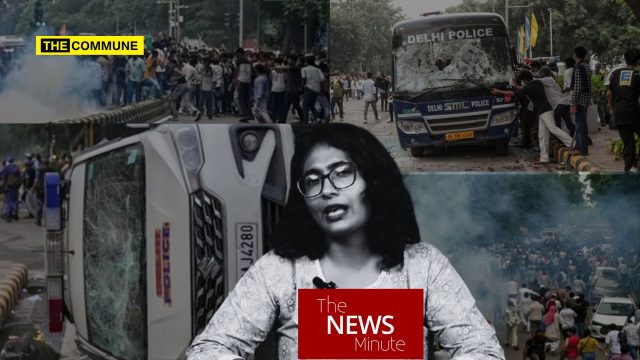
Leftist rag and propaganda outlet The News Minute (TNM) published an 8-minute video by their ‘journalist’ who covered the anti-Dharmasthala narrative extensively – Shivani Kava, this time she is gaslighting the viewers about how the Jantar Mantar cockroach protests must be seen as purely organic, indigenous and has no foreign hand, whatsoever.
This is coming from a portal which is financially linked to foreign funding through a corporate nexus, where Raghav Bahl’s Quintillion Media, backed by the Media Development Investment Fund (MDIF), holds a significant equity stake. Additionally, The Quint founded Digipub whose chairperson is Dhanya Rajendran. It is a known fact that Quintillion Media invested in TNM.
Now coming to the propaganda video posted by Shivani Kava.
The video uses a New Zealand academic Professor Mohan J. Dutta of Massey University’s ‘study’ of Republic TV’s Jantar Mantar coverage to make one big claim: that any talk of foreign money, foreign narratives, or foreign support around India’s protests is just paranoia, dressed up to look like real journalism.
Protests Were Organic
The paper and thus Kava portray the Jantar Mantar protests as a purely organic, student-led movement. They criticize Republic TV for “disappearing” the students’ demands and replacing them with a narrative of foreign conspiracy.
This assumption reflects a profound naïveté about the mechanics of modern protest movements. Sustained mass agitations involving thousands of participants, coordinated messaging, digital infrastructure, and international solidarity rarely emerge organically. They require resources, organization, and often, external support.
From a national security perspective, it is not paranoid to inquire into the origins and funding of such movements. It is the duty of any sovereign state. The News Minute treats this inquiry as a “cosmology” – a made-up universe of conspiracy. In reality, it is standard due diligence that any responsible nation must undertake.
Checking Foreign Money Isn’t Paranoia – It’s Common Sense
TNM treats FCRA rules and money-trail checks as an unfair government crackdown that only looks serious because of how it’s presented. But look at India’s own history. During the Kudankulam anti-nuclear protests and the 2020–21 farmers’ protests, investigations found that foreign-funded NGOs had actually pumped in money to slow down India’s own development and law-making. So, tracking where protest funding comes from isn’t overreacting – it’s simply making sure outside money isn’t quietly shaping what happens inside the country.
The “Just a Scared Teenager” Story Doesn’t Add Up
The video treats a digital safety guide telling protesters to leave their main phone at home, turn off face unlock, avoid being tracked as normal advice for a nervous student. But think about what that actually means: a 15-year-old being told to hide their digital identity before joining a protest. That’s not something a worried teenager thinks up on their own. It’s the kind of careful planning usually taught by organised groups who want to make it harder for police to identify who’s involved. TNM calls this basic safety. It could just as easily be read as coordination. A state has a sovereign duty to maintain public order. Opposing this undermines public safety.
A Real Complaint Can Still Be Used by Others
TNM’s main charge against Republic TV is that by focusing on funding and foreign links, the channel ignored the students’ real demand over the exam-leak issue. But that’s not a fair comparison. A genuine student grievance and outside groups using that grievance for their own purposes aren’t opposites – both things can be true at once. Reporting on who might be using a protest doesn’t erase the protest. It’s simply asking a second, necessary question alongside the first.
Looking Beyond Pakistan Isn’t Far-Fetched
TNM mocks the shift from the usual “Pakistan angle” to mentions of the CIA, the US Embassy, and even Greta Thunberg, treating it as an over-the-top conspiracy. But foreign governments and Western organisations do have a long, documented history of getting involved in local protests around the world, often through funding or public support, especially when a country is going through a sensitive political moment. Assuming that could never happen in India isn’t being smart. It’s ignoring how these things have actually played out elsewhere.
Police Cameras and Protester Secrecy Aren’t the Same Thing
One of the video’s weakest points is treating police facial recognition and protesters hiding their identity as equally reasonable – just two sides of the same privacy coin. They’re not. A government has a basic responsibility to know who’s in a crowd, to keep people safe. A group of protesters actively working to avoid being identified is a different situation altogether and treating both as equally fine blurs an important line. Did Kava not read the news that over 2000 people in the protest were history sheeters?
Last Word
The News Minute presents itself as fact-checking media narratives, but its latest video does something far more ideological, it dismisses legitimate questions about national security as if merely asking them is an act of authoritarianism.
No serious democracy can afford that luxury.
A protest can be genuinely driven by public anger while simultaneously attracting external amplification, financial support, narrative backing, or geopolitical interest. These possibilities are not mutually exclusive. TNM claims that they do independent journalism, isn’t responsible journalism a part of this? Ideally, anyone claiming to be a news portal should examine both, not declare one off-limits because it does not fit an ideological worldview.
By portraying scrutiny of foreign funding, digital operational security, and geopolitical influence as little more than conspiracy theories, TNM replaces critical inquiry with selective scepticism. Ironically, a video claiming to expose media bias ends up exhibiting its own – one that reflexively treats the state, sovereign institutions, and national security concerns with suspicion while extending unquestioning benefit of the doubt to activist networks and international actors.
Subscribe to our channels on WhatsApp, Telegram, Instagram and YouTube to get the best stories of the day delivered to you personally.