In India’s media discourse, the charge of political bias is often directed at journalists perceived to be sympathetic to the Modi government. The label ‘Godi Media’ has become a convenient weapon against those who question the Opposition or defend the Centre.
But does the same suspicion apply to journalists whose personal lives, family networks and professional careers are closely connected to Opposition politics?
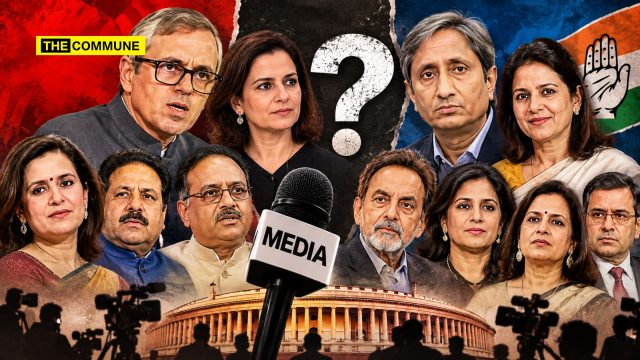
A look at some of the country’s most prominent media personalities reveals a web of relationships that deserves public scrutiny.
Former NDTV journalist Nidhi Razdan has married Jammu and Kashmir Chief Minister Omar Abdullah.
A new journey began yesterday 💍@Nidhi https://t.co/BXbdLq2d1H
— Omar Abdullah (@OmarAbdullah) October 31, 2026
Journalist Amrita Rai is married to senior Congress leader Digvijaya Singh. Ravish Kumar’s brother, Brajesh Kumar Pandey, has contested elections on a Congress ticket. Gargi Rawat’s husband, Yusuf Ansari, has also contested elections as a Congress candidate.
The political connections do not end there.
Sagarika Ghose entered Parliament as a Trinamool Congress representative. Rajeev Shukla, once associated with journalism and media management, is now a Congress MP. Kumar Ketkar, the former Loksatta editor, also became a Congress Rajya Sabha MP.
NDTV co-founder Prannoy Roy’s wife, Radhika Roy, is the sister of CPI(M) leader Brinda Karat. Hindustan Times Media chairperson Shobhana Bhartia served as a nominated Rajya Sabha MP during the UPA years. Pankaj Pachauri, formerly with NDTV, went on to serve as Communications Adviser to Prime Minister Manmohan Singh.
Individually, these relationships and career choices do not establish editorial bias. A journalist’s spouse, sibling or political affiliation cannot automatically determine the journalist’s professional conduct. But the media’s own insistence on examining political proximity makes the absence of an equally consistent standard striking.
When a journalist is perceived to be close to the BJP, questions about credibility and independence are raised. When the connections lead to Congress or other Opposition parties, the same demand for scrutiny is far less visible.
The issue is not whether journalists can have political associations. They can. It is whether the public is entitled to know about those associations—and whether media organisations apply the same standards to their own ecosystem that they demand from everyone else.
Political proximity cannot be a disqualification only for journalists on one side of the ideological divide.
If the term ‘Godi Media’ is meant to expose the relationship between journalism and political power, it cannot be a one-party accusation.
Journalism must be judged by one standard, regardless of which party its connections lead to.
Subscribe to our channels on WhatsApp, Telegram, Instagram and YouTube to get the best stories of the day delivered to you personally.