
“I Notice A Definite Pattern”: Madras High Court Summons Chief Secretary, ADGP Over Defiance Of Thirupparankundram Karthigai Deepam Orders
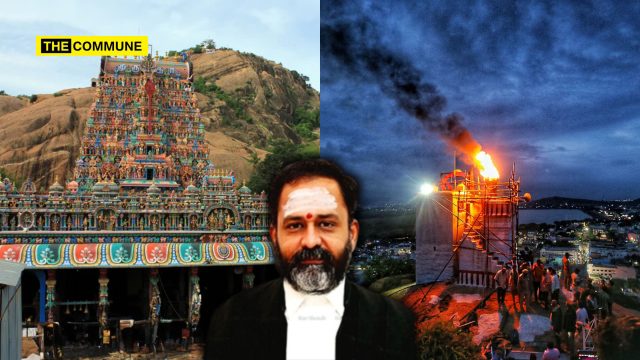
The controversy surrounding the lighting of the Karthigai deepam (lamp) on the Deepathoon (stone lamp pillar) atop the Thiruparankundram hillock escalated further on Monday, 9 December 2025, with the Madras High Court summoning two senior State officials to explain why its directions were not followed in the case.
Justice GR Swaminathan directed the Tamil Nadu Chief Secretary and the Additional Director General of Police, Law and Order, Chennai, to appear before the Court through video conference on 17 December 2025, after finding “repeated” breaches of his earlier orders permitting the lighting of the lamp atop the hill.
The judge noted that his December 3 order, allowing Hindu devotees to light the lamp, especially after the Subramania Swamy Temple administration failed to comply with the initial directive continued to be defied even after a Division Bench confirmed the order on 4 December 2025.
Justice Swaminathan remarked that such conduct could amount to contempt of court if it constituted wilful disobedience, and therefore said the responsible officers must explain their actions. He also observed that the pattern of non-compliance was not confined to this single case.
“I notice a definite pattern. I am certain that officials at the District Level would not dare to so brazenly defy the orders of this Court. Let me remind the officials concerned that their duty is to enforce the law and not go by dictates that are often issued orally,” the order stated.
The Court said it required clarity from the highest levels of State administration on whether instructions or circulars would be issued to guide district officials in handling such matters.
“But since such conduct is not confined to one District, I have to necessarily call upon the highest officers of the State to clarify the position. I would want to know from them if they propose to issue any circular or instructions for the guidance of the District level officers. I am not here to throw up my hands and helplessly cry ‘O Father, Forgive Them, for they do not know what they are doing.’ I direct the Chief Secretary, Government of Tamil Nadu and the Additional Director General of Police, Law and Order, Chennai to appear before this Court through VC on 17.12.2025 at 03.00 P.M.,” Justice Swaminathan ordered.
In highlighting what he termed a recurring pattern of non-compliance, the judge referred to two earlier cases involving Hindu religious practices that he said were similarly obstructed by local authorities.
He noted that he had previously ordered the reinstallation of a Lord Murugan statue at Mayiladum Parai in Kanyakumari, after finding that it had been “illegally” removed on a complaint by one Wilson, said to represent the Christian community. “Till date, the administration has refused to enforce the order of this Court,” he remarked.
He also cited the situation in Perumalkovilpatti village in Dindigul district, where Christians, whom he observed form the majority, had allegedly prevented the Hindu community from celebrating Karthigai Deepam at “Mandu Kovil,” near the local Kaliamman temple. The judge said he allowed a petition in February 2025 supporting the Hindu community’s right to celebrate, but the district collector subsequently passed a prohibitory order enabling the police to flout the Court’s directions.
The present dispute concerns the Thirupparankundram hillock in Madurai, which houses both the Sikkandar Badhusha Dargah and the Arulmigu Subramania Swamy temple. A group of devotees approached the High Court after the lamp atop the hill was not lit as part of the Karthigai Deepam festival.
On 1 December 2025, Justice Swaminathan ruled that the temple was obliged to light the lamp, holding that doing so would not violate the rights of the nearby dargah or affect Muslim devotees. When that order was not implemented, he passed a second order on December 3 permitting devotees to light the lamp themselves and directing the Central Industrial Security Force (CISF) to provide protection.
On Monday, the Commandant of the CISF unit attached to the High Court submitted a report stating that police officials led by the city commissioner prevented CISF personnel from carrying out the Court’s directive. Police cited a prohibitory order issued by the District Magistrate, under which no person was allowed to ascend the hill.
Justice Swaminathan dismissed this explanation, pointing out that “The prohibitory order had been quashed and the order was dictated in the presence of the Police Commissioner.”
He also rejected a request to refrain from proceeding further on the ground that the district authorities had filed an appeal before the Supreme Court. Senior Advocate Vikas Singh, representing the State, submitted that the auspicious dates for lighting the deepam had already passed.
The Court rejected these arguments, noting Singh’s own submission that the State might withdraw the Supreme Court appeal, given that a similar appeal was already pending before a Division Bench of the High Court and that the State did not wish to contest the same issue in multiple courts.
“I, therefore, conclude that as of this moment, the Hon’ble Supreme Court is not seized of the issue,” Justice Swaminathan held.
He further recorded that the Division Bench had confirmed his 3 December 2025 order and granted no interim relief to the State. “The corollary is that the order passed by this Court (permitting devotees to light the lamp) is still holding good,” he observed.
Justice Swaminathan has listed the matter for further hearing on December 17. He also impleaded the Union Home Secretary as an additional respondent.
“Based on the submissions/clarifications to be made by the Chief Secretary, Government of Tamil Nadu and the Additional Director General of Police, Law and Order, Chennai, I may seek inputs from the Union Home Secretary,” the order stated.
Source: Bar and Bench
Subscribe to our channels on WhatsApp, Telegram, Instagram and YouTube to get the best stories of the day delivered to you personally.




No Facts, Full Fiction In English For The West: Rahul Gandhi Repeats Debunked Claims To Undermine India’s Election System
Congress scion Rahul Gandhi’s 9 December 2025 speech in the Lok Sabha was remarkable not for its substance, but for its falsehoods. Delivered almost entirely in English, the address seemed designed less for India’s MPs and more for foreign media outlets waiting to publish headlines about a “compromised Indian democracy.”
It is a familiar pattern: statements tailored for Western consumption, allegations recycled without evidence, and an underlying attempt to delegitimize India’s institutions on the global stage.
But beyond the theatrics, the claims themselves collapse under basic scrutiny.
The CJI “Removed” From The Election Commissioner Selection Panel? A Complete Fabrication
Rahul Gandhi dramatically asked why the Chief Justice of India was “removed” from the EC appointment committee.
Fact: There was no removal. The CJI has never, at any point in history, been part of the Election Commissioner selection mechanism. Under Congress’ own governments, the CEC and ECs were appointed directly by the ruling party, effectively by the Union Cabinet.
Today, at least there is a three-member panel that includes the Leader of the Opposition, where Rahul Gandhi himself sits. If anything, the new arrangement reduces unilateral executive control compared to the Congress era.
To claim “removal” of an element that never existed is pure fiction.
The CCTV Footage “Destroyed After 45 Days” Conspiracy
Rahul Gandhi’s next charge was equally unserious. He insinuated that the Election Commission wants CCTV footage erased after 45 days to enable fraud.
Reality: CCTV footage, especially for a country as vast as India, cannot be stored indefinitely. Data retention policies across the world set limits, often 30, 60, or 90 days, due to storage, cost, and technical logistics.
Expecting every booth’s CCTV video to be archived forever is absurd. Even Rahul Gandhi likely deletes emails, photos, and WhatsApp messages. Would that then constitute “destroying evidence”? This is not electoral fraud. It is routine data-management practice.
Additionally, the time period limits are set for any petitions to be filed – so the system allows citizens to question the process in case of mismanagement/foul play.
Immunity For Election Commissioners? Misrepresented Again
Rahul Gandhi claimed the government changed the law so that Election Commissioners “cannot be punished for anything they do.”
The Truth: Election Commissioners remain fully accountable to Parliament. No immunity shields them from action if wrongdoing is proven.
The clarification in law was required precisely because Rahul Gandhi and his bloc were publicly threatening “revenge” against officials should I.N.D.I Alliance ever come to power. The institutional safeguard ensures ECs are not coerced by political vendetta. This is protection of the office, not impunity for the individuals.
Separately from the 2023 Act, Article 324(5) of the Constitution continues to govern removal: the CEC can be removed only like a Supreme Court judge, by a special‑majority resolution of both Houses of Parliament on grounds of proved misbehaviour or incapacity, and other ECs can be removed by the President on the CEC’s recommendation.
The Recycled Haryana “Vote Chori” Allegations
From here, the speech descends into Rahul Gandhi’s familiar conspiracy catalogue:
– Brazilian woman appearing 22 times on rolls
– One woman appearing 200 times
– “Lakhs” of duplicate voters
– A BJP leader supposedly voting in Haryana
Investigations have already clarified that these were clerical errors, outdated records, or misinterpretations, many of which have existed for decades, long before BJP governments. The Brazilian model claim was outright false; no such photo ever existed in EPIC records.
Rahul Gandhi keeps repeating these claims despite corrections, simply because they serve the narrative, he wants global audiences to believe.
Reviving EVM Bogey After Giving It Up
After months of focusing solely on “voter list manipulation,” Rahul Gandhi has now returned to questioning EVMs, something even his party had quietly stopped doing.
EVMs have been tested, challenged, verified, audited, judicially upheld, and internationally acknowledged as robust. Congress itself won multiple state elections through the same machines without raising doubts.
But now, with cameras rolling and foreign correspondents on alert, Rahul Gandhi revived the trope for maximum amplification.
The Real Target Of The Speech: Global Media, Not Indian Democracy
This was not a parliamentary speech aimed at improving election laws. It was not a domestic appeal to Indian citizens.
This was an international pitch.
A speech crafted in English, packed with unverifiable accusations, designed to appear in Western newspapers as “Opposition leader claims India’s election is rigged.”
Rahul Gandhi knows these claims will not withstand institutional scrutiny within India. But outside India, nuance does not matter, only the headline does.
The goal is simple: To portray India as unstable, unreliable, and institutionally compromised and to blame the government for it.
It is a political strategy that seeks international legitimacy at the cost of national credibility.
And that is precisely what makes the speech not just misleading, but sinister.
Subscribe to our channels on WhatsApp, Telegram, Instagram and YouTube to get the best stories of the day delivered to you personally.