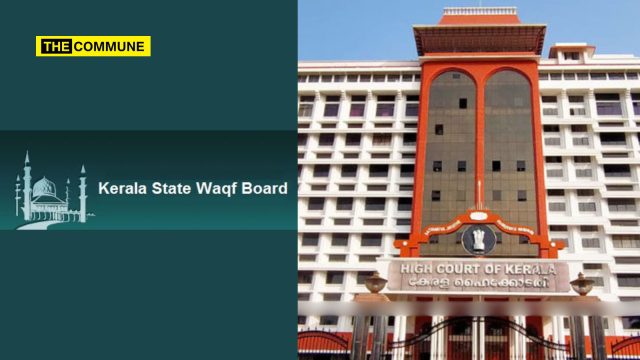
The Kerala High Court on 15 July 2026 restrained the Kerala State Waqf Board from taking any major decisions, incurring capital expenditure, or making policy decisions after prima facie finding that the Board had not been constituted in accordance with Section 14 of the Unified Waqf Management, Empowerment, Efficiency, and Development Act, 1995, as reported in LiveLaw.
A Division Bench comprising Chief Justice Soumen Sen and Justice Syam Kumar V.M. passed the interim order while hearing four Public Interest Litigations (PILs) challenging the constitution of the State Waqf Board.
The Court observed that the Board had not included two non-Muslim members as mandated under the amended law and that petitioners had also raised the issue of the absence of a Shia member.
Passing the interim order, the Bench said, “In view of the fact that admittedly, two non-Muslim members have not been included in the Waqf Board and also, as urged by some of the writ petitioners that one Shia member should also be included, we hold that the constitution of the Board prima facie appears to be not in conformity with Section14 of the said Act. Hence, the present Board shall not take any major decisions or incur any capital expenditure or any policy decision without the express leave of this Court.”
The Court also directed the Kerala government to ensure that its representative on the Board, who serves as an ex-officio member, is appointed in accordance with the provisions of the Act. It further ordered that, for the time being, the Board would function under the Joint Secretary of the State Government department dealing with Waqf matters.
State Admits ‘Infirmity’ In Board’s Constitution
During the hearing, Advocate General Jaju Babu informed the Court that the State had filed an affidavit and admitted that there were certain infirmities in the present constitution of the Board.
Seeking clarification, Chief Justice Sen asked, “So, the stand of the State is, that to reconstitute the Board in accordance with the mandate of S. 14? That is after taking into consideration the representation?… Impliedly, you accept that the Board has not been properly constituted?”
The Advocate General replied, “Subject to your Lordships’ approval regarding the allegation of illegality in the existing Board…Impliedly, yes…Infirmity is accepted by us.”
Senior Advocate T. Krishnanunni, appearing for the present Waqf Board, sought time to examine the State’s affidavit and defend the Board’s constitution. He conceded that two non-Muslim members had not been nominated but submitted, on instructions, that the nominations had been withheld because related matters were pending before the Supreme Court.
However, Additional Solicitor General of India P. Sreekumar and the petitioners submitted that no such cases were pending before the Supreme Court.
The Court then orally observed, “So two non-Muslims have not been nominated?…Shia members come later. First, if two non-Muslims are not nominated, then prima facie, that only will not allow you to function. For the time being, may be an administrator, if it is there, who shall function till this issue is resolved. No major decision could be taken.”
In view of its prima facie findings, the High Court restrained the Board from taking any major decisions until the issue regarding its constitution is resolved. The matter has been posted for further hearing after one week.
PILs Challenge Constitution Of Board
The interim order came in four PILs challenging the constitution of the Kerala State Waqf Board.
The petitions contend that the Board has not been constituted in accordance with Section 14 of the amended Waqf Act, which mandates the inclusion of two non-Muslim members.
One of the PILs, filed by the Christian charitable organisation Assembly of Christian Trust Services (ACTS), also challenges the uploading of details relating to the disputed Munambam land on the UMEED (Unified Waqf Management, Empowerment, Efficiency, and Development) Portal. The organisation contends that the inclusion of the land affects Hindu and Christian communities residing in the area.
ACTS has further challenged the composition of the Board on the ground that representatives from the Shia, Bohra and Aghakhani communities have not been included as required under the law. It has also questioned the Board’s composition on other grounds and sought directions to the State government to issue a fresh notification constituting the Board in accordance with law within a time frame fixed by the Court.
The organisation has additionally challenged the uploading of the disputed Munambam land on the Centre’s UMEED Portal, contending that the Waqf Act authorises only the muttawali to upload such details.
Another PIL, filed by BJP leader Shone George, seeks directions to the Kerala government to immediately nominate the two non-Muslim members and declare that the present Waqf Board is functioning in violation of Section 14(1) of the Waqf Act as amended in 2025. The High Court had earlier directed the State to file its response through an affidavit.
A separate PIL raises similar grounds and additionally challenges the inclusion of CPI(M) leader and former MLA Kunhammed Kutty Master as a member of the Board.
Subscribe to our channels on WhatsApp, Telegram, Instagram and YouTube to get the best stories of the day delivered to you personally.