Home Blog Page 204

“Foxconn Has Many Subsidiaries, They Respond Differently To Different Reporters” Says DMK Min TRB Rajaa

foxconn trb rajaa

Tamil Nadu Industries Minister T. R. B. Raja on Wednesday reaffirmed in the Legislative Assembly that Foxconn’s planned ₹15,000 crore investment in the state remains confirmed and genuine, amid questions raised by opposition members over conflicting statements from the company.

During a debate session, AIADMK MLA Thangamani asked why Google had chosen to invest in Andhra Pradesh instead of Tamil Nadu and sought clarification on reports that Foxconn had denied any investment plans in the state.

DMK Minister Rajaa clarified that all the agreements announced so far by the Tamil Nadu government had been confirmed and that the Foxconn deal was legitimate. He explained that Foxconn comprises multiple subsidiary companies, and while one American entity under the Foxconn group had denied plans to set up operations in Tamil Nadu, another Foxconn company is indeed proceeding with the investment.

Foxconn has many firms which produce different things. Their responses will be different for different reporters who extend a mic. They asked an American firm (related to Foxconn). We can’t talk about it I’ll tell you why. That firm had responded that they did not do the investment. This is what has happened.“, TRB Rajaa said.

Raja further said that the Chief Minister had advised legislators not to politicize issues involving India–U.S. trade relations and to maintain a consistent stance aligned with the Union government.

Commenting on Google’s investments and the role of major conglomerates, Raja stated that he did not wish to criticize the neighbouring state’s investments or the involvement of industrial groups such as Adani.

Rajaa further said “You can ask how come Google, a US company is announcing. That’s because Google is not there in China. A company which is there in China, US and India is not able to openly announce their decisions. When an investment comes in, as Indians we should understand the geopolitical reason. He has said that no ‘new’ investments are being made and did not say no investments are coming. Can’t you see the diplomacy in this? You’ve been in power.

He reiterated that the ₹15,000 crore investment generation 14,000 jobs is assured and is definitely coming to Tamil Nadu.

The minister added that misinformation about industrial projects could discourage investors and harm youth employment prospects, noting that the state had already facilitated 32 lakh jobs under current initiatives.

Raja concluded that the central government had also issued clarifications on the matter and that Tamil Nadu remained a preferred destination for global manufacturers like Foxconn.

Source: News 18 Tamil Nadu

Subscribe to our channels on TelegramWhatsApp, and Instagram and get the best stories of the day delivered to you personally.

England: Peterborough’s Only Hindu Temple Faces Closure As Council Puts Building Up For Sale

Peterborough’s Only Hindu Temple Faces Closure As Council Puts Building Up For Sale
Image Source: OpIndia

The only Hindu temple in the East of England, serving around 13,500 Hindus across Cambridgeshire, Norfolk, and parts of Lincolnshire, is facing possible closure after the Peterborough City Council decided to sell the property it occupies to pay off municipal debts.

The Bharat Hindu Samaj Temple, located in the New England Complex in Peterborough, has been a religious and cultural centre since its establishment in 1984. The temple management submitted a bid before the council’s Monday night deadline to purchase the entire complex, which consists of seven units.

Temple president Kishor Ladwa said the temple had initially reached an agreement in April with the council to buy the property for £1.3 million, which included a £504,000 discount recognising the social value of its community services. However, in September, the council informed them that other buyers had emerged and that it could no longer offer the complex at the previously agreed amount, asking the temple to increase its bid. The council has not revealed the identities of the other bidders but has suggested that they may be community organisations.

According to Ladwa, the temple has been negotiating with the council for 14 years to secure ownership, but the terms have repeatedly changed. He said the temple wished to avoid becoming a tenant under a new owner and added that despite their willingness to sign a purchase agreement, the council never provided a legally binding contract.

The temple functions as a major community hub, particularly for the elderly. It hosts weekly luncheons, health workshops for dementia and diabetes, and cultural activities such as Bollywood dance, yoga, Zumba, and language classes in Hindi and Gujarati. Members of the management committee have said the facility helps reduce social isolation among older members of the community and saves public funds by providing essential social services.

Temple representatives also noted that the idols consecrated in a week-long ceremony years ago could not easily be relocated if they are forced to vacate the site. Petitions have since gained thousands of signatures urging the council to halt the sale.

Peterborough City Council cabinet member for finance and corporate governance, Councillor Mohammed Jamil, stated that while the council recognises the anxiety among the Hindu community, it must sell community assets on the open market to ensure the best value for taxpayers. He added that if the Bharat Hindu Samaj Temple is not selected as the preferred bidder, its tenancy rights would transfer to the new owner, and it would continue to have legal protections under the Landlord and Tenant Act of 1954.

(Source: Times of India)

Subscribe to our channels on Telegram, WhatsApp, and Instagram and get the best stories of the day delivered to you personally.

Trump Confirms CIA Covert Operations In Venezuela To Target Maduro Regime, Says Land Strikes Being Considered

Trump Confirms CIA Covert Operations In Venezuela To Target Maduro Regime, Says Land Strikes Being Considered

U.S. President Donald Trump has confirmed that he has authorised the Central Intelligence Agency (CIA) to conduct covert operations inside Venezuela, signalling a major escalation in Washington’s long-running campaign to remove Venezuelan President Nicolás Maduro from power.

Trump said the decision was part of a broader effort to counter what he described as drug trafficking and criminal networks linked to the Maduro regime. Speaking to reporters in the Oval Office on Wednesday, alongside FBI Director Kash Patel and Attorney General Pam Bondi, the President stated that Venezuela had “emptied their prisons into the United States” and was responsible for large quantities of drugs entering the country.

“I authorised for two reasons really,” Trump said. “Number one, they have emptied their prisons into the United States of America. They came in through the border. And the other thing are drugs. We have a lot of drugs coming in from Venezuela, and a lot of the Venezuelan drugs come in through the sea. So, you get to see that, but we’re going to stop them by land also.”

Trump added that Washington was now considering extending its operations to land-based strikes, saying, “we are certainly looking at land now, because we’ve got the sea very well under control.”

When asked if the CIA’s new mandate included plans to directly overthrow Maduro, Trump declined to give details. “Wouldn’t it be a ridiculous question for me to answer?” he said, calling it inappropriate to comment on operational specifics. He added, “I think Venezuela is feeling heat. But I think a lot of other countries are feeling heat too. We’re not going to let this country, our country, be ruined because other people want to drop, as you say, their worst.”

According to U.S. officials familiar with the decision, the authorisation outlined in a classified presidential finding grants the CIA authority to conduct a broad range of covert activities, including potentially lethal operations. The stated objective is to remove Maduro from power, amid ongoing U.S. accusations that he leads a criminal network tied to narcotics trafficking, including the Cartel of the Suns and the Venezuelan gang Tren de Aragua. Maduro has repeatedly rejected these allegations, and some U.S. intelligence assessments have questioned claims that Venezuela is a major producer of drugs.

The move follows a series of U.S. military actions in the region. The administration has reportedly deployed around 10,000 troops to the Caribbean, mainly stationed in Puerto Rico, and positioned eight surface warships and a submarine near Venezuelan waters. Over the past several weeks, U.S. forces have carried out at least five strikes on suspected drug-carrying vessels off the Venezuelan coast, resulting in 27 deaths. The operations have drawn criticism from United Nations human rights experts, who described them as potential “extrajudicial executions.”

A leaked congressional memo has classified the U.S. campaign as part of a “non-international armed conflict” against drug-trafficking groups, which it identifies as “nonstate armed organizations” posing a direct threat to the United States. CIA Director John Ratcliffe, known for his advocacy of a more aggressive intelligence posture, has expanded the agency’s counternarcotics operations across Latin America, including drone-based surveillance targeting fentanyl laboratories in Mexico.

Secretary of State and National Security Adviser Marco Rubio has been closely involved in shaping the policy, labelling Maduro a “narcoterrorist” and pressing for his removal. The strategy mirrors previous CIA interventions in Latin America, such as the 1954 coup in Guatemala and efforts against Fidel Castro in Cuba, which led to prolonged instability in the region.

The Venezuelan government has condemned Trump’s statements, accusing Washington of openly admitting to planning “CIA coups.” In a statement, Caracas said, “The Bolivarian Republic of Venezuela rejects the extravagant statements of the President of the United States, in which he publicly admits having authorized operations in order to act against the peace and stability of Venezuela.”

Venezuela’s foreign ministry announced that it would raise the issue with the United Nations Security Council and the UN Secretary-General, warning of escalating threats to regional sovereignty and peace.

(Source: OpIndia)

Subscribe to our channels on TelegramWhatsApp, and Instagram and get the best stories of the day delivered to you personally.

Supreme Court Rejects Telangana Govt’s Plea Against High Court Stay On 42% OBC Reservation In Local Body Polls

Supreme Court Rejects Telangana Govt’s Plea Against High Court Stay On 42% OBC Reservation In Local Body Polls

The Supreme Court on Thursday, 16 October 2025, dismissed the plea filed by the State of Telangana challenging the Telangana High Court’s interim order that stayed the implementation of 42% reservation for Backward Classes in local body elections. A bench comprising Justices Vikram Nath and Sandeep Mehta clarified that the High Court should decide the main matter on merits without being influenced by the dismissal of the State’s Special Leave Petition.

At the outset, Justice Nath asked Senior Advocate Dr. Abhishek Manu Singhvi why the reservation was not brought in before the elections were notified. Singhvi responded that the Governor had kept the Bill pending without granting assent. “The Bill became a law based on ‘deemed assent’ in terms of the Supreme Court’s judgment in the Tamil Nadu Governor case. Without making any challenge to the law, a stay has been secured,” he added.

Justice Nath then asked, “How do you challenge a Bill?” Singhvi replied, “The Bill has become an Act now, and has been acted upon on the basis of deemed assent.”

Senior Advocate Gopal Sankaranarayanan, representing the respondents, said the challenge was made to the Government Order that resulted in the reservation exceeding the 50% ceiling. “As per the K. Krishna Murthy (Dr.) & Ors. v. Union of India and Vikas Kishanrao Gawali judgments, triple tests have to be fulfilled before giving reservations in local self-government institutions. Earlier, it was 15%, 10% and 25% respectively for SC, ST and OBCs within the 50% limit,” he added. He pointed out that the Supreme Court has previously held in Maharashtra and Madhya Pradesh that reservation should not cross 50% for local body elections.

Another counsel for the respondents submitted that the State cannot unilaterally act on the basis of “deemed assent” for the Bill, as the Tamil Nadu Governor judgment held that the State must seek a writ of mandamus from the Court if there is a delay on the part of the Governor in granting assent to the Bill.

In response, Singhvi argued that the 50% limit was not an “inflexible rule” and claimed that the State satisfied the triple tests to enhance the reservation. “Door-to-door household socio-economic surveys were done ‘painstakingly’ for one year,” he added.

Justice Nath remarked, “Based on these exercises, you have come up with the Ordinance and a Bill. That is yet to take a final shape.” Singhvi asserted that the law was in operation. Justice Mehta pointed out that the Gawali judgment did not allow crossing the 50% limit. Singhvi replied that Gawali held 50% could be crossed if there was empirical data and highlighted that Telangana was the only State to have conducted such a survey.

The bench was not persuaded by these arguments and dismissed the petition. “You may continue with your elections [without reservations]… dismissed,” Justice Nath said.

(Source: LiveLaw)

Subscribe to our channels on TelegramWhatsApp, and Instagram and get the best stories of the day delivered to you personally.

Sahara, Who Defrauded Lakhs In Chitfund, Now Represented By Former Congress Leader Kapil Sibal In Asset Sale Plea

Sahara, Who Defrauded Lakhs In Chitfund, Now Represented By Congress Leader Kapil Sibal In Supreme Court Asset Sale Plea

The Supreme Court on Tuesday sought responses from the Centre and the Securities and Exchange Board of India (SEBI) on a plea filed by Sahara India Commercial Corporation Ltd (SICCL), which is seeking permission to sell its assets, including the 8,810-acre Aamby Valley City in Maharashtra, to Adani Properties Pvt Ltd, to raise funds to refund its investors.

A bench comprising CJI B R Gavai and Justices Surya Kant and M M Sundresh directed that the Finance and Cooperation Ministries be impleaded, following submissions by Solicitor General Tushar Mehta that the Centre may need to examine Sahara’s proposal and provide its perspective. “Please consider impleading the Secretary, Finance, and the Secretary, Cooperative Societies. Because some cooperative societies have invested through their employees, etc.,” Mehta noted.

Senior Advocate Kapil Sibal, a prominent former Congress leader, is representing Sahara in this high-profile case. He argued that earlier attempts to sell the properties piecemeal had failed and the only viable option was to sell them as a single block of 88 properties.

Representing SEBI, Senior Advocate Arvind Datar stated that Sahara could proceed with the sale provided the sale price is not less than 90% of the market value. The court also directed parties, including Sahara employees, to submit their claims to Senior Advocate Shekhar Naphade, appointed as Amicus Curiae in the matter.

Sahara has so far deposited about ₹16,000 crore of the principal ₹24,030 crore in the SEBI-Sahara Refund Account, leaving roughly ₹9,000 crore yet to be paid. Naphade suggested that this amount should be deposited first.

The plea highlighted that multiple agencies investigating Sahara family members and officials had complicated efforts to monetise assets. It also alleged that the decision to sell all properties in one lot was due to unauthorised attempts by certain individuals to alienate Sahara’s valuable assets following the death of founder Subrata Roy in 2023.

Senior Advocate Mukul Rohatgi, appearing for Adani Properties, confirmed that the real estate group is ready to purchase all 88 properties.

The Supreme Court will next hear the matter on November 17, as Sahara attempts to resolve its long-standing obligations to investors who were defrauded through its controversial chitfund schemes.

About Sahara Scam

The “Sahara scam” refers to the allegations of fraud and financial irregularities against the Sahara India Pariwar group, particularly its founder Subrata Roy. The group was accused of running ponzi schemes and failing to refund investors a significant amount of money, which led to a major legal battle, Roy’s arrest, and a prolonged effort by regulatory bodies like the SEBI (Securities and Exchange Board of India) to get the money back to investors.

(Source: Indian Express)

Subscribe to our channels on Telegram, WhatsApp, and Instagram and get the best stories of the day delivered to you personally.
Indian Nurse Nimisha Priya’s Execution In Yemen On Hold, Modi Govt Tells Supreme Court

Family And Diplomats Race Against Time To Save Nimisha Priya From Yemen Death Row

The Supreme Court on Thursday was informed that the execution of Indian nurse Nimisha Priya, convicted of murdering her Yemeni business partner in 2017, has been temporarily stayed, and no adverse action has taken place so far.

During the hearing of a plea seeking directions for the Union Government to use diplomatic channels to secure Priya’s release, Attorney General R. Venkataramani told a bench of Justices Vikram Nath and Sandeep Mehta that a new mediator has stepped into the matter. “The only good thing is that nothing adverse has happened,” he added.

The counsel appearing for the petitioner organisation ‘Save Nimisha Priya International Action Council’, which is extending legal support to Priya, confirmed that her execution has been stayed. The bench indicated that the matter may be adjourned, saying, “List in January 2026. It will be open for the parties to apply for early listing in case the situation demands.”

Priya, hailing from Palakkad in Kerala, was convicted in 2017, sentenced to death in 2020, and had her final appeal rejected in 2023. She is currently imprisoned in Sana’a, Yemen.

The petitioner’s counsel informed the Court that under Sharia law, payment of blood money to the victim’s family could be explored, which might lead to Priya’s pardon. It was also noted that Priya’s mother is in Yemen to negotiate with the victim’s family, after receiving permission from the Delhi High Court to travel there.

According to NDTV, the Union Government has been engaging with Yemeni authorities and friendly nations to reach a mutually agreeable solution. Earlier updates to the Supreme Court indicated that there was no immediate threat to Priya’s life, and the government has assured it is doing everything possible to ensure her safety.

(Source: NDTV)

Subscribe to our channels on TelegramWhatsApp, and Instagram and get the best stories of the day delivered to you personally.
DMK Govt Fact-Check Unit Claims Hindi Ban Bill Was A ‘Rumour’ But DMK Cadres Were Seen Celebrating And Burning Hindi Posters

The Dravida Munnetra Kazhagam (DMK) government’s claim that reports of a proposed bill to ban Hindi imposition were “rumours” stands contradicted by substantial evidence, including celebratory acts by party cadres and confirmed internal legislative preparations. The government’s abrupt U-turn today following alleged pressure from coalition partners reveals a calculated political strategy gone awry.

Multiple sources had confirmed that the DMK government was set to table legislation in the Tamil Nadu Assembly seeking to ban Hindi hoardings, boards, movies, and songs across the state. Senior DMK leader TKS Elangovan had explicitly stated, “We won’t do anything against the Constitution. We are against the imposition of Hindi,” providing official confirmation of the party’s intent.

Following heavy backlash, the alleged ‘fact-checking’ unit of the DMK government dismissed it as a rumour adding that no proposal for such a bill has been received.

The party’s grassroots response further exposed the planned move. In Pollachi, DMK functionaries were seen burning Hindi letters in celebration upon learning about the impending bill, demonstrating this was not merely speculative but a coordinated political action.

In the video, the Pollachi district DMK cadre are seen saying, “Today, we heard that chief minister MK Stalin is going to table a bill in TN assembly to ban Hindi in TN. If such a bill is passed, on behalf of Pollachi city DMK unit and other units, we are conducting a demand protest by burning Hindi letters and welcoming the decision to table such a bill.”

However, in a dramatic reversal, the government withdrew the proposal amid reports of pressure from the INDI alliance partners. Senior journalist Rajagopalan reported that “two critical phone calls—one from Patna and another from New Delhi to Chennai”, possibly involving Congress leader Rahul Gandhi and RJD leader Tejashwi Yadav, forced the DMK to retreat, fearing electoral repercussions in Hindi-speaking Bihar.

The sequence of events, from legislative preparation and cadre mobilization to sudden withdrawal under coalition pressure, reveals the DMK’s attempt to use language politics to divert attention from governance failures, including the Karur stampede and Kallakurichi hooch tragedy, only to be reined in by national political realities.

Subscribe to our channels on TelegramWhatsApp, and Instagram and get the best stories of the day delivered to you personally.
DMK Govt Arrests Hygiene Workers Protesting For Permanency In Job

DMK Govt Arrests Sanitation Workers While Attempting To Submit Petition To Chennai Mayor, Commissioner

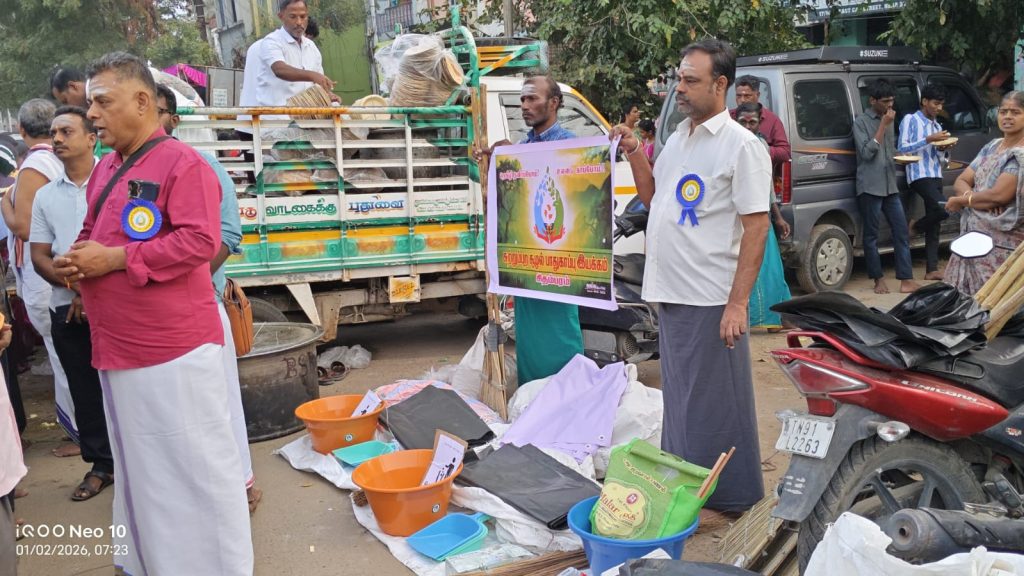
Hundreds of sanitation workers were detained again by police on Tuesday, marking the 75th day of their ongoing protest demanding job regularisation under the Greater Chennai Corporation (GCC) and opposing the privatisation of solid waste management operations.

The workers had gathered in their respective wards to submit petitions to ward councillors, reiterating their demands for reinstatement and permanent employment. Police reportedly detained workers at seven marriage and community halls across the city during these submissions.

Speaking to the media, K. Bharathi of the Uzhaippor Urimai Iyakkam, which is leading the protest, said, “The workers who are seeking reinstatement and regularisation of employment under GCC are being detained repeatedly. Today marks the 75th day since the workers have been denied work under the city corporation, where they have served for over a decade. The government seems to be siding with the private contractor, Ramky.” He also alleged that workers were asked to pay ₹3,000 for not filing a counter affidavit, but the workers have collectively decided not to comply.

K. Suresh, secretary of the Labour and Trade Union Council (LTUC), said that workers from 30 wards in Royapuram and Thiru-Vi-Ka Nagar zones were detained while attempting to meet their councillors. “Among those detained were workers from Mayor R. Priya’s ward. However, a few councillors, including ward 49 councillor D. Elango, ward 62 councillor Jagadeesan, and ward 63 councillor Siva Raajashekaran, received the petitions,” he added.

Union representatives reported that around 400 workers were detained on Tuesday and reaffirmed that their protest would continue until their demands are met, emphasising that the call for job regularisation and opposition to privatisation remains firm.

(Source: The New Indian Express)

Subscribe to our channels on TelegramWhatsApp, and Instagram and get the best stories of the day delivered to you personally.

“Flawed Logic”: How The Hindu’s Editorial On Supreme Court Order On Karur Stampede Tragedy Protects DMK, Not Victims

"Flawed Logic": How The Hindu's Editorial On Supreme Court Order On Karur Stampede Tragedy Protects DMK, Not Victims

In the aftermath of a tragedy that claimed 41 innocent lives, one would expect India’s leading newspapers to champion accountability and justice. Instead, The Hindu, under the editorial leadership of N. Ram, has published a deeply troubling editorial titled “Flawed Order” that does more to shield the ruling DMK government in Tamil Nadu than to seek truth for the victims of the Karur stampede.​

The editorial’s central premise that the Supreme Court erred in ordering a CBI investigation reveals a startling disconnect from both legal principles and ground realities. What The Hindu dismisses as a “flawed order” is, in fact, a necessary judicial intervention to restore public confidence in an investigation marred by political undertones, procedural irregularities, and credibility concerns.

Misreading the Court’s Necessary Intervention

The editorial’s central premise that the Supreme Court erred in ordering a CBI investigation reveals a startling disconnect from the facts. What The Hindu dismisses as a “flawed order” was actually a necessary judicial correction after senior Tamil Nadu police officials, including Additional Director General of Police Davidson Devasirvatham, held press conferences defending their conduct before any investigation could begin. When investigators become public advocates for their own innocence, the integrity of the entire process collapses.

The Supreme Court rightly observed that “the comments made before the media by top officers of the Police Department may create doubt in the minds of the citizenry on impartiality and fair investigation.” This isn’t a “gag order” as The Hindu claims, but common sense: you cannot credibly investigate yourself after publicly declaring your innocence. The editorial’s position suggests that state officials should be free to try their case in the media while simultaneously conducting an “impartial” investigation – a contradiction that undermines basic principles of natural justice.

Selective Legal Analysis and Cherry-Picked Precedents

The editorial’s invocation of the 2010 State of West Bengal case is particularly misleading. While correctly noting that the precedent warns against routine CBI transfers, The Hindu conveniently ignores that the same judgment affirms constitutional courts’ power to order CBI investigations when state police lack credibility. The Constitution Bench explicitly ruled that High Courts and the Supreme Court possess this power without state consent when circumstances demand.

The Karur case, with 41 deaths, allegations of conspiracy from both sides, rushed nighttime autopsies, and investigating officers publicly defending themselves, presents exactly the “exceptional circumstances” warranting such intervention. The Hindu’s selective quotation from this precedent, amounts to legal cherry-picking designed to support a predetermined conclusion rather than honest legal analysis.

Conveniently Ignoring Troubling Facts

Most revealing is what the editorial completely omits. It makes no mention of the medically questionable autopsies – 31 completed in just over six hours at a hospital with only 2-3 tables that fueled public suspicion. Medical experts consistently state that proper autopsies require approximately 2-4 hours per body. This procedural irregularity, combined with bodies being handed over for cremation by dawn, created legitimate questions about investigative thoroughness that The Hindu conveniently ignores.

The editorial also fails to address the fundamental mathematics of the autopsy controversy. Even with three tables and 22 additional doctors rushed in from neighboring districts, completing 31 detailed postmortems documenting cause of death, injuries, and chain of custody in just over four hours defies credibility. This silence on substantive factual concerns undermines the editorial’s claim to be defending “factual inquiry.”

The “Caged Parrot” Red Herring and Robust Safeguards

The Hindu dismisses the CBI as “a caged parrot of the centre,” recycling a phrase from a 2013 case. This rhetorical flourish ignores that the Supreme Court specifically addressed this concern by appointing a three-member supervisory committee headed by retired Supreme Court Justice Ajay Rastogi. This oversight mechanism, stronger than in most CBI transfers and including two IPS officers from outside Tamil Nadu, directly counters concerns about central government influence.

The supervisory committee possesses authority to “issue proper direction for the areas in which the investigation is required to be carried out” and review evidence “from time to time.” By dismissing the CBI transfer with a glib “caged parrot” reference while ignoring these robust safeguards, The Hindu reveals that its real objection isn’t about investigative independence, it’s about protecting the DMK government from scrutiny.

The editorial notes allegations that “one petitioner was unaware of the petition filed in his name” and “another litigant who abandoned his family years ago is not a real representative of a child victim”. While these allegations merit examination, they don’t undermine the Supreme Court’s fundamental rationale for transferring the case to the CBI. The core issue remains whether Tamil Nadu police, who publicly defended their actions through press conferences, could impartially investigate themselves. Notably, The Hindu applies rigorous procedural scrutiny here while remaining silent about the Madras High Court’s own overreach, where a single judge made sweeping allegations against Vijay’s TVK without making them a party to the proceedings. This selective concern reveals inconsistent standards.

Double Standards on Judicial Overreach

The editorial faults the Supreme Court for making “no mention of the TVK’s or leaders’ responsibilities” while simultaneously accusing the Court of pre-judgment. This contradictory logic ignores that the Madras High Court single judge, whom The Hindu doesn’t criticize had already pre-judged the case by declaring that Vijay and TVK leaders “absconded from the venue” and showed “no remorse” without making them parties to the proceedings.

The Supreme Court’s approach, focusing on structural impartiality rather than assigning preliminary blame, represents judicial restraint, not overreach. The Hindu essentially faults the Supreme Court for not doing what it criticizes the Court for allegedly doing: pre-judging responsibility before evidence is properly examined.

Subscribe to our channels on TelegramWhatsApp, and Instagram and get the best stories of the day delivered to you personally.
ADMK MLAs Wear “Protect Your Kidneys” Shirt To Assembly Taking A Dig At Kidney Theft Scandal Involving DMK MLA

The third day of the Tamil Nadu Legislative Assembly session witnessed fresh protests from the opposition AIADMK, as its MLAs attended the proceedings wearing badges that read “Protect Your Kidneys,” in reference to the ongoing kidney theft controversy in the state.

The Assembly session, which began on 14 October 2025, has already seen repeated confrontations between the ruling DMK and the AIADMK. On the second day yesterday, AIADMK members had worn black badges to condemn both the Karur stampede incident and the alleged kidney theft case. This led to heated exchanges between ruling and opposition benches. The situation escalated when AIADMK MLAs sat on the floor of the House in protest, prompting both AIADMK and BJP members to stage a walkout.

As the House reconvened today for the third day, it was announced that seven bills were expected to be tabled during the day’s proceedings. However, the opposition continued its symbolic protest, with AIADMK legislators arriving wearing “Protect Your Kidneys” badges as a mark of condemnation against what they called government negligence in handling the kidney theft issue.

Adding to the day’s developments, three MLAs aligned with PMK leader Dr. Anbumani Ramadoss attended the session dressed in black shirts, also signaling dissent. Their attire was seen as an expression of solidarity with public outrage over the kidney trafficking controversy.

Despite the planned legislative business, the opposition’s continued protests ensured that the kidney theft issue remained a dominant theme inside the Assembly.

(Source: Hindu Tamil)

Subscribe to our channels on TelegramWhatsApp, and Instagram and get the best stories of the day delivered to you personally.