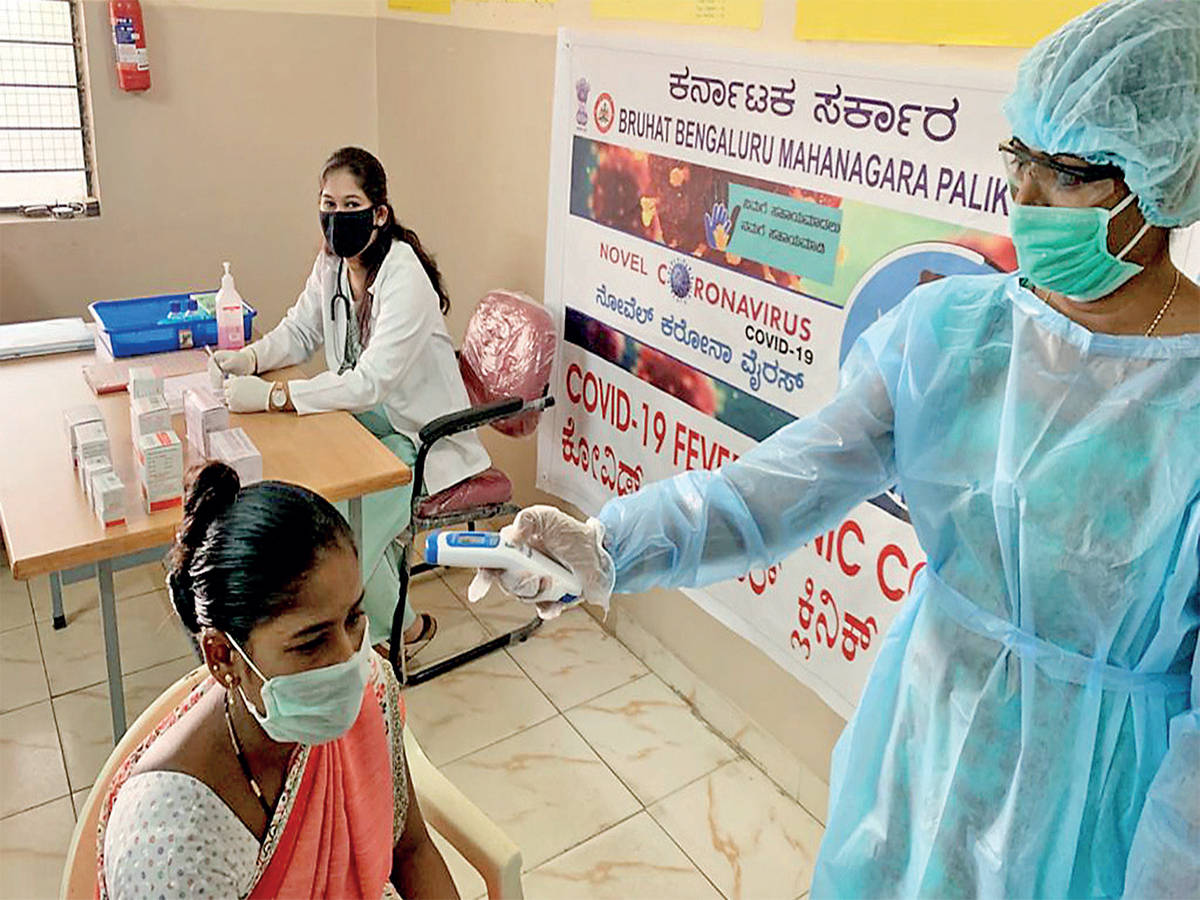
In a bid to better screen for patients infected with COVID-19, the Karnataka government has issued an order enforcing the use of fingertip pulse oximeters in the state’s fever clinics.
Dr Om Prakash Patil, director of the Health and Welfare Department, has instructed fever clinics in the state to acquire fingertip pulse oximeters to determine oxygen saturation levels of patients presenting with complaints of breathlessness. All SARI (Severe Acute Respiratory Illness) and ILI (Influenza-Like Illness) patients with blood oxygen saturation level of less than 95% have been asked to test for the coronavirus infection.
The order stated, “It has come to the notice of the State that fingertip pulse oximeter is an essential tool for stratification of ILI and SARI, and must be made available at all fever clinics. All ILI and SARI cases with less than 95 per cent peripheral oxygen saturation should be subjected for Covid-19 swab test.”
A fingertip pulse oximeter is a non-invasive tool that measures the pulse rate and the oxygen carried in the blood pumped from the heart. A blood oxygen percentage of less than 95% indicates breathing difficulties and lung troubles.
Karnataka’s 651 fever clinics in its government and private hospitals are the primary screening centres for COVID-19. The clinics were earlier using an infrared thermal scanner which only measures the body temperature to indicate a fever. The additional use of finger pulse oximeters would ensure swift and prioritised services and referrals from healthcare professionals and concerned authorities.
All three wings of the armed forces – the Indian Army, the Indian Navy and the Indian Air Force pay tributes to the frontline workers who have been working selflessly since the menace of Wuhan virus began. The act of honouring the frontliners includes playing military bands, lighting up ships at sea, flypasts and showering of flower petals across different regions of the country.
The IAF aircraft C-130J Super Hercules is flying from Srinagar in Jammu & Kashmir to Thiruvananthapuram in Kerala. The flight flew over Rajpath in Delhi at 10:15 AM. The aircraft was spotted over the Dal Lake in Srinagar, Sukhna Lake in Chandigarh and is on its way to the southern part of India.
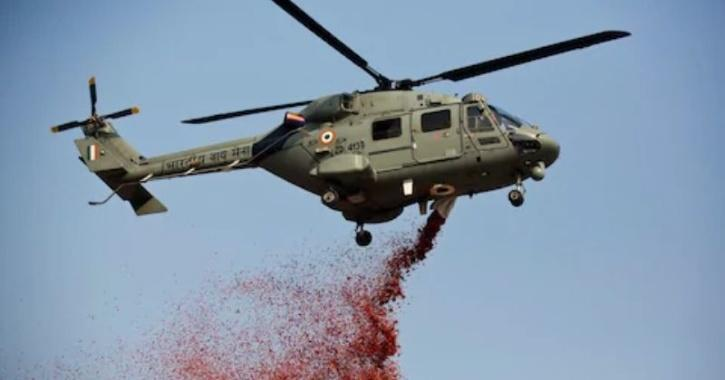
Meanwhile, the Indian Air Force choppers showered petals on Police War Memorial in Delhi as a mark of respect to the police officers maintaining law and order amidst the lockdown. It also flew past the Government Hospital in Panchkula to honour the medical professionals. Navy choppers in Goa to showered petals on frontline health workers at the Goa Medical College.
In Mumbai, Indian Air Force’s Su-30 aircraft flew past Marine Drive. An IAF chopper showered flower petals over the Victoria Hospital in Bengaluru to honour the healthcare workers.
Later in the evening, Naval ships on the coasts of Chennai, Kochi, Mumbai, Karwar, Port Blair, Vizag and Porbandar, will illuminate flare fires in solidarity with the frontliners. The Army bands will visit select hospitals and pay tributes.
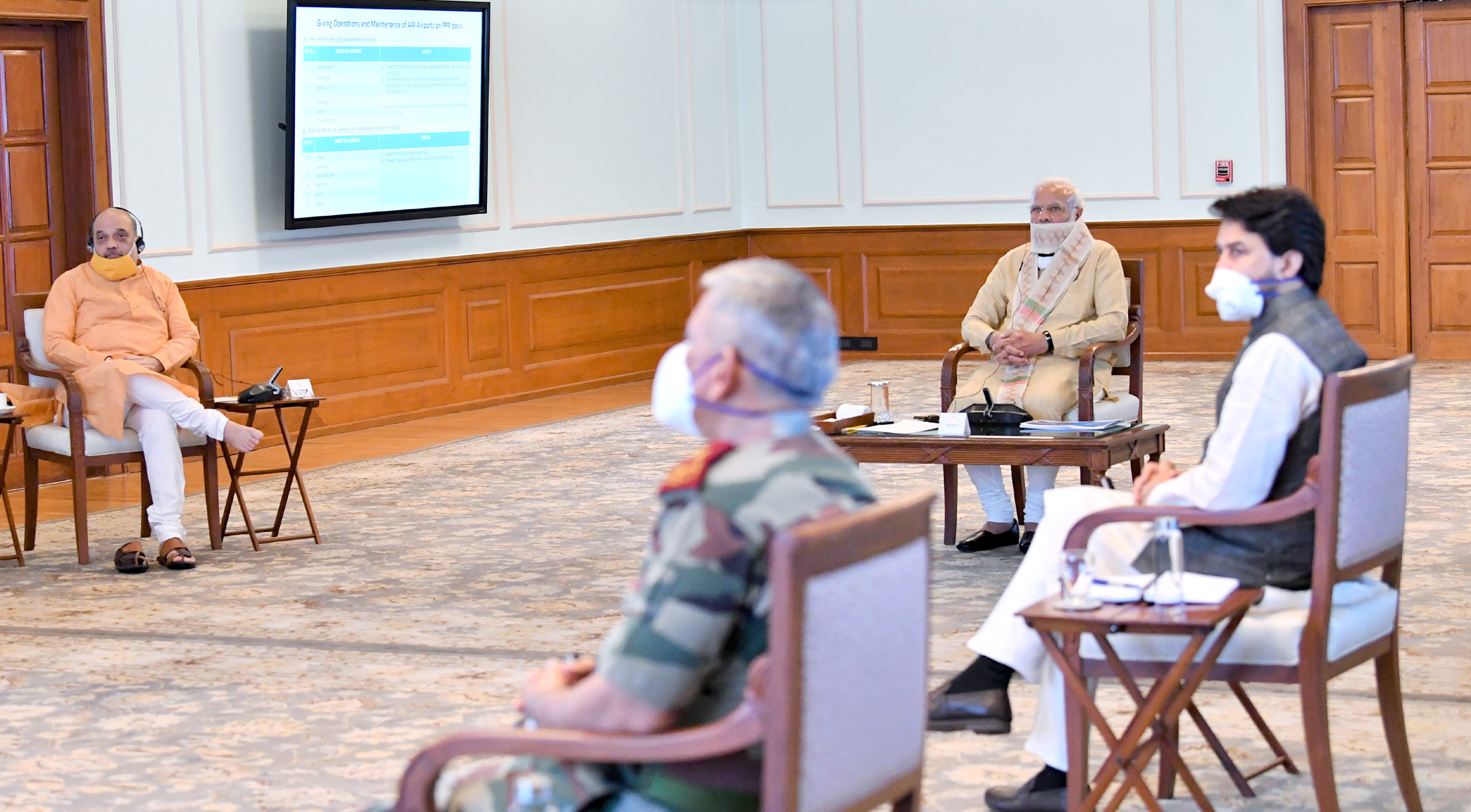
The Prime Minister, Shri Narendra Modi holding a review meeting to discuss Civil Aviation Sector, in New Delhi on May 01, 2020.
A meeting with several key ministers that included Finance Minister Nirmala Sitharaman, Home Minister Amit Shah and other senior officials was convened by Prime Minister Narendra Modi on Saturday to discuss about a package for sectors impacted by the lockdown. The PM is said to follow it up with round of meeting of that will include other economic ministries like Ministry of Micro, Small and Medium Enterprises and Ministry of Commerce and Industries.
Finance Minister Nirmala Sitharaman is set to make a detailed presentation about the state of economy and the measures it is planning to take to the Prime Minister.
On Friday, Prime Minister Modi met with Ministers of Civil Aviation, Labour and Power. The day before, he met with Commerce and Industries Minister Piyush Goyal and MSME Minister Nitin Gadkari to deliberate on attracting foreign investments and giving a boost to domestic small businesses in the country.
Two instances of earthquake were reported at two different points on earth – one at the US island of Puerto Rico in the Caribbean Sea and another one at the Greek island of Crete. The earthquake at southern Puerto Rico measured 5.5 on the Richter scale while the one that hit the southern island of Greece measured 6.6.
In Puerto Rico, hundreds of homes were destroyed and power was disrupted forcing the relocation of more than 50 families who were housed in shelters following a quake that rocked the island earlier this year. In the small city of Ponce, the earthquake led to cracking of walls, and caused a balcony to crash. The earthquake has it the city at a time the US is reporting the highest number of cases.
Meanwhile, no damages were reported in the Greek island of Crete.
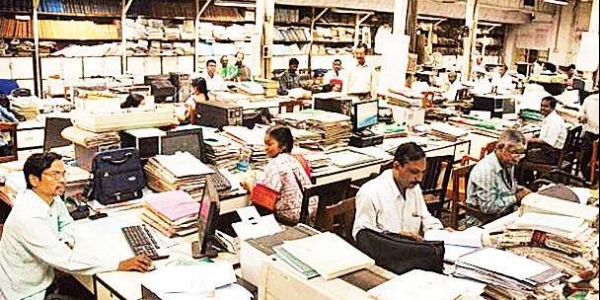
Come May 4, all government offices in Tripura will function as usual with all categories of officers working from office, the state Chief Secretary Manoj Kumar has said. An order regarding the same has also been released.
This comes after the Union Ministry of Home Affairs (MHA) issued an order that there are no restrictions in the functioning of government offices in orange and green zones of Tripura. The MHA has categorized 6 districts of Tripura as green zones and 2 as orange zones.
The total number COVID-19 cases in Tripura as on date stands at 4 of whom 2 have already been discharged.
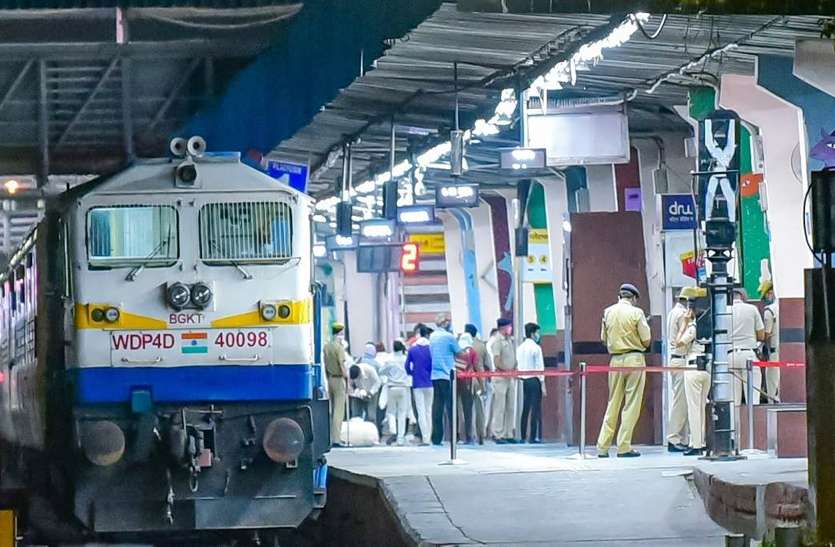
Following the decision taken by the Ministry of Home Affairs to transport migrant workers, students, tourists and other persons stranded in various parts of the country due to the lockdown, the Ministry of Railways has decided to ply ‘Shramik’ trains for the same.
The order comes after the MHA decided to extend the current phase of the lockdown beyond May 3 for a period of 2 more weeks.
However, it was clarified by Railways Ministry that these special trains will be operated only upon the request of state governments. Nodal Officers to coordinate with state government and UTs for the movement of stranded people will be appointed by the Ministry of Railways and the respective state governments.
Passengers will be screened by the state that is currently hosting the stranded people and only those found asymptomatic would be allowed to travel. It will be mandatory for those travelling to wear masks. Meals and drinking water would be provided by the sending states at the origin station.
A special train carrying 1200 people left from Telangana to Hatia in Jharkhand after the Railways Ministry acceded to the request of Jharkhand government to facilitate their return.
The other special trains slated to run are on the routes of Aluva to Bhubaneswar, Nasik to Lucknow, Nasik to Bhopal, Jaipur to Patna and Kota to Hatia.
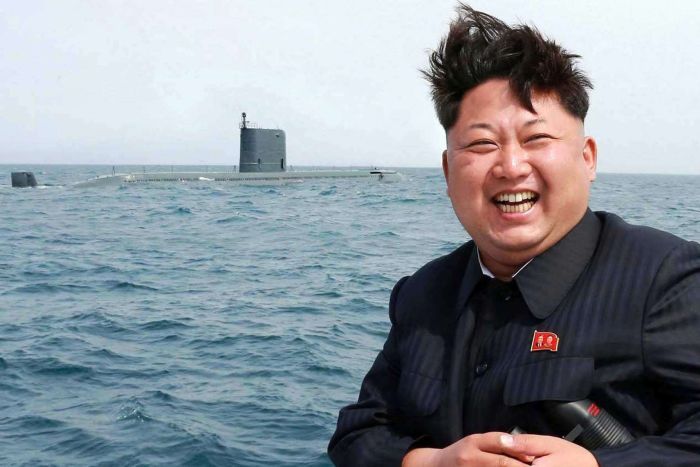
In what seems like a rebirth of sorts, images of Kim Jong Un have surfaced on the internet. Putting an end to weeks of speculation, the North Korean leader’s images at a ribbon cutting claimed to be taken on Friday, show that he is well and healthy, as well as out and about.
According to the country’s state news agency KCNA, he was present at a ribbon cutting ceremony of a factory at Sunchon city in North Korea. This report, although not entirely confirmed, has dampened the theories behind his disappearance.
The North Korean leader’s last public appearance was on April 11. Claims of him recovering from a critical heart surgery and being ‘gravely ill’ in a vegetative state, have been doing the rounds. This had triggered the possibility of his sister taking over after his passing. However, the South Korean officials had in April mentioned that “no unusual signs supporting reports about his health conditions have been detected.”
The fact that he skipped attending the country’s biggest holiday on April 15, the birthday commemoration of the country’s founder who also happens to be his grandfather, raised many eyebrows.
The opening ceremony of the fertilizer plant was attended by his sister Kim Yo Jung and other senior officials.
The Sri Lankan Election Commission has postponed the general elections for the country that was scheduled to happen on April 25 to June 20, in view of the prevailing situation due to the Wuhan virus.
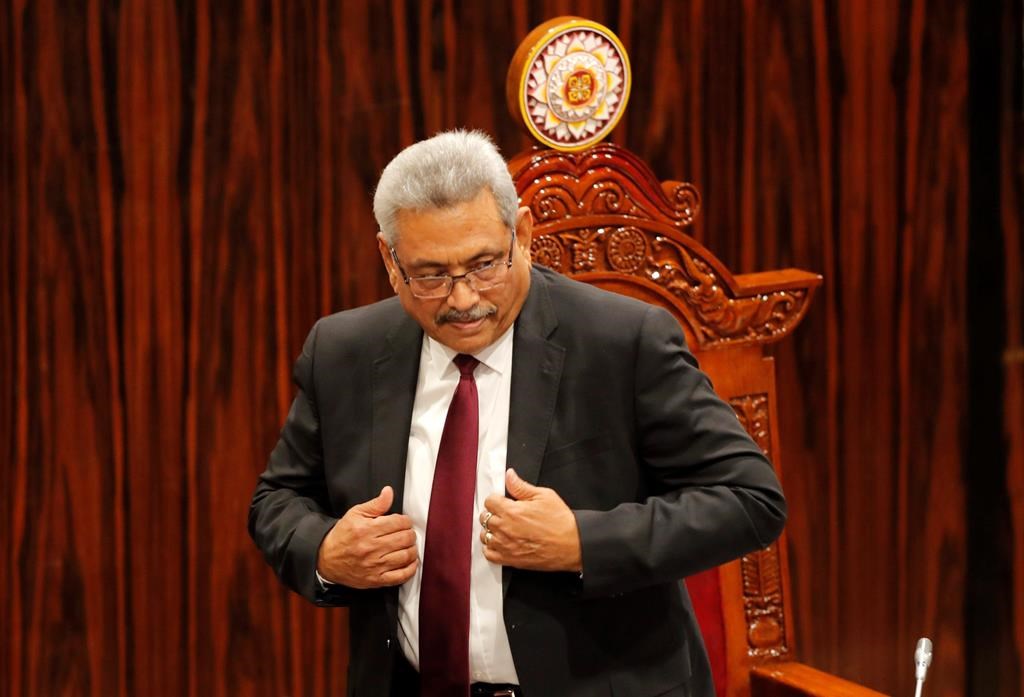
The Sri Lankan Parliament was dissolved exactly 2 months ago on March 2 by President Gotabaya Rajapaksa who was elected in November 2019.
Opposition parties have objected to the new date citing public health risks. It is to be noted that the new poll date poses the risk of an imminent constitutional crisis as the Sri Lankan Constitution mandates that Parliament be summoned not later than 3 months after dissolving the House.
But President Rajapaksa had earlier mentioned that the said poll date was the Election Commission’s prerogative.
Sri Lanka has virtually been under lockdown since March 20. The government has imposed curfews in high risk districts which includes Colombo, the district with highest number of positive cases (157 as of May 2) in the country.
In light of this, President Rajapaksa on Friday ruled out the possibility of reconvening the dissolved Parliament. This comes days after leaders of opposition wrote to President Rajapaksa to reconvene the Parliament. They had evoked Article 70 (7) of the Sri Lankan Constitution that says that if the President is satisfied that an emergency has arisen of such a nature that an earlier meeting of Parliament is necessary, he may summon the dissolved legislature by proclamation. However, President Rajapaksa said that the requirement to abide by the said article didn’t arise.
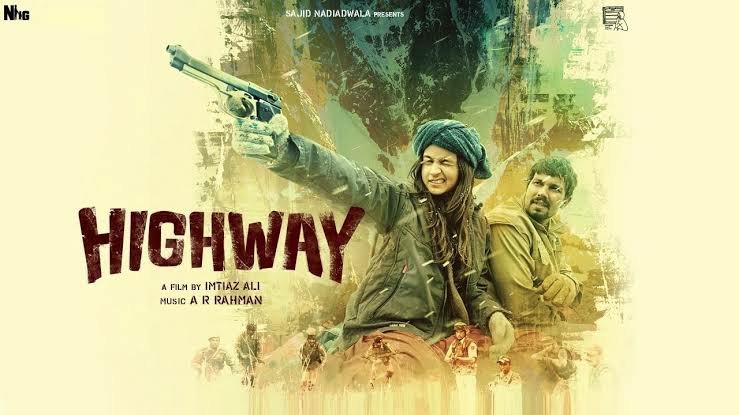
What happens when a man who is as tough as a rock, who is without any remorse, encounters an unexpected and unexplainable love from a girl who he has been held captive? Mahabir Bhati is one such man who discovers that life is not what he had imagined it to be and what he had believed to be all these years. The next few paragraphs break down the character and psyche of the character played by Randeep Hooda.
When a group of local gangsters kidnaps the daughter of a rich business tycoon, unlike others in his gang, Mahabir isn’t afraid of the kidnapping. He isn’t afraid of the rich, he isn’t afraid of dying like a dog in the hands of them.
Mahabir is a man who had made peace with himself and is ready for death.
When they decide to keep Veera in an abandoned place by providing her with just food and water for survival, he isn’t least bothered about anything else for her. After all, he is a kidnapper, why would someone even care about the person’s well-being?
Mahabir is a man who feels no remorse for his fellow beings.
When Mahabir catches one of his men trying to misbehave with Veera, he says to the guy – “She is just a consignment. Not a girl.”. After all, he sees her not more than a package that has to be delivered.
Mahabir is a man who is only focused on the work at hand, does not feel the need to protect/show pity for anyone around him.
When Veera describes the horrors of her uncle molesting her multiple times when she was young, he doesn’t know how to react, he just listens to her wailing and walks away from that place. Later, when Veera hugs him, he realizes that the struggles of being a woman in this world is not just confined to the poor, but also to the rich.
Mahabir is a man who is disturbed by the words of Veera, realizes the reason why Veera wants her freedom.
During their journey on the Highway, Mahabir discovers the other side of Veera, a side that Veera herself discovers for the first time. He lets her walk into open fields, lets her climb trees, lets her enjoy the rain, lets her enjoy the water flowing from the pumps.
Mahabir is a man who is confused to see Veera enjoying her newly found freedom.
When Mahabir and co. reach a dilapidated warehouse in Bengal to hold Veera captive, he vents out the anger on all the rich men who use the poor women for their pleasures. He is appalled at the class difference in society with respect to crimes committed.
Mahabir is a man who hates the rich completely, despises them to the core that he considers Veera as a representative of the rich and selling off her to a brothel is the perfect revenge he can take on the rich.
When Veera asks Mahabir about the song that he had been humming, he refuses to say anything about the song, that he even shouts her to go back to her room. After continuous pestering from Veera, he says that it was a song that his mother would sing when he cried. Veera is surprised to even imagine that Mahabir could cry. This moment reminds him of his mother and the song she would sing for him when he was small.
Mahabir is a man in whom there is a yearning that keeps reminding him for what he wants to be, but his current life keeps pulling him back to what it needs him to be.
When Veera dances her heart out right in the open, he is initially confused as to what has gotten into Veera, but later realizes that she has become a little too comfortable around him. A sense of fear, then engulfs around him as he sees himself as a bad man, who may even harm Veera. Hence, he decides to reluctantly drop her off to the police.
Mahabir is now a man who does not like being a good guy, who tries to return to being the so-called bad man that his life wants him to be.
The moment when Veera comes back to him at the bus station is the moment he realizes he has this unique, unusual affection towards Veera. He feels genuinely happy about her being with him.
Mahabir is a man who finds happiness inside of him with this newly found love. He also becomes a man has let himself go from the clutches of his past life.
When they find a place on top of the mountains and when Mahabir sees Veera cooking and cleaning their “house”, all that yearning he had for his mother’s affection has vanished in these moments with Veera. He was a man who believed that the days of someone showing him affection is well behind him and the fact that there is someone else other than his mother who genuinely cares for him, breaks him down completely.
Mahabir has been a man who has had a past that he never wants to forget, at least his mind never lets him. Earlier, when Veera asks that whether one bullet is enough to end a man’s life, Mahabir replies back saying that it kills two people – The person who is shot and the person who shoots. He feels that his life was over the moment he killed three people.
He has always been a seemingly fearless man all his life, who has been devoid of any kind of emotions/affection all these years. When someone starts doing the things that reminds of his mom, he does not know how to handle the feeling of being loved again after 20 years. He realizes what love can do to a person, that he has been dead for all these years, that he has lived a life devoid of all the emotions that a man has to go through in his life.
In this journey with Veera, Mahabir becomes free and Veera shows him how.
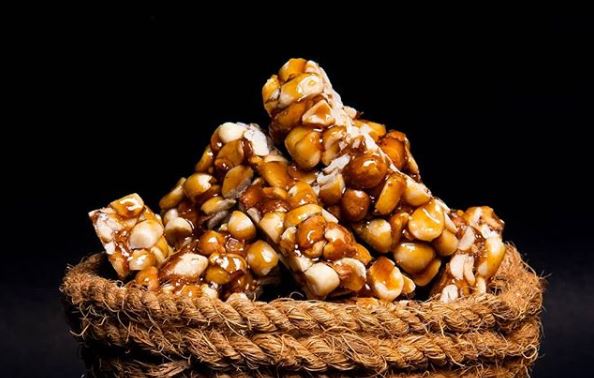
Roasted peanuts and crushed jaggery is all it takes to make Kadalamittai, an Indian sweet delicacy, but not everybody can give the traditional touch and the crispiness that Kovilpatti gives. The Kovilpatti Kadalamittai was granted the GI tag recently by the Office of the Controller General of Patents, Designs and Trademarks. But the humble dish had to wade through several obstacles to get this recognition. Just like its appearance, this sweet dish also has a humble journey to it.
The ‘sweet’ history of Kovilpatti Kadalamittai
Manufactured in and around Kovilpatti and other villages of Thoothukudi district, the dish was first prepared by Ponnambala Nadar who had a grocery store in the Bazaar area in 1940s. He decided to put the extra peanuts that he had in his store to make Kadalamittai. The dish in itself was not something new as back in those days, villagers used to make balls of peanut crushed with jaggery. However, it would stay fresh for not more than 3 days. Krishnamoorthy, a 75 year old resident of Kovilpatti recalls that his uncle (father’s brother) Ponnambala Nadar improvised on this by caramelizing the jaggery which enhanced its shelf life and voila, the Kovilpatti Kadalamittai was born. Later, Ponnambalam Nadar started a separate unit to manufacture Kadalamittai under the brand “Baby”, named after his daughter. Sweet.
The ‘bitter’ struggle of Kovilpatti Kadalamittai
The process for acquiring GI started back in 2014. Mr. Vijayakarthikeyan IAS, currently leading the fight against COVID-19 in Tirupur, took mission of getting the GI tag for Kadalamittai when he was the Sub Collector of Kovilpatti. He convened a meeting that was attended by more than 15 manufacturers of Kadalamittai in the region and made them realize the importance of having the GI tag. He explained to them that the GI tag was necessary to preserve the authenticity and also to boost the market value of the product. He also made the manufacturers realize how other manufacturers outside Kovilpatti are selling off their Kadalamittai as Kovilpatti’s, thereby affecting local manufacturers, their sales and market. So, in 2014, Mr. Vijaykarthikeyan filed an application for the GI tag from his side. However, the application was returned in 2015 citing that individuals, organizations or government servants cannot apply and that only associations were eligible to do so. After his transfer, the cause was put in the backseat.
The issue again gained momentum, thanks to GST. Initially, Kadalamittai attracted a GST rate of 18% as it was considered as an item under confectionaries and not under sweet meat that had a 5% GST rate. The issue became a talking point after memes that compared GST rates of pizza and kadalamittai went viral. Manufacturers then formed an association in 2016 to lobby for a reduction of GST rates. Nirmala Sitharaman, the then Minister for Commerce and Industry gave clarity and created a separate item called Kadalamittai with 5% GST.
As Kadalamittai made news, it grabbed the attention of Sanjay Gandhi, a nodal advocate for GI in Chennai. He took it up and reached out to the manufacturers. The manufacturers formally registered themselves as Kovilpatti Kadalamittai Manufactureres and Retailers Association and filed a fresh application in 2017. Dhinesh Rodi, the CEO of Namo Candy and the Treasurer of the association said that they produced evidences that would strengthen the case. People like Krishnamurthy and other documentary evidences like photos, old news articles, advertisements, were used as evidences.
But it doesn’t matter if you are living human or a Kadalamittai, you have to pass through the firewall of Indian bureaucracy. The process was getting delayed due to several bureaucratic procedures. Later, the association met Kadambur Raju, the ADMK MLA for Kovilpatti who pursued the matter with the current Minister for Commerce and Industry Piyush Goyal.
The arduous journey came to an end a few days back when it was notified in the gazette that Kovilpatti Kadalamittai had been given the GI tag.
What makes Kovilpatti Kadalamittai unique?
The Kovilpatti Kadalamittai comes in the form of rectangular cuboids. Groundnuts grown in native black soil, vellam (jaggery) from the cottage industries in around the district and water from the Thamirabarani river enhances its taste naturally.
How will GI tag help?
With the dish getting the GI tag, no other individual or manufacturer can sell their product as Kovilpatti Kadalamittai. This will help in adding brand value to the Kadalamittais coming out of Kovilpatti and will also help the local manufacturers of the region tap into national and international markets thereby boosting the local economy.