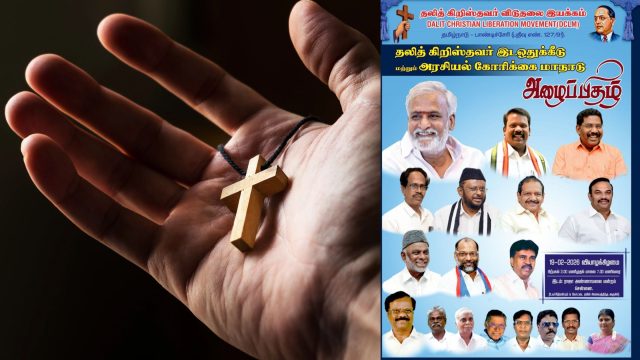
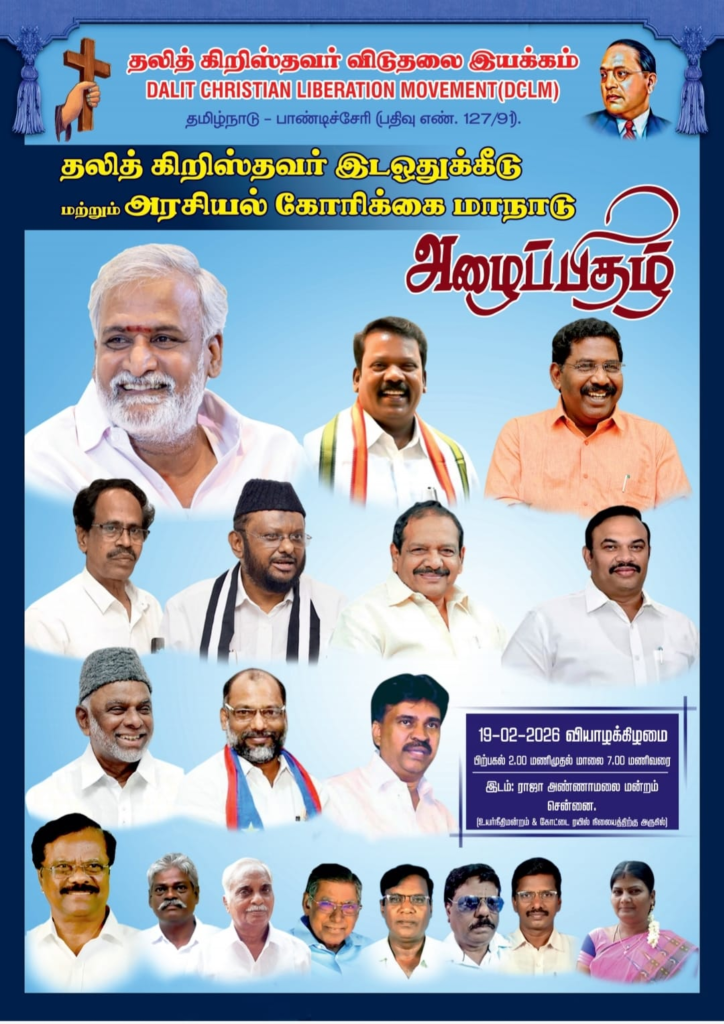
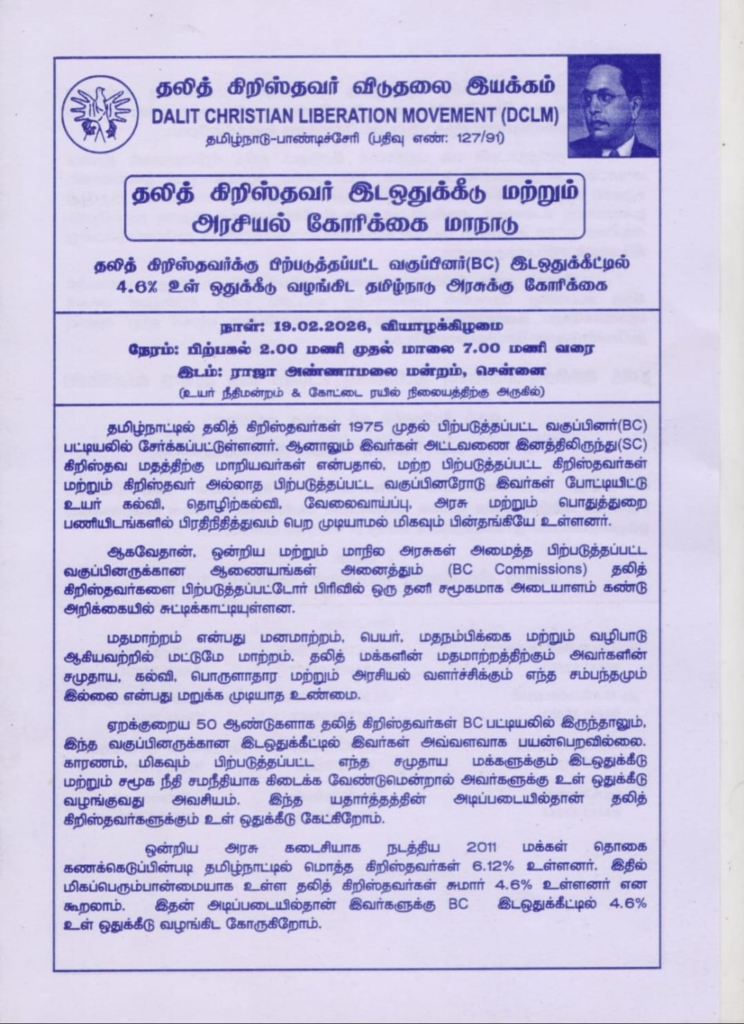
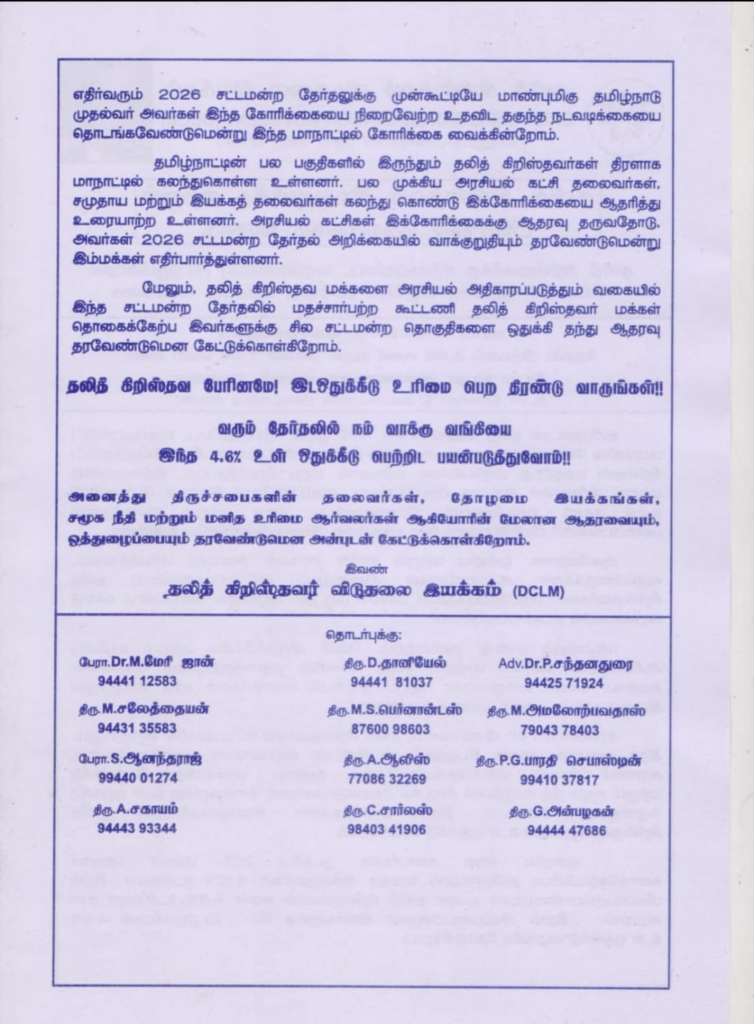
With the 2026 Tamil Nadu Assembly elections, the Dalit Christian Liberation Movement (DCLM) organised a state-level conference in Chennai on 19 February 2026, with the participation of several leaders from parties aligned with the DMK-led coalition.
It is noteworthy that members of the DCLM met with DMK HR&CE minister Sekar Babu earlier in this regard.
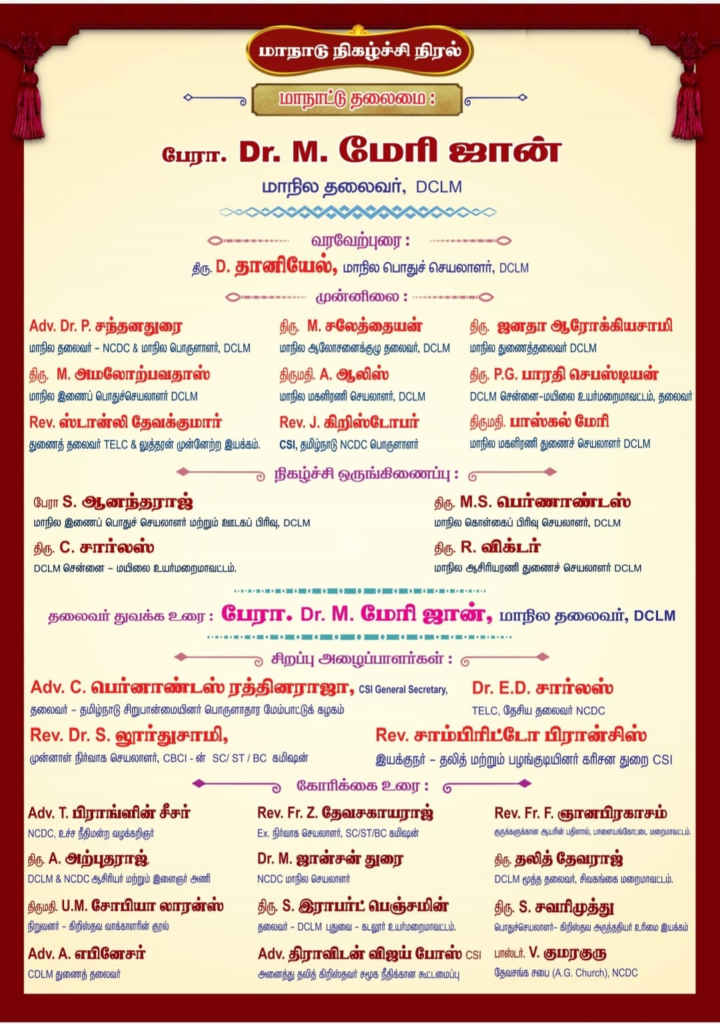
The event, held at Raja Annamalai Mandram from 2:00 PM to 7:00 PM, was led by DCLM State President Dr. M. Mary John and projected as a major mobilisation for the rights of Dalit Christians.
The central agenda of the conference was a renewed push for 4.6% internal reservation within the Backward Classes (BC) quota for Dalit Christians.
Event material circulated by organisers argued that Dalit Christians, despite conversion, continue to face social and economic backwardness and therefore deserve quota benefits. The movement framed the demand as a long-pending justice issue and called for political intervention to secure it.
The demand can be seen as part of a broader attempt to reopen the contentious debate around religion-linked reservation benefits.
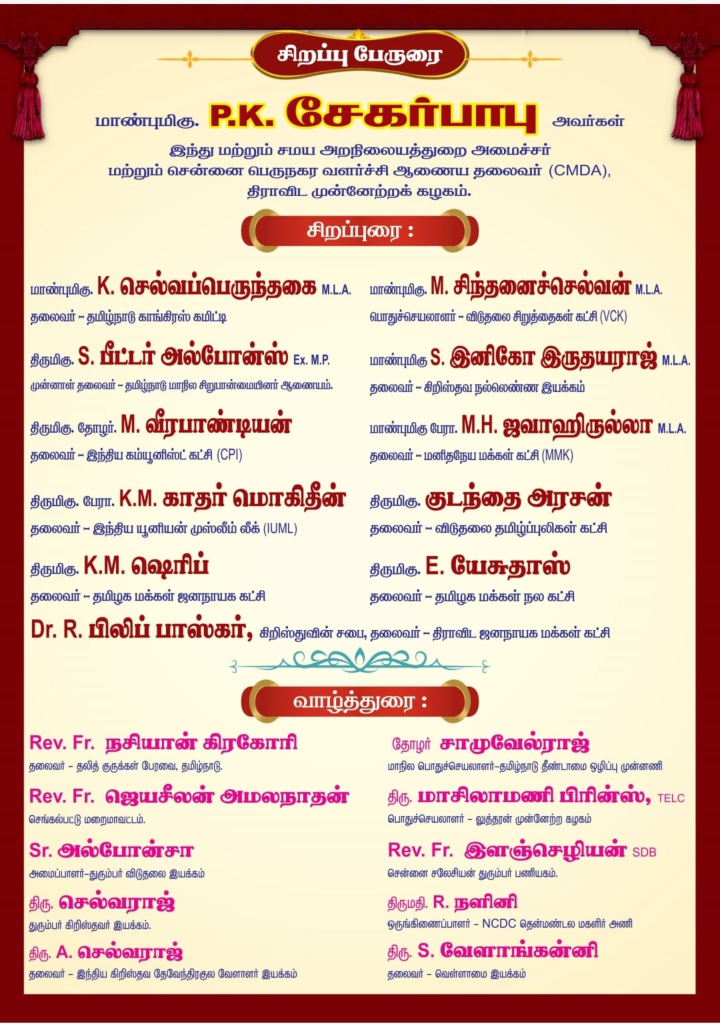
What has drawn particular attention is the heavy presence of leaders from parties that are part of or aligned with the DMK-led alliance. Those listed in the programme include:
K. Selvaperunthagai, MLA (TNCC chief – Congress)
M. Sindhanai Selvan, MLA (VCK)
S. Inigo Irudayaraj, MLA
M.H. Jawahirullah, MLA (MMK)
S. Peter Alphonse, former MP (Congress)
M. Veerapandian (CPI)
K.M. Kader Mohideen (IUML)
K.M. Sheriff (TMMK)
Kudanthai Arasan (Viduthalai Tamil Puligal)
E. Yesudoss (Tamilaga Makkal Nala Katchi)
Dr. R. Philip Baskar
The conference also featured an extensive lineup of Christian clergy and denominational representatives, including figures from CSI, TELC and CBCI-linked bodies such as:
Rev. Dr. S. Irudhayaraj (CBCI SC/ST/BC Commission)
Rev. Fr. Ilanchezhiyan (SDB)
Rev. Fr. Jayaseelan Amalnathan
Rev. Fr. Z. Jesukumaraj
Rev. Fr. F. Gnanapragasam
The scale of church participation indicates organised institutional backing for the demand, despite them saying people convert to their fold to ‘escape’ caste discrimination.
This is the same group of people who would be opposed to the EWS reservation.
Subscribe to our channels on Telegram, WhatsApp, and Instagram and get the best stories of the day delivered to you personally.
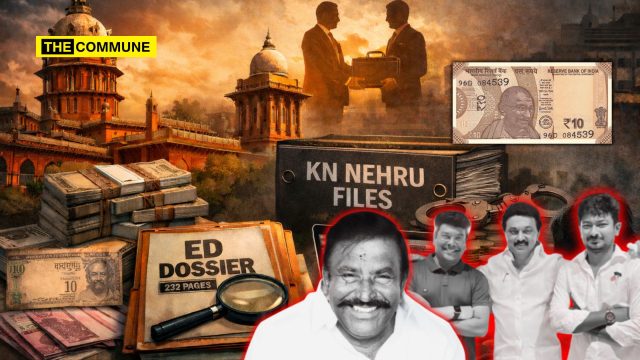
The Madras High Court, on Friday 20 February 2026, directed the Directorate of Vigilance and Anti-Corruption (DVAC) to register a criminal case based on inputs from the Enforcement Directorate (ED) alleging large-scale corruption in the Municipal Administration and Water Supply (MAWS) Department headed by DMK Minister KN Nehru.
The direction was issued by a Division Bench comprising Chief Justice Manindra Mohan Shrivastava and Justice G. Arul Murugan while hearing writ petitions seeking registration of an FIR in the alleged cash-for-jobs and transfer-posting scam. The Bench had earlier reserved orders after hearing detailed submissions from all sides.
Pulling up the State over the delay in acting on the ED’s communication, the court held that the material already on record disclosed cognisable offences warranting immediate registration of a case.
“The details shared and materials available reveal that those candidates got selected pursuant to the alleged transactions. And when a large-scale corruption stated to have happened involving several hundred crores of rupees, we find that source material is sufficient enough disclosing the commission of a cognisable offence for the purpose of registering a case,” the court observed.
The Bench noted that the ED had, on 27 October 2025, shared detailed source information with the State under Section 66(2) of the Prevention of Money Laundering Act (PMLA), along with voluminous supporting material.
“It was for the State to register a case on the detailed information shared by the Enforcement Directorate…and they could have thereafter concluded a detailed investigation to unravel the truth and bring the culprits to book,” the court said.
Rejecting the State’s stand that a preliminary or detailed inquiry should precede FIR registration, the court clarified that the ED’s communication could not be treated as a mere complaint.
“It is not a case where the authorities have received a bare complaint…it is a detailed source information provided by the Enforcement Directorate with a voluminous set of evidence…disclosing a cognisable offence,” the Bench held.
So What Was The Source Information?
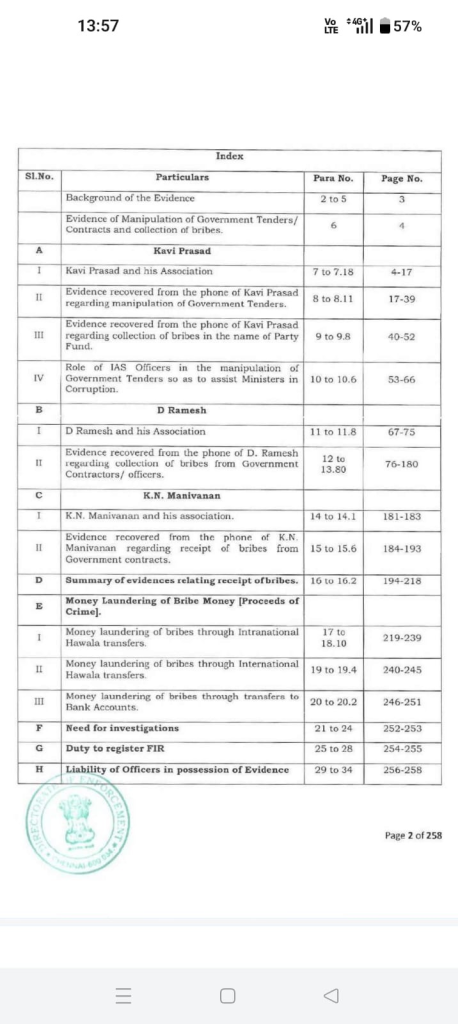
A few months ago, the Enforcement Directorate (ED) formally alleged the existence of a structured tender-manipulation network inside the Municipal Administration and Water Supply (MAWS) Department. The allegations that are circulating now on social media are from a 232-page October 27 dossier submitted in a sealed cover, that was shared with the TN DGP. This information has now gained fresh momentum following the Madras High Court’s direction to the Directorate of Vigilance and Anti-Corruption (DVAC) to register a criminal case and proceed with a full investigation.
The ED did not submit before the #MadrasHighCourt any 258-page document in the cash for jobs scam case against Municipal Administration Minister K.N. Nehru. The ED had submitted, in a sealed cover, only a 232- page dossier which it had shared with the Tamil Nadu DGP on October… pic.twitter.com/80OGr4A8hA
The primary source for the court’s directive is the ED’s 232-page dossier dated October 27, 2025, shared under Section 66(2) of the Prevention of Money Laundering Act (PMLA) with the Tamil Nadu DGP (and later submitted in sealed cover to the court). This dossier details alleged corruption in MAWS recruitment, including bribes for irregular appointments discovered incidentally during April 2025 searches in a now-quashed bank fraud case linked to Minister KN Nehru’s brother, K.N. Ravichandran, and True Value Homes (TVH) Group. Note: A separate ED communication dated December 3, 2025 (258-page dossier/note) alleges tender manipulation, 7.5–10% “Party Fund” commissions, hawala trails, and estimates up to ₹1,020 crore in corruption.
The ED’s communication, dated 3 December 2025 and issued by its Chennai Zonal Office-I under Section 66(2) of the Prevention of Money Laundering Act (PMLA), was sent to the Tamil Nadu Chief Secretary, the DGP, and the DVAC. The ED states that this dossier is backed by extensive digital forensics recovered during search operations, including WhatsApp chats, call records, photographs, financial calculations, and tender documents.
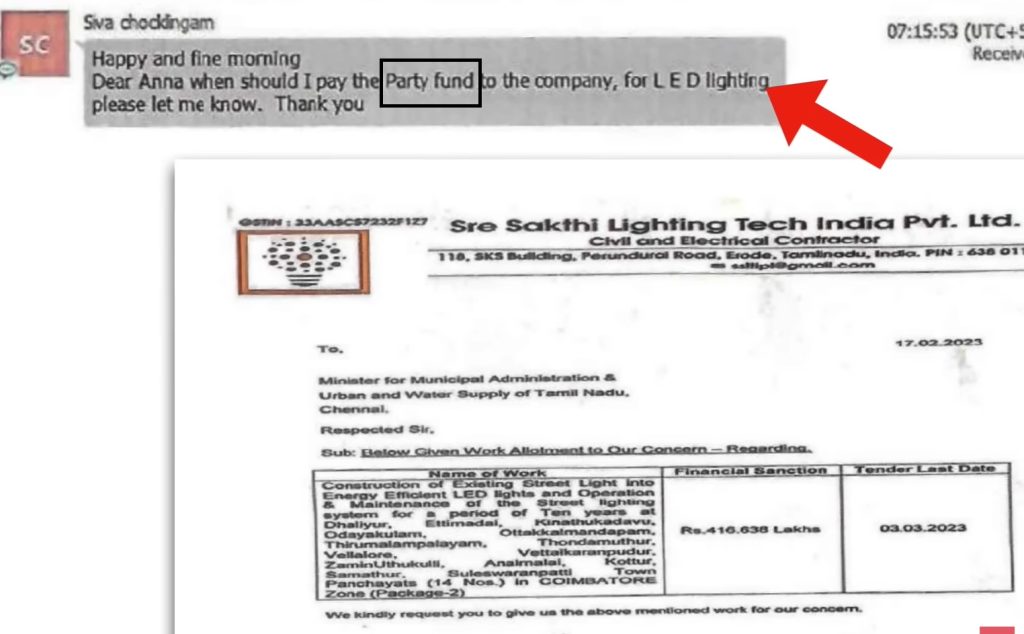
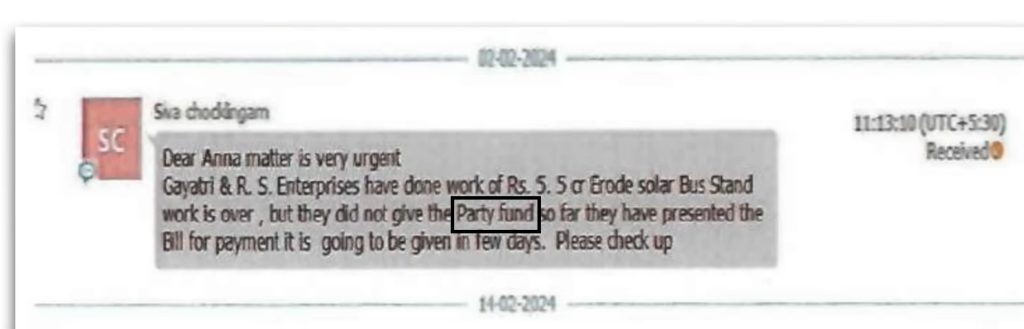
At the heart of the ED’s case is a serious allegation: that a parallel, informal system allegedly operated within MAWS through which government tenders were effectively decided in advance, with contractors required to pay a fixed percentage of project value as what was described in chats as “Party Fund.”
How The Evidence Surfaced
Important clarification: The following details on “Party Fund”, tender pre-fixing, hawala mechanisms (₹10-note photos, Dubai links), Kavi Prasad’s role, specific commission examples, ₹1,020 crore estimates, pre-allocated tenders, Stalin family references (e.g., Para 9.8), and bureaucratic/political links are drawn from the ED’s separate December 3, 2025, communication on alleged tender corruption and transfers/postings. These were not part of the 232-page dossier on which the Madras High Court based its February 20, 2026, directive to register an FIR. The court order focuses exclusively on recruitment irregularities (cash-for-jobs). Claims of Stalin family as ultimate beneficiaries remain unendorsed ED allegations from the separate dossier and are not referenced in the court order.
According to the ED, the material did not originate from a tender probe. It emerged incidentally during searches conducted in April 2025 at premises linked to MAWS Minister KN Nehru, his relatives, associates, and entities connected to the True Value Homes (TVH) Group owned by his brother KN Ravichandran.
Those searches were initially tied to a CBI-registered bank fraud case. Although that predicate case was later quashed by the Madras High Court and the related PMLA investigation closed, the ED has stated that forensic examination of seized digital devices revealed large-scale corruption in municipal contracts. The agency then compiled the material into multiple communications to the State government, culminating in the dossier.
The Alleged “Party Fund” Model
Based on the 232-page dossier, it is stated that the ED’s central claim is that MAWS contractors were allegedly required to pay between 7.5% and 10% of contract value as commission to secure or retain government works. In recovered chats, investigators say these payments were repeatedly referred to as “PF,” which the agency interprets as shorthand for “Party Fund.”
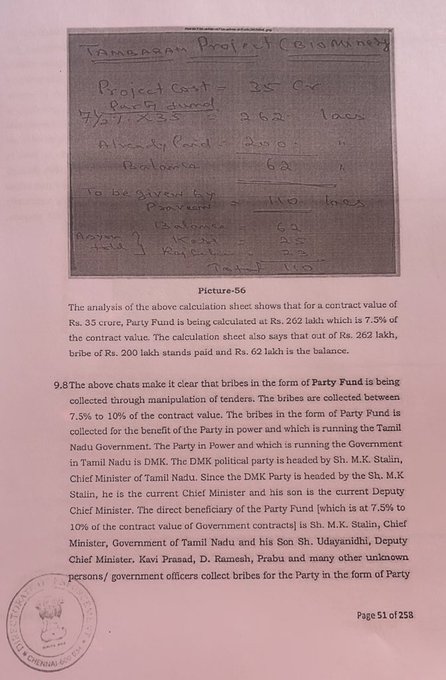
The dossier cites multiple calculation sheets recovered from phones that appear to apply this percentage formula mechanically across projects. In one example, a ₹35-crore municipal project allegedly carried a calculated “party fund” of approximately ₹2.62 crore, of which around ₹2 crore was shown as paid with a balance pending. Another sheet reportedly recorded ₹91.96 lakh as the fund component for a ₹9.19-crore work.
Image Source: X
Investigators describe these not as isolated instances but as evidence of what they believe was a standardised commission framework operating across MAWS tenders.
Scale Of The Alleged Operation
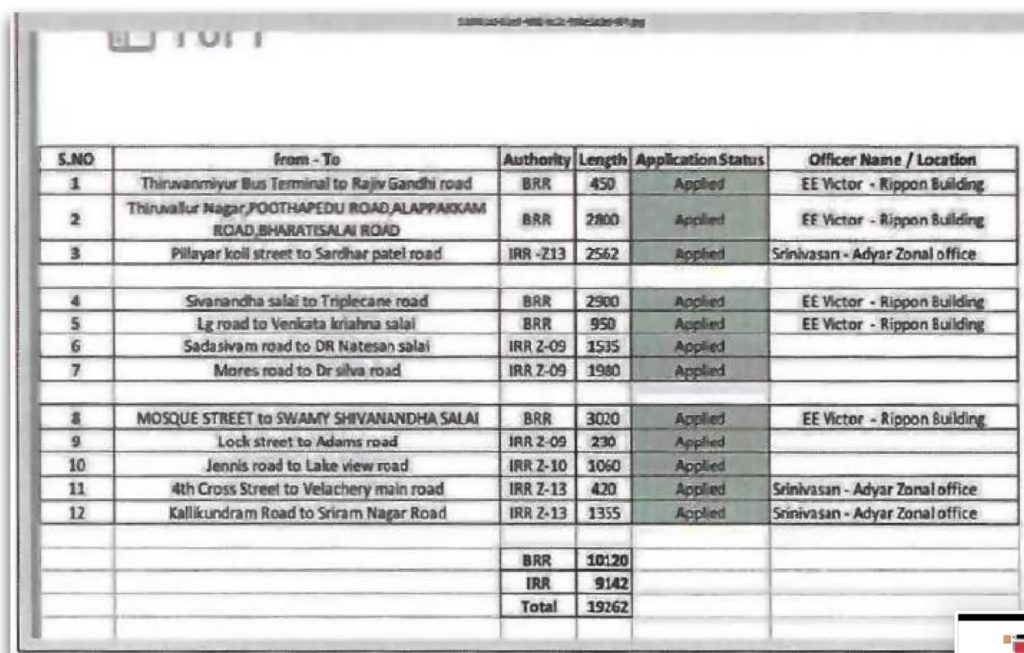
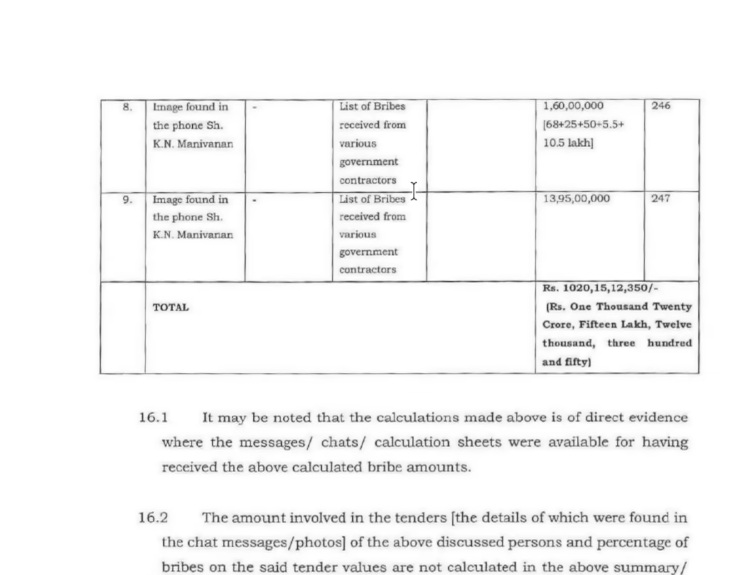
The ED’s analysis suggests the suspected system may have operated across multiple categories of municipal works, including stormwater drains, sanitation outsourcing, community toilets, village roads, sweeper quarters, and NABARD-funded schemes. One compiled table cited in the dossier allegedly links around ₹410 crore worth of projects to commission calculations. In its formal communication, the agency has gone further, estimating that bribe collections tied to tender rigging may have touched ₹1,020 crore.
The agency says these conclusions are based on a combination of contractor statements, digital chats, financial records, and internal calculation sheets recovered during the searches.
Kavi Prasad: The Alleged Nodal Intermediary
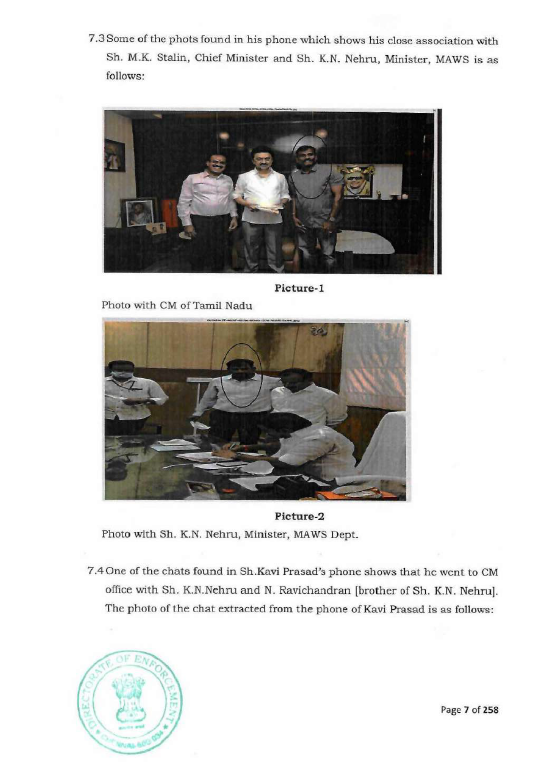
A central figure in the ED’s narrative is Kavi Prasad, described as a long-time associate of the minister’s family and a former director in companies belonging to the TVH Group. According to the dossier, forensic extraction of his mobile phone revealed extensive communication with senior bureaucrats, police officers, elected representatives, contractors, and municipal officials.
Image Source: Harish X handle
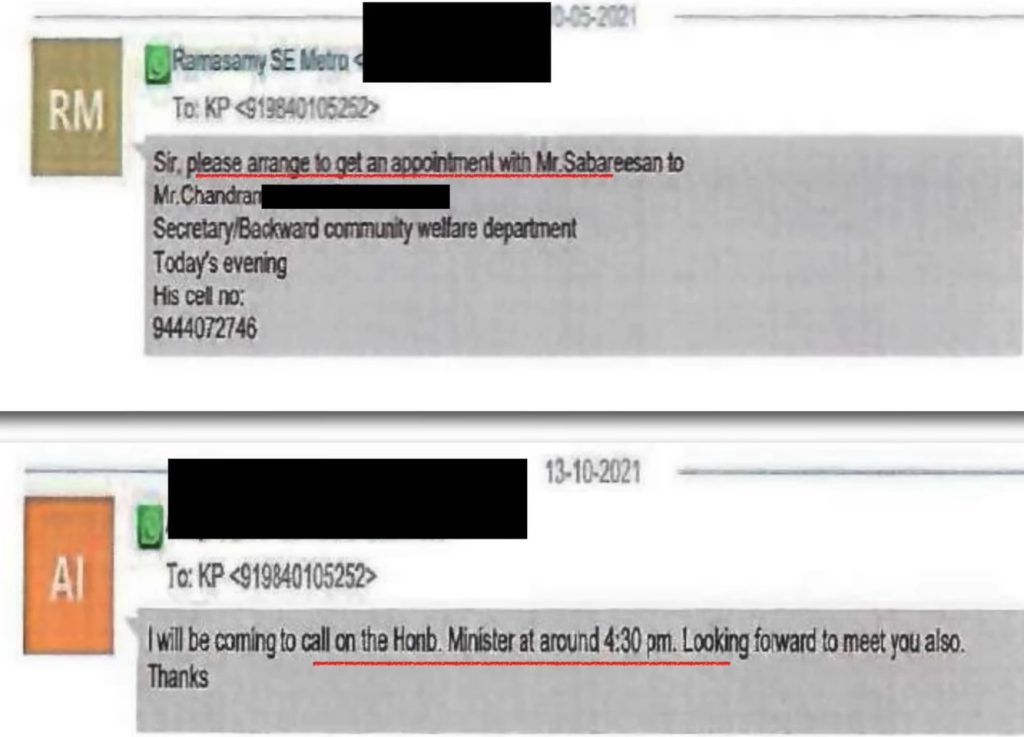
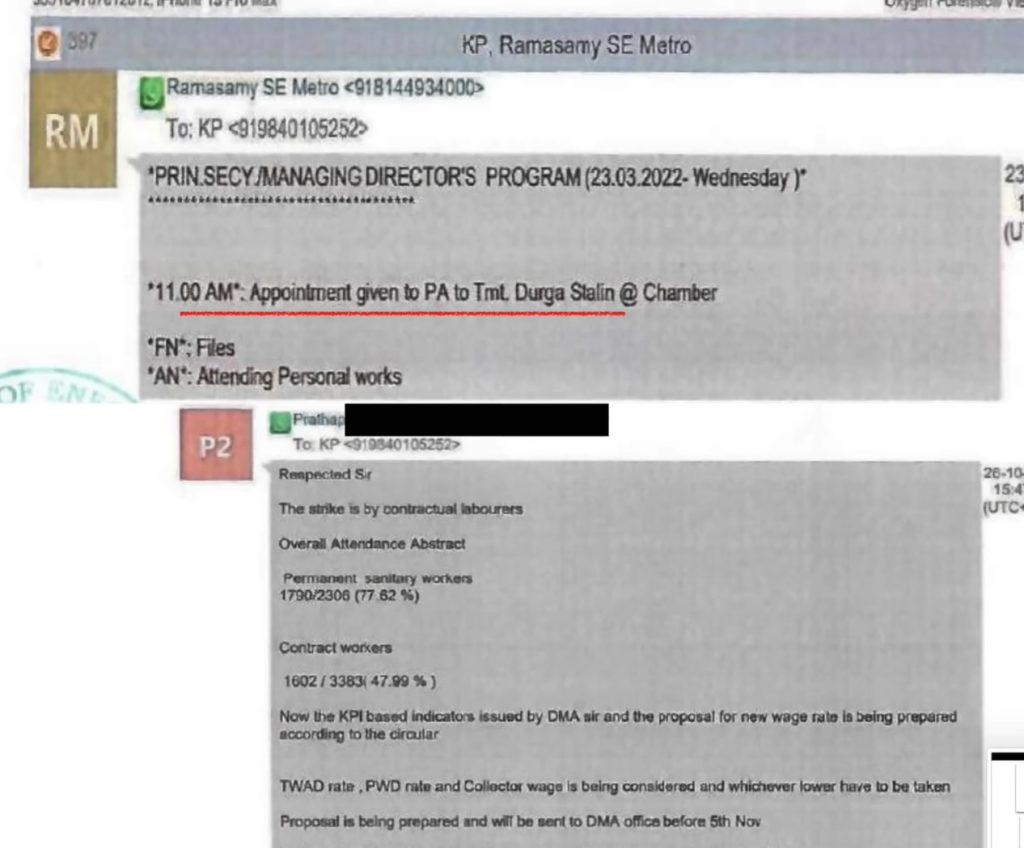
The ED alleges that Prasad functioned as a liaison between contractors seeking government work and decision-makers within the administration. In several chats cited by investigators, officials are said to have addressed him with deferential titles such as “Sir,” “Chief,” and “Respected Sir,” while allegedly seeking his assistance for arranging ministerial meetings, facilitating transfers and postings, or securing allotment of works.
Alleged ₹10-Note Hawala Trail, Points To Network Involving Nehru Associates
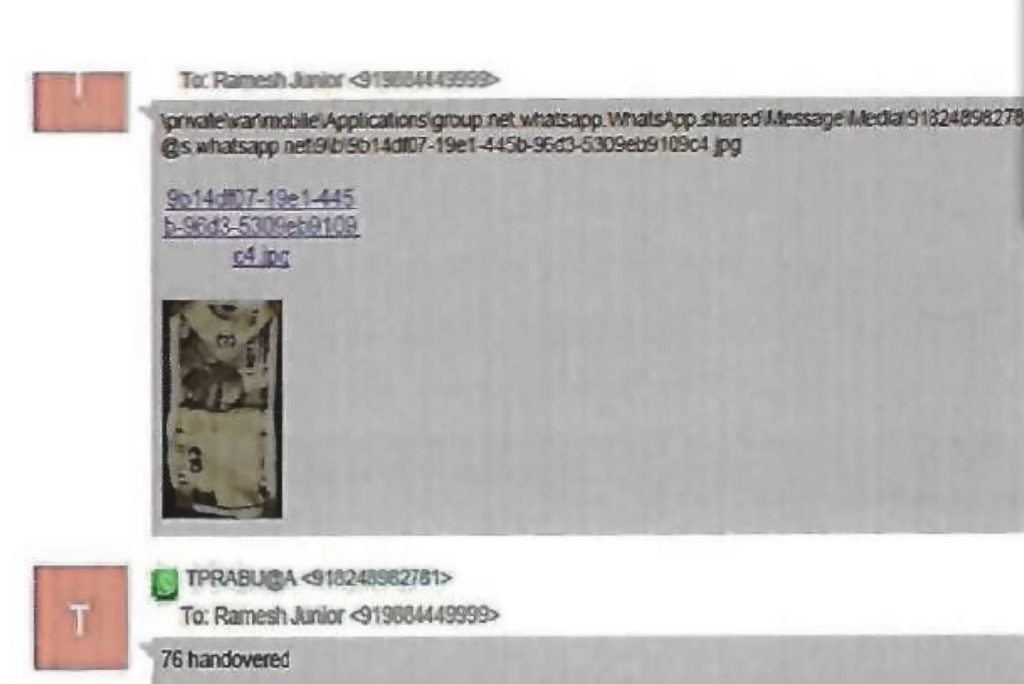
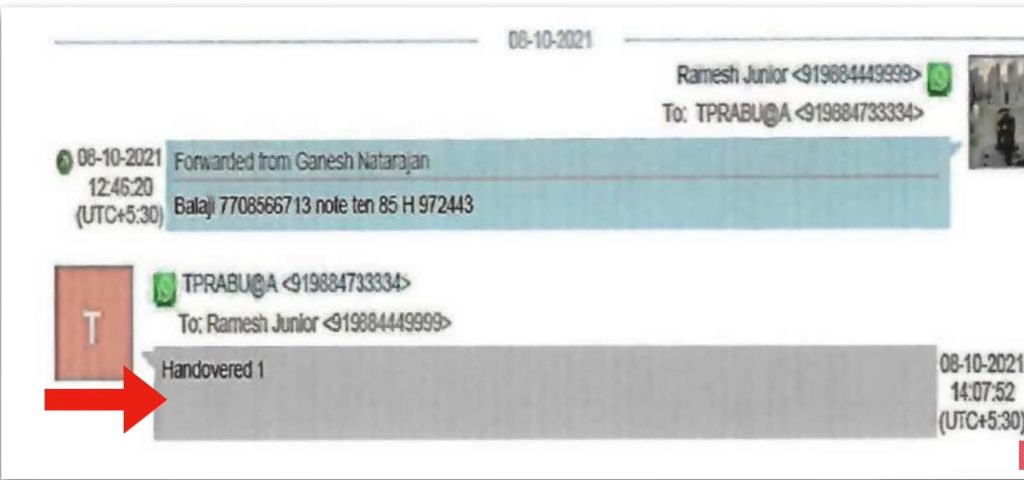
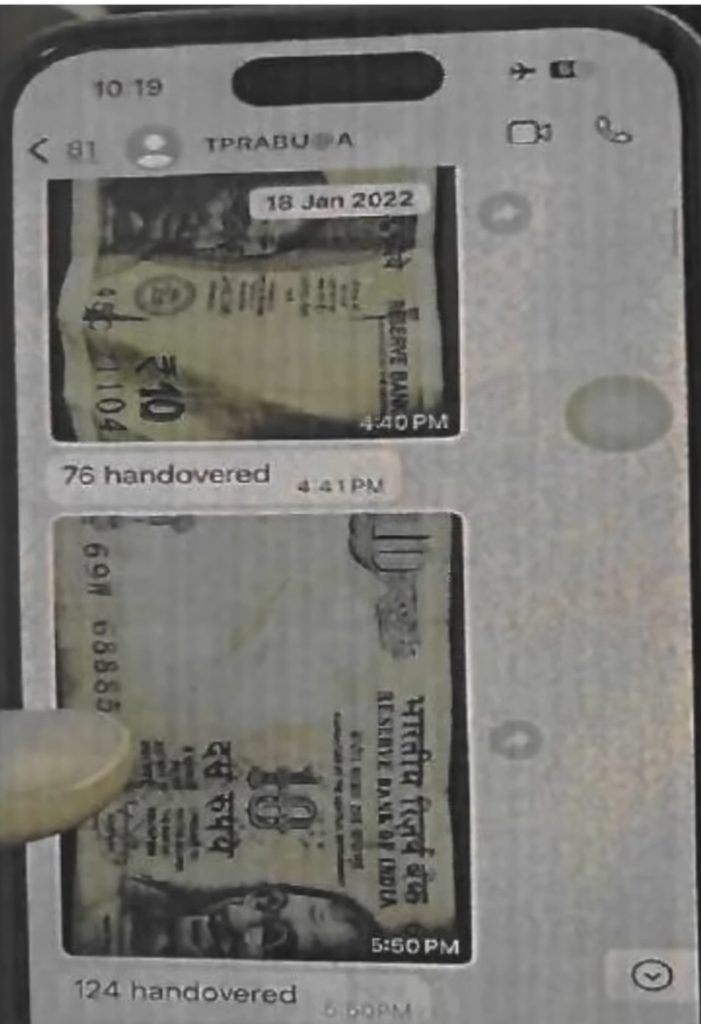
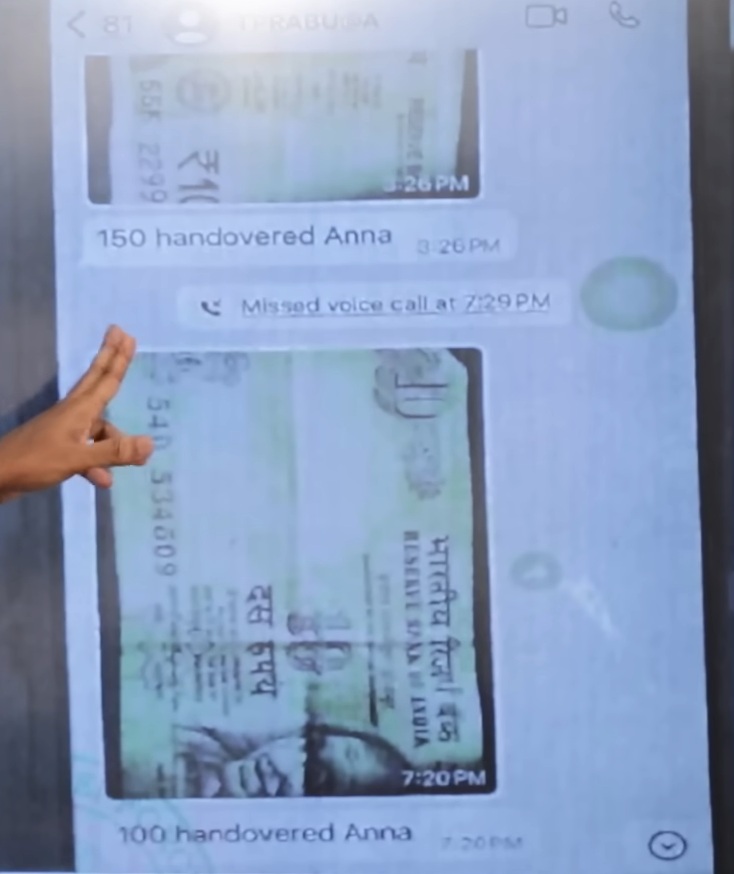
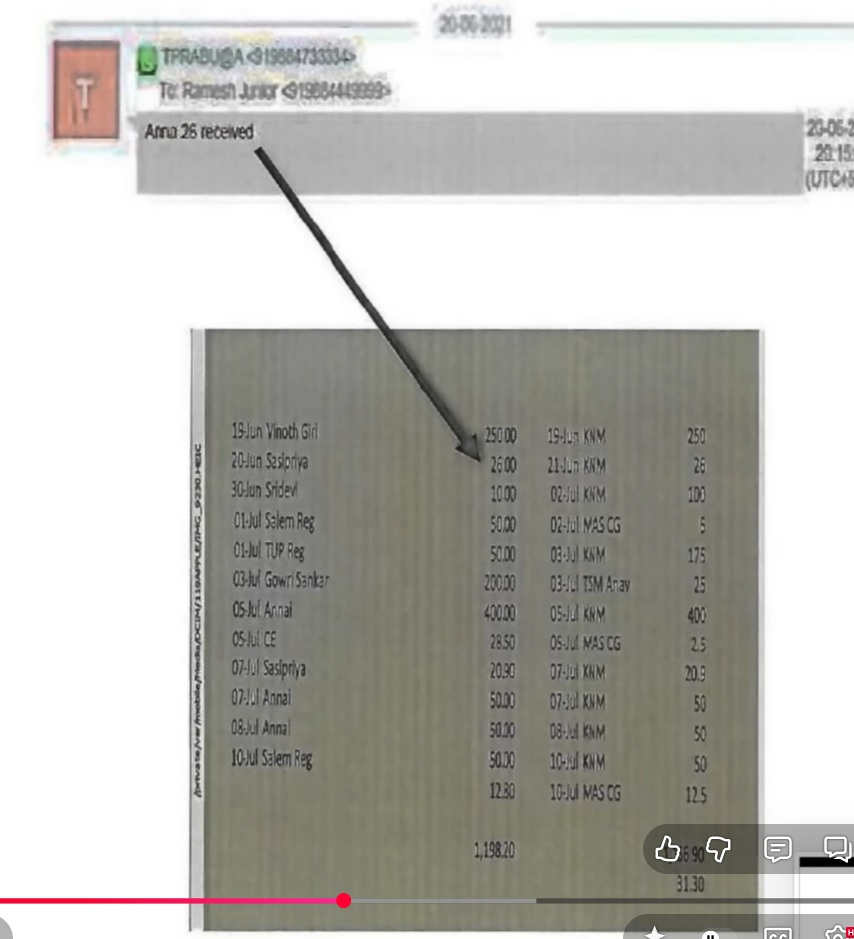
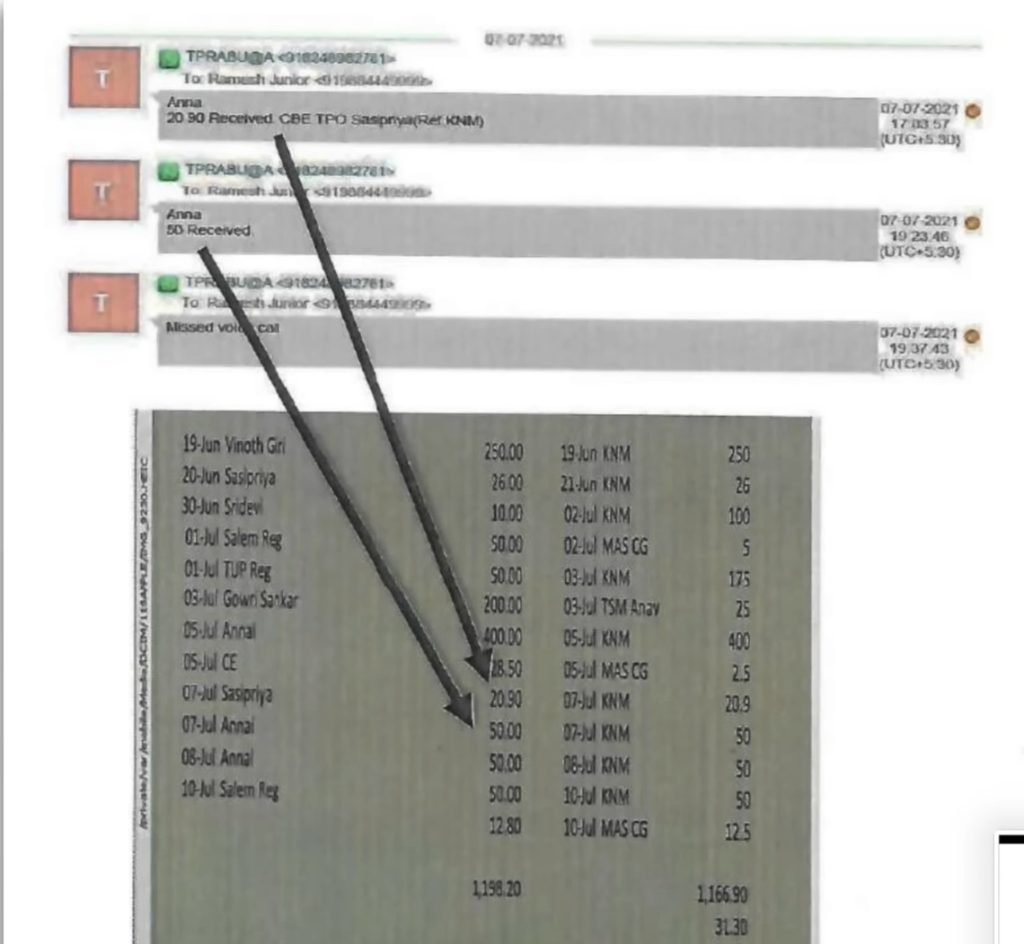
According to material cited in the Enforcement Directorate’s dossier, investigators analysed digital evidence purportedly recovered from the phone of D Ramesh, an employee linked to entities associated with Minister K. N. Nehru’s family. The agency notes that chats between Ramesh and one T Prabhu repeatedly referenced cash “hand over” entries alongside photographs of ₹10 notes, which investigators interpret as token markers in an alleged hawala settlement mechanism.
Image Source: MaridhasImage Source: Maridhas
In several instances, figures such as “76” and “124” were recorded, which the ED claims correspond to ₹76 lakh and ₹1.24 crore respectively, suggesting systematic cash movement.
Image Source: MaridhasImage Source: Maridhas
The dossier further alleges that once cash was handed to intermediaries, the photographed ₹10 note numbers were used as identifiers to facilitate settlement through overseas channels, including entities linked to Dubai. Investigators also flag deposits allegedly routed through multiple accounts, described as suspected shell entities, using party-linked operatives.
Image Source: Harish X handle
Parallel extractions from the phone of Kavi Prasad, described as a close associate of K. N. Manivannan (brother of the minister), reportedly indicate his role as a liaison point connecting contractors, officials and political functionaries.
Image Source: Maridhas
The ED notes chats referencing appointments with the DMK first family including MK Stalin’s son-in-law Sabareesan, PA of Durga Stalin, etc ad also other chats about advance-linked tender discussions.
Image Source: Maridhas
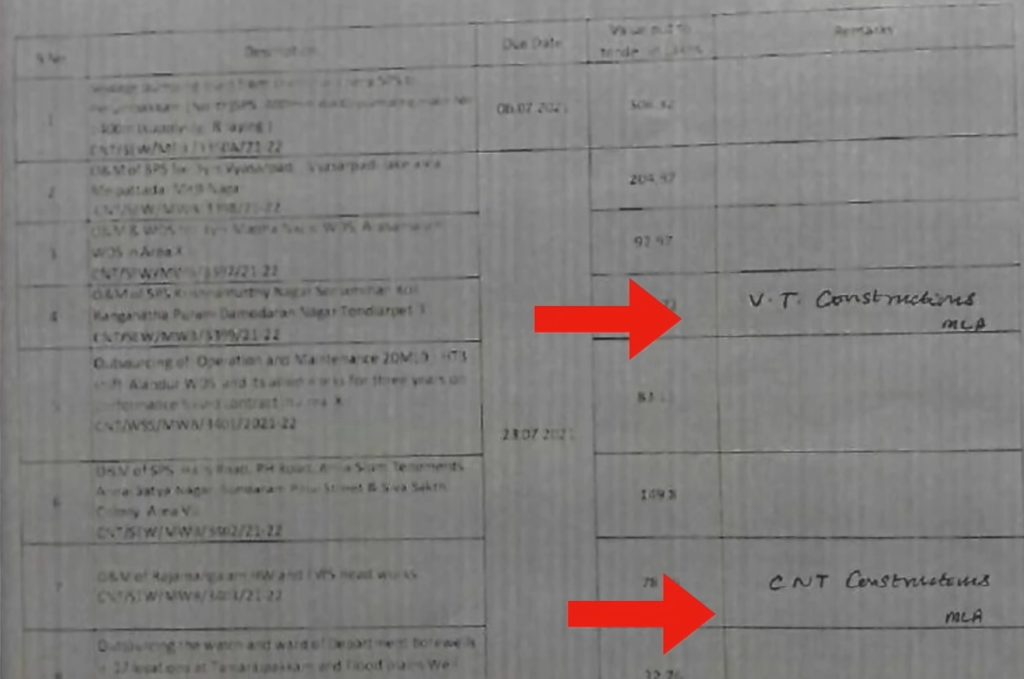
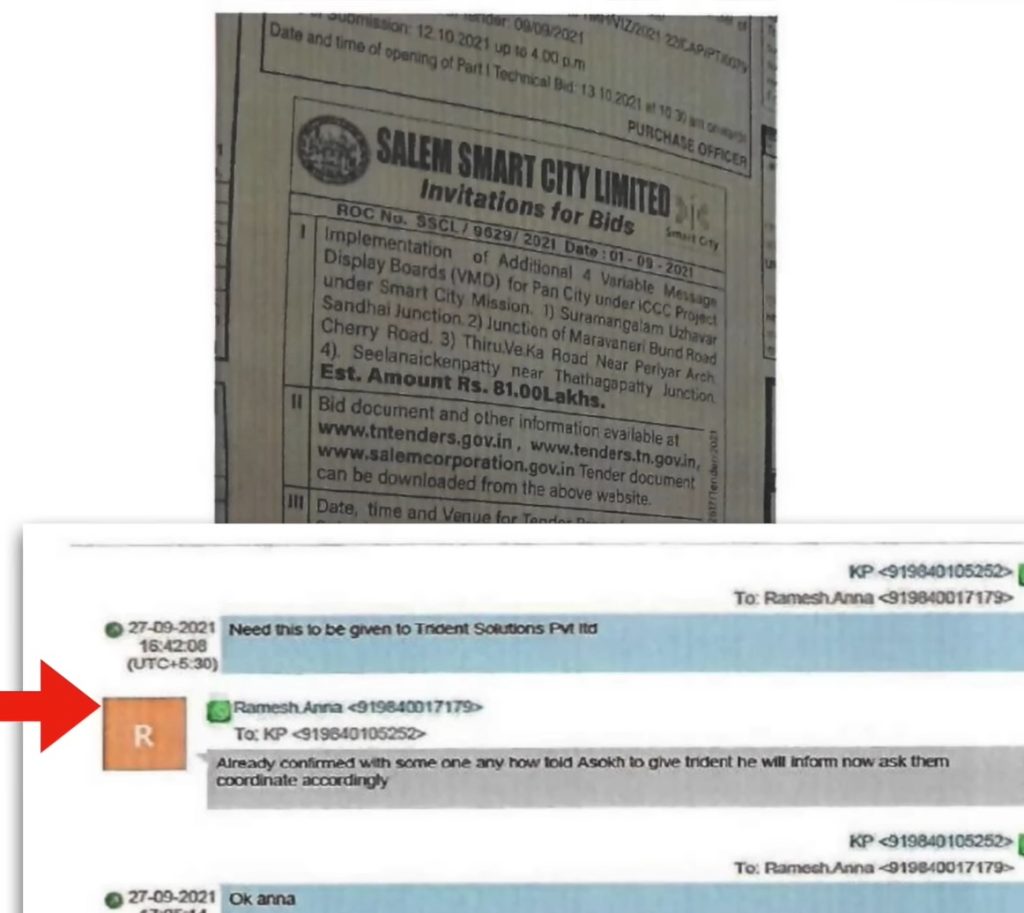
In tender-related communications, the agency claims certain works, including Smart City digital board projects, appeared to be earmarked in advance for specific firms such as VT Constructions, CNT Constructions and Trident Solutions, with alleged commission demands in the range of 10–15%.
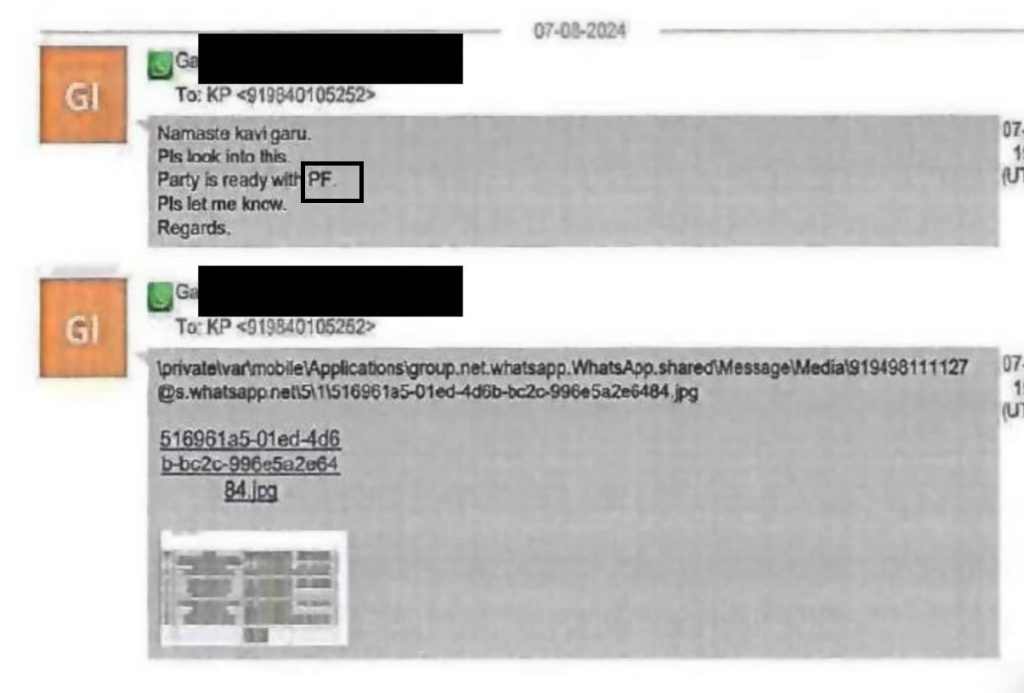
One message cited in the dossier refers to “PF” or “party fund” readiness in connection with a ₹19-crore project, which investigators interpret as a 10% cut.
The material also references internal acknowledgements in KN Manivannan’s chats showing amounts marked “received,” which the ED says mirror earlier handover entries.
Image Source: MaridhasImage Source: Maridhas
Based on a limited six-to-eight-month slice of these communications, the agency estimates that roughly ₹1,020 crore may have been moved through the suspected network, though it notes that larger financial flows linked to the department’s annual outlay, estimated in the dossier at ₹80,000 crore to ₹1 lakh crore, would require deeper forensic verification.
Image Source: Maridhas
This information is based on the chats between 3 people over the above timeline alone. The chats show a pattern commonly associated with hawala transactions – an illegal value-transfer system in which physical cash is settled through parallel networks rather than formal banking channels. The repeated sharing of specific ₹10 note numbers, the “hand over” confirmations, and references to overseas settlement points such as Dubai are cited in the dossier as indicators of off-book fund movement. Investigators state that offshore movement of such funds, if established, could have broader economic implications.
Bureaucratic And Political Links Cited
The dossier references communications involving multiple IAS and IPS officers, as well as elected representatives. An IAS officer from Salem is alleged to have provided a report to Kavi Prasad in response to a complaint routed through the Chief Minister’s Office, which Prasad then relayed back to the CMO.
There are many IPS officers whose communications are referenced. The ED says these exchanges form part of the digital evidence under examination.
The note also names several elected representatives, including Sudharshan, A.P. Nandhakumar, Ebenezer (RK Nagar MLA), and DMK MP Kalanithi, who are alleged to have shared tender lists or project details via messaging platforms.
Image Source: Harish X handle
Allegations Of Pre-Fixed Tenders
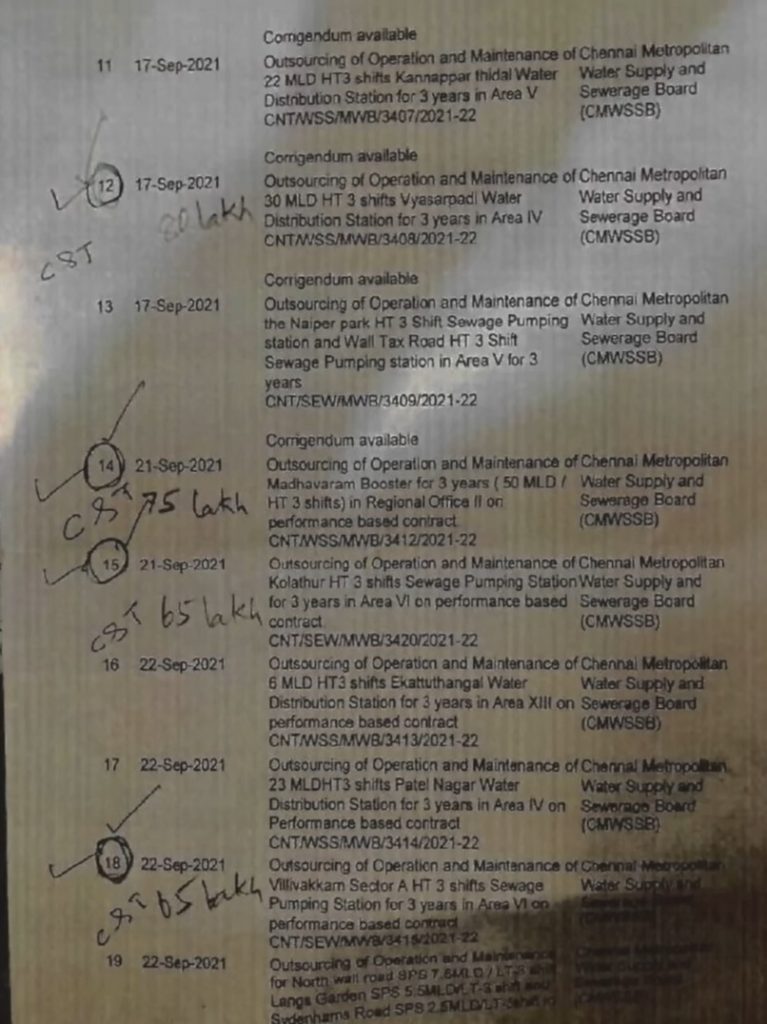
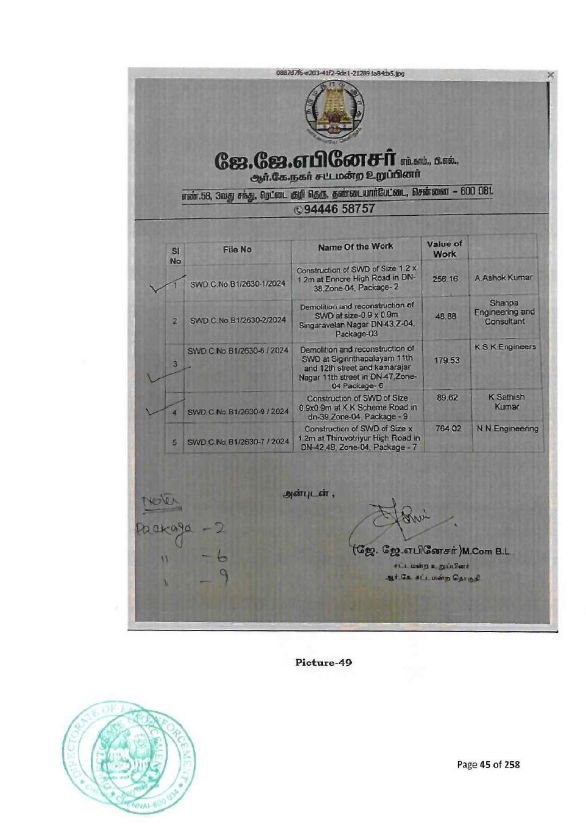
One of the most serious aspects of the ED’s findings concerns the alleged pre-allocation of works. The dossier claims investigators recovered photographs of tender lists that were circulated while bid deadlines were still open but already had contractor names handwritten next to specific projects.
In multiple chats cited by the agency, contractors allegedly asked whether particular works were available, to which the reported reply was: “All above tenders already blocked.” The ED interprets this language as indicating that certain tenders were treated as pre-decided inventory rather than competitive procurements.
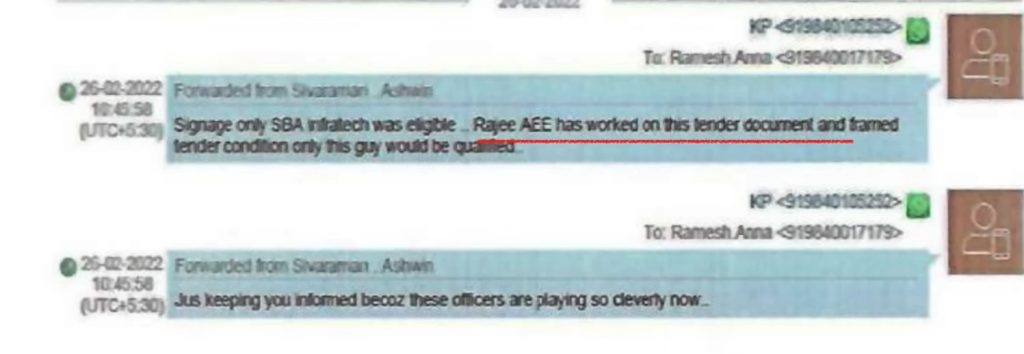
The note further alleges that eligibility criteria for some tenders were framed or modified in advance to suit particular contractors, with retired Chief Engineer Ponnambalam named as having assisted in this process.
Advance Collections And Code Language
The ED claims some chats suggest that up to 50% of the alleged commission was collected even before bid closure. Investigators also say coded financial shorthand was used in conversations, including references such as “50” for ₹50 lakh and “5 books” for ₹5 crore. In one cited exchange, an IPS officer allegedly wrote that the “Party [is] ready with PF.”
Alleged Money Trail
The dossier contains a dedicated section on suspected fund movement. According to the ED, proceeds from the alleged commission system were layered through bank transfers, domestic hawala operators, and international hawala channels before final settlement. Investigators say they recovered material indicating serial-number tracking of currency bundles, photographs of cash packets, and calculation sheets tied to specific contract values.
Stalin Family – Ultimate Beneficiary
In what is perhaps the most politically sensitive portion of the note, the ED states in Para 9.8 (pages 51–52) that the “Party Fund” referenced in communications was allegedly collected for the benefit of the ruling DMK. The document notes that the DMK is headed by Chief Minister MK Stalin and further alleges that the ultimate beneficiaries of such collections include Stalin and Deputy Chief Minister Udhayanidhi Stalin.
Image Source: X
The agency’s reasoning, as described in the communication, is based on Stalin’s position as party chief. The dossier does not state that the ED has opened any investigation into the personal assets of either leader.
Sources close to Kavi Prasad have denied the allegations and indicated they view the action as politically motivated.
Engineers’ Contribution?
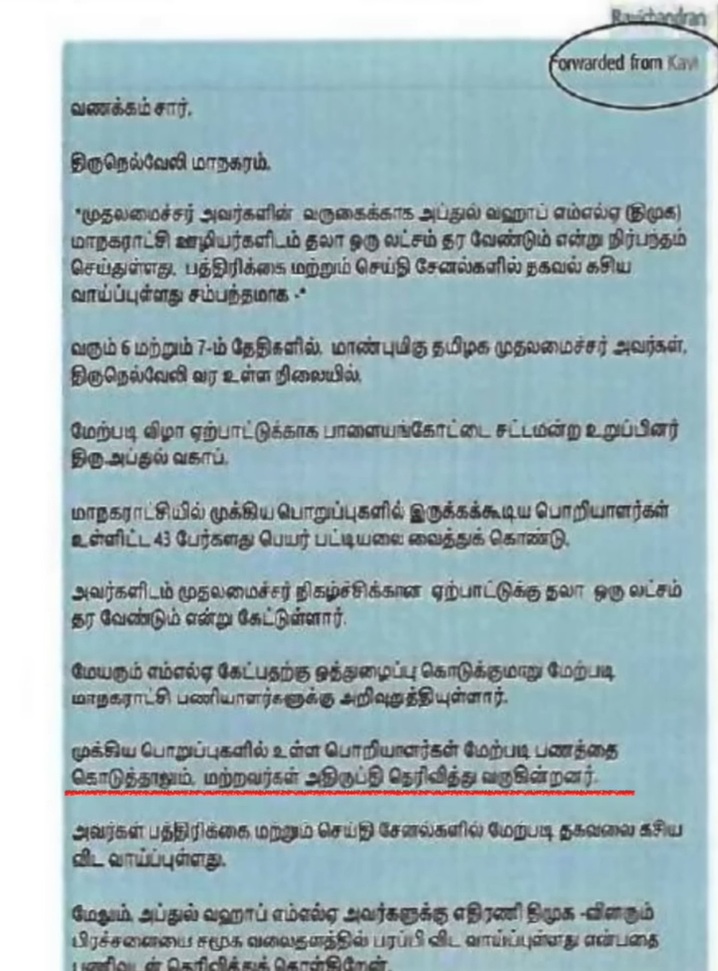
The ED also cites a message recovered from the phone of N. Ravichandran, attributed to Kavi Prasad, referring to ₹1 lakh contributions allegedly collected from 43 MAWS engineers and officers for organising an official function connected to the Chief Minister in Tirunelveli.
Image Source: Maridhas
Investigators present this as further evidence of informal fund collection mechanisms.
🚨🔺Going through the ED dossier details I have as of now. (KN Nehru)
The evidences point to an alleged tender manipulation network involving municipal infrastructure contracts in Tamil Nadu.
With the High Court’s directive now in force, the DVAC is required to formally register a case and carry out a comprehensive probe into the alleged tender manipulation and associated financial flows. The outcome of that investigation will determine whether the ED’s explosive claims translate into prosecutable evidence.
Subscribe to our channels on Telegram, WhatsApp, and Instagram and get the best stories of the day delivered to you personally.
The National Human Rights Commission (NHRC) has taken cognisance of a complaint concerning jewellery major Malabar Gold & Diamonds following controversy over the company’s invitation to a social media influencer accused by critics of making anti-India remarks.
In a communication dated 20 February 2026, the Commission noted that the complaint alleged potential violations of human rights and directed multiple authorities to submit an Action Taken Report within two weeks. The notice was issued under Section 12 of the Protection of Human Rights Act, 1993.
The NHRC registry instructed the Joint Secretary (IS-I), Ministry of Home Affairs, the Secretary, Ministry of Corporate Affairs, and the Director General of Police, Kerala, to examine different aspects of the complaint, including regulatory compliance and public order concerns. The Commission observed that the allegations in the complaint, at a prima facie level, appeared to raise human rights issues warranting examination.
NHRC has taken cognizance against Malabar Gold and issued a notice.
They had started to think that they were too powerful to be touched….
The development follows a public backlash against Malabar Gold & Diamonds over its Birmingham showroom expansion event held on 6 September 2025. The event, which featured actor Kareena Kapoor Khan, reportedly included Pakistani Instagram influencer Alishba Khalid among the invitees.
Social media criticism intensified after Khalid’s past posts, since deleted, circulated online. These posts had criticised India’s “Operation Sindoor,” described it as a “cowardly act,” and included slogans supportive of Pakistan. Some users also flagged earlier remarks attributed to her expressing indifference toward Indian followers.
The controversy quickly escalated online, with critics questioning the company’s vetting process for event invitees.
Company’s Legal Response
Amid mounting criticism, Malabar Gold & Diamonds approached the Bombay High Court seeking relief against what it described as defamatory social media content linking the brand to the influencer’s political views.
During proceedings on 29 September 2025, before Justice Sandeep V. Marne, the company’s counsel submitted that Khalid’s engagement had been handled by a third-party agency, JAB Studios, and was finalised before the Pahalgam attack and before her controversial posts surfaced. The company told the court it was unaware of her alleged anti-India stance at the time and had since severed ties.
The company further argued that the online campaign against it was a strategic attempt by competitors to damage its business during the festive season.
The High Court granted an ad-interim injunction directing social media platforms to take down 442 identified URLs and restrain further publication of the impugned material.
The legal move itself triggered further debate. The company was accused of attempting to suppress public criticism rather than addressing concerns about due diligence in selecting event participants.
Among the vocal critics has been social media user Vijay Patel (@vijaygajera), who publicly questioned the company’s actions. Patel later stated that a legal notice issued to him warned of possible detention in civil prison for up to three months for alleged non-compliance with the court’s order.
In posts shared online, Patel stated he was prepared to face legal consequences over the issue. Excerpts of the notice circulated on social media seek removal of his tweets and reference possible civil prison action, though the matter remains subject to legal process.
What the NHRC Notice Says
According to the NHRC communication, the complainant alleged that Malabar Gold & Diamonds had collaborated with a Pakistani social media influencer who had publicly mocked the Indian Armed Forces and criticised India’s counter-terror operations. The complaint further raised questions relating to corporate due diligence, cross-border financial compliance, and regulatory adherence under Indian law.
The Commission noted that the allegations, at the preliminary stage, appeared to involve possible human rights concerns and therefore warranted examination by the concerned authorities.
Officials have been asked to submit their Action Taken Reports within two weeks of receipt of the notice.
Subscribe to our channels on Telegram, WhatsApp, and Instagram and get the best stories of the day delivered to you personally.
Delhi Police on Saturday, 21 February 2026, arrested six Bangladeshi nationals residing in Tiruppur for allegedly posting content on social media in support of a Pakistan-based terrorist organisation.
The action follows an ongoing investigation into online posts backing terrorists involved in the Red Fort blast incident. During digital surveillance, Delhi Police reportedly identified several individuals living in Tiruppur who had shared posts supporting banned terror groups.
Acting on the intelligence, a Delhi Police team arrived in Tiruppur and conducted inquiries at multiple locations. The suspects were found hiding in Uthukuli, Palladam and Thirumuruganpoondi areas.
Police arrested two persons from Uthukuli, three from Palladam and one from Thirumuruganpoondi, taking the total number of Bangladeshi nationals held to six.
Preliminary information indicates that the accused not only posted supportive content for Pakistan-based terrorist organisations on social media but are also suspected of conducting reconnaissance and passing information to terrorist handlers. Officials said the angle is under investigation.
Authorities further stated that the six individuals had allegedly entered India illegally using forged documents.
During the operation, police seized eight mobile phones and sixteen SIM cards from the accused. Further interrogation is underway in connection with the Red Fort blast case, police said.
The Madras High Court has held that denying members of the Scheduled Caste community access to a public burial ground constitutes a criminal offence under the Scheduled Castes and the Scheduled Tribes (Prevention of Atrocities) Act, 1989 and amounts to untouchability prohibited under Article 17 of the Constitution.
The observation came while a Bench of Justice V. Lakshminarayanan disposed of a batch of three writ petitions concerning lands at Thiruvengadampalayam Hamlet in Karumandisellipalayam Town Panchayat, Perundurai Taluk, Erode district.
The court noted that although the survey lands were classified in revenue records as “cart track poromboke,” several villagers claimed the site had been used as a burial and cremation ground for decades.
Conflicting Petitions Before Court
The first writ petition was filed by a landowner seeking to restrain authorities from reclassifying the land as a burial ground and to prevent any burial or cremation there. He contended the land functioned as a cart track providing access to his property and alleged attempts were being made to convert it into a graveyard.
The second petition, filed by another resident, sought reclassification of the land as a designated burial and burning ground. He alleged that in August 2025, private individuals had uprooted trees, removed headstones and levelled graves using machinery.
The third petition sought strict enforcement of burial rules and prayed for exhumation of the body of a man buried there on 21 October 2025, arguing that burial in the cart track was unlawful.
In view of the competing claims, the court had earlier directed the District Collector to conduct an enquiry.
Tahsildar Report ‘Extremely Disturbing’
The Special Tahsildar’s report found that though the survey numbers were recorded as cart track, portions of the land had been used as a burial ground for more than 70 years. The report also confirmed that graves had been disturbed and levelled using machinery.
It specifically recorded that members of the Arunthathiyar (Scheduled Caste) community were utilising parts of the land for burials and that graves in those areas had been levelled.
Taking note of the findings, the Bench described the report as “extremely disturbing”.
Court on Dignity and Untouchability
The High Court reiterated that the dignity of the dead is protected under Article 21 of the Constitution and that the right to dignity extends even after death. The destruction of graves, the court said, affects not only the deceased but also their surviving relatives.
Significantly, the court observed that denying persons from a marginalised community access to a public burial or cremation ground constitutes a criminal offence under the SC/ST (Prevention of Atrocities) Act. Such denial, it noted, amounts to practicing untouchability, which stands abolished under Article 17.
The court also faulted authorities for failing to initiate criminal proceedings after the levelling of graves was brought to their notice, stating that appropriate penal provisions ought to have been invoked.
Legal Position Clarified
On the statutory framework, the court clarified that the Karumandisellipalayam body is a Special Grade Town Panchayat governed by the Tamil Nadu Urban Local Bodies Act, 1998, and not the Tamil Nadu Panchayats Act, 1994.
Referring to Section 172 of the 1998 Act and the Tamil Nadu Local Urban Rules, 2023, the court noted that burial or cremation must ordinarily take place in registered or licensed grounds.
However, relying on historical material, including a 2000 Town Panchayat resolution describing a road as “Cemetery Road”, the court concluded that a burial ground existed at least from that year.
It rejected the argument that the presence of a modern crematorium 1.5 km away automatically barred cremation at the site, observing that any such prohibition would require a formal notification by the council.
Directions Issued
Disposing of the second writ petition, the court directed the District Collector to:
ensure segregation and proper fencing of the burial and cremation areas,
keep the site free from encroachment and garbage dumping,
act on the Town Panchayat’s resolution seeking reclassification, and
initiate appropriate action against those responsible for levelling the graves.
The other two writ petitions, seeking to restrain burials and to order exhumation, were dismissed.
Expressing strong displeasure over the commercial use of an ancient temple structure, the Madras High Court’s Madurai Bench has ordered the immediate removal of all encroachments from the ‘Kanniyambalam’ Kal Mandapam of the Arulmigu Kanyakumari Bagavathi Amman Thirukovil and directed authorities to seal the structure.
A Division Bench comprising Justice G. Jayachandran and Justice K.K. Ramakrishnan came down heavily on the Hindu Religious and Charitable Endowments (HR&CE) Department, observing that the heritage structure had been exploited “for financial gain” and that debris and construction materials were being stored inside the mandapam.
The court was hearing a writ petition filed by Nagarajan, who sought restoration of the mandapam to its original condition by removing structures put up by rental shop owners. He had also requested consideration of his representation dated June 26, 2025.
The Bench noted that photographs previously placed on record showed shops located outside the temple had extended brickwork into the mandapam. In an earlier order dated 22 September 2025, the court had directed that such brickwork be removed “immediately and forthwith” and had made it clear that no commercial activity could take place inside the temple mandapam.
However, in its order dated 10 February 2026, the court recorded that the situation reflected a deeper failure. The Bench said it was “shocked” to see how an ancient structure containing sculptures with excellent artistic work had been let out for rent by the HR&CE Department “unmindful of their responsibility to protect the antique structure.” It further noted that waste materials, construction debris and other discarded items were being kept inside the mandapam.
During the proceedings, persons occupying the mandapam and surrounding areas and carrying on commercial activities were impleaded as respondents 6 to 16. They claimed to be tenants under the HR&CE Department. The order records that their Special Leave Petition before the Supreme Court had been dismissed.
Rejecting their claim, the court held that the private respondents could not occupy or damage antique and ancient temple structures on the strength of what it termed illegal permission granted by the Joint Commissioner of the HR&CE Department. The Bench went further to observe that the Joint Commissioner had been involved in exploiting the temple property for financial gain.
Warning that allowing the occupants to continue even for a day longer would lead to further deterioration of the structure, the court said urgent intervention was necessary to arrest the damage.
The Bench directed the Joint Commissioner, HR&CE Department, Kanyakumari, to take police assistance, remove the entire encroachment, seal the mandapam and file a compliance report along with photographs.
Significantly, the court also indicated that the failure to protect the temple property would not go unexamined, stating that further course of action against the erring officials would be considered at the next hearing.
Tamil Nadu’s higher education sector has come under scrutiny after a new analysis showed that engineering colleges affiliated with Anna University recorded the highest number of research paper retractions in 2025.
According to data cited by India Research Watch from the Retraction Watch Database, as many as 161 research articles published between 2019 and 2024 by Anna University-affiliated engineering colleges were withdrawn by journals in 2025. Nearly half of these retracted papers were from the computer science and information technology domains.
The development comes even as Anna University topped the global list of institutions with the highest number of retractions – an “honour” observers say reflects deeper systemic concerns rather than academic achievement.
Reasons Behind the Retractions
Research journals cited multiple grounds for withdrawing the papers, including unreliable results, concerns over references and attribution, the use of computer-generated content, third-party investigations and compromised peer review processes.
Nationally, 887 research articles were retracted in 2025, while China continued to lead globally with 1,701 retractions, according to the data highlighted in the report.
Experts noted that AI-generated content is emerging as a significant challenge for academic publishing. Achal Agrawal, founder of India Research Watch, said many retractions linked to computer-generated material occur because authors fail to disclose AI usage or because AI tools produce fabricated references that are later detected by journals.
Wider Institutional Impact
The issue is not limited to Anna University’s affiliated colleges. The analysis showed that several prominent deemed universities from Tamil Nadu also featured among institutions with high retraction counts in 2025.
These include:
Saveetha Institute of Medical and Technical Sciences (SIMATS) – 159 retractions
Vellore Institute of Technology (VIT) – 48 retractions
SRM Institute of Science and Technology (SRMIST) – 38 retractions
Concerns Over Research Quality
Former Anna University vice-chancellor M. K. Surappa described the data as “very shocking” and said the university should establish a research integrity office to monitor publication quality. He warned that research misconduct in India had reached “epidemic proportions.”
Policy researchers also flagged structural issues. Moumita Koley of the DST-Centre for Policy Research at IISc, Bengaluru, said the pressure to publish has led to questionable practices, including instances where even undergraduate and postgraduate students were producing papers with unreliable data. She added that weaknesses in journal peer-review systems were also contributing to the problem.
Agrawal argued that the current National Institutional Ranking Framework (NIRF) places heavy emphasis on publication volume, which may be incentivising quantity over quality. Although a retraction penalty was introduced last year, he said the deterrent effect remains weak and evaluation metrics need urgent reform.
Institutions Respond
Anna University officials indicated that university departments and constituent colleges were not directly involved in the specific retractions but said new regulations would be framed.
SIMATS, in an official statement, said it already has a designated research integrity officer and robust governance policies. The institution maintained that most retractions linked to it were procedural actions by journals rather than cases of data manipulation. It also argued that given its high publication volume, absolute retraction numbers without proportional context could be misleading and that its retraction rate remains within global norms when measured as a percentage.
VIT vice-chancellor SB Kanchana Bhaskaran said many of the affected papers came from special journal editions that were later withdrawn in full and had not undergone standard peer review. She added that the percentage of retracted papers was very small compared with the university’s overall research output.
Experts warned that the rise of AI-assisted writing, inconsistent disclosure norms and uneven peer-review standards are creating new risks for academic integrity. Without stronger oversight and revised evaluation metrics, they cautioned, the credibility of institutional research output could face increasing scrutiny.
161 research papers from Anna University retracted in 2025. Computer science alone accounting for nearly half. Unreliable results, AI-generated content, compromised peer review
Serious credibility crisis for TN’s premier state-run institution already reeling from reputational… pic.twitter.com/53TEuNvMnJ
Anna University and its affiliated institutions have always been in one controversy or the other. In 2024, an investigation exposed widespread “ghost faculty” malpractice in private engineering colleges across Tamil Nadu. The probe found hundreds of teachers simultaneously listed as full-time staff in multiple institutions, with some appearing in up to 11–22 colleges. University analysis of 52,500 faculty records identified 676 such cases in 2023–24 and 686 in 2022–23. Show-cause notices were issued to nearly 295 colleges, and repeat offenders face blacklisting.
Back in 2017-18, the Anna University “paper chasing” scandal involved alleged manipulation of revaluation marks for bribes, not question paper leaks. Uncovered in 2018, the fraud centred on April-May 2017 engineering exam revaluations. Of 3.02 lakh applicants, 73,733 passed and 16,636 saw suspicious mark jumps, with students allegedly paying about ₹10,000 per paper to agents who altered answer sheets or signalled evaluators. Former Controller of Examinations G.V. Uma was the prime accused, and DVAC booked several professors and staff. The scam, believed to have run for nearly a decade, led to suspensions, firings, and lasting damage to the university’s credibility.
Subscribe to our channels on Telegram, WhatsApp, and Instagram and get the best stories of the day delivered to you personally.
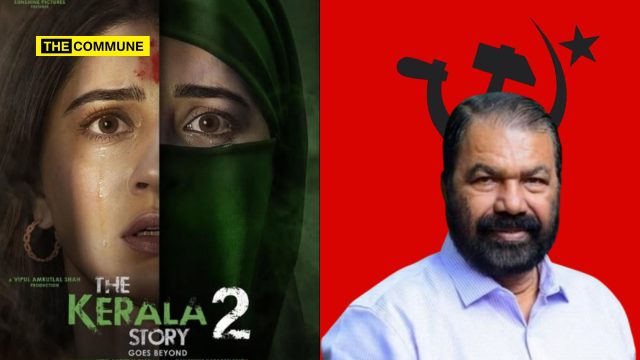
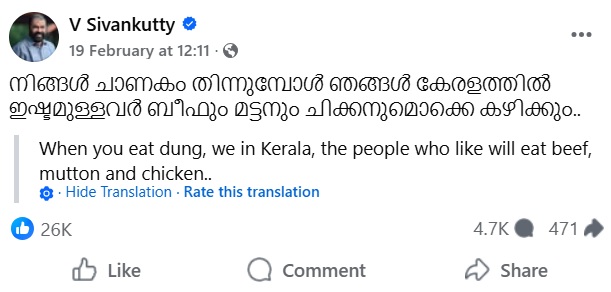
Kerala General Education Minister V Sivankutty has triggered fresh political controversy after posting a sharply worded remark on Facebook amid the ongoing debate over the upcoming film The Kerala Story 2: Goes Beyond.
In the social media post, Sivankutty wrote in Malayalam that while others may choose to “eat cow dung,” people in Kerala would eat whatever they prefer, including beef, mutton and chicken. He wrote, “When you eat cow dung, we in Kerala will eat whatever we like – beef, mutton, chicken, and so on.”
The comment quickly drew attention online and added to the already charged political atmosphere surrounding the film’s release.
Earlier, on 19 February 2026, Kerala CM Pinarayi Vijayan took to X to expose his meltdown to the upcoming sequel, describing the earlier film as “hate-mongering” and accusing the new instalment of pursuing a communal agenda. He said Kerala had already rejected what he termed the “blatant lies” of the first film and would again resist attempts to demonise the State’s secular fabric.
Vijayan also questioned what he described as a double standard in the treatment of artistic expression, stating that fabricated narratives that incite communal discord appear to receive a free pass while critical art is suppressed. He called for unity against efforts to portray Kerala as a hub of extremism.
He wrote, “The reports regarding the release of a sequel to the hate-mongering film ‘The Kerala Story’ should be seen with utmost gravity. Having already seen through the communal agenda and blatant lies of the first part, Kerala will once again reject this attempt to demonise our secular fabric with contempt. It is shocking how fabricated narratives aimed at inciting communal discord receive a free pass, while critical expressions of art get gagged. We must stand united against these attempts to paint our land of harmony as a hub of terror. The truth shall always prevail.”
The reports regarding the release of a sequel to the hate-mongering film ‘The Kerala Story’ should be seen with utmost gravity. Having already seen through the communal agenda and blatant lies of the first part, Kerala will once again reject this attempt to demonise our secular…
The sequel, directed by Sudipto Sen and produced by Vipul Amrutlal Shah under the Sunshine Pictures banner, is scheduled for theatrical release on 27 February 2026. The trailer, unveiled on February 17, has already sparked political and public debate similar to the controversy surrounding the original 2023 film.
According to the makers, the sequel presents three parallel narratives involving Hindu women who allegedly face coercion and religious conversion after relationships with Muslim men. The storylines span Rajasthan, Madhya Pradesh and Kerala.
The original The Kerala Story had generated nationwide controversy over its portrayal of alleged forced conversions and recruitment by the Islamic State. Despite the backlash, the film went on to win two honours at the 71st National Film Awards, including Best Director for Sudipto Sen and Best Cinematography for Prasantanu Mohapatra.
Subscribe to our channels on Telegram, WhatsApp, and Instagram and get the best stories of the day delivered to you personally.
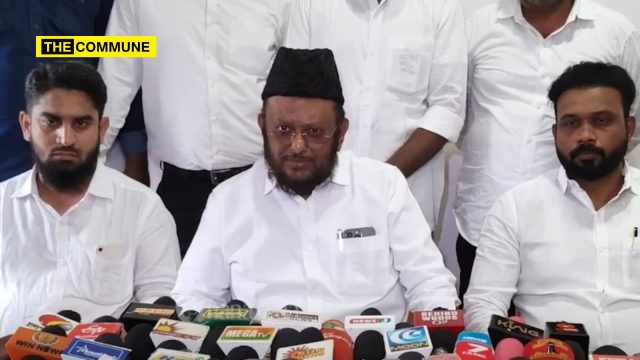
Manithaneya Makkal Katchi (MMK) president and MLA Prof. MH Jawahirullah on Friday, 20 February 2026, took to his X handle to strongly criticise the Maharashtra government’s reported decision to cancel the 5% reservation for Muslims in education and employment.
In a statement, Jawahirullah said that during the tenure of the Congress–Nationalist Congress Party alliance government in Maharashtra, reservations had been introduced on the basis of social justice, providing 16 percent for Marathas and 5 percent for Muslims. He alleged that the present BJP-led government in the state had now moved to completely withdraw the quota for Muslims.
Jawahirullah contended that the Muslim reservation had earlier been upheld by the Bombay High Court and accused the state government of first failing to fully implement the provision and now abolishing it altogether. He described the move as one that undermines both the law and the judiciary.
The MMK leader further alleged that retaining the Maratha quota while cancelling the Muslim reservation reflected what he termed a pattern of discrimination against minorities. He maintained that reservation should be viewed not as a political concession but as a social justice mechanism intended to uplift historically marginalised communities.
According to Jawahirullah, the decision would further distance the Muslim community from access to education, employment and positions of authority. He characterised the move as contrary to the constitutional values of equality, social justice and fraternity.
On behalf of his party, Jawahirullah urged the Maharashtra government to immediately restore the 5% reservation for Muslims.
மராட்டியத்தில் முஸ்லிம்களுக்கான இடஒதுக்கீடு ரத்து: அரசியலமைப்பை அவமதிக்கும் மிகப்பெரிய சமூக அநீதி
மனிதநேய மக்கள் கட்சியின் தலைவர்
பேராசிரியர் எம். எச். ஜவாஹிருல்லா, எம்எல்ஏ
வெளியிடும் அறிக்கை
மகாராஷ்டிரா மாநிலத்தில், காங்கிரஸ் – தேசியவாத காங்கிரஸ் கூட்டணி ஆட்சிக் காலத்தில்,…
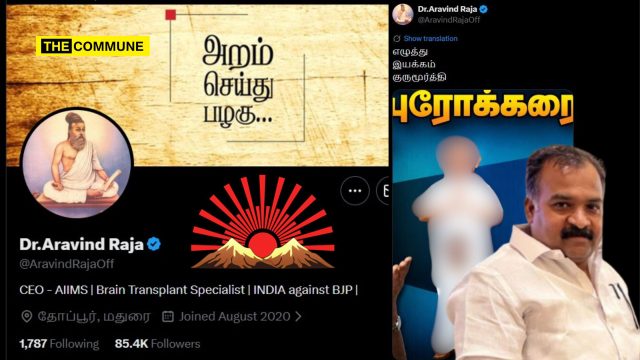
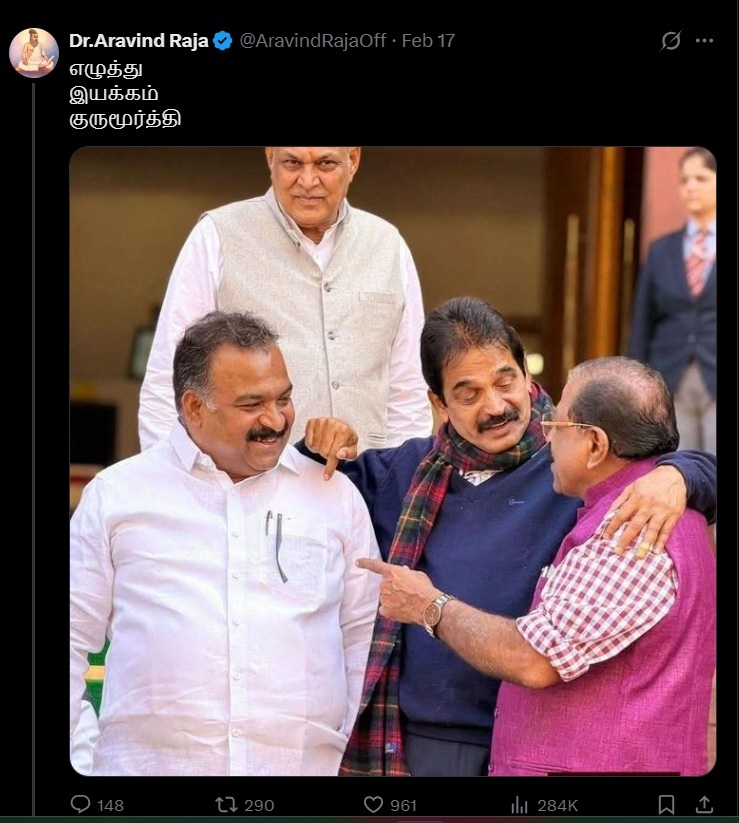
With Congress leader Manickam Tagore firing salvo after salvo each passing day at the DMK, reminding the party that the Congress is demanding a share in power as well as an increase in seat allocation for the upcoming Assembly elections in Tamil Nadu, DMK-supporting Dravidianist “Dr” Aravind Raja on 17 February 2026 picked a picture featuring Tagore and a few other Congress leaders and claimed Tagore was being “directed” by Thuglaq editor S Gurumurthy.
In his post, Aravind Raja shared a photograph featuring Tagore alongside other Congress leaders and claimed Gurumurthy was seen “directing” him. He captioned the image, “Script, direction Gurumurthy”
However, it later emerged that the person in the photograph was not Gurumurthy.
Responding to the post, Gurumurthy wrote, “I wish I had so much hair (as Unnithan whose photo is shown as mine has) on my head which is almost 80% empty. I had this much hair as Unnithan 20 years as before when none of these guys were in politics… This idiot didn’t even choose a better photo to fake it as mine”
I wish I had so much hair (as Unnithan whose photo is shown as mine has) on my head which is almost 80% empty. I had this much hair as Unnithan 20 years as before when none of these guys were in politics… This idiot didn’t even choose a better photo to fake it as mine https://t.co/T2gikSY932
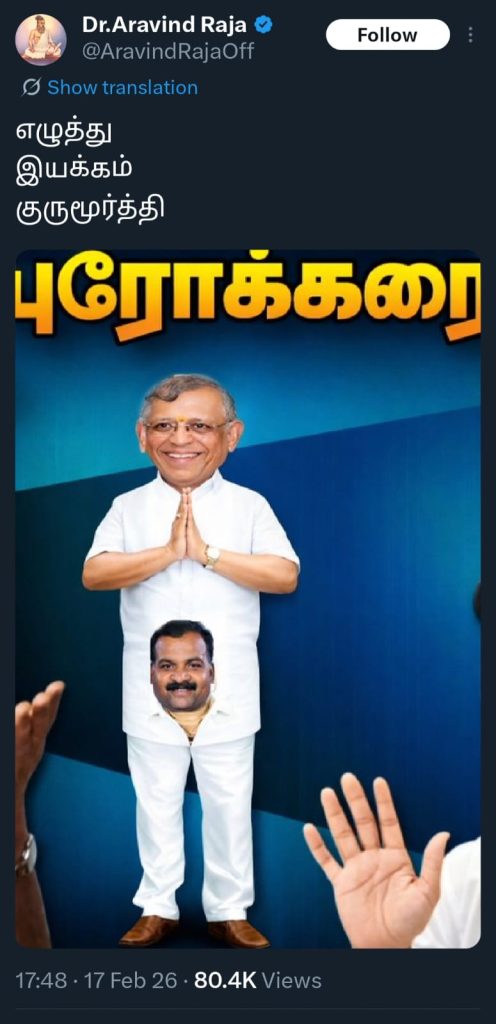
Despite the misidentification being publicly pointed out, Aravind Raja did not delete the post. He subsequently shared what critics described as an even more derogatory image targeting both Tagore and Gurumurthy.
Aravind Raja later came up with an even more derogatory image of Tagore and Gurumurthy as below:
The exchange appears to have been triggered by Gurumurthy’s earlier political assessment shared alongside a report regarding the DMK seeking action against Tagore. Gurumurthy had written, “If congress leaves DMK, inevitably joins TVK, DMK will be voted out, TVK will not win, NDA will win. Rahul will lose his most reliable ally at Delhi against Modi. With Cong turning enemy DMK will look like a fool having stood by Rahul. Congress needs DMK in Delhi and DMK needs congress in TN. It will be foolish for both to turn against each other. It will not be just loss of a friend for both but an enemy more for both. BJP will enjoy that happening.”
If congress leaves DMK, inevitably joins TVK, DMK will be voted out, TVK will not win, NDA will win. Rahul will lose his most reliable ally at Delhi against Modi. With Cong turning enemy DMK will look like a fool having stood by Rahul. 1/2 chttps://t.co/3fZacD9M5t