The Delhi Police recently arrested six suspects from Tamil Nadu for allegedly planning a major terrorist plot with the support of Pakistan’s intelligence agency, the ISI, and Bangladeshi terrorist organisations.
According to the Delhi Police, the suspects are being brought to the national capital for further investigation. Officials said a Bangladeshi national is among those arrested. Dozens of mobile phones and SIM cards were recovered from the accused during the operation.
Six suspects arrested from Tamil Nadu for planning a major terrorist plot with the support of Pakistan’s intelligence agency, ISI, and Bangladeshi terrorist organisations. Delhi Police are bringing all the suspects from Tamil Nadu to Delhi. A Bangladeshi citizen is among the…
The development triggered sharp political reactions in Tamil Nadu.
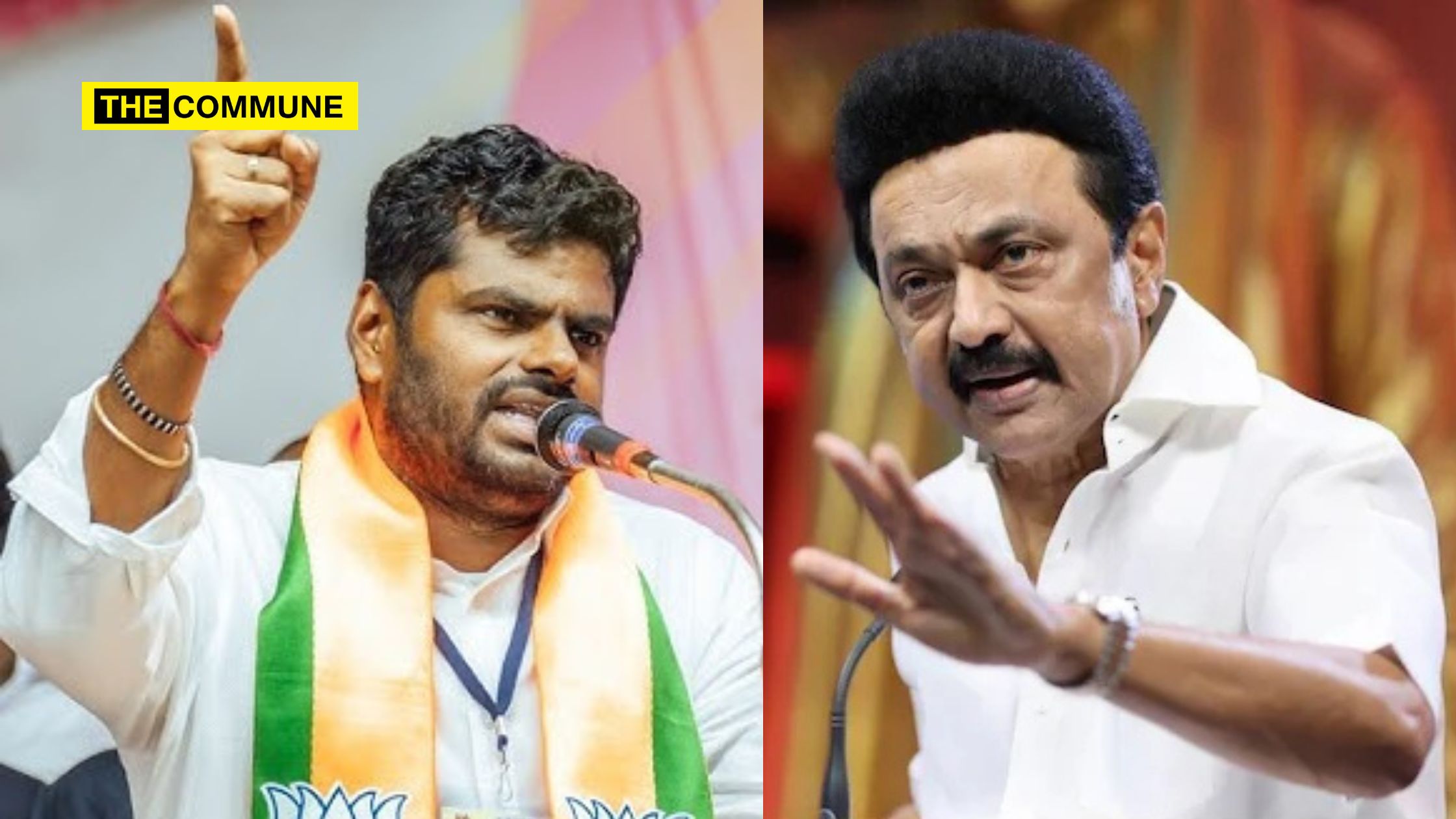
BJP leader K Annamalai, in a post on X, alleged that the DMK government had failed to maintain law and order in the state. He wrote that the “corrupt & incompetent DMK Govt has transformed a once peaceful state into a safe haven for terrorists, anti-social elements, international drug smugglers and ruthless criminals.”
He further stated that the state’s law and order situation was in disarray and alleged that capable civil servants were being diverted from governance priorities.
Annamalai also accused the ruling dispensation of remaining a “mute spectator” instead of acting in the interests of the state and the country.
The corrupt & incompetent DMK Govt has transformed a once peaceful state into a safe haven for terrorists, Anti-social elements, International Drug smugglers and ruthless criminals.
The law & order of the State is in shambles for the very reason. The most competent & respected… https://t.co/c9OSdrpcz4
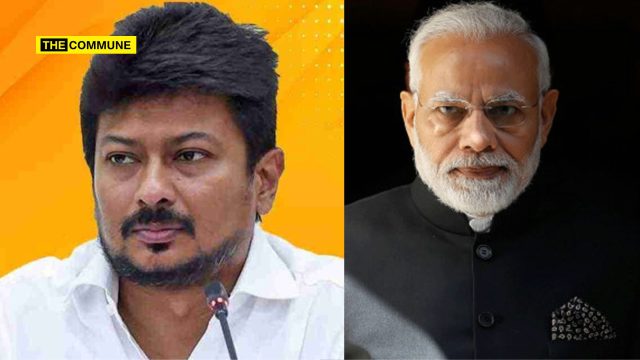
Tamil Nadu Deputy Chief Minister and DMK scion Udhayanidhi Stalin has sparked a political controversy after his sharp remarks targeting Prime Minister Narendra Modi during a recent address, drawing strong reactions ahead of the Assembly elections.
Speaking at a party event, Udhayanidhi criticised the Union government’s policies and leadership style. He said, “Union Prime Minister Mr. Modi appears on television from time to time. Whenever he appears on TV, people become anxious – wondering what he is going to say this time.”
Referring to past decisions of the Centre, he added, “In 2020, you will remember, one day he suddenly appeared on television and said coronavirus was coming and that the only way to handle it was for everyone to go inside their homes and remain shut in for a month.”
He added, “In 2016, in the same way, he suddenly came on TV and announced demonetisation, saying the ₹500 and ₹1000 notes people had would no longer be valid.” He further alleged that “so many people, hundreds of people died standing in queues under the sun.”
Contrasting the Centre with the state government, Udhayanidhi said the BJP-led Union government was “a government that snatches from the people,” while the DMK’s Dravidian Model government “always gives to the people.”
He also accused the Centre of attempting to undermine Tamil Nadu’s growth and rights, alleging efforts to impose Hindi and Sanskrit through the New Education Policy and claiming that the Union Budget had not allocated schemes for the state. He said, “The Union BJP government is now planning how to obstruct that progress. They are trying to take away every right – language rights, education rights, financial rights. By bringing the New Education Policy, they are trying to bring Hindi and Sanskrit into Tamil Nadu. Mr. Amit Shah and Mr. Modi, who never used to even look towards Tamil Nadu, have started coming frequently now that elections are approaching. Only they will come, but no funds will come to Tamil Nadu, no schemes will come.”
He added, “Recently the Union government presented its Budget. If you look at that Budget, no scheme was allotted to Tamil Nadu. But even before they finished reading the Budget fully, praise came from Tamil Nadu – from the Leader of the Opposition Mr. Edappadi Palaniswami. That is why today Edappadi Palaniswami is praising the Budget.”
Targeting AIADMK leader Edappadi K. Palaniswami, Udhayanidhi said, “We have seen many extreme devotees (murattu bhaktar)in politics; we have seen extreme party workers (murattu thondar). But today, Mr. Edappadi Palaniswami has become an “extreme slave” to Mr. Modi.” He further alleged that Palaniswami had progressively surrendered the AIADMK to the BJP between 2019 and 2026.
The Deputy Chief Minister’s most controversial remark came when he asserted, “Today across India they are trying to threaten movements using agencies like the ED and CBI. To all this, our leader gave a clear reply yesterday in Madurai – What cases will you file? Are these cases that DMK cadres have not seen before? The Dravida Munnetra Kazhagam is a movement that stood up even against the Army during the language struggle; it is a movement that faced MISA. Even if our lives go, we will never give up our self-respect. We will never give up Tamil Nadu’s rights.”
He added, “That is why I keep saying – we are not afraid of the ED, we are not afraid of Modi. Even if not Modi, even if Modi’s daddy comes, we are ready to face them.”
BJP’s Shehzad Poonawalla Hits Back At Udhayanidhi Stalin
Following this, the BJP launched a sharp attack on the DMK, with party leaders accusing the ruling party of lowering political discourse.
BJP national spokesperson Shehzad Poonawalla criticised both the DMK and its ally Congress, referring to last week’s protest at the India AI Impact Summit and Udhayanidhi’s earlier comments on Sanatan Dharma.
“Congress went shirtless, topless, and characterless in the way it protested at the AI Summit. Actually, it was not a protest; it was a disruption. And now the DMK, its ally, has gone senseless, ethicless, and moralless,” Poonawalla told news agency ANI.
Escalating his attack, Poonawalla alleged that Udhayanidhi Stalin had repeatedly made objectionable remarks.
“Udhayanidhi Stalin, who has given death threats to Hindus and called for the genocide of Hindus, is now targeting the Prime Minister’s late father. Imagine. In the Bihar elections, the I.N.D.I. Alliance targeted and abused his mother. They have used more than 150 abusive words, especially against his mother and father, particularly because he comes from the OBC community,” he said.
“They have abused his family and his background. They have abused him for being a chaiwala. They have said, “Modi, teri kabar khudegi,” and threatened that he would die or be killed, using violent language like “lathi dande.” Now Udhayanidhi Stalin, who has said that he wants to exterminate Hindus and eradicate Sanatan, and for which the High Court has come down heavily on him, has delivered such hate speech. And now he is abusing the Prime Minister’s late father. This shows the journey from shirtless to shameless, from characterless to senseless. This is the directionless I.N.D.I. Alliance. They talk about the Constitution, but they are an ‘abuse ki dukaan’,” Poonawalla added.
VIDEO | Delhi: On Tamil Nadu Deputy CM Udhayanidhi Stalin’s remarks on PM Narendra Modi’s father, BJP leader Shehzad Poonawalla says, “Congress went shirtless, topless, and characterless with the way it protested at the AI Summit. It was not protest, it was disruption. Now DMK,… pic.twitter.com/21nnMXLo5J
The BJP on Saturday organised a street-corner campaign titled “Tomorrow is ours… Tamil Nadu is ours!” in Chintadripet, within the Chepauk–Thiruvallikeni Assembly constituency.
Addressing the gathering, BJP leader K. Annamalai said, “Yes, change is needed. In politics, heroic speeches won’t bring change. Structure and experience matter – leaders who connect with people, who deeply understand people’s problems. When such leaders are present, real change happens. That’s why I have great respect for all leaders.”
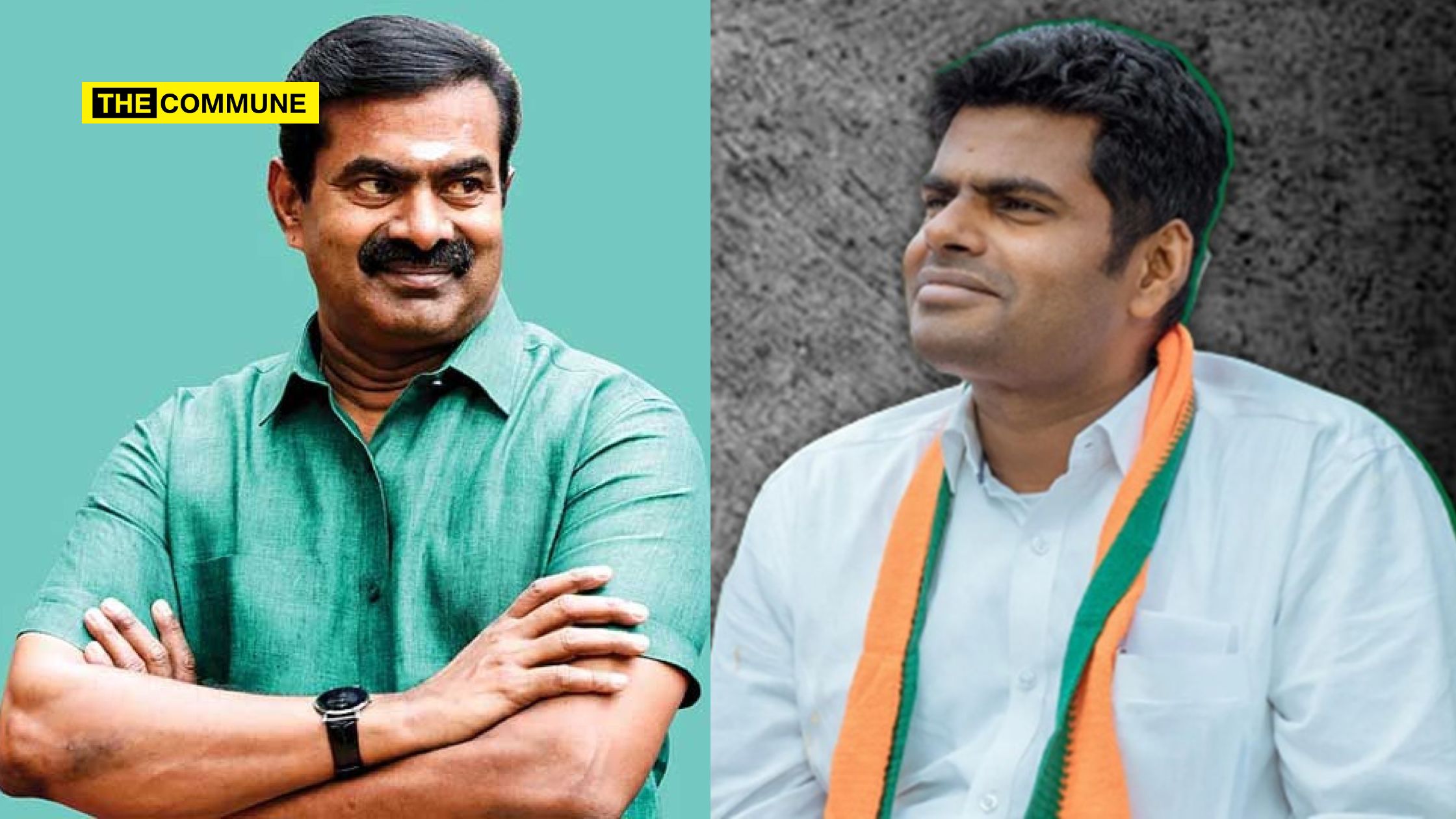
Praising Naam Tamilar Katchi chief Seeman’s latest announcement of candidates for all 234 constituencies in the state, Annamalai said, “Regarding Seeman, putting up a candidate in all 234 constituencies is a big deal – 117 men and 117 women, that’s significant.”
He, however, argued that the upcoming election was not the time for political experimentation. “But today’s election isn’t about taking risks. 10.62 lakh crore in debt – they made mistakes for five years, friend. Tamil Nadu has had enough. That’s why this election is different – Vijay has come leaving 250 crores, asking for votes. I respect that, but think about whether this election is for him,” he said.
Calling for consolidation of opposition votes against the ruling party, Annamalai added, “That’s why this time, every vote against DMK shouldn’t be scattered. All anti-DMK votes should unite behind the NDA. Even if it’s a four-cornered fight, when votes go into the EVM machine, it becomes a two-cornered contest. I have faith in that. And when the button is pressed, it will become a single-cornered contest. I have faith in that.”
The meeting was part of the BJP’s ongoing outreach efforts ahead of the upcoming elections.
Subscribe to our channels on WhatsApp, Telegram,Instagram and YouTube to get the best stories of the day delivered to you personally.
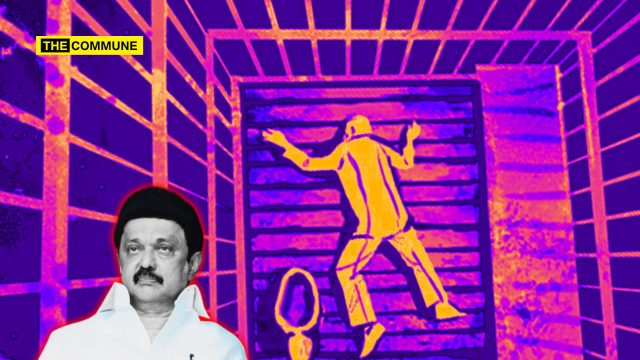
Human rights activist Henri Tiphagne has alleged custodial torture and raised serious questions over the death of a youth identified as Vibhi alias Punithan, claiming it was the 24th custodial death since the DMK assumed office.
Detailing the sequence of events, Tiphagne said, “Ever since the DMK has come to power, this is the 24th custodial death that has occurred. A man named Vibhi alias Punithan from Koodameri, Tambaram, was arrested by 3 policemen in mufti on 13 February 2026, Friday at 630AM from his home.”
He further stated, “That evening, they get a certificate/approval clearing him to be taken into custody, from Chromepet Hospital. Following that, he is admitted at Puzhal prison that evening at 6PM. The magistrate who ordered the magistrate is a question we must ask.”
Raising concerns about the prisoner’s medical condition, Tiphagne alleged, “At Puzhal prison, after seeing the injuries on his body, the swelling on his hands, the injuries on his legs below his knees, the injuries on the soles of his feet, he was refused admission at Puzhal prison and was sent to Stanley hospital.”
He added, “At Stanley, he was prepared for admission for treatment. But instead of keeping him under custody there, he is taken at 8PM once again to Puzhal prison by the doctors. What kind of doctors are they?”
According to Tiphagne, the man’s condition deteriorated days later. He said, “On the 18th, once again his health is not good at Puzhal prison so his brother Gopinath receives information that he is being taken to Stanley Hospital for treatment. On 19th, we hear that he passed away.”
Tiphagne described the deceased as belonging to the Scheduled Caste community and alleged custodial torture. He said, “He is a youngster from the SC community. He is the victim of yet another brutal police torture under DMK government.”
He also questioned senior police leadership, stating, “Will Amalraj IPS of Tambaram Commissionerate answer? Is this your leadership trait? This is a torture that has taken place without any prior intimation by the Shankarnagar police station that comes under your purview.”
Calling for wider accountability, Tiphagne said, “Who is the magistrate who permitted his remand? Who are the doctors who certified him fit for being remanded? It is our responsibility to add them to the case.”
The BJP on Saturday organised a street-corner campaign titled “Tomorrow is ours… Tamil Nadu is ours!” in Chintadripet, which falls under the Chepauk–Thiruvallikeni Assembly constituency.
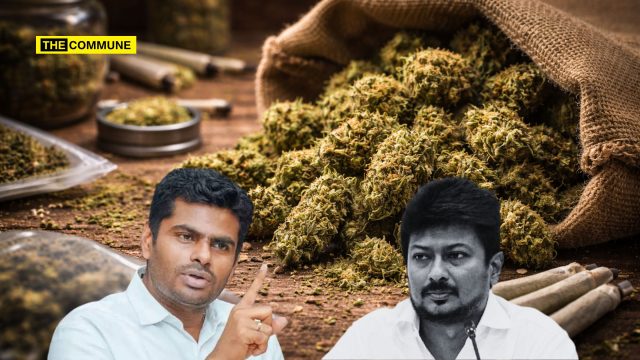
Addressing the gathering, BJP leader K Annamalai alleged a sharp rise in ganja circulation across the state and claimed the problem had reached residential areas and educational institutions.
He said, “Today wherever you see in Tamil Nadu, we have ganja circulation has spread to every nook and corner of the state. I am not saying ganja was not there all these years, but today it has come to the streets. Today if you go to a government school, you will find that in a student’s bag. Due to this ganja proliferation, major crimes are increasing in Tamil Nadu today.”
Annamalai went on to name several localities in and around Chepauk where he alleged the narcotics trade was prevalent. He said, “Today, if you ask where the ganja trade is most prevalent in Chepauk’s streets, even the local people here will tell you – it’s in Neelam Paasha Dargahpuram, Lady Wellingdon Women’s School area, near Nadukuppam, Krishnaampettai cemetery area, Shivaraja Puram, Mattankuppam, Chellamma Thottam, Mannjakori, Border Thottam, Pudupettai areas. To that extent, if you ask whether there is a part in Tamil Nadu that has become the capital of cannabis, then today the Chepauk area has become the capital of ganja circulation and addiction.”
Referring to actor Revathi’s recent remarks about safety concerns in parts of Chennai, Annamalai alleged harassment by the DMK’s IT wing. He said, “Actress Revathi says that she is afraid to go to some places in Chennai. On that, DMK’s IT wing is sexually harassing her.”
He further claimed that crimes against women and children had been rising in the state. Annamalai said, “From 2021 to 2025, crimes against women and children are increasing by 8 percentage points every year. Every capital in India is progressing. But this government is preventing Chennai’s development by claiming they are creating problems with the central government.”
Subscribe to our channels on WhatsApp, Telegram,Instagram and YouTube to get the best stories of the day delivered to you personally.
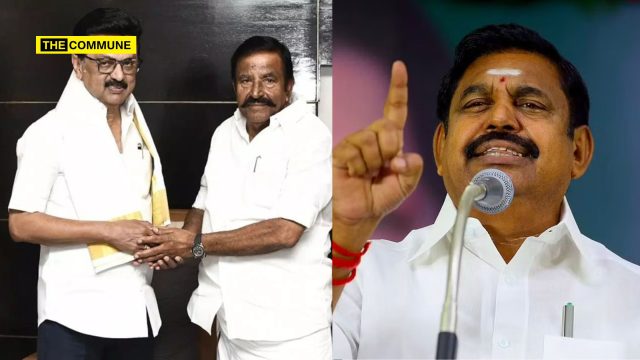
Following the disclosures emerging in the public domain regarding the alleged hawala links in the MAWS corruption scandal involving DMK minister KN Nehru, AIADMK general secretary and Leader of the Opposition Edappadi K Palaniswami on Saturday, 21 February 2026, launched a sharp attack on the ruling DMK, accusing the Municipal Administration Minister of corruption and hawala-linked irregularities and asserting that the AIADMK would return to power in the upcoming elections.
Addressing an election campaign meeting in Ambattur as part of his ‘Makkalai Kaappom, Thamizhagathai Meetpom’ yatra, Palaniswami alleged that the DMK regime had engaged in “five years of loot” and claimed that the public had not received any tangible benefits during its tenure.
He said that once the AIADMK returned to power, the party would recover funds allegedly sent abroad through hawala channels and use the reclaimed money to implement welfare schemes.
Referring to Chief Minister MK Stalin’s recent remarks that he was not afraid of raids, Palaniswami alleged that the chief minister’s comments reflected nervousness following a court direction to register an FIR in connection with the issue.
The AIADMK leader further alleged that Minister Senthil Balaji had previously spent 453 days in jail in connection with alleged corruption in TASMAC and claimed that Minister K.N. Nehru was now facing allegations related to hawala transactions. He stated that the Enforcement Directorate had written to the Director General of Police seeking registration of a case based on evidence gathered during raids, but no action was taken until the court intervened following a petition by the AIADMK.
Palaniswami also alleged that Nehru collected bribes ranging from ₹30 lakh to ₹35 lakh for postings in the water supply department and took commissions on public works. He further claimed that Senthil Balaji had siphoned off more than ₹24,000 crore through TASMAC operations.
Continuing his attack, Palaniswami accused the chief minister of avoiding direct responses in the Assembly despite speaking for over two-and-a-half hours and questioned the government’s handling of law and order.
He also alleged the existence of a kidney trafficking racket linked to a hospital run by a DMK MLA and warned the public to exercise caution while seeking treatment at hospitals owned by ruling party functionaries. In addition, he criticised the state government’s claims on poverty reduction, alleging that economic distress was forcing people into extreme measures.
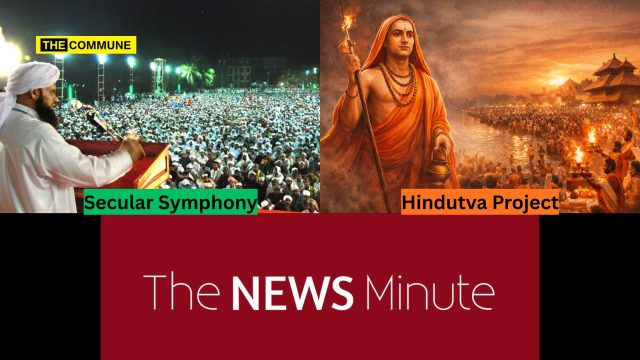
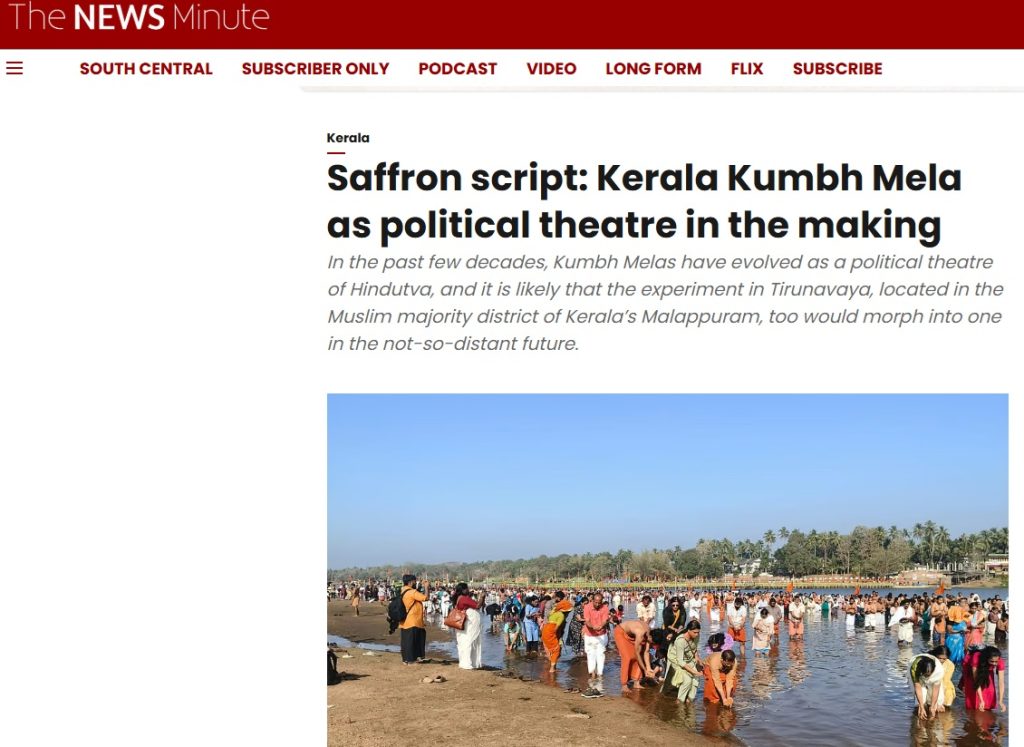
The News Minute recently published an opinion piece by a Binu Karunakaran on the Maha Magha festival that concluded recently.
In the piece, Karunakaran calls Tirunavaya’s Maha Magha Mahotsavam a “saffron script” and “political theatre of Hindutva,” warning it will morph into a full Kumbh Mela to polarize Kerala ahead of 2028 elections.
But read between the lines, this is peak pseudo-secular hypocrisy from a Left-leaning outlet that stays silent when other religions dominate public spaces with fanfare. Let’s call it out with facts they conveniently ignore.
“Thankfully Ignored by Secular Politicians” – Except When It’s Convenient
Karunakaran pats the Left and Congress on the back: “Thankfully… ignored by secular politicians… None trooped for photo-ops.” Really? Where was this “secular vigilance” when Kerala CM Pinarayi Vijayan hosted lavish Christmas-New Year feasts at Cliff House, complete with carols and cakes? Or when Thiruvananthapuram airport shuts down runways for Hindu Padmanabhaswamy Temple processions, yet TNM never cries “political theatre” or “Brahminic rituals dominating public infrastructure.” Selective silence?
“Divisive Fear-Mongering Targeting Muslims” – But Christmas Processions Are Fine?
He quotes ABAP’s shop restrictions at Prayagraj Kumbh as “normal divisive rhetoric,” and Tirunavaya swami warning Hindus about Malappuram’s demographics: “Our future should not be like Bangladesh.” Alarmist? Sure. But TNM ignores massive Christmas street prayers blocking roads in Trivandrum, Palayam Cathedral masses drawing thousands (non-Christians included), or Kerala churches voicing “concern” over “attacks elsewhere” while demanding unrestricted celebrations. Why no “Christian political theatre” label when Cardinal Cleemis calls for “free celebration without fear”?
“Brahminic Rituals” vs. “Subaltern Space” – Where’s the Outrage for Eid/Christmas Dominance?
TNM frets over “high importance to Brahminic priestly rituals” at Tirunavaya while “esoteric practices” get space. Yet Malappuram’s Kondotty Nercha (Muslim festival) turns into a “carnival” with trade fairs, no “fear-mongering” scrutiny. Airports like Kannur have prayer rooms (Muslim/Christian focus) – no “desperate revenue source” cries. And Kerala schools canceling Christmas under pressure? TNM reports it neutrally, but Hindu revival is “sentiment manipulation.”
Kumbh as “Political Theatre”? Try Mamankam Revival as Cultural Pride
Mamankam was always ritual-trade-power nexus on Bharathapuzha-Zamorin coronations, Kalaripayattu, diverse traders (Muslims included). Reviving it as “Kerala’s Kumbh” celebrates Hindu roots in Muslim-majority Malappuram—peaceful, lakhs attended, no riots. TNM’s own “Let Me Explain” calls it “plural past reshaped”, but that’s evolution, not “desperate measures.” Compare to TNM ignoring RSS “Ganageetham” pressure canceling Christmas in post offices.
TNM’s “history demands caution” is code for “Hindu assertion bad.” They amplify swami quotes on Pakistan/Bangladesh while silent on church demands or street Eid fairs. Kerala’s secularism thrives because Hindus don’t riot over Christmas airports or Ramzan feasts, yet TNM pathologizes Juna Akhada’s expansion as “militant.” Hypocrisy exposed: When Hindus reclaim their riverbanks, it’s “theatre.” When others block roads/airports, it’s “culture.” Wake up, TNM, Kerala’s pluralism works because Hindus prioritize harmony, not hegemony.
Subscribe to our channels on Telegram, WhatsApp, and Instagram and get the best stories of the day delivered to you personally.
A woman identified as Devi, the daughter-in-law of DMK Minister Rajendran’s (who is the Minister of Tourism and Tourism Development Corporation of Tamil Nadu) brother, has publicly alleged that she has been subjected to harassment by members of the minister’s family. She made the allegations while speaking to reporters in Salem.
According to Devi, assurances about housing were given at the time of her marriage, but she has allegedly been forced to live in rented accommodation for years. She stated that she has changed eight rented houses over the past eight years due to the situation.
When questioned about the timing of her press interaction, given that a related property dispute is currently pending before a family court, Devi said she had been struggling for several months and had approached the police and the Superintendent of Police’s office multiple times without receiving support. She further alleged that she and her family members had been threatened and that she was being prevented from seeing her child.
Responding to suggestions that her public statements were aimed at seeking money, Devi denied the claim. She also rejected allegations that she had demanded ₹2 crore as part of a divorce-related settlement. Devi said discussions about any settlement would arise only after the divorce case is concluded and maintained that any compensation must be decided through legal proceedings.
The matter is understood to be under consideration before the family court. There has been no immediate response from Minister Rajendran or his family members at the time of reporting.
Subscribe to our channels on WhatsApp, Telegram,Instagram and YouTube to get the best stories of the day delivered to you personally.
Leftist rag The Wire has once again done it – fumbled numbers to suit propaganda narrative and when exposed, quietly edit everything and pretend as if nothing happened.
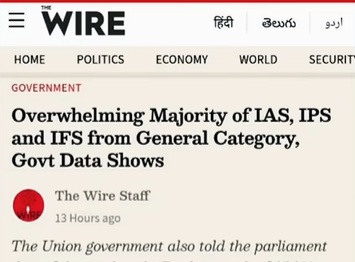
Here’s what the portal did – The Wire quietly revised both the headline and portions of its report on caste representation in the All India Services after publishing what was initially framed as a story suggesting an “overwhelming majority” of IAS, IPS, and IFS officers were from the General Category.
The original headline, which circulated widely on social media, read “Overwhelming Majority of IAS, IPS, IFS From General Category.”
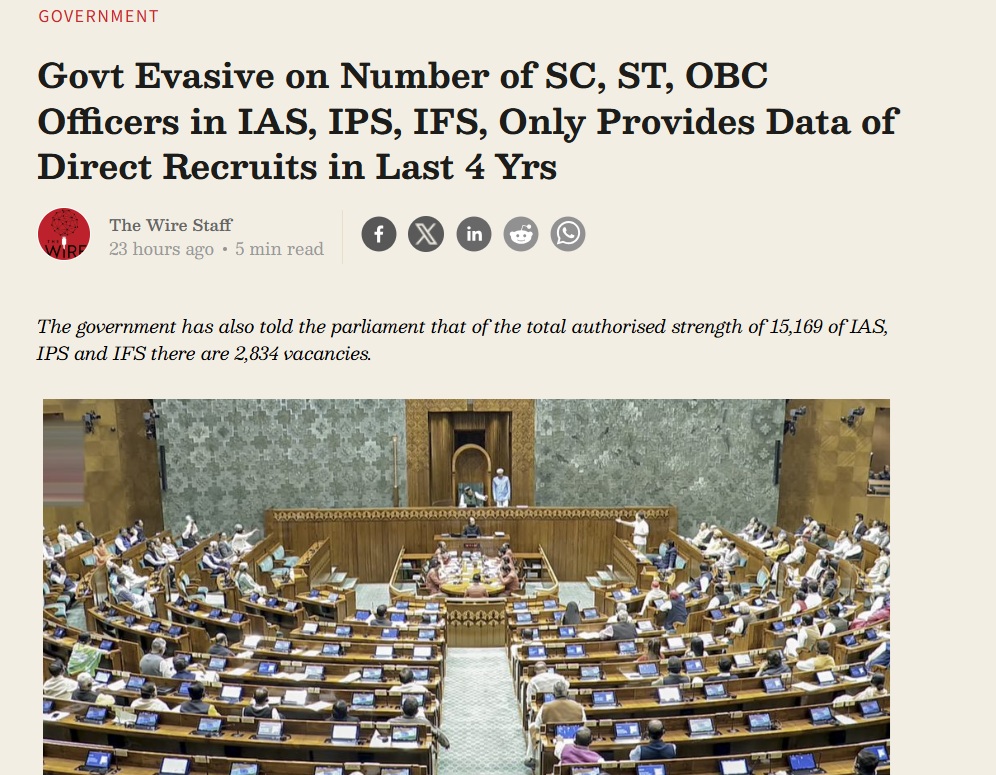
However, after the data framing came under scrutiny, the publication altered the headline to, “Govt Evasive on Number of SC, ST, OBC Officers in IAS, IPS, IFS, Only Provides Data of Direct Recruits in Last 4 Yrs.”
An editor’s note was subsequently inserted at the bottom of the article stating: “This copy was edited on February 17, 2026 to correct for some inaccuracies in how we had first represented the data.”
No detailed public breakdown was issued explaining the nature or scale of the inaccuracies.
What the Parliamentary Reply Actually Contained
The report was based on a written reply tabled in the Rajya Sabha by Minister of State Jitendra Singh.
The government provided:
Total officers in position
IAS: 5,577
IPS: 4,594
IFS (Indian Forest Service): 2,164
Direct recruits (2020–2024)
IAS: 135 SC | 67 ST | 245 OBC
IPS: 141 SC | 71 ST | 231 OBC
IFS: 95 SC | 48 ST | 231 OBC
The reply did not include:
Category-wise total composition of all serving officers
General category recruit numbers for the same five-year window
Instead, it confined itself to recent direct recruitment figures.
How the Narrative Setting Occurred
The original framing juxtaposed the total serving cadre strength accumulated over decades with SC/ST/OBC direct recruits from only recent years.
By placing five-year recruitment numbers against the full historical officer pool, representation percentages appeared sharply compressed.
These apply to annual intake, not retrospectively to the entire serving cadre, which includes officers recruited prior to OBC reservation implementation and through promotion channels.
IFS Mislabelled in Initial Framing
The parliamentary data referred to Indian Forest Service (IFS), one of the three All India Services alongside IAS and IPS.
The initial article framing, however, referred to “Indian Foreign Service” in places, a separate Central Service with different recruitment data structures.
All India Services data is routinely grouped together in parliamentary replies, whereas Indian Foreign Service statistics are reported separately.
The headline was later modified without a standalone clarification note on this distinction.
Vacancy Context Also Omitted in Initial Framing
The same parliamentary reply also disclosed significant vacancies:
Total authorised AIS strength: 15,169
Vacancies: 2,834 (18.6%)
Break-up:
IAS: 1,300 vacancies (~18.9%)
IPS: 505 vacancies (~9.9%)
IFS: 1,029 vacancies (~32.2%)
This structural gap further complicates category representation snapshots, especially when relying solely on direct recruitment figures.
By the time the correction note was added:
The original headline framing had already circulated widely.
Screenshots of the earlier version continued to remain in public circulation.
The revised headline fundamentally shifted the thrust of the story, from cadre dominance to alleged government opacity.
The edit note acknowledged inaccuracies but did not specify what numerical or interpretive elements were incorrect.
Subscribe to our channels on WhatsApp, Telegram,Instagram and YouTube to get the best stories of the day delivered to you personally.
Tamil Nadu is frequently cited in contemporary political discourse as one of India’s most developed states, with supporters of Dravidian parties often attributing many of its socio-economic achievements to post-1967 regional governance. However, historical data and pre-Independence records indicate that several foundational development indicators in the region pre-date the rise of Dravidian political formations.
Present-Day Development Claims
A range of widely circulated indicators place Tamil Nadu among India’s leading states on multiple fronts:
Among the top states by Gross State Domestic Product (GSDP)
One of India’s most urbanised states
A leading industrial and manufacturing hub
Highest or among the highest female workforce participation bases
Low poverty ratios relative to national averages
Ranked high in domestic tourism inflow
Major exporter of electronics goods
Higher education enrolment significantly above national average
These indicators are broadly supported by contemporary economic and social datasets.
Urbanisation: Evidence from 1901 Census
Historical census tables from the Madras Presidency (1901), which covered large parts of present-day Tamil Nadu, show that the region already had a high concentration of urban settlements compared to most of British India outside the Bombay Presidency.
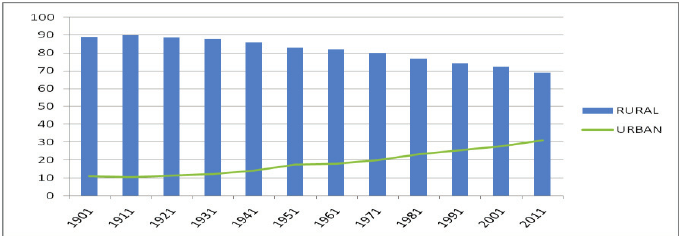
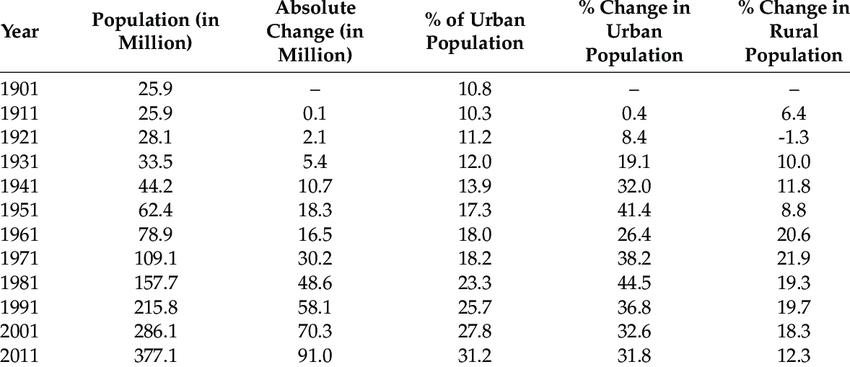
Level of Urbanisation (1901-2011); Source- Various census Reports Image Source: ResearchGateSize and growth of urban population in India, 1901-2011. Image Source: ResearchGate
The below table titled “Distribution of Population, Madras Presidency, 1901” records significant urban population clusters across districts such as Madras City, Chingleput, Tanjore, Trichinopoly, Madura, and Tinnevelly, indicating an established urban base decades before the emergence of Dravidian parties in the mid-20th century.
This is mostly true. However, this has got nothing to do with DMK and other regional parties as you have been claiming.
Already in 1901, when Dravidian parties were not even born, Tamilnadu was the most urbanized region of India outside Bombay.
This positions the Tamil region among the more urbanised parts of colonial India at the time.
Literacy and Education Before Dravidian Politics
Pre-Independence literacy studies and colonial education records show that:
The Madras Presidency, especially Tamil and Malayalam regions, ranked among the most literate in India in the early 20th century.
Missionary schooling networks, princely patronage, and early social reform movements contributed to educational spread.
Community-level literacy data from the early 20th century indicates exceptionally high literacy rates among certain social groups. For instance, Tamil Brahmin literacy rates recorded in early 20th century administrative studies were among the highest globally outside industrialised Western nations and Japan.
Early Scientific Achievement
The region’s academic ecosystem also produced globally recognised scholars prior to Dravidian party rule.
The first non-white Nobel laureate in science, physicist CV Raman (awarded the Nobel Prize in Physics in 1930), was from the Madras Presidency. His work emerged from institutional and intellectual networks that pre-dated post-Independence regional political formations.
Industrial and Urban Foundations Under Colonial Administration
Madras Presidency functioned as one of British India’s major administrative and commercial hubs, with:
Port-based trade centred in Madras (Chennai)
Textile and agro-processing industries
Railway connectivity expansion
Municipal governance institutions
These laid early foundations for later industrial expansion.
Continuity vs Political Attribution
Post-Independence and especially post-1967 governments, including Dravidian parties, operated on an already urbanised, literate, and institutionally networked social base.
Subsequent administrations expanded:
Public sector manufacturing
Automobile and electronics corridors
Welfare delivery systems
Higher education capacity
However, historical census and literacy data indicate that several baseline development indicators – urbanisation, literacy concentration, educational institutions, and early scientific output were already visible before the political rise of Dravidian parties.
Tamil Nadu’s contemporary economic and social indicators are widely acknowledged. Yet archival census records and early 20th century educational data show that many structural advantages – urban clustering, literacy penetration, and intellectual capital, were present well before regional party politics took shape.
Subscribe to our channels on WhatsApp, Telegram,Instagram and YouTube to get the best stories of the day delivered to you personally.