Home Blog Page 141

‘You Spoke For Minorities, Why Not For The Majority?’ BJP Leader Annamalai Questions TVK Chief Vijay’s Silence On Thirupparankudra Murugan Temple Deepam Issue

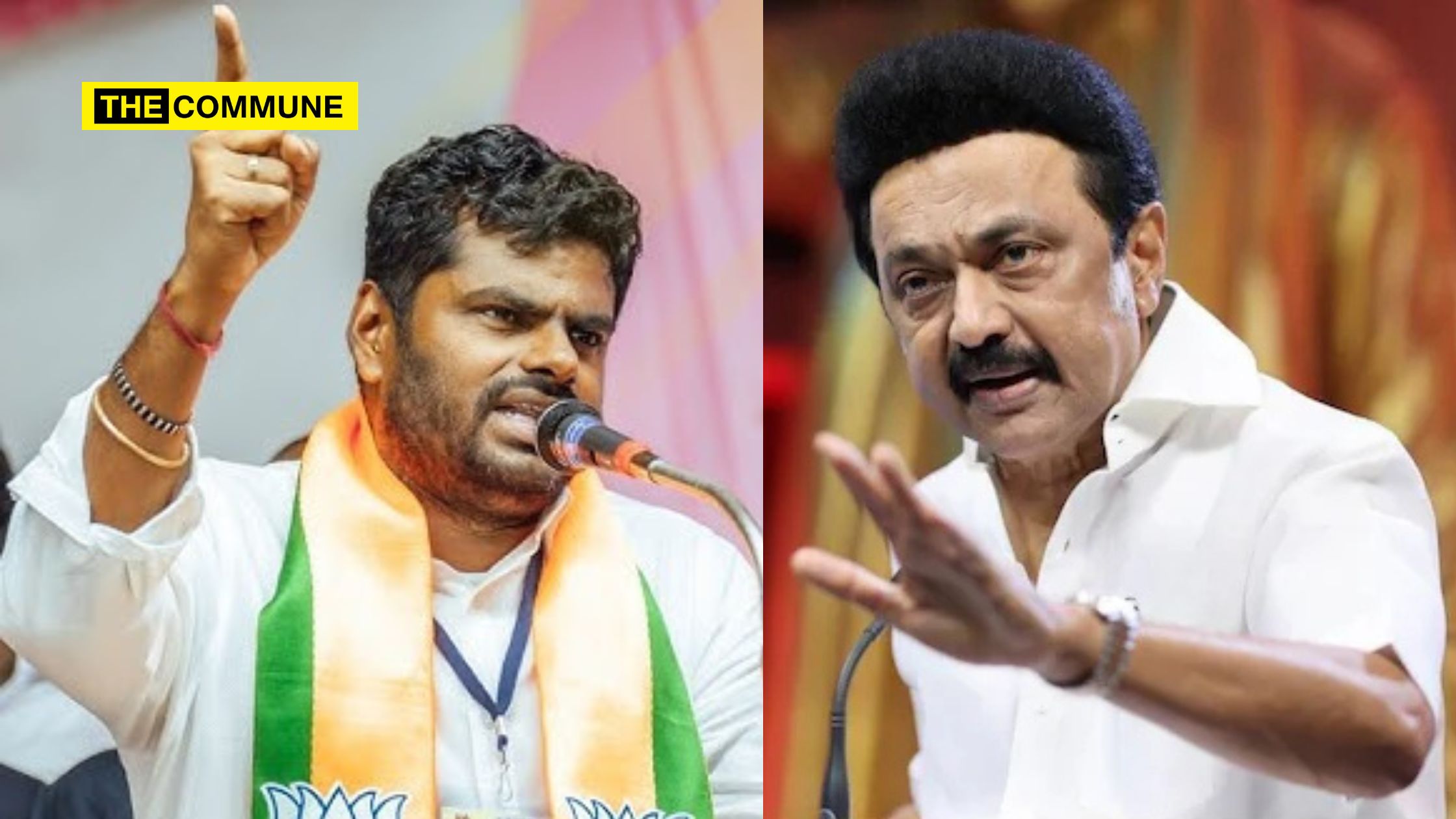
BJP leader K Annamalai on Tuesday, 16 December 2025, questioned actor Vijay’s silence on the Thiruparankundram Deepam controversy, saying that a political leader could not afford to remain neutral when public sentiment was clearly visible.

Speaking to reporters in Puducherry, Annamalai said politics demanded clear positions and accused Vijay of avoiding difficult issues. “There are times when one must speak and times when one must remain silent. The question is who decides that” he said, adding that a leader who merely watches developments without responding could not expect people to entrust him with governance.

Referring to the dispute over lighting the Karthigai Deepam at Thirupparankundram, Annamalai said public opinion strongly favoured allowing the ritual. “When people are clear that the Deepam should be lit, where does Vijay stand?” he asked.

Annamalai also alleged that Vijay had adopted selective positions based on political convenience. He recalled that Vijay had earlier spoken about minority representation in Puducherry when an MLA from a minority community was not given ministerial responsibility.

“If Vijay could speak then because the MLA was from a minority community, why is he silent now when the majority community is affected?” he asked.

Stating that voters in both Tamil Nadu and Puducherry were observing such positions closely, Annamalai said electoral outcomes would reflect public judgment. “Wrong must be called wrong and right must be called right. Standing in the middle is not an option in politics,” he said.

He concluded by saying that political differences should be settled in the electoral arena and urged unity on issues of justice.

Subscribe to our channels on WhatsAppTelegram, Instagram and YouTube to get the best stories of the day delivered to you personally.
‘Access Is Allowed, Ritual Such As Lighting Lamp Is Not’: Waqf Board’s Submission Before Madras High Court In Thirupparankundram Deepam Row

The hearing in the Thirupparankundram dispute before the Madurai Bench of the Madras High Court will continue on Thursday. Following the day’s proceedings, counsel for the petitioner, Advocate Niranjan Kumar, addressed the media and outlined the arguments raised in court.

Niranjan Kumar said counsel appearing for the Waqf Board had relied on the 1920 judgment to contend that Nellithoppu and the steps leading from Nellithoppu to the Dargah had been declared as belonging to the Dargah. He said the Waqf Board’s counsel argued that while members of the public could visit the area as ordinary visitors, religious rituals such as lighting a lamp could not be permitted.

Quoting the submission, Niranjan Kumar said the argument was that “if one comes as a friend, one can walk up the steps, go around the hill, visit the Dargah and the pillar, and return peacefully, but if one comes with an ideological or religious intention to light a lamp, it cannot be allowed.”

He said this submission was responded to by Senior Advocate Guru Krishnakumar, who relied on the same 1920 judgment to clarify the extent of ownership declared by the court.

“Guru Krishnakumar pointed out that the 1920 judgment clearly states that the entire Thirupparankundram hill belongs to the Arulmigu Subramania Swamy Devasthanam, except for Nellithoppu measuring 33 cents and the flight of steps leading from Nellithoppu to the Dargah,” Niranjan Kumar said.

According to him, the senior counsel submitted that the argument advanced by the Waqf Board was improper and unrelated to the issue of religious harmony. He also pointed out that the judgment records that the steps from the foothills up to Nellithoppu belong to the Hindu Religious and Charitable Endowments Department.

Elaborating on the response, Niranjan Kumar said the petitioner’s side had never sought to prevent access to the hill or restrict the religious practices of others. “If we had any intention of hurting religious sentiments or politicising the issue, we could have taken the stand that no one should go beyond the foothills. We have never taken such a stand, and we will not take it in the future,” he said.

He further questioned the logic of permitting visits as ordinary access while objecting to the performance of a religious ritual. “Saying that someone can come as a friend but cannot perform a religious ritual if they come with that intent is not acceptable,” he said.

Referring to constitutional protections, Niranjan Kumar said Articles 25 and 26 guarantee every individual the right to profess, practise and propagate religion according to conscience. He said it was therefore “surprising” that such an argument was advanced by the Waqf Board’s counsel.

“The submission made today came as a shock to us. We have placed our response on record and will continue our arguments tomorrow. We are hopeful of a favourable order,” he said.

Subscribe to our channels on WhatsAppTelegram, Instagram and YouTube to get the best stories of the day delivered to you personally.
Tiruppur: DMK Govt Unleashes Police On Residents Opposing Garbage Dumping Yard In Iduvai Village; BJP Leader Annamalai Condemns

tiruppur garbage dumping annamalai dmk stalin black flag

Tension prevailed near Palladam in Tiruppur district on Tuesday, 16 September 2025, after residents protesting against the dumping of municipal waste detained garbage trucks and clashed with police, resulting in injuries to both protesters and police personnel and the detention of over 200 people.

The incident occurred at Chinnakalipalayam near Iduvai village, where the Tiruppur City Municipal Corporation has been dumping municipal waste. Local residents, including farmers and cattle rearers, have been opposing the proposed garbage dumping site for several months, arguing that garbage should not be dumped within their panchayat limits as it would affect agriculture, livestock, groundwater and public health. The issue is also stated to be pending before a court.

According to residents, despite repeated protests and sit-ins over the past several weeks, civic authorities proceeded with the establishment of the dumping yard without addressing public concerns. On Tuesday, when two municipal garbage trucks arrived at the site to unload waste, residents blocked the vehicles and launched a protest.

Police were deployed in large numbers as the situation escalated. Attempts were made to hold talks with the protesters; however, when the residents continued with road blockades, personnel from the Rapid Action Force and Tiruppur city police were brought in. A heated argument broke out between the protesters and the police, following which the police forcibly removed the protesters and detained them.

During the confrontation, some protesters released cattle into the crowd, triggering panic among police personnel and creating a chaotic, riot-like situation at the site.

Eyewitnesses said that elderly persons and women were also detained during the operation. Reportedly, more than 200 people were taken into custody and transported in police vehicles, leading to heightened tension and commotion in the area.

In the clashes, three villagers, identified as Arun Kumar, Vidhya and another resident sustained injuries. On the police side, Assistant Commissioner John, Inspector Ganeshan, Sub-Inspector Muthupandi and Armed Reserve constable Thenmozhi were injured. All the injured were admitted to hospital for treatment.

Condemning the police action, BJP leader Annamalai issued a statement stating that the DMK government was proceeding with the garbage dumping project in Iduvai village despite sustained public opposition. The statement said the project would adversely impact farmers and livestock rearers and accused the district administration of acting against public sentiment.

The situation in the area later stabilised, though police deployment continued to prevent further protests.

Subscribe to our channels on WhatsAppTelegram, Instagram and YouTube to get the best stories of the day delivered to you personally.
“DMK Instigating The Dargah”: Says BJP Leader Annamalai Over Thirupparankundram Deepam Dispute

BJP Leader K Annamalai, in a press meet on Tuesday, 16 December 2025, launched a sharp attack against the ruling DMK government, accusing it of intentionally instigating religious discord over temple practices and predicting significant electoral repercussions in the 2026 Assembly polls.

His comments centered on two recent controversies: the renaming of a hillock to ‘Sikandar Malai’ against a court order, and the ongoing legal battle over lighting a lamp (deepam) at the ancient Thirupparankundram Murugan Temple in Madurai.

On ‘Sikandar Malai’ and Electoral Justice

Annamalai asserted that the attempt to unilaterally rename a hill, despite a court verdict, is an act of disorder that the public is watching closely. He connected this directly to political accountability.

“The attempt to change the name of the hill to Sikandar Malai, after the court gave its verdict, [they] say they will not respect it and are unilaterally creating disorder and problems,” he stated. “Certainly, this will reflect in the 2026 Tamil Nadu Legislative Assembly elections.”

He extended this warning to the Congress, citing anger against its Puducherry MP over the issue. Framing it as a matter of justice for Hindu devotees, Annamalai said, “Because Hindu brethren, Murugan devotees, must seek permanent justice through the ballot box today. Even if the court gives justice, when representatives elected by the people try to break it, there is no option for Murugan devotees other than this.”

On the Thirupparankundram Deepam Controversy

The BJP leader delved into the history of the Thirupparankundram case, disputing the Wakf Board’s claim that the lamp-lighting practice has been absent for long. “They filed this case in the Madurai Sub Court in 1920. Starting from that day until today, this practice has been absent, as we all know,” he noted, highlighting that the 1300-year-old temple has a specific lamp pillar (deepathoon) for the purpose.

He cited the December 1st court verdict, which called it a “great injustice” if devotees cannot light the lamp even once a year on Karthigai Deepam. Annamalai alleged deliberate provocation by the DMK, pointing out that the Dargah management did not appeal immediately after the verdict.

“When the verdict was given on December 1st, the Dargah did not appeal on the 2nd, nor did they appeal on the 3rd. Only after the 4th did the DMK instigate and bring the Dargah forward. This truth is known to all the people,” he stated.

Addressing legal arguments that the case should be in a civil court, Annamalai clarified that the court had already distinguished between locations. “Justice GR Swaminathan gave a verdict saying that the top of the hill has the Dargah, so the lamp should not be lit there. There is no problem for anyone if the lamp is lit on the deepathoon, which is 50 meters away from the summit.”

He accused the DMK government of “intentionally instigating the Dargah and creating communal riots.”

Responding to “Two Pillars” Argument

Annamalai strongly condemned an argument presented by a lawyer for the HR&CE department, who reportedly asked if lamps could be lit on two pillars because “Murugan has two wives.”

“We demand that the State government kneel before the Murugan devotees and apologize. They should apologize just for presenting this argument,” he said, adding that this was viewed as the opinion of the DMK government. “They are not asking for all pillars, they are only asking for the deepathoon.”

Assured of Electoral Impact

Drawing a parallel to the Sabarimala issue in Kerala, Annamalai was confident of electoral backlash. “It will definitely be reflected in the elections,” he said, citing BJP’s gains in Thiruvananthapuram local body polls as an example.

He framed the issue as one of selective discrimination. “Open the Haj house, no problem. Go to the Christmas celebrations, no problem. Why are you hurting the Hindu community?… We are questioning because you are belittling Hindu sentiments and making a mistake. That is our right, our duty.”

Concluding, Annamalai positioned the BJP and allied Hindu groups as protectors of religious rights without being antagonistic to other faiths. “None of us here are against Muslims or Christians, and we will not become opponents.”

Subscribe to our channels on WhatsAppTelegram, Instagram and YouTube to get the best stories of the day delivered to you personally.
Emperor Perumbidugu Mutharaiyar II Of Trichy: The Warrior Who Combined Might, Justice And Tamil Culture

On 14 December 2025, Vice President C.P. Radhakrishnan released a commemorative postage stamp honouring Emperor Perumbidugu Mutharaiyar II, also known as Suvaran Maran, marking a significant recognition of one of ancient Tamil Nadu’s most formidable rulers. The stamp release at the Vice President’s Enclave in New Delhi drew dignitaries including Union Finance Minister Nirmala Sitharaman, Deputy Chairman of Rajya Sabha Harivansh, and Minister of State for Information and Broadcasting Dr L Murugan, underlining the national importance of honouring this towering historical figure.​

A Ruler of Remarkable Vision and Military Prowess

Emperor Perumbidugu Mutharaiyar II belonged to the illustrious Mutharaiyar dynasty, which held dominion over the central regions of Tamil Nadu during the 7th to 9th centuries CE. His reign, spanning nearly four decades from Tiruchirappalli, represents one of the most significant periods in medieval Tamil history – a time when administrative sophistication, military genius, and cultural refinement converged to shape South Indian civilization.​

The Emperor’s name itself – Perumbidugu, meaning “Great Thunder”, reflects the formidable respect and awe he commanded during his lifetime. His reputation was not built on conquest alone; it was grounded in a balanced approach to statecraft that valued justice, prosperity, and the arts with equal measure.​

Administrative Stability and Territorial Expansion

Vice President Radhakrishnan, in his address at the stamp release, highlighted that Mutharaiyar’s reign was marked by administrative stability, territorial expansion, cultural patronage, and military prowess. Unlike many rulers who relied solely on martial might, Emperor Perumbidugu Mutharaiyar II demonstrated a sophisticated understanding of governance, establishing systems of administration that ensured not merely the consolidation of power, but the stability and prosperity of his realm.​

His unwavering commitment to justice became a hallmark of his rule, and Prime Minister Narendra Modi emphasised this quality in his remarks following the stamp release, noting that the Emperor was “endowed with remarkable vision, foresight and strategic brilliance” and acted “with determination in establishing justice.”​

Patron of Infrastructure and Agricultural Transformation

One of the most enduring legacies of Emperor Mutharaiyar II lies in his visionary approach to irrigation and agricultural development. The irrigation works initiated during his reign fundamentally transformed the Tiruchirappalli region, converting it into a granary and bringing unprecedented prosperity to the people.​

Inscriptions found across multiple locations in Tamil Nadu including Senthalai, Narthamalai, and areas along the northern banks of the Cauvery, bear witness to his contributions to temple endowments and irrigation infrastructure. These stone records, silent echoes from over a millennium ago, testify to the Emperor’s conviction that a ruler’s true wealth lay in enriching the lives of his subjects through resource management and public works.​

A Champion of Tamil Culture and Literature

Beyond the battlefield and the administrative chamber, Emperor Perumbidugu Mutharaiyar II earned recognition as a great patron of Tamil culture and literature. His court became a space where poets, scholars, and artisans flourished, contributing to the vibrancy of Tamil intellectual and artistic traditions during the medieval period.​

The Vice President observed that the Emperor’s reign occupies a distinguished place in South Indian history, precisely because it represents an era when cultural sophistication and martial capability reinforced rather than competed with each other. This duality—the warrior-king who also refined the arts—makes Mutharaiyar II a unique figure in Tamil annals.​

Living Memory in Folklore and Tradition

Even today, nearly twelve centuries after his death, Emperor Mutharaiyar II remains alive in the collective memory of Tamil Nadu through folk songs and temple festivals in districts such as Tiruchirappalli, Pudukottai, and Thanjavur. These living traditions represent the deepest form of historical continuity, not preserved merely in scholarly texts, but woven into the cultural fabric of millions of ordinary people who keep his memory and legacy alive through ritual, song, and oral narrative.​

Significance of the Stamp Release

The release of a commemorative postage stamp is more than a philatelic event; it represents a deliberate act of national recognition and historical rebalancing. Vice President Radhakrishnan framed the stamp release as part of a broader government initiative to identify and honour Tamil kings, leaders, and freedom fighters who have not received adequate historical recognition.​

In the context of India’s journey towards “Viksit Bharat” (Developed India), the Vice President articulated a crucial point: recognising overlooked historical figures and civilisational heroes helps restore the nation’s cultural pride and provides the youth with exemplars of visionary leadership. Emperor Perumbidugu Mutharaiyar II, in this framing, becomes not merely a historical curiosity, but a living lesson about what effective, just, and culturally conscious governance can achieve.​

Prime Minister Modi, in his response to the stamp release, called upon the nation, particularly the younger generation, to study and learn from the extraordinary life and legacy of this ancient Tamil emperor, whose contributions to administration, justice, and culture continue to inspire generations across the subcontinent.​

Conclusion

The release of the commemorative postage stamp honouring Emperor Perumbidugu Mutharaiyar II is a fitting tribute to a ruler whose four-decade reign set benchmarks for administrative excellence, military acumen, cultural patronage, and public welfare. From his transformative irrigation works that shaped agricultural prosperity to his cultivation of Tamil letters and temple patronage, Mutharaiyar II exemplified the ideal of the enlightened monarch who viewed power not as an end in itself, but as a means to elevate the wellbeing and dignity of his people.

In honouring this emperor through a national stamp, India acknowledges not only a pivotal chapter of Tamil Nadu’s history, but affirms that the values he embodied – justice, vision, cultural stewardship, and commitment to public welfare, remain eternally relevant to the project of nation-building.​

Subscribe to our channels on WhatsAppTelegram, Instagram and YouTube to get the best stories of the day delivered to you personally.

The Global Jihad Against Kaffirs By Islamists

Over the past 26-36 hours, multiple Islamic terror related incidents have happened, one thwarted and the world is on high alert given the severity of the incidents. Let us take a look at what happened across the world just hours ago.

A Converging Timeline of Violence

Syria, 13 December 2025: An Islamic State (ISIS) gunman ambushed a U.S. patrol near Palmyra, killing two American soldiers and a civilian interpreter before being neutralized. The attack served as a stark reminder of ISIS’s enduring insurgency and threat to international forces in the region.

Australia, 14 December 2025: Terrorists opened fire on a Hanukkah celebration at Bondi Beach in Sydney, killing at least 11 people and injuring dozens in what Australian authorities immediately declared a terrorist attack targeting the Jewish community. The terror attack, which saw one terrorist killed and another critically wounded, was described as an act of antisemitic terror. The terrorists were identified to be of Pakistani origin.

Germany, 19-20 December 2025: In a major counter-terrorism operation, German police arrested five suspected militant Islamists, three Moroccans, an Egyptian, and a Syrian, at the Suben border crossing with Austria. Authorities stated the cell was planning a vehicle-ramming attack on a crowded Christmas market in Bavaria, with prosecutors citing an “Islamist motive.” Reports indicated one suspect, an Egyptian imam, had allegedly used a sermon to call for such an attack.

France, Pre-emptive Security Move: Citing the heightened threat environment, including pressure on resources and specific risks to seasonal gatherings like Christmas markets, the Paris police prefecture cancelled the city’s traditional open-air New Year’s Eve concert on the Champs-Élysées. The decision to scrap the event, which typically draws nearly a million people, was directly attributed to overarching “security concerns” in the context of the global terror alert level.

Analysis: A Persistent Pattern Re-emerges

This cluster of December incidents reflects the evolving yet consistent nature of the Islamist terrorist threat. It demonstrates a blend of tactics:

Asymmetrical Insurgency: The Syria attack represents continued guerrilla-style warfare in conflict zones.

Plots Against Soft Targets: The foiled German plan follows a recurring template of aiming vehicle attacks at high-density civilian gatherings during cultural or religious festivals.

Direct Sectarian Mass Violence: The Bondi Beach shooting exemplifies the trend of direct, deadly assaults on specific religious communities during their holidays.

Security experts note that while the operational scale varies—from lone actors or small cells to more coordinated plots—the ideological driver remains consistent. The timing near religious holidays (Hanukkah, Christmas) also highlights the continued symbolic targeting of Kaffir (non-believer) cultural events by terrorist groups.

A Brutal Historical Pattern Echoed

This recent wave evokes grim precedents, demonstrating a consistent modus operandi of targeting civilians and public spaces.

The 2008 Mumbai Attacks: Often seen as a blueprint for coordinated urban terror, ten terrorists from the Pakistan-based Lashkar-e-Taiba (LeT) laid siege to India’s financial capital for four days, killing 175 people at hotels, a train station, a café, and a Jewish community center.

The 2023 Nova Festival Massacre: During Hamas’s October 7th attack on Israel, terrorists specifically targeted the Nova music festival near the Gaza border, killing approximately 260 attendees in one of the deadliest single incidents of the conflict.

The 2025 Pahalgam Massacre: In a chilling act of religious targeting, terrorists entered Jammu & Kashmir, India from Pakistan, separated Hindu and Christian tourists from Muslims at a scenic meadow before executing 26 civilians in April 2025 in front of their family members.

An Ideology of Hate and a Common Source of Terror

The bloody events of the past 24-48 hours are not random. They are chapters in a single, grim chronicle written by the ideology of Islamist terror. From the beaches of Sydney to the meadows of Pahalgam and the streets of Mumbai, the script is horrifyingly consistent: the deliberate, systematic hunting of the “Kaffir” – the non-believer.

While the locations change, a sinister thread connects Bondi, Pahalgam, and Mumbai. It is a thread that leads back to Pakistan. It was Pakistani-origin terrorists who carried out the antisemitic slaughter in Sydney. It was terrorists who infiltrated from Pakistan who conducted the religious screening and execution of Hindu and Christian tourists in Pahalgam. It was the Pakistan-based Lashkar-e-Taiba that orchestrated the 26/11 rampage in Mumbai, specifically targeting places frequented by Westerners, Indians, and Jews.

Whether the terrorist carries a Pakistani passport, a European residency card, or an Australian driver’s licence, the ideological script remains unchanged – Islamist terror.

The ISIS ambush in Syria, the foiled Christmas market plot in Germany, and the cancelled celebrations in Paris are all manifestations of the same expanding threat. This ideology does not seek territory alone; it seeks civilizational rupture. It aims to replace coexistence with fear, tolerance with terror, and multicultural harmony with sectarian purity.

The lesson from December 2025 is stark.
Islamist terrorism does not require a battlefield.
It does not require a provocation.
It requires only an opportunity and a belief system that dehumanises the victim in advance.

Ignoring this ideological through-line has cost lives from Mumbai to Pahalgam to Bondi. Recognising it is not “Islamophobia”; it is the first step toward honest counter-terrorism policy, effective intelligence cooperation, and the protection of civilians whose only “crime” is living outside an extremist’s definition of belief.

Subscribe to our channels on WhatsAppTelegram, Instagram and YouTube to get the best stories of the day delivered to you personally. 
Bondi Beach Terror Attack: How A Hanukkah Celebration Became Australia’s Deadliest Antisemitic Massacre

The sun-kissed sands of Bondi Beach, a global symbol of Australian leisure, became the scene of one of the nation’s deadliest terrorist attacks on the evening of Sunday, 14 December 2025. A joyous Hanukkah celebration, known as “Chanukah by the Sea,” was shattered by gunfire, leaving 16 people dead and more than 40 wounded in an act officially classified as antisemitic terrorism.

The Attack: Chaos by the Shore

The assault began in the early evening, around 6:45 PM AEDT, as hundreds of families and community members including children and elderly worshippers gathered near Archer Park and the Bondi foreshore for the festival of lights organised by Chabad of Bondi.​​ Witnesses say two men in dark clothing opened fire from a pedestrian bridge and nearby ground‑level positions, sending crowds fleeing across the promenade, sand and surrounding streets as repeated bursts of gunfire echoed across the beachfront.

The attackers, later identified as a father-son duo, Sajid Akram, 50, and Naveed Akram, 24, focused their fire on a playground and dense gathering areas, firing more than 100 rounds.

New South Wales Police responded rapidly, establishing a large exclusion zone on Campbell Parade and surrounding streets. In the confrontation, Sajid Akram was shot dead at the scene. His son, Naveed, was critically wounded by police and taken into custody. Authorities confirmed no other active shooters were at large.

A heroic act by an unarmed civilian, identified as Ahmed al-Ahmed (with conflicting reports naming Luca Carter), likely prevented further carnage.

Footage shows the bystander tackling one gunman from behind, disarming him and forcing a retreat in the crucial final minutes before police secured the area.

The terror was not limited to firearms. In a chilling post-incident discovery, police bomb disposal units found suspected Improvised Explosive Devices (IEDs) and Islamic State (ISIS) flags in a vehicle linked to the attackers, indicating a planned multi-stage assault designed to also target first responders.

The Victims: A Community Targeted

The attack was a deliberate strike at Sydney’s Jewish community on the first night of Hanukkah. New South Wales Premier Chris Minns described it as an “act of evil antisemitism.” The victims, ranging in age from 10 to 87, reflected the multi-generational nature of the gathering.

Among the 16 fatalities were a 10-year-old child, two rabbis, and an 87-year-old Holocaust survivor, deaths carrying profound symbolic weight. Over 40 injured were rushed to hospitals, with several in critical condition. Among the wounded was Arsen Ostrovsky, a prominent Jewish human rights lawyer, who later posted a defiant message online. The trauma has extended beyond immediate survivors, deeply affecting schools, synagogues, and the entire community. In a deeply disturbing secondary incident, unknown persons set off firecrackers in apparent celebration of the attack.

The Perpetrators: A Radicalized Father-Son Duo

We have attempted to piece together a profile of the attackers, residents of Bonnyrigg in Sydney’s southwest.

Sajid Akram was a Pakistani citizen, a small business owner who operated a fruit shop. He held a legal firearms licence covering six registered weapons, all believed used in the attack.

His son, Naveed Akram, was an Australian national of Pakistani origin. His driver’s license, displaying a Pakistani cricket jersey, listed an address on Brown Road in Bonnyrigg.

Home Location As Per Address On Driving Licence

Born on 12 August 2001, he attended Cabramatta High School. Described as a recently unemployed bricklayer, he was a student at Central Queensland University in Sydney and had also been associated with the Al-Murad Institute, a private religious institute teaching Arabic and Quranic studies.

Open-source reports further suggest he studied at Hamdard University in Islamabad, Pakistan.

Videos of Naveed “spreading Dawah” have surfaced. In the video, he says, “Assalamualaikum, brothers. We’re here at Bankstown Station spreading dawah, doing the work of the prophets, continuing the work of the prophets. We’re here to spread the message that Allah is one and Muhammad is the last messenger of Allah.​ Guys, spread dawah wherever you can. Spread the message that Allah is one wherever you can. Spread the message by pamphlets, even if it is just one ayah, and whether it is raining, hailing, or clear sky, Allah will reward you for whatever actions you do in His cause.​ Inshallah, this will save you on the Day of Judgment, when everyone will be asking, “Oh, where’s the hope, where’s this?” This will come for you on the Day of Judgment.​ So come join us at Bankstown, or in your own area, and spread Islam. Assalamualaikum.”

Disturbing new intelligence alleges that both men underwent military-style training in the southern Philippines just one month before the attack, a region known as a hotspot for Islamist militancy. Furthermore, financial irregularities are under scrutiny, including Naveed’s purchase of a house from his parents for $477,500 roughly 22 months prior, a transaction suspected of defrauding the NSW Treasury.

Intelligence Failures and Ideological Links

A significant failure has come to light. The Australian Security Intelligence Organisation (ASIO) had monitored Naveed Akram in 2019 for links to an Islamic State-linked terror cell led by Isaak El-Matari. However, ASIO concluded then that he was “known” but not an immediate threat, leading to no action on the family’s firearm access, a critical disconnect now under intense review.

The ideological profile points to Salafi-jihadist inspiration. The recovered ISIS flags align with this, and analysts note the attackers’ exposure to Salafi-leaning literature. The ideological alignment mirrors that of Pakistan-based terrorist organizations like Jaish-e-Mohammad (JeM) and Lashkar-e-Taiba (LeT), groups now under examination for potential links to the attackers. Reports from 2025 document a Hamas delegation’s visit to JeM headquarters in Bahawalpur, Pakistan, indicating active coordination. Unverified open-source claims even allege a transfer of 712.2 USDT (approx. 200,000 PKR) from Hammad Azhar, son of JeM founder Masood Azhar, to a Gaza-associated account, suggesting financial ties between JeM and Hamas.

Israeli officials have suggested possible indirect roles for Iran or Hezbollah, though Australian authorities have not confirmed any international operational link.

Media Wars and the Pakistani Narrative

The attack triggered an immediate information war. While reputable global media identified the perpetrators’ Pakistani origin, major Pakistani television channels initially avoided naming the attackers or highlighting their nationality. Alternative Pakistani media, including ARY News, advanced narratives describing the attackers as Afghan and accusing Indian intelligence agency RAW of a “false flag” operation to tarnish Pakistan’s image. ARY framed Pakistan as a victim of “media terrorism” by Indian, Afghan, and Israeli outlets.

This deflection was starkly contradicted when Bloomberg published an erroneous report, later edited, that initially claimed the attackers travelled on Indian passports. Their revised article still controversially cited a Philippine immigration spokesperson labelling Sajid Akram an “Indian national,” a claim contested by all other official and journalistic sources.

National and Global Response

Prime Minister Anthony Albanese condemned the “dark moment” and “heinous antisemitic crime,” convening national security meetings. The NSW Police Commissioner formally declared it a terrorist incident. The national terror threat level remains at “probable.”

Policy responses are focusing on firearms law reform, specifically closing the gap that allows individuals with prior intelligence scrutiny to legally amass weapons. The NSW Joint Counter Terrorism Team (JCTT) has launched a comprehensive multi-agency investigation, with Australia deepening cooperation with Five Eyes partners and Israeli intelligence, including Mossad.

Globally, leaders from the US, UK, and India’s Prime Minister Narendra Modi offered condolences and solidarity. Israeli President Isaac Herzog condemned the antisemitism, while PM Benjamin Netanyahu controversially linked the attack to global policy debates, suggesting support for a Palestinian state risked emboldening extremists.

Subscribe to our channels on WhatsAppTelegram, Instagram and YouTube to get the best stories of the day delivered to you personally.
Bondi Beach Terror Attack: Telangana Police Confirm Hyderabad-Origin Of Terrorist Sajid Akram

Telangana police on Tuesday, 16 December 2025, issued a detailed clarification on the identities and background of the father and son involved in the mass shooting at Bondi Beach in Sydney, Australia, during a Hanukkah celebration on 14 December 2025, which left 16 people dead. One of the attackers was also killed during the incident, which Australian authorities have classified as a terrorist attack inspired by ISIS ideology.

The attackers were identified as Sajid Akram, aged 50, and his son Naveed Akram, aged 24. Australian police and government authorities have confirmed that further investigation into the incident is ongoing.

According to a press note issued by the Telangana Police, Sajid Akram originally hailed from Hyderabad and completed a Bachelor of Commerce degree in the city before migrating to Australia in November 1998 in search of employment opportunities. He subsequently married Venere Grosso, a woman of European origin, and settled permanently in Australia. The couple had two children – Naveed Akram, who was the other terrorist who did the attack, and a daughter. While Sajid Akram continues to hold an Indian passport, both his son and daughter were born in Australia and are Australian citizens.

The press note stated that Sajid Akram had maintained limited contact with his relatives in Hyderabad over the past 27 years. After relocating to Australia, he reportedly visited India on six occasions, primarily for family-related matters such as property issues and visits to his elderly parents. It was also noted that he did not travel to India at the time of his father’s death.

Family members in India told the police that they had no knowledge of Sajid Akram holding extremist views or engaging in radical or terrorist activities, nor were they aware of the circumstances that may have led to his radicalisation.

Based on preliminary findings, the Telangana Police stated that the factors contributing to the radicalisation of Sajid Akram and his son Naveed appeared to have no connection with India or with any local influences in Telangana. The police further clarified that there was no adverse record against Sajid Akram during his stay in India prior to his departure in 1998.

The Telangana Police said it is continuing to cooperate fully with central agencies and other relevant authorities, as required, and urged the public and media to refrain from speculation or attribution without verified facts.

Australian authorities have said that the incident remains under investigation and that additional details would be released as inquiries progress.

Source: ABP News

Subscribe to our channels on WhatsAppTelegram, Instagram and YouTube to get the best stories of the day delivered to you personally.
Ramalingam Murder Case: NIA Arrests Final Proclaimed Absconder, Ex-PFI District President Mohammed Ali Jinnah, & Harbourer

Ramalingam Murder Case: NIA Arrests Final Proclaimed Absconder, Ex-PFI District President Mohammed Ali Jinnah & Harbourer

The National Investigation Agency (NIA) has arrested the last of the six absconding proclaimed offenders and one additional harbourer in connection with the murder of Ramalingam in Thanjavur district, Tamil Nadu.

The arrested proclaimed offender has been identified as Mohammed Ali Jinnah, a resident of Thanjavur district, who had been declared a proclaimed offender and was carrying a reward of ₹5 lakh for information leading to his arrest. Ramalingam was hacked to death in Thanjavur on 5 February 2019, in a case in which members of the banned Popular Front of India (PFI) have been accused.

According to the NIA, its investigation has revealed the role of Mohammed Ali Jinnah, who previously served as the district president of the PFI in Thanjavur, in conspiring, supervising and coordinating with other accused in the killing. The agency stated that Jinnah was arrested based on specific inputs received from the Anti-Terrorism Squad (ATS) unit of the Tamil Nadu Police.

The NIA also arrested Asmath, who is accused of having harboured the proclaimed offenders in the case for the past several years. The agency said the arrests marked a significant development in the case, as Jinnah was the last remaining absconding proclaimed offender.

The arrests come days after the NIA apprehended two other absconding proclaimed offenders and three additional harbourers in the same case. Those arrests were made five days earlier in connection with the case registered as RC-06/2019/NIA/DLI.

The NIA had taken over the investigation from the Thiruvidaimaruthur police on 7 March 2019 and subsequently filed a chargesheet in August 2019. The agency said it continues to investigate the larger conspiracy behind the murder.

Source: Deccan Chronicle

Subscribe to our channels on WhatsAppTelegram, Instagram and YouTube to get the best stories of the day delivered to you personally.

“Created A Religious Right Where None Exists”: Senior Advocate Vikas Singh Representing DMK Govt Ascribes Political Motive To Justice GR Swaminathan’s Order On Thirupparankundram Deepathoon

justice gr swaminathan vikas singh deepathoon thirupparankundram dmk

Senior Advocate Vikas Singh, appearing for the Tamil Nadu state authorities, launched a sharp and pointed attack on the December 1 order of Justice GR Swaminathan of the Madras High Court permitting the lighting of a lamp at a stone pillar, referred to as “Deepathoon”, atop the Thiruparankundram hill during the Karthigai Deepam festival.

Addressing a Division Bench of Justices G Jayachandran and KK Ramakrishnan, which is hearing appeals against the single judge’s order, Singh went beyond assailing the legal reasoning and questioned the very constitutional propriety of the decision. He argued that Justice Swaminathan had “created a religious right where none exists” and had travelled far beyond the limits of judicial authority.

Singh, who is also the President of the Supreme Court Bar Association, contended that there was no historical, religious or legal basis for the claimed right to light a lamp at the stone pillar. Relying on earlier decrees, including a 1923 judgment, he submitted that while the hill was broadly associated with the Devasthanam, the Nellithope area and the flight of steps leading to the dargah were clearly recognised as falling within Muslim rights. According to Singh, those records explicitly noted that attempts to light a lamp at the top of the hill had been stopped in the past and that there was no established custom supporting such a practice.

“There is no agama, no shashtra, and no legal material to support this claimed religious right,” Singh told the court. He further pointed out that even the term “Deepathoon” did not appear in any prior judgment or historical record and surfaced for the first time only in the writ petition that resulted in the impugned order.

Singh also criticised the single judge for ignoring the constitutional limitation that Articles 25 and 26 are expressly subject to public order. Allowing access to the stone pillar, which lies along the route to the dargah, would inevitably create serious law-and-order issues, particularly during Karthigai Deepam when large crowds could attempt to reach the site, he argued. He questioned how the order envisaged crowd regulation in an area that was narrow and historically recognised as belonging to the dargah.

The most stinging criticism was reserved for what Singh described as clear judicial overreach. He highlighted that Justice Swaminathan had directed the lighting of an “additional lamp”, even though no such relief had been sought by the petitioner. “What is this ‘additional’ lamp and where does it come from?” Singh asked, arguing that the direction had no basis in the pleadings before the court.

At one point, Singh remarked, “I wonder what the judge was doing in this process,” and alleged that the order had the effect of creating public disorder rather than preserving public order. He asserted that the judge had no material to even conclude that a Deepathoon existed, and that, even assuming its existence, the court had no business directing that a lamp be lit there. At most, he said, the authorities could have been asked to examine feasibility, but nothing further.

When counsel on the opposite side objected to the tenor of the remarks, Singh defended his submissions, stating that the gravity of the situation would soon become evident. He added that the judge would be seen “contesting an election very soon” and said that while he had refrained from commenting on the impeachment notice moved against Justice Swaminathan, it was legitimate to examine whether the judge had adhered to constitutional boundaries.

The Division Bench did not immediately respond to Singh’s remarks on the judge but continued hearing arguments on the merits of the appeals. It also indicated that it would consider the Tamil Nadu Waqf Board’s earlier offer of court-monitored mediation and sought to hear the stand of the Archaeological Survey of India on the issue.

Source: LawBeat

Subscribe to our channels on WhatsAppTelegram, Instagram and YouTube to get the best stories of the day delivered to you personally.