The Prime Point Foundation has been studying and reporting on the work and performance of the members of Parliament. Every year, the organization presents the Sansad Ratna Award to a Member of Parliament who has done outstanding work in the parliament based on the number of debates attended, starred and unstarred questions asked, attendance, and other criteria.
The Prime Point Foundation has published a ranking of parliamentarians for the budgetary year 2022-23. Dr. Senthil Kumar, a DMK MP, was ranked 17th overall and first among Tamil Nadu MPs, with 453 points.
However, DMK MP SS Palanimanickam of Thanjavur constituency has performed poorly and is ranked as India’s worst-performing MP.
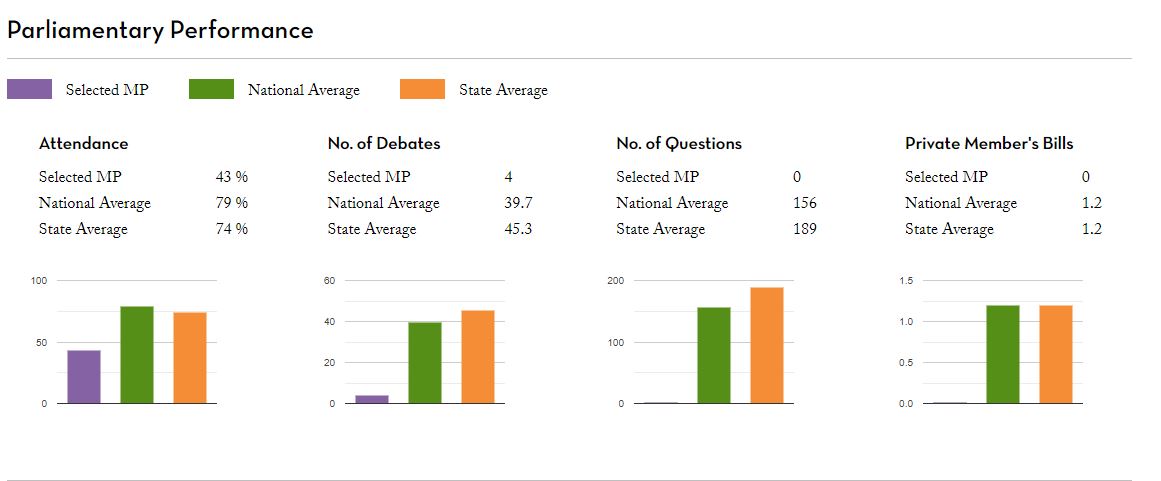
For the period 01-06-2019 to 23-12-2022, SS Palanimanickam of DMK has only 43% attendance when the national and state averages are 79% and 74% respectively.
He has only participated in four debates, whereas the national average is 39.7% and the state average is 45.3%.
DMK MP SS Palanimanickam has raised no questions in parliament, despite the fact that the average number of questions raised by an MP is 156 and the state average is 189. He also never introduced a private member’s bill in parliament.
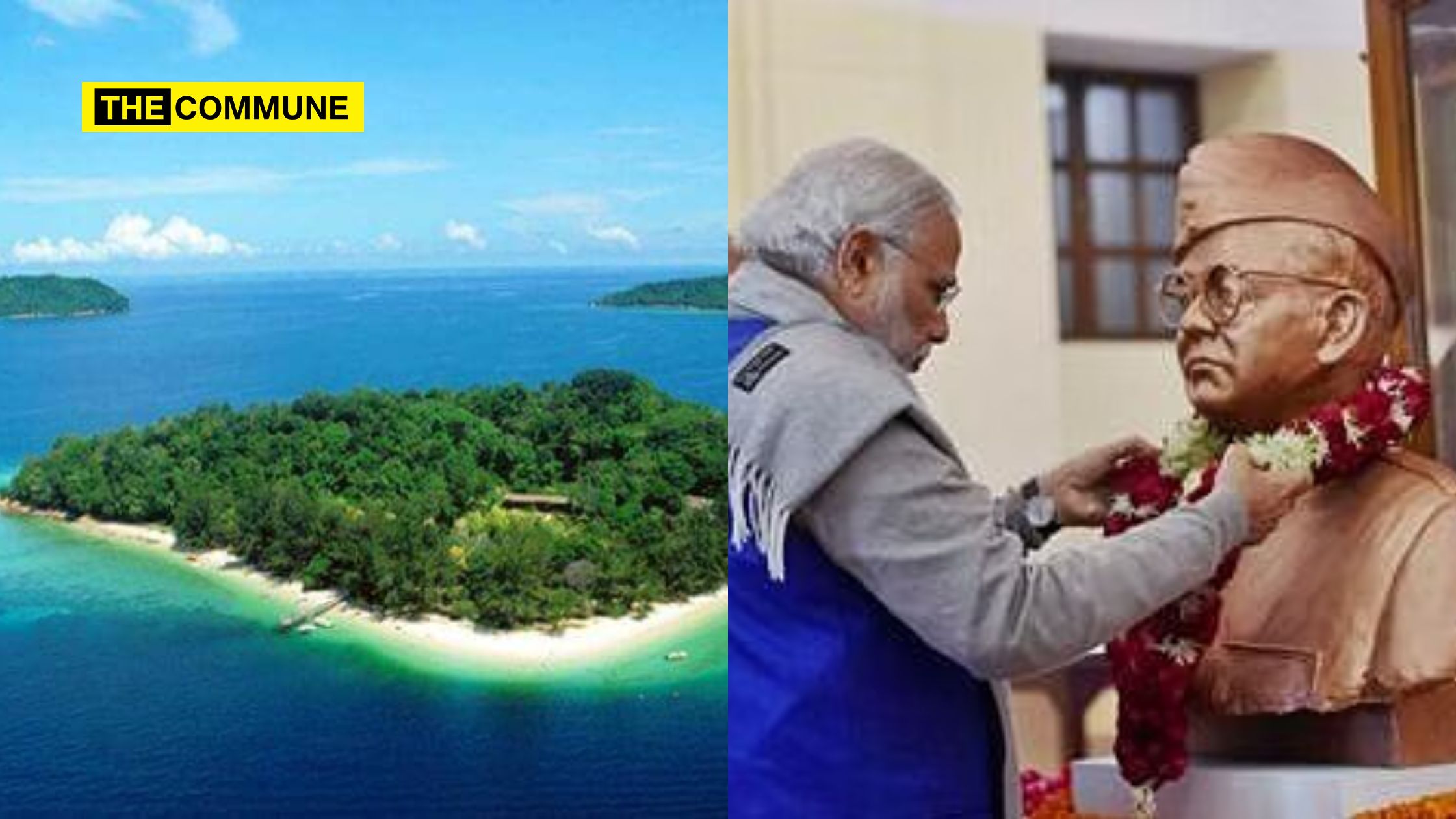
On Parakram Diwas, the Prime Minister Narendra Modi participated in a ceremony to name the 21 largest unnamed islands of Andaman & Nicobar Islands after 21 Param Vir Chakra awardees today via video conferencing. During the programme, the Prime Minister also unveiled the model of the National Memorial dedicated to Netaji to be built on Netaji Subhas Chandra Bose Dweep.
Addressing the gathering, the Prime Minister greeted everyone on the occasion of Parakram Diwas and remarked this inspirational day is celebrated countrywide on the occasion of the birth anniversary of Netaji Subhas Chandra Bose. The Prime Minister noted that today is a historical day for Andaman and Nicobar Islands and said, “When history is being made, the future generations not just remember, assess and evaluate it, but also find constant inspiration from it.” The Prime Minister informed that the naming ceremony of 21 islands from the Andaman and Nicobar Islands is taking place today and they will now be recognised as the names of 21 Param Vir Chakra awardees. He further added that the foundation stone of a new memorial in honouring the life of Netaji Subhas Chandra Bose is being laid at the island where he stayed, and remarked that this day will be remembered by future generations as a significant chapter in the Azadi Ka Amrit Kaal. The Prime Minister underlined that the Netaji Memorial and the 21 newly named islands will be a source of constant inspiration for the young generations.
Throwing light on the history of Andaman and Nicobar islands, the Prime Minister informed that the Tricolour was hoisted for the first time here and the first independent government of India was formed. He further added that Veer Savarkar and many other heroes like him had touched the pinnacle of penance and sacrifice for the country on this very land. He said, “The voices of that unprecedented passion along with immense pain are still heard from the cells of the Cellular Jail today.” The Prime Minister lamented that the identity of Andaman was associated with the symbols of slavery instead of the memories of the freedom struggle and said, “Even the names of our islands had the imprint of slavery.” The Prime Minister recalled his visit to Port Blair four-five years ago to rename the three main islands and informed, “Today Ross Island has become Netaji Subhash Chandra Bose Island, Havelock and Neil Islands have become Swaraj and Shaheed Islands.” He noted that the names, Swaraj and Shaheed were given by Netaji himself but no importance was given even after independence. The Prime Minister interjected, “When the Azad Hind Fauj government completed 75 years, our government reinstated these names.”
The Prime Minister observed the 21st century of India which is remembering the same Netaji that was once lost in the pages of history after India’s independence. He highlighted the sky-high Indian flag which is hoisted today at the same spot where Netaji hoisted the Tricolour for the first time in Andaman and remarked that it fills the hearts of all countrymen with patriotism who visit the place. He noted that the new museum and memorial which is going to be built in his memory will make the trip to Andaman even more memorable. The Prime Minister highlighted the Netaji Museum that was inaugurated at the Red Fort of Delhi in 2019 and said that place has become a source of inspiration for the people. He also noted the special events that were held in Bengal on his 125th birth anniversary and the day being declared as Parakram Diwas. “From Bengal to Delhi to Andaman, every part of the country salutes and cherishes the legacy of Netaji”, the Prime Minister remarked.
The Prime Minister highlighted the works related to Netaji Subhash Chandra Bose which should have been done immediately after independence and informed that they have been carried out in the last 8-9 years. He underlined that the first government of independent India was formed in this part of the country in 1943 and the country is accepting it with more pride. He noted that the country paid homage to Netaji by hoisting the flag at the Red Fort on the completion of 75 years of the formation of the Azad Hind Government. The Prime Minister emphasised the demand to declassify files related to Netaji’s life for decades and noted that the work was done with full devotion. “Today, the grand statue of Netaji in front of our democratic institutions and Kartavya Path is reminding us of our duties.”, the Prime Minister said.
Noting that the countries which connected their imminent personalities and freedom fighters with the public in due time and, created and shared capable ideals, are the ones that went far ahead in the race of development and nation-building, the Prime Minister underlined that India is taking similar steps in the Azadi Ka Amrit Kaal.
Highlighting the unique message of ‘Ek Bharat Shreshtha Bharat’ behind naming the 21 islands, the Prime Minister said that it is a message of the immortality of the sacrifices made for the country and the bravery and valour of the Indian Army. The Prime Minister underlined that the 21 Paramveer Chakra winners had sacrificed everything to protect Mother India and noted that the brave soldiers of the Indian Army were from different states, spoke different languages, and dialects and lived different lifestyles but it was the service of Maa Bharti and unwavering devotion for the motherland that united them. “Like the sea connects different islands, the feeling of ‘Ek Bharat, Shrestha Bharat’ unites every child of Mother India”, the Prime Minister remarked. “From Major Somnath Sharma, Piru Singh, Major Shaitan Singh to Captain Manoj Pandey, Subedar Joginder Singh and Lance Naik Albert Ekka, from Veer Abdul Hameed and Major Ramaswamy Parameswaran to all 21 Paramveers, everyone had only one resolve – Nation First! India First! This resolution has now become immortal forever in the name of these islands. A hill in Andaman is also being dedicated in the name of Captain Vikram Batra from the Kargil war”, he said.
The Prime Minister underlined that the naming of the islands of Andaman and Nicobar is not only dedicated to the Paramveer Chakra awardees but also to the Indian armed forces. Recalling that our army had to face wars right from the time of independence, the Prime Minister said that our armed forces have proved their bravery on all fronts. “It is the duty of the country that the soldiers who dedicated themselves to these national defence operations should be widely recognized along with the contributions of the army”, the Prime Minister continued, “Today the country is fulfilling that responsibility and it is being recognized in the name of soldiers and armies.”
Throwing light on the potential of the Andaman and Nicobar Islands, the Prime Minister said that it is a land of water, nature, environment, effort, bravery, tradition, tourism, enlightenment, and inspiration, and emphasised the need to identify the potential and recognise the opportunities. The Prime Minister highlighted the work done in the last 8 years and informed that the number of tourists visiting Andaman has doubled in 2022 when compared to 2014. He also noted the boost in employment and income related to tourism. The Prime Minister drew attention to the fact that the identity of the place is also getting diversified as curiosity about the history of independence related to Andaman is also increasing. “Now people are also coming here to know and live the history”, he said. He also noted the rich tribal tradition of the Andaman and Nicobar Islands and said that the memorial related to Netaji Subhash Chandra Bose and honouring the bravery of the army will create a new eagerness among Indians to visit.
The Prime Minister lamented the efforts of the previous government in recognising the country’s potential due to decades of inferiority complex and lack of self-confidence, especially due to distorted ideological politics. “Whether it is our Himalayan states, especially the Northeast, or the oceanic island regions like Andaman and Nicobar, the development in such areas was neglected for decades as these were deemed remote, inaccessible and irrelevant areas”, the Prime Minister remarked. He also observed that the account of the number of islands and islets in India was not maintained. Giving examples of developed island nations like Singapore, Maldives, and Seychelles, the Prime Minister noted that the geographical area of these nations is less than that of Andaman and Nicobar but they have reached new heights with the right use of their resources The Prime Minister underlined that the islands of India also have similar potential and the country is moving forward in this direction. The Prime Minister gave the example of connecting Andaman with fast internet through ‘submarine optical fibre’ which is giving rise to digital payments and other complex services and benefiting the tourists. “Now natural balance and modern resources are being taken forward together in the country”, the Prime Minister said.
Drawing an analogy with the Andaman and Nicobar Island of the past that gave a new direction to the freedom struggle, the Prime Minister concluded his address by mentioning that the region will also give a new impetus to the development of the country in the future. “I am confident, we will build an India that is capable, and will attain the heights of modern development”, the Prime Minister remarked.
Union Minister of Home Affairs, Amit Shah, and Lieutenant Governor of Andaman and Nicobar Islands, Admiral D K Joshi, Chief of Defence Staff, General Anil Chauhan were present on the occasion among others.
Background
Keeping in mind the historical significance of the Andaman & Nicobar Islands and to honour the memory of Netaji Subhas Chandra Bose, Ross Islands was renamed as Netaji Subhash Chandra Bose Dweep by the Prime Minister during his visit to the Island in 2018. Neil Island and Havelock Island were also renamed Shaheed Dweep and Swaraj Dweep.
Giving due respect to the real-life heroes of the country has always been accorded the highest priority by the Prime Minister. Going ahead with this spirit, it has now been decided to name the 21 largest unnamed islands of the island group after 21 Param Vir Chakra awardees. The largest unnamed island will be named after the first Param Vir Chakra awardee, the second largest unnamed island will be named after the second Param Vir Chakra awardee, and so on. This step will be an everlasting tribute to our heroes, several of whom made the ultimate sacrifice to protect the sovereignty and integrity of the nation.
These islands have been named after the 21 Param Vir Chakra awardees. Major Somnath Sharma; Subedar and Hony Captain (then Lance Naik) Karam Singh, MM; 2nd Lt. Rama Raghoba Rane; Nayak Jadunath Singh; Company Havildar Major Piru Singh; Capt GS Salaria; Lieutenant Colonel (then Major) Dhan Singh Thapa; Subedar Joginder Singh; Major Shaitan Singh; CQMH. Abdul Hamid; Lt Col Ardeshir Burzorji Tarapore; Lance Naik Albert Ekka; Major Hoshiar Singh; 2nd Lt. Arun Khetrapal; Flying Officer Nirmaljit Singh Sekhon; Major Ramaswamy Parameswaran; Naib Subedar Bana Singh; Captain Vikram Batra; Lt Manoj Kumar Pandey; Subedar Major (then Rifleman) Sanjay Kumar; and Subedar Major Retd (Hony Captain) Grenadier Yogendra Singh Yadav.
A lie told once remains a lie but a lie told a thousand times becomes the truth
– Joseph Goebbels
UK’s national broadcaster BBC aired a two-part series attacking PM Narendra Modi’s tenure as Gujarat Chief Minister during the Gujarat riots of 2002. The documentary has sparked outrage from several corners claiming it to be well crafted piece of propaganda. Even prominent Indian-origin UK citizens condemned the series. Prominent UK Citizen Lord Rami Ranger said the “BBC caused a great deal of hurt to over a billion Indians.”
So, why is the BBC trying to beat a dead horse again? Is it to discredit India, Modi, Hindus or their own Hindu Prime Minister?
A Failed Propaganda At Best
Post the release of documentary, India denounced the controversial BBC documentary series on Prime Minister Narendra Modi and described it as a “propaganda piece” that is designed to push a discredited narrative. Addressing a weekly media briefing External Affairs Ministry Spokesperson, Arindam Bagchi said this documentary show, based on some internal UK report, shows the colonial mindset. “We think this is a propaganda piece designed to push a particular discredited narrative. The bias and the lack of objectivity and frankly continuing colonial mindset are belatedly visible,” Bagchi said in response to the question on the PM documentary series. The MEA spokesperson said the documentary is a reflection of the British Broadcasting Corporation (BBC) and individuals that are peddling this narrative again. He even raised questions on “the purpose of the exercise and the agenda behind it.” Referring to apparent remarks made by former UK Secretary Jack Straw in the documentary series, Bagchi said “He (Jack Straw) seems to be referring to some internal UK report. How do I have access to that? It’s a 20-year-old report. Why would we jump on it now? Just because Jack says it how do they lend it that much legitimacy.”
Jack Straw himself has been accused of peddling lies about Iraq having weapons of mass destruction which ultimately resulted in regime change and carnage.
The fun fact in this context is that even the British PM has denounced the documentary which had targeted PM Modi. British Prime Minister Rishi Sunak dismissed the villainous portrayal of Prime Minister Narendra Modi in a BBC documentary. Responding to Imran Hussain, a Pakistani-British Muslim MP, who quoted the characterization showcased by BBC in its documentary series while asking a question to the British PM in the British parliament, the PM said that he does not agree with the characterization of his Indian counterpart in the documentary.
That's what the @BBC wants. Join hands with the far left labour MPs to question the legitimacy of the Modi govt. Good shutdown by Rishi Sunak.#DefundtheBBCpic.twitter.com/EUdv8Czsjm
It is notable that several courts in India including the Supreme Court have ruled on multiple occasions that the Gujarat riots were brought under control quickly and there is no evidence that the state govt had asked police to not take action against the rioters. But still the BBC carries on with its propaganda. The documentary falls flats on its face as it not only insults the two times democratically elected Prime Minister of the largest democracy in the world but also the judiciary and Parliament, which investigated Mr Modi rigorously, and exonerated him from being involved in the riots in any way.
Also, the documentary focuses on interviews of just one set of people who have been accused of crimes ranging from fund embezzlement to fabricating evidences – RB Sreekumar, Teesta Setalvad, Sanjiv Bhatt and so on.
By not presenting the views of the courts, the investigating agencies and the fact that PM Modi has been given a clean chit both by the SIT and the courts, the BBC has violated its own charter of editorial integrity.
Not just that, the documentary has blatantly abused institutions of democracy in India and also has opened old wounds by creating hatred between Hindus and Muslims by attempting to paint India as an intolerant nation where Muslims are persecuted. But the BBC, who enthusiastically makes documentary discrediting PM Modi will think twice before making documentary on the famine in Bengal caused by Britain or the Jallianwala Bagh massacre.
The BBC Shamelessly Whitewashes The Role Of Islamists In Riots
The documentary by BBC has followed a pattern of utter indecency. It not only tries to blame Hindus of India for causing the 2002 riots, but also tries to exonerate and whitewash the role of Islamist in causing the riot.
At about 9:12 minutes into the programme, it claimed, “The final death toll was 59 and the cause of the fire was disputed. But at the time, Muslims were blamed.” Former BBC reporter Jill McGivering was then brought in to further lend credence to the insinuation. “This is in a State that has a particular history of tensions between the Hindu majority and the Muslim minority. There is a history of communal violence, nasty violence,” she was heard saying. “And the concern was something like this happens, the Hindu community will feel angered that their community has been targeted,” McGivering further added while she tried to portray Narendra Modi as a Hindu hardliner who avenged the riots. But by doing so, the BBC nullified the role of the extremists who set the Sabarmati express on fire, which is not disputed in any sense.
The truth is that on 27th February 2002, the Sabarmati express was scheduled to reach Godhra station at about 3:30 am. On that day, the train was running four hours late. As such, it arrived at Godhra by 7:40 am. 8 minutes later, a mob of 2000 Islamists set 59 Hindus, including 25 women and 15 children, in the coach S6 of the train on fire in Godhra’s predominantly Muslim area, Signal Falia. Many evidences point to this fact but the BBC seems to be blind about it. 31 Islamists were found guilty of the Godhra massacre on February 22, 2011, by the trial court (with only 11 receiving the death penalty and 20 receiving life in prison), and all 31 convictions were affirmed by the Gujarat High Court in October 2017, resulting in everyone receiving a life sentence. Prior to that, based on the testimony of witnesses and survivors, it was obvious to anybody with even iota of intellectual integrity that Muslims had set the train on fire. The Godhra massacre is the clearest illustration of the ruthless inhumanity of Islamists, as seen by their sympathy for vile criminals, their blame of innocent victims. Thus, the documentary by the BBC is the latest attempt to create an atmosphere of communal unrest in the country by disputing well-established facts via propaganda.
But Why?
But what is the purpose of this propaganda? And why is it being released now? – in 2023. It is said that people tend to believe lies as truths if they are confident in themselves to distinguish between both and the timing of the documentary, just a year before Lok Sabha elections tell volumes about the intention behind release of the documentary. It is now clear that the ‘bugle; has been sounded by the so called ‘woke left’ against the Modi government in an apparent bid to influence election results of 2024. In this context one can expect more synchronised campaigns from New York Times, Washington Post and Al Jazeera. BBC documentary might’ve just started what will be a concerted effort by ‘left-liberal’ media to tarnish Modi government. The ‘Left-Liberal’ media will try again, they have tried with ‘Hashtag-toolkit’ to create unrest in India during farm riots and republic day (Greta and Khalistani tool kit), they had lobbied NGOs to release reports tarnishing India (Reporters without borders, Oxfam etc), they had also tried to hate and make other people hate anything that gives pride to Indians. As citizens of this great nation, we must not fall prey to this propaganda and as intelligent human beings we must expose these sinister people at every chance we get. With confidence we must tell to these ‘left-liberal propagandists’ together that- we are not slaves to your propaganda.
And lastly, India doesn’t need the erstwhile butchers of nations lecture on human rights to the leader of a peaceful, pluralistic, politically stable, fastest growing economic power.
Click here to subscribe to The Commune on Telegram and get the best stories of the day delivered to you personally.
A woman from Madurai has filed a complaint with the Tirunelveli District Collector’s Office against a Christian pastor who promised to marry her and then cheated on her after being in a relationship with her for ten years.
In her complaint Varnika, a resident of the Vandiyur area of Madurai district, alleged that a Christian pastor named Samuel had cheated her after they had been in a relationship for over ten years. She also claimed that the pastor had sexually harassed her for several years.
She mentioned, “I live in the Takkarammalpuram neighborhood of the Tirunelveli district. Samuel, a Christian religious preacher from the Yerwadi area, had been in a relationship with me for the past ten years and he promised to marry me. However, he married another woman from Chennai named Blessey without my knowledge. He was lying about his marital status because he promised to marry me. When questioned about his marriage to the other woman, he pretended he wasn’t married at all.”
She also stated that when she attempted to contact the Christian pastor via phone, he scolded her and threatened to release her private images and videos stored on his cell phone if she revealed this to anyone.
She also claimed that the pastor was sexually exploiting her by blackmailing her with intimate photos and videos and that he was beating and torturing her if she did not comply with his wishes.
The complaint added, “Apart from this, he has taken up to ₹2 lakhs from me while claiming to have family problems and is now refusing to return the money. His uncle Muthu James has threatened to kill me if I ask for the money back. My neighbors rescued me when I attempted suicide as a result of various tortures caused by the Christian Pastor. No one else should suffer like me and hence strict action should be taken against the pastor who cheated me.”
The Hindu Sindhis and the Sikhs have always had cordial, mutually respectful relations based on common roots and culture. While the Sindhis are originally from the Sindh province of pre-partition India, a significant number of Punjabi Sikhs are from the Punjab province of pre-partition India. During India’s Partition, both the Sindhis and the Punjabis lost their ancestral lands. Both communities were deeply impacted by the horrors of Partition and both communities share common roots and traditions. Both communities feel the historic pangs of separation from their ancestral, native lands that were given away to Pakistan.
Both these communities, as well as other Hindu communities, share a painful historic past of centuries of religious persecution under Islamic rule. Sindhis, Punjabi Sikhs and Punjabi Hindus share close and common cultural and religious ties. While the Sikh gurus and their Sikh followers respected and paid obeisance to Hindu gods, gurus and scriptures (including Sri Krishna, Sri Rams and Mother Durga), the Hindu Sindhis respected and paid obeisance to the brave Sikh gurus and their spiritual texts.
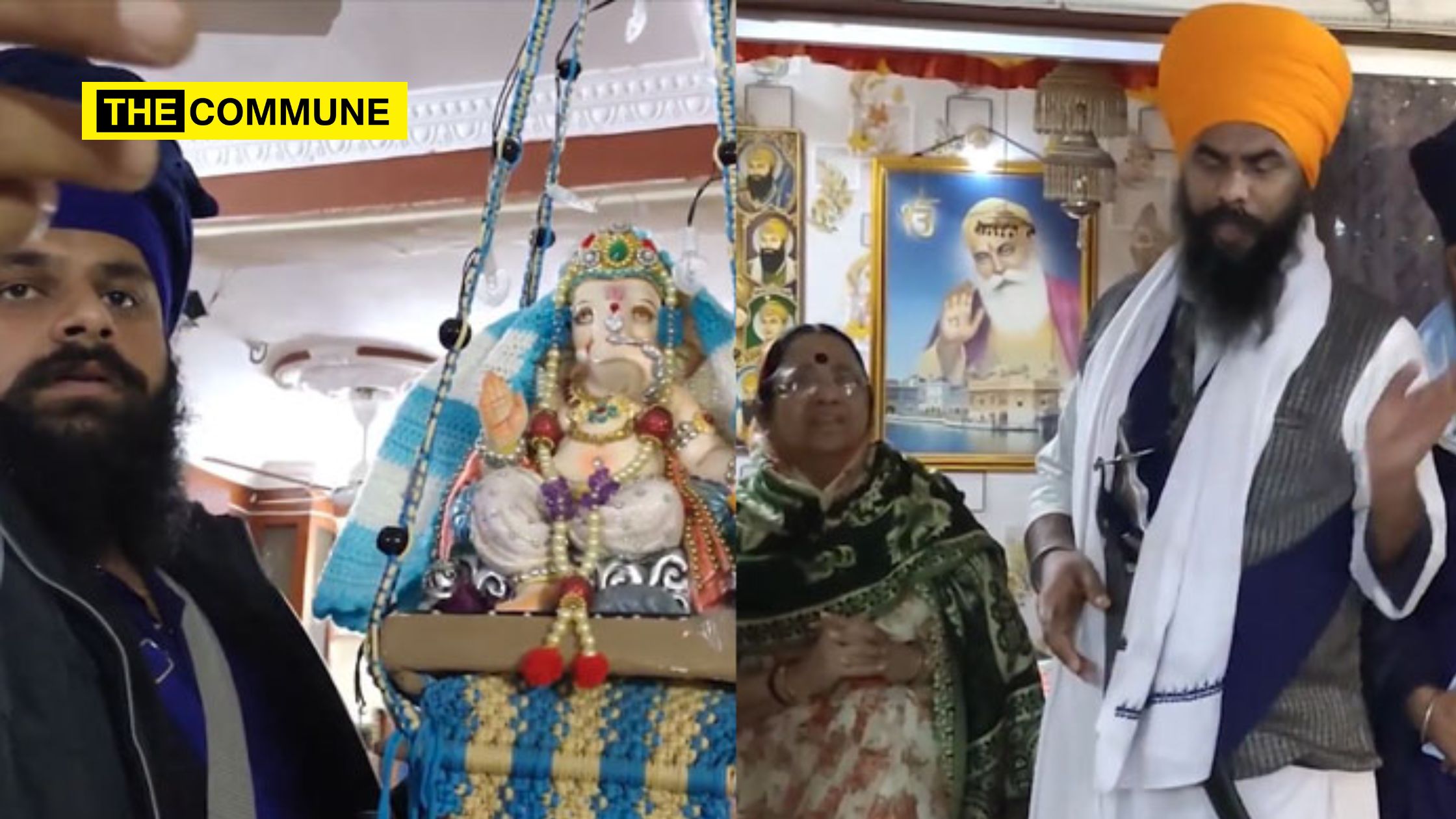
But this beautiful, long standing, inter faith, syncretic religious tradition between Sindhi Hindus and the Sikhs, is now under threat with recent reports of several Sindhi Temples in Madhya Pradesh, returning their temples’ copies of the Holy Book of the Sikhs, the Guru Granth Sahib, to the local Gurudwaras (Sikh temples).
Since last week, Sindhi Hindu Temples (Sindhi Tikanas) in Madhya Pradesh, which display and honour the Sikh Holy Book in their temples, have returned close to a hundred copies of the “Shri Guru Granth Sahib” to the local Gurudwaras. The local Sindhi community in Madhya Pradesh says, these unfortunate events are happening on account of what they claim to be a misunderstanding. It had started when some Nihang Sikhs (the revered Akali warrior sect of the Sikh community) alleged that the sanctity of Shri Guru Granth Sahib was not being upheld in the required manner, in the Sindhi Hindu temples, after they were informed of a ‘Mundan’ or hair-cutting ceremony that allegedly took place right outside the ‘Darbar’, where the holy book was placed. The temple administration has denied any intentional wrong doing and has stated that they had not performed a hair-cutting ritual.
It appears that the temple authorities were not involved in the ritual which begs the question. Who are the real culprits behind the incident and what kind of mischief is being played, resulting in a religious misunderstanding between the two closely related Indic religions? If such an incident did take place near the space respectfully allotted to the Holy Book in the temple, was it conducted with a malicious intent? The Nihang Sikhs have not accepted the temple administration’s explanation about their non-involvement in the hair-cutting event. Cutting of hair is against the tenets of orthodox Sikhism, likely based on the circumstances under which Sikhism was born, leading to their courageous defence of the native faiths against the tyranny of the fanatic Islamic rulers of the day. “Kesh” or hair is part of the Five Ks (Kesh, Kangha, Kara, Kachera, and Kirpan) in Sikhism. They are considered to be auspicious symbols in Sikhism. It is being reported that the Nihang Sikhs have also expressed displeasure at the placement of Hindu idols next to the Sikh holy book, something they had not fussed about in the past.
Is there a possible link between the spread of extremist views in certain sections of Sikh society under “secular” political parties and the unfortunate disruption of a lovely, religiously-syncretic tradition between the Sikhs and Sindhi Hindus? It is a well known fact that the Islamic Republic of Pakistan has been encouraging and providing covert support to a section of the Sikh community, for the idea of a separate statehood for Sikhs, distinct from the rest of India. Anytime, a “secular” party takes over the political reins in Punjab, the state seems to experience a rise in extremist/separatist activities, fuelled by the “Khalistani” movement, whose top pay masters are reputed to be from the Islamic Republic of Pakistan.
Over the past few months, Punjab has seen an alarming rise in extremist activities, claimed by members of Sikh separatist Khalistani groups. It is not surprising that such activities are happening under a “secular” AAP government. The Khalistani movement was at its peak under the various Congress-led governments at the Centre. The radicalisation of Sikhs, indoctrinated and brainwashed by those who receive training and attractive financial packages from their Pakistani handlers, is worrisome for India, already forced to fight a never-ending Islamist guerilla war, fuelled by the Pakistanis. Vulnerable Sikhs are encouraged to think of their religion as having closer ties to the tenets of Islam rather than the Sikh’s strong and unmistakable roots in Hinduism. A twisted, distorted, perverted version of Sikhism’s history and principles along with a Pakistan-encouraged and financed sikh-statehood narrative, has led to dangerous separatist ideas, among some sections of Sikh society. An increase in incidents of Sikh separatist extremism, is good news for Pakistani Islamists who are playing the old, tried-and-tested card of dividing the Indic, dharmic religions (Hinduism, Buddhism, Sikhism, Jainism, other native, tribal faiths) on the basis of trivial differences.
Sikhism was founded in the 15th century in response to the religious extremism and cruelty of the Muslim rulers of India. The Sikhs fought for themselves and their Hindu brethren. The tradition of respectfully keeping, displaying and honoring a copy of the Sikh holy book- the Shri Guru Granth Sahib, in many Sindhi Hindu temples, is a good example of unity and common cultural roots of all the Indic faiths. A vast majority of Sindhis as well as Punjabi Sikhs and Hindus, had immigrated to India from Pakistan during and after the Partition of the Indian subcontinent. Both Sikhs and Hindus of various communities, chose to immigrate to India out of fear of a Muslim majority Pakistan which had already declared itself an Islamic Republic even as India chose not to adopt Hinduism as a state religion.
It would be a shame if certain Sikh groups now fall prey to the false propaganda spread by Pakistani Islamists. Coincidentally, around the same time that the Sikh separatist ideology/Khalistani movement, is causing incidents of violence in Punjab and Hindu-Sikh ‘misunderstandings’ in India, there appear to be unfortunate incidents of temple vandalism in far away Australia by members of the Khalistani movement.
Let’s hope our Sikh brethren, choose not to disassociate themselves from the true origin of their brave, resilient religion. Let’s hope our Sikh brothers and sisters do not buy into the lies and incitement for a separate statehood, spread by Islamic extremists, who were responsible for countless horrors experienced by both the Sikh and Hindu communities, both of which, share a history of common cultural and spiritual roots. We must continue to stay united, defend and support one another against the onslaught of the common enemy, the fundamentalist Islamic state of Pakistan!
Click here to subscribe to The Commune on Telegram and get the best stories of the day delivered to you personally.
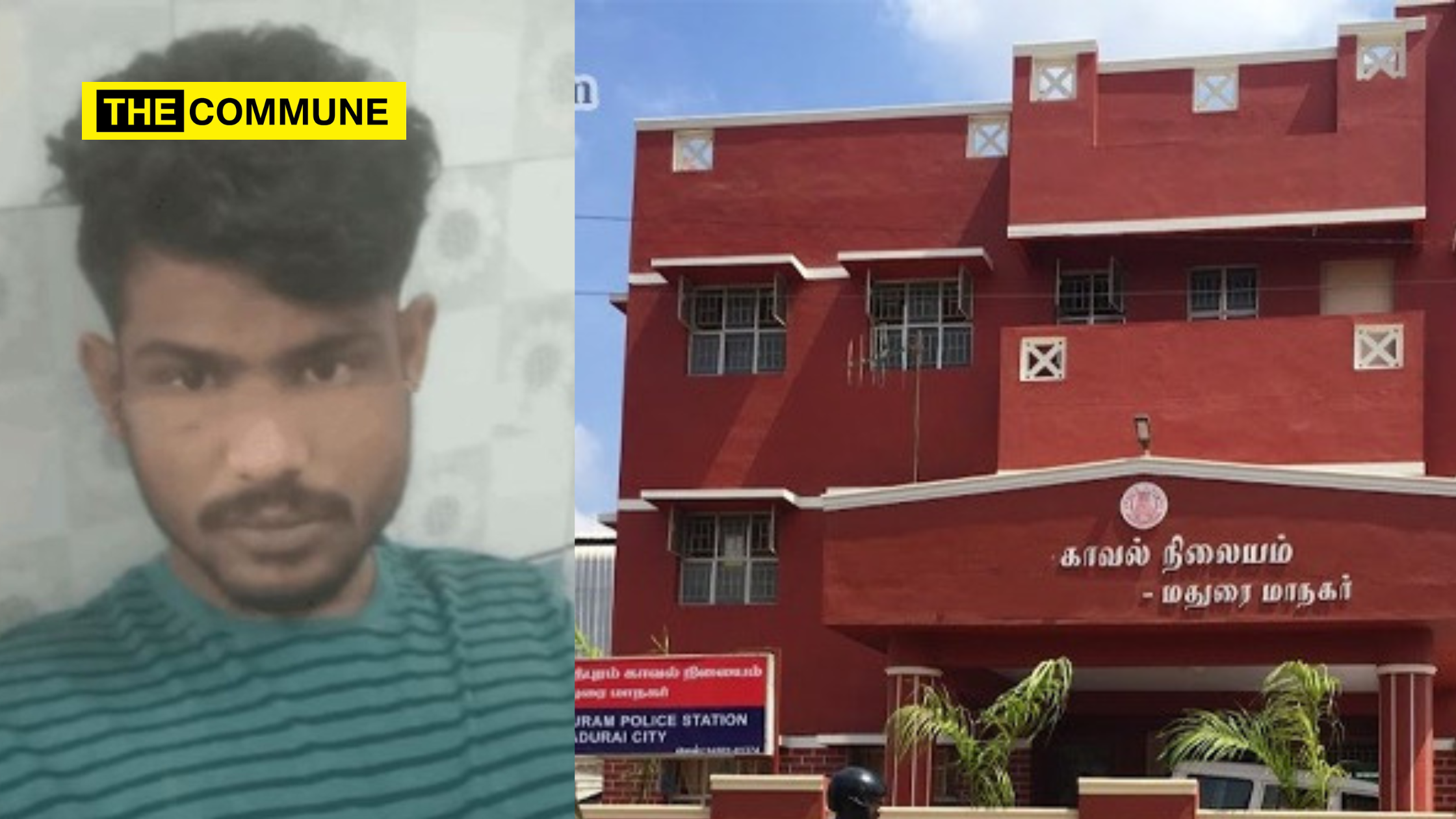
A hooligan was arrested in Madurai on January 20th for attempting to kill a Sub Inspector of Police with a sickle and a petrol bomb, raising serious concerns about the state’s law and order under the DMK government.
Koolmani alias Manikandan, a famous rowdy from the Madurai area, has various cases of murder, robbery, and human trafficking pending against him. A few months ago, a case has been filed against Koolmani by Sub Inspector of Police Azhagumuthu at Theppakulam Police Station.
Later, a few weeks ago, Sub-Inspector Agumumuthu was transferred to Madurai SS Colony Police Station. In this case, Sub-Inspector Azhagumuthu and his colleagues were on vehicle inspection duty in Madakulam, Madurai, last evening.
At the time, SI Azhagumuthu stopped a passing car, and it was revealed that the notorious rowdy Koolmani was inside. SI Azhagumuthu and other officers on duty attempted to stop the car and apprehend the criminal after learning that a notorious criminal was inside. When the police tried to stop him, Koolmani tried to slash the SI Azhagumuthu with a sickle. Later, he threw a petrol bomb at the police and drove away without stopping.
On receiving the information, SS Colony Inspector of Police Bhoominathan arrived at the spot and conducted an investigation. He immediately formed a special force to apprehend the criminal. On the same day, the criminal Koolmani was apprehended after an extensive search throughout the city.
This incident in Madurai city, in which a notorious rowdy attempted to kill police officers on patrol by throwing a petrol bomb, sparked public outrage and drew sharp criticism of the state’s law and order.
A shocking incident from Chennai has recently come to light, bringing to the fore yet again, the long standing debate on christian conversion activities in our country.
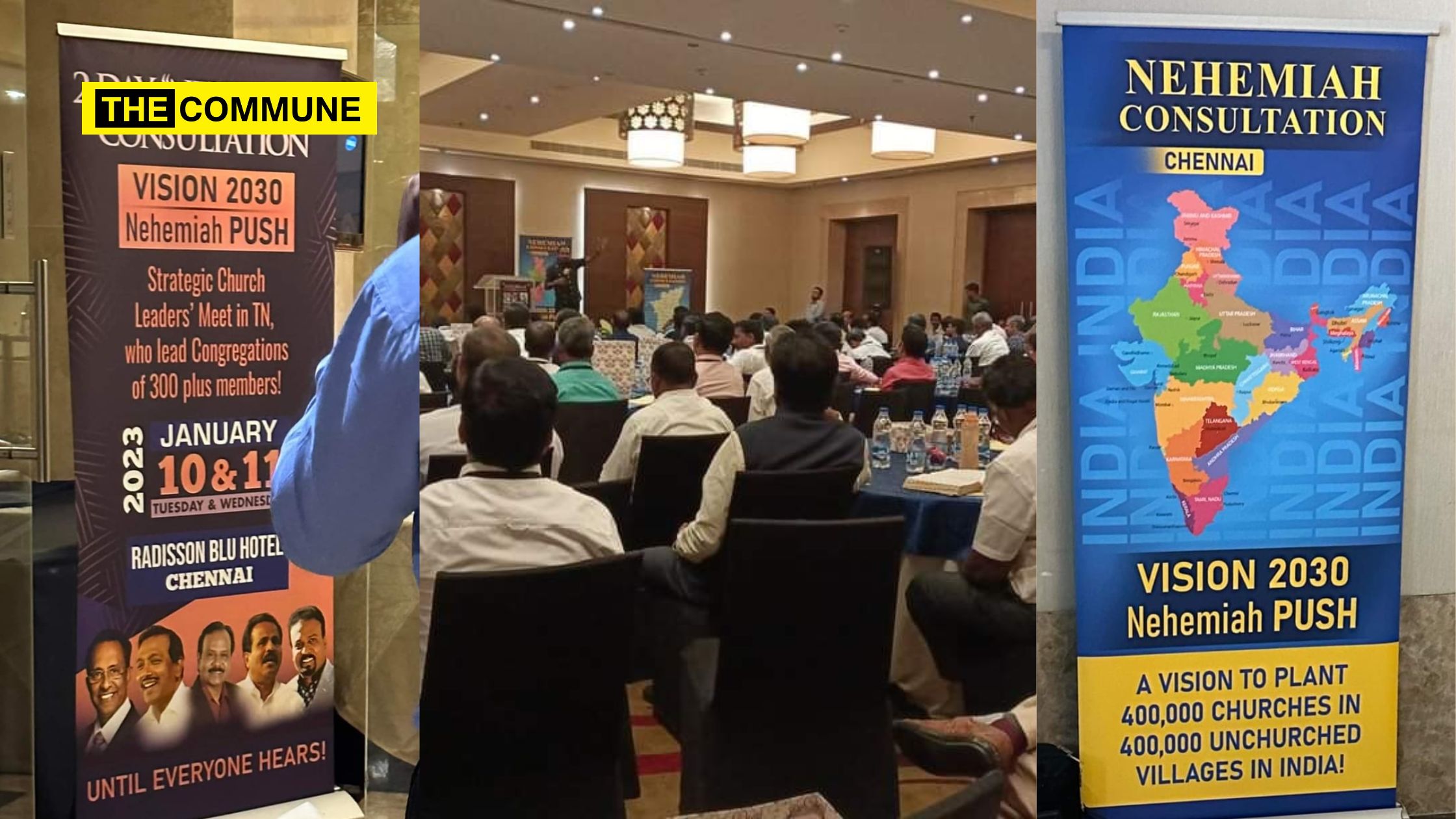
According to a report by Organiser, a strategic conference of Church leaders to discuss their “Vision 2030 Nehemiah Push” was held in Chennai on January 10 and 11 attended by over 300 missionaries and christian priests. The event was reportedly held at Radisson Blue Hotel in Chennai. The event saw the participation of controversial Christian pastor Mohan C. Lazarus who is known for his hate speech against Hindus.
Reportedly, the Church leaders congregated at Chennai for this ‘strategic meet’ to make a big push for establishing 400,000 Churches in the ‘unchurched villages in India’ under the leadership of Rev. Kalyan Kumar of Harvest Church India.
It is said that during the meeting it was resolved that they would undertake random mass conversion targetting 2292 ‘unreached’ communities totalling to 59,92,74,000 people, almost half of the Indian population.
In the first phase, the missionaries plan to target 25 communities and convert them to Christianity.
The Vision 2030 Nehemiah Push declares, “Ask God to rise up prayer teams who will begin breaking up the soil through worship and intercession. Ask the Lord to call full time Christian workers to works amongst the Brahmin, Yatav, Chamar, Rajput, Pathan, Ansari, Mahishya, Mali” and prays for a ‘vibrant Church planting’ in a bid to change the demography and make India a ‘Christian nation’.
The meeting gains significance in light of the ruling DMK openly declaring that the MK Stalin-led government in the state was formed by Christians and for Christians.
Where Will The Money Come From To Plant 4 Lakh Churches?
Let’s do some number crunching. If the target is to build approximately 4 lakh new Churches across India, it would amount to a minimum of ₹80,0000 crores, given a minimum of ₹20 lakhs for each church, for a small, modest church/prayer hall, including purchase of the required land, construction and labour costs, basic indoor requirements like electricity, plumbing, seating etc.
To build four lakh Churches would require a minimum of ₹80,000 crores and to meet their 2030 target, the christian organizations will need to spend upwards of ₹12,000 crores annually, a minimum of Rs 1,000 crores per month! Domestic Christian contributions cannot make up for the lakhs of crores that churches, their missionary activities, christian charities and institutions like hospitals, schools, christian groups like the YMCA etc. require every year.
The world wide church is a huge world wide business enterprise that demands and receives funds from christian believers, big business corporations looking for religious and political support as well as governments of christian nations that fund churches for “welfare” activities. Large banking and financial corporations fund them too at low interest rates, apart from free CSR (corporate donations) type of money inflow, in the name of social welfare. Overall, the huge, unimaginable amount of funds of the churches and missionary organizations, are in turn invested into profitable christian businesses such as educational institutions, hospitals, research centres Etc. Church businesses also take advantage of tax loopholes, citing ‘charity’. In certain countries like India, where government regulation and financial accountability are not taken seriously, they operate as profitable yet tax-exempt “NGOs” (non governmental organizations claiming to be non-profit).
In countries like India, church and missionary organizations go a step further in financing and promoting small, medium and large business enterprises by converted christians – they help with the set up, financing and promoting of businesses like schools, hospitals, transportation and even shopping complexes run by converted christians. Many christian or muslim owned businesses start with the financial help of christian/muslim religious organizations (purported NGOs, charities). When they establish themselves and start making profits, they give back generously to their religious institutions and thus, this profitable religious-funding cycle continues!
About two years ago, in one of his video posts, writer Maridhas presented worrying information along with the relevant statistics, of a whopping 15,000 churches built in Tamil Nadu alone, in just the last ten years.
In countries like India, domestic contributions alone are not sufficient, hence the need for foreign funding. The religiously-motivated foreign organizations plan, fund and supervise conversion activities in countries like India with two broad categories of objectives – the domestic agenda of increasing the numbers of Christians in India and an international objective of influencing India’s policies by covertly supporting “secular” politicians and parties.
Thus far, India is the only major nation protecting all Eastern-Indic faiths, that has managed to survive the onslaught by the two religions, barring the smaller nations holding on to their Buddhist faith.
Recently, Kerala Pradesh Mahila Congress President Adv. Jebi Mather wrote to DGP of Kerala insisting to take action against CPM Alleppey area committee member AP Sona on his alleged sexual predatory behaviour. The incident marks one among plethora of incidents which points out to the continuous anti-women attitude of the left but what is more interesting is that many sections of media are being silent about this incident. Playing down magnitude of a news to please certain sections having particular political affiliation seems to be the ‘modus operandi’ here. In this context, this article will look in to the misogynist attitude of the left and understand as to why certain sections of media are silent about it.
The Scandals Of The Left
Following the controversy, CPM expelled Alappuzha south area centre member AP Sona from the party for allegedly capturing obscene visuals of women on his mobile phone. The accused member has been dismissed from the party following the district committee finding his actions violating decency of the party. Meanwhile, police have deployed security in the area where AP Sona’s house is located. Officials were stationed in the area considering the possibility of a clash between two factions inside the CPM. Controversy has also surfaced over the complaint against the CPM leader not being forwarded to the police. Organisations, including the Youth Congress, have come forward criticising the CPM. A section inside the CPM also demanded the party to forward the case to the police.
The action was taken by CPM due to pressure from their voters base itself and also due to pressure from other political parties. It is pertinent to note in this situation that this is not the first time that CPM in Kerala is spreading their venomous misogynist fangs. In fact, this follows a pattern adopted by left in Kerala. Not so long ago, former minister MM Mani sparked a controversy in the Kerala Legislative Assembly by his unsavoury remark on Revolutionary Marxist Party (RMP) leader KK Rema, close on the heels of incendiary speeches against her by CPM central committee member Elamaram Kareem and Kozhikode CPM district committee secretary P Mohanan. Speaking on the issue Rama said that, ‘CPM want to insult political rivals with unsavoury comments rather than taking them on politically’, she further stated that violence and misogyny are typical nature of CPM. One must understand that Rama is a victim of CPM violence, widow at an early age her husband who was an ex-CPM worker was hacked to death by the party for not walking along party line. In another instance in the past, Kerala Police did not file a case against Communist Party of India (Marxist) (CPM) Thiruvananthapuram councillor DR Anil even after several BJP councillors complained that he insulted women councillors. Anil is also the LDF parliamentary party secretary and passed disgraceful remarks while the lady BJP councillors signed the attendance register. He said that if they wanted money, they might as well do ‘other’ jobs. If you think this is heinous, one cannot comprehend the extent to which CPM workers will go to take advantage of women. Couple of years ago, a special POCSO court in Kerala’s Palakkad district acquitted three persons in connection with the rape of two minor Dalit sisters in Walayar, a region on the Kerala-Tamil Nadu border, dating back to the year 2017. The two girls, aged 13 and nine, were found hanging inside their one-room home 52 days apart and post-mortem examinations had confirmed that the minors were subjected to sexual assault before their deaths. The girl’s mother states that accused belong to CPM and police is showing leniency towards the issue due to intervention by local CPM leadership. The bestiality by party workers created a blot which cannot be removed on the face of ‘cultural Kerala’ and ruling left dispensation continues with its misogynist attitude unbridled by these instances.
The Media Silence
‘There won’t be a change, not until common people realize the venom spread by mainstream media in Kerala ‘
Left is supposed to be the forerunners of rights of the downtrodden and flag bearers of equality but in Kerala the situation is different. It is the oligarchic attitude of the left which prevails in Kerala and disappointingly the liberal media is silent on the issue. If we look at an instance in which Kerala Governor lashed out against media, we could see the situation unfolding on the ground. Governor made a remark in response to CPM’s statement that it will ramp up attacks against him for misusing his post to create ‘a constitutional crisis’. Replying to the questionnaire from media Governor stated that, “I’m not afraid. I’m simply performing my duties. The government is in the wrong here,”Khan alleged, but not before making sure that Media One and Kairali (two channels which he labelled as ‘cadre media’) were not among the crowd of reporters. “I will not speak to ‘cadre media’,” Khan said, implying that the two channels were pro-Left and catering to their agenda. It’s not only the political affiliation which creates this bias, it is also the fear against the left government who are known to hack their opponents to death in case of differences in opinion. The left also tries to take legislative route to silence the media. One such example was introduction of media regulation bill. The Bill proposes to introduce a new sub-Section 292 (A) through legislation after amending the IPC Section 292, with an objective to curb the printing, publishing, and distribution of ‘grossly indecent or scurrilous matter or matter intended for blackmail’. It also provides for the amendment of certain sections of the Criminal Procedure Code (CrPC) in line with changes in the IPC. Even though the move failed, it sounded alarm as to the intention of the left in silencing media.
Even though it’s not a forced silence many sections of left liberal media are keeping itself out from criticising CPM or pointing out to the instances of misogyny by CPM. This is wrong and it goes against every inch of ethics in journalism. As conscious citizens we must not be misled or misguided by these venomous media outlets and shall realise the truth behind the facade of these news outlets.
Click here to subscribe to The Commune on Telegram and get the best stories of the day delivered to you personally.
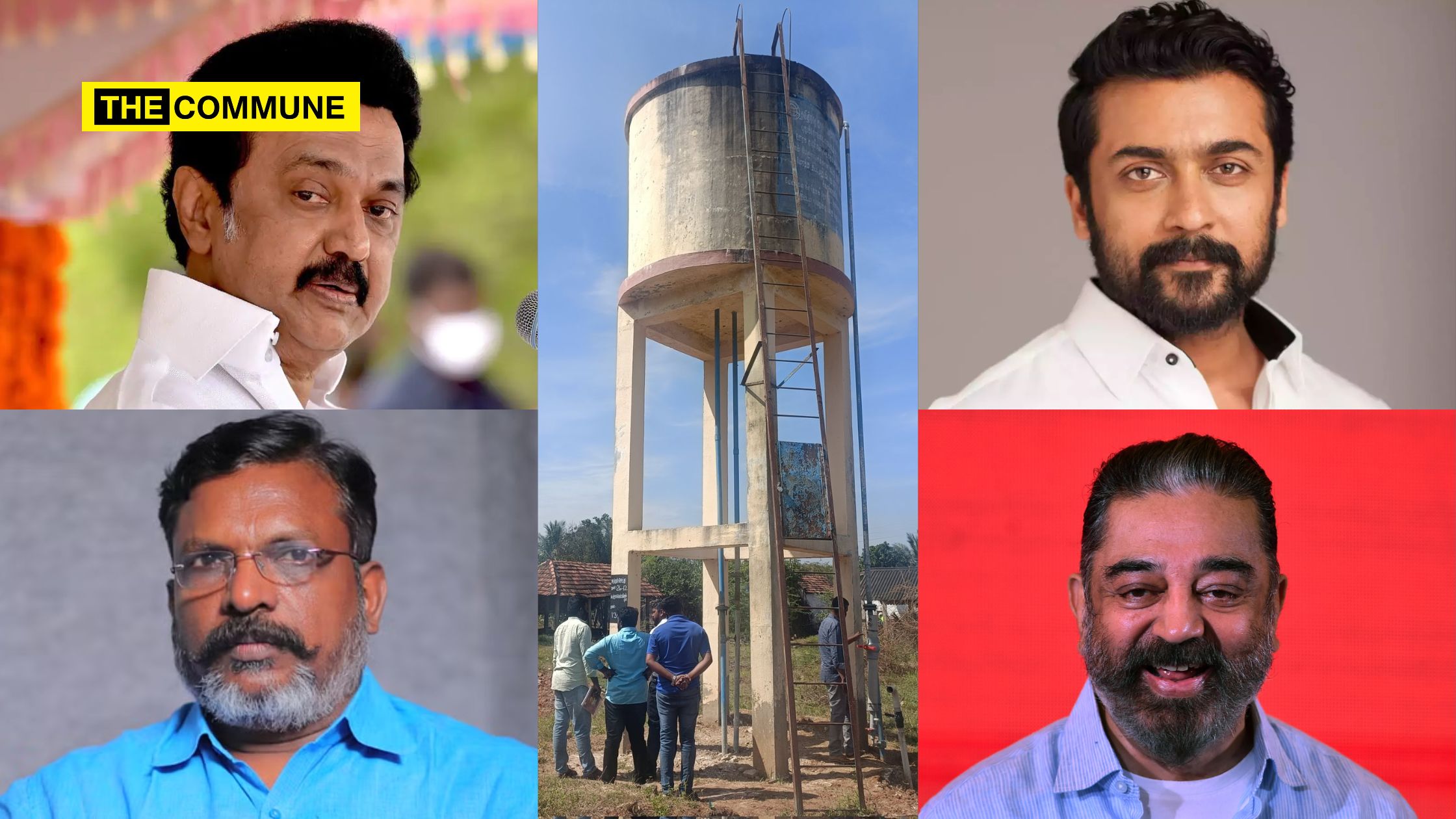
Recently in the so-called land of ‘Periyar’ where Dravidian Model of governance is in effect under the rule of MK Stalin, a horrific incident was reported where human excreta was found dumped in water tank used by Dalits of the Vengaivayal village in Pudukottai district.
The incident came to light after many families fell sick. Residents had complained of yellow-coloured water and foul smell coming in their household pipes. A probe into the incident revealed that the contamination was from a single source – the water tank where human faeces were found floating.
Residents of the village complained to the police but the culprits behind the horrific crime are yet to be brought to justice.
What is most disturbing about the horrific incident is how the self-proclaimed champions of social justice, DMK’s allies, and the Dravidian Stockist media have been underplaying the incident in order to save the face of Stalin government.
How The Dravidian Stockist Media Is Trying To Buttress The Ruling DMK
In the beginning, the incident was widely reported by many media outlets triggering massive public outrage. However, the issue hardly featured as prime-time debates. Instead the mainstream news channels latched onto the DMK versus Governor controversy where Governor RN Ravi skipped portions of the speech prepared by the DMK government as it had factual errors and high on superlative adjectives extolling the government. The DMK MLAs creating a ruckus in the Assembly and Stalin moving a resolution against the Governor can itself be seen as an attempt to shift the focus away from real issues like the Vengaivayal incident.
Just a few days later, the Tamil mainstream media projected that the people of Vengaivayal have been celebrating ‘Samathuva Pongal,’ and are happy and moved on from the incident.
But even the ‘Samathuva Pongal’ was no happy affair. The Pongal cooked by Dalits were not eaten by members of the dominant Agamudayar and Muthuraiyar communities.
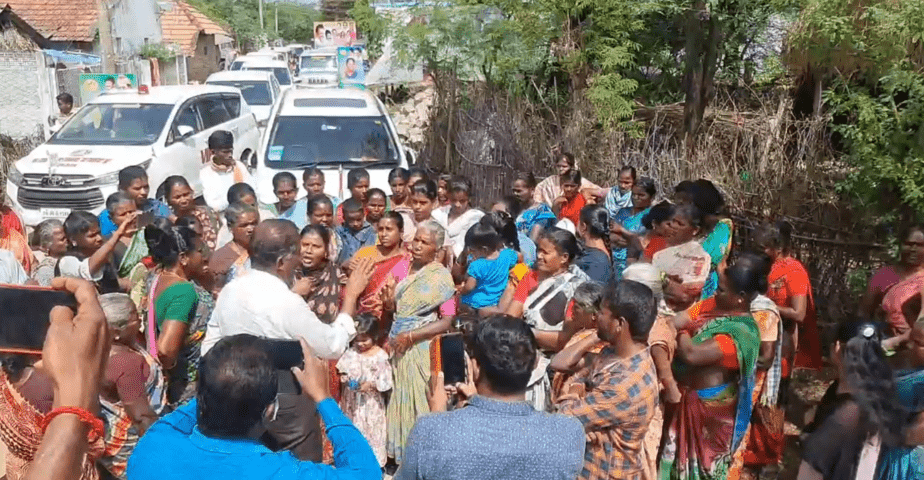
The truth is that the people of Vengaivayal village had besieged DMK ministers Raghupathi, Meyyanatha, and Kayalvizhi Selvaraj, who had gone there after nearly 20 days of that incident, and demanded that the DMK apprehend the criminals before celebrating ‘Samathuva Pongal’. DMK Minister Meyyanathan did not even visit the Dalit colony in Vengavayal and instead stayed in the Elementary school in the village, allege residents. But this was hardly discussed or debated by the Dravidian Stockist media.
Why Is DMK Underplaying?
Pudukottai district is dominated by three major communities. They are Mutharaiyar, Paraiyar (SC), and Thevar. Activist Airport Moorthy has alleged that the human excreta was mixed in the drinking water of the Paraiyar community by the Valayar, a sub-sect of the Mutharaiyar community.
There are six assembly constituencies in the Pudukottai district, namely, Gandharvakottai (SC), Viralimalai, Pudukottai, Thirumayam, Alangudi, and Aranthangi. Except for Viralimalai, where ADMK Vijayabhaskar won with Thevar votes, the DMK and its allies won all five constituencies. Thevar, Muthairaiyar, and Paraiyars are the main vote bank of ADMK, DMK, and VCK (Viduthalai Chiruthaigal Katchi) respectively. Since 2019, VCK, a Paraiyar party, has been in an alliance with the DMK, and as a result, the DMK has won the majority of constituencies in the Pudukkottai district, where the incident occurred, using Mutharaiyar and Paraiyar votes.
Parliament constituencies which include the parts of Pudukottai districts include Karur, Trichy, Sivagangai and Ramanathapuram. All four parliamentary constituencies are won by DMK and its allies using Mutharaiyar and Paraiyar votes. However, none of the MPs, particularly the publicity-hungry Jothimani, have visited the site.
It is for this reason, the DMK is afraid to speak out on the issue because it involves the two communities that voted it into power in the Pudukottai district. It is because of this reason that Chief Minister MK Stalin or his Minister-son Udhayanidhi Stalin are yet to visit the village and express solidarity with the affected families. In order to not antagonize the the votebank of Valayars and Muthuraiyars, the DMK has been underplaying and have refused to vocally call out the horrific crime.
VCK Head Thirumavalavan’s Silence
DMK won Paraiyar votes by having Thirumavalavan, a Paraiyar leader, as a catalyst in its alliance. The Paraiyar caste has been betrayed not only by the DMK, the party for which they voted but also by their leader Thirumavalavan, who has refused to even engage in ‘Thozamai Suttuthal’ (soft criticism) this time.
VCK Thirumavalavan had previously announced a protest in Pudukottai in response to the incident, but he later canceled it in order to organize a protest against Tamil Nadu Governor RN Ravi using Tamizhagam instead of Tamil Nadu. This begs the logical question: Is Governor RN Ravi’s ‘Tamizhagam’ issue more important than the Vengaivayal incident, or is it a diversionary tactic by Thirumavalavan to save the DMK?
After much outrage and people calling him out, only on 19 January 2023, Thirumavalavan organized a protest in Pudukottai to condemn the incident.
#வேங்கைவயல் பேரிழிவைக் கண்டித்து தமிழ்நாடெங்கும் #விசிக சார்பில் ஆர்ப்பாட்டங்கள் நடைபெற்றன. சென்னையில் வள்ளுவர் கோட்டம் அருகே நடந்த ஆர்ப்பாட்டத்தில் உரையாற்றினேன். குற்றவாளிகளைக் கைது செய்யவேண்டும். பொதுவான தொட்டியிலிருந்தே ஆதிதிராவிடர்களுக்கும் குடிநீர் வழங்க வேண்டும்.. (1/2) pic.twitter.com/SOsJNngmNK
There is an actor called Suriya Sivakumar. He had recently produced and acted in the controversial film ‘Jai Bhim’ which sought to shed light on the plight of Dalits facing police torture.
When the AIADMK was in power, this actor and his brother Karthi who is also an actor, often grabbed limelight by condemning and issuing statements over every other matter unrelated to the domain of cinema. Surya and his brother Karthi, who have spoken out against issues such as the New Education Policy, NEET, the death of IT girl Subhashree due to the AIADMK’s banner falling, farmers’ protests, Vedanta’s Sterlite plant, Sathankulam incident where two men were beaten to death in police custody, have remained tight-lipped about the Vengaivayal incident.
Full-time actor and part-time politician Kamal Haasan who demanded action against the police, judiciary, doctors involved in the Sathankulam incident is today missing in action.
‘Superstar’ Rajinikanth, who relased a picture of his ‘angry face’ expressing shock over the incident and calling for all the officials to be severely punished, has gone on mute to shoot for his next film with Sun Pictures.
Another such alleged actor is Siddharth, who has remained silent about the Vengaivayal incident.
When the AIADMK was in power, these virtue-signaller who were very active have gone into hibernation now.
These social activists cum ‘Poralis’ who spoke out against the police murder of Jeyaraj and Bennix, have remained silent on numerous lock-up deaths during the DMK regime, including Vignesh’s death, in which CM Stalin was caught lying in the State Assembly.
Periyarists, who see themselves as the saviors of social justice in Tamil Nadu, has gone into hiding and have yet to comment on the incident. Subha Veerapandian, a Periyarist who serves on the Tamil Nadu government’s social justice committee, has not even tweeted his condemnation of the Vengaivayal incident.
Dalit film-maker Pa. Ranjith who never left an opportunity to take positions during the AIADMK regime has now gone soft with a name-sake condemnation. Without naming the concerned Minister and region’s MLAs, Pa. Ranjith condemned them for not visiting the village to address the issue. He stated that the police are attempting to pin the blame on the victims in the Vengaivayal incident, without naming the DMK government under which the police department functions.
The Dravidian Model Of Social Justice
The Vengaivayal incident once again busts the myth of the “Dravidian Model” of social justice. According to a 2019 RTI data, the number of villages practising ostracism remains the highest in Tamil Nadu.
646 villages in 20 districts of the state still ostracise people based on caste. Ironically the largest number of villages that practice untouchability is in Thiruvarur district, the home district of late DMK patriarch Karunanidhi.
The incident also shows the duplicity of the actors, activists, media and other self-proclaimed champions of social justice who now stand exposed that they have an agenda and it is to act as mouthpiece for the DMK.
No matter how much these people try to cover up, the Vengaivayal incident will remain infamous for not just DMK’s apathy but also a testimony to the fallacy of Dravidian Model.
Click here to subscribe to The Commune on Telegram and get the best stories of the day delivered to you personally
The silence of the “main stream” leftist media is sometimes deafening especially when socially important matters intersect with personal political views.
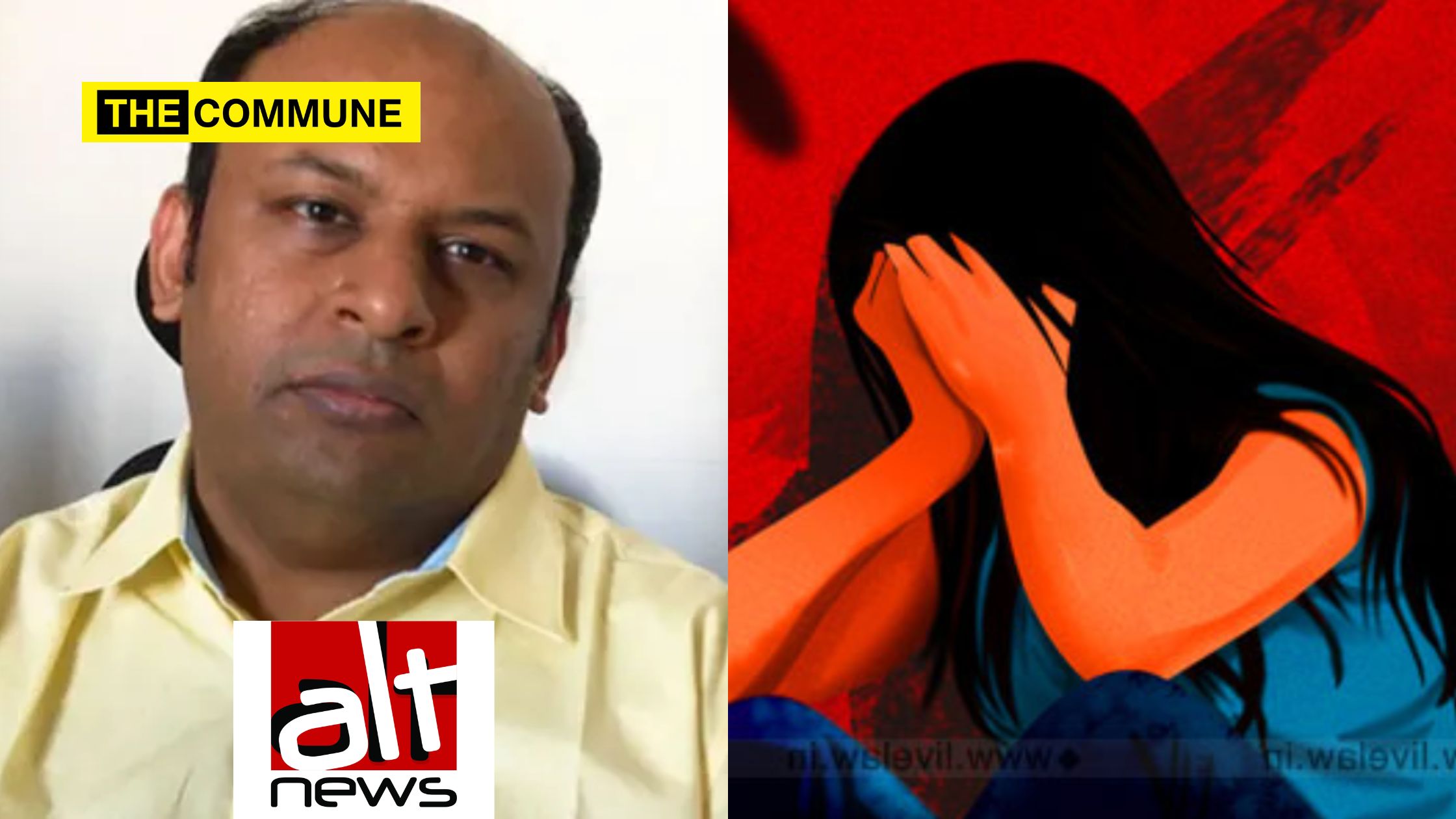
A woman has come forward with her story of Pratik Sinha, a co-founder of the alleged “fact checking” site ‘Alt News’, taking advantage of her physically and emotionally, despite the lady making her intent and preferences clear to him, at the very onset of their relationship. Its other founder, Mohammed Zubair is out on bail on several accusations including an FIR under Protection Of Children from Sexual Offences (POCSO) Act. As was the case with Alt-News co founder, Mohammed Zubair in 2020 and after over various allegations of offences against him, now too, the so called mainstream, Left media outlets have refused to report on this latest allegation of sexual misconduct and deceit against ‘Alt-News’ co-founder, Pratik Sinha because doing so would mean discrediting one of their own!
The woman’s story was presented in an anonymous Instagram handle ‘fightforjustworld’ on 14 January 2023. The woman alleged Pratik Sinha to be a “fraudster who could stoop to any extent to be in bed with a woman”. The woman lamented that he used the same modus operandi that he used with her with other women to get them into a physical relationship with him.
Her story is said to have begun in April 2020 when Pratik Sinha messaged her on Facebook who at the end of the conversation got her phone number.
Considering who he was, she gave in and the interactions went from texts to calls and video calls. Soon, Sinha conveyed that he had a feeling of ‘more than that of friendship’ and expressed interest to get into a relationship. But the lady refused as she had academic commitments and told him that a relationship was possible only after 2 years to which Pratik Sinha agreed.
In November 2020, Sinha apparently said it would not be possible for him to continue the relationship but they kept talking. Again a month later in December 2020, he expressed his feelings for her and allegedly urged her to meet him as soon as possible once the pandemic restrictions are lifted.
But the lady apparently cut off his contact because of his wavering and volatile mindset. Again in May 2021, he got in touch with her and allegedly wanted to have a ‘monogamous’ and ‘exclusive’ relationship with her. He had said that he had not been physically involved with anyone since March 2019 and always denied it whenever she asked if he was involved with anyone else in any kind – be it physical or emotional.
In July 2021, he again expressed his “genuine feelings” for her and asked her to meet before he shifted to Kolkata in September 2021. According to the lady, both of them decided to meet in the first week of September and stayed together for three days. During that period, they got physical. The lady made it clear that she did not want just a casual fling. Pratik Sinha apparently assured her saying, “he wouldn’t put in so much effort, changing two flights to meet up with someone, if it was casual”.
Sinha also allegedly expressed his interest to marry her and is mother is said to have known about the two.
12 days after the meeting, Sinha once again changed his attitude towards her saying that he had been misleading her and that all the assurances he gave about the relationship were drama. He reportedly accepted that he wasn’t truthful to her.
The lady wanted to make a big deal and even claimed to have warned Pratik to go public about the issue.
However, a ‘female friend’ of Sinha intervened and persuaded against it under the pretext of resolving the issue.
“She messaged & called me on the pretext of “trying to resolve the issue” but the real purpose was to dissuade me from going public, to coax me into silence, & thus “protect him”.”, the lady wrote in her ordeal.
The lady was told by the female friend that Sinha was involved with multiple women and that he was a ‘sex maniac’, who would go to any extent of lying to get women into his bed.
The supposed victim called Sinha a fake, fraudster, and someone who “ogles at women’s breasts”. She expressed her anguish over the fact that someone who calls himself “the buster of fake information, champion of truth and warrior of women’s rights” allegedly duped her with lies.
“Beware of such ‘champions of truth’ & their enablers who call themselves feminists, female rights warriors. They think nothing of looking out for this person’s interests because he is a public figure. They will try to convince you to keep quiet and move on rather than think about other women—they will claim all women agreed to consensual, casual flings.”, she wrote.
https://www.instagram.com/p/CnYxdIgDGSt/
Despite the serious allegations, the self-proclaimed champions of women’s rights and #MeToo activist haven’t spoken on the allegation of sexual abuse against one of their fellow ideologists and a propagandist. The leftist media has yet again proven that they priotize their personal political preferences over the social causes, they claim to champion. The Left’s ideologically-influenced political bias has a strong impact on what type of news they choose to report, who is reported on, what and who is championed and promoted, the timing of a report and the political intent or purpose of a news report.
The leftist, pseudo-secular journalism and reporting, typically starts off with pretentions of fairness, equality and women’s rights, universal compassion, minority rights, human-rights, universal justice and what not, yet the “What, Who, How and When”, they choose to report on, is reflective of their stinking bias and high levels of hypocrisy when they protect one of their own.
Click here to subscribe to The Commune on Telegram and get the best stories of the day delivered to you personally.


The Scandalous Kerala Communists And The Stoic Silence Of The Media And ‘Progressives’
Recently, Kerala Pradesh Mahila Congress President Adv. Jebi Mather wrote to DGP of Kerala insisting to take action against CPM Alleppey area committee member AP Sona on his alleged sexual predatory behaviour. The incident marks one among plethora of incidents which points out to the continuous anti-women attitude of the left but what is more interesting is that many sections of media are being silent about this incident. Playing down magnitude of a news to please certain sections having particular political affiliation seems to be the ‘modus operandi’ here. In this context, this article will look in to the misogynist attitude of the left and understand as to why certain sections of media are silent about it.
The Scandals Of The Left
Following the controversy, CPM expelled Alappuzha south area centre member AP Sona from the party for allegedly capturing obscene visuals of women on his mobile phone. The accused member has been dismissed from the party following the district committee finding his actions violating decency of the party. Meanwhile, police have deployed security in the area where AP Sona’s house is located. Officials were stationed in the area considering the possibility of a clash between two factions inside the CPM. Controversy has also surfaced over the complaint against the CPM leader not being forwarded to the police. Organisations, including the Youth Congress, have come forward criticising the CPM. A section inside the CPM also demanded the party to forward the case to the police.
The action was taken by CPM due to pressure from their voters base itself and also due to pressure from other political parties. It is pertinent to note in this situation that this is not the first time that CPM in Kerala is spreading their venomous misogynist fangs. In fact, this follows a pattern adopted by left in Kerala. Not so long ago, former minister MM Mani sparked a controversy in the Kerala Legislative Assembly by his unsavoury remark on Revolutionary Marxist Party (RMP) leader KK Rema, close on the heels of incendiary speeches against her by CPM central committee member Elamaram Kareem and Kozhikode CPM district committee secretary P Mohanan. Speaking on the issue Rama said that, ‘CPM want to insult political rivals with unsavoury comments rather than taking them on politically’, she further stated that violence and misogyny are typical nature of CPM. One must understand that Rama is a victim of CPM violence, widow at an early age her husband who was an ex-CPM worker was hacked to death by the party for not walking along party line. In another instance in the past, Kerala Police did not file a case against Communist Party of India (Marxist) (CPM) Thiruvananthapuram councillor DR Anil even after several BJP councillors complained that he insulted women councillors. Anil is also the LDF parliamentary party secretary and passed disgraceful remarks while the lady BJP councillors signed the attendance register. He said that if they wanted money, they might as well do ‘other’ jobs. If you think this is heinous, one cannot comprehend the extent to which CPM workers will go to take advantage of women. Couple of years ago, a special POCSO court in Kerala’s Palakkad district acquitted three persons in connection with the rape of two minor Dalit sisters in Walayar, a region on the Kerala-Tamil Nadu border, dating back to the year 2017. The two girls, aged 13 and nine, were found hanging inside their one-room home 52 days apart and post-mortem examinations had confirmed that the minors were subjected to sexual assault before their deaths. The girl’s mother states that accused belong to CPM and police is showing leniency towards the issue due to intervention by local CPM leadership. The bestiality by party workers created a blot which cannot be removed on the face of ‘cultural Kerala’ and ruling left dispensation continues with its misogynist attitude unbridled by these instances.
The Media Silence
‘There won’t be a change, not until common people realize the venom spread by mainstream media in Kerala ‘
Left is supposed to be the forerunners of rights of the downtrodden and flag bearers of equality but in Kerala the situation is different. It is the oligarchic attitude of the left which prevails in Kerala and disappointingly the liberal media is silent on the issue. If we look at an instance in which Kerala Governor lashed out against media, we could see the situation unfolding on the ground. Governor made a remark in response to CPM’s statement that it will ramp up attacks against him for misusing his post to create ‘a constitutional crisis’. Replying to the questionnaire from media Governor stated that, “I’m not afraid. I’m simply performing my duties. The government is in the wrong here,”Khan alleged, but not before making sure that Media One and Kairali (two channels which he labelled as ‘cadre media’) were not among the crowd of reporters. “I will not speak to ‘cadre media’,” Khan said, implying that the two channels were pro-Left and catering to their agenda. It’s not only the political affiliation which creates this bias, it is also the fear against the left government who are known to hack their opponents to death in case of differences in opinion. The left also tries to take legislative route to silence the media. One such example was introduction of media regulation bill. The Bill proposes to introduce a new sub-Section 292 (A) through legislation after amending the IPC Section 292, with an objective to curb the printing, publishing, and distribution of ‘grossly indecent or scurrilous matter or matter intended for blackmail’. It also provides for the amendment of certain sections of the Criminal Procedure Code (CrPC) in line with changes in the IPC. Even though the move failed, it sounded alarm as to the intention of the left in silencing media.
Even though it’s not a forced silence many sections of left liberal media are keeping itself out from criticising CPM or pointing out to the instances of misogyny by CPM. This is wrong and it goes against every inch of ethics in journalism. As conscious citizens we must not be misled or misguided by these venomous media outlets and shall realise the truth behind the facade of these news outlets.
Click here to subscribe to The Commune on Telegram and get the best stories of the day delivered to you personally.