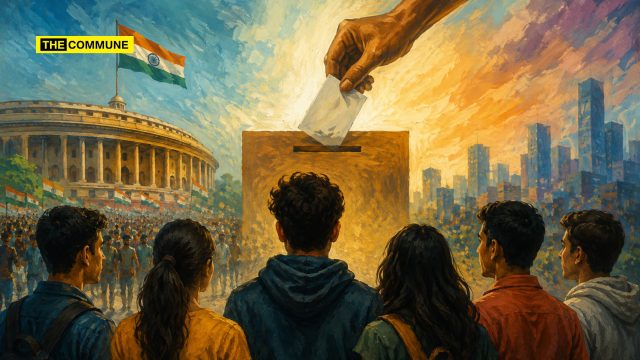
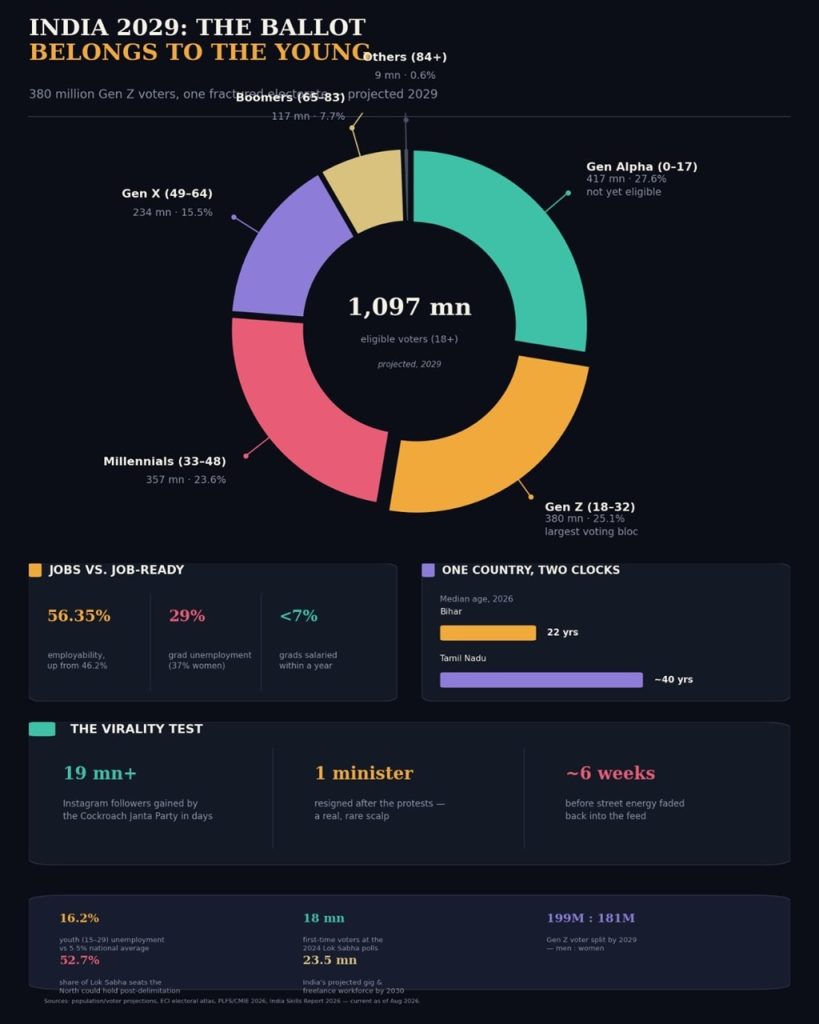
Here’s a number worth thinking for a second- 380 million. That’s how many Indians will belong to Gen Z (the 18 to 32 bracket) by the time the country votes again in 2029. It’s more people than the entire population of the United States. It’s bigger than the BJP’s and Congress’s combined vote tallies from 2024, put together, twice over. And it will officially make Gen Z India’s largest single generation of voters.
Any political strategist, psephologist or thinks tanks of political parties who reads that number and quietly parks it under “youth outreach, can be handled later” deserves to lose their job. Because this isn’t a side plot anymore. This is the main story of the next general election.
Think about what that number actually does to the electoral map. A voting bloc this size doesn’t need to win every constituency to matter – it just needs to swing the ones sitting on a knife’s edge, and in a country where Loksabha seats regularly change hands on margins of a few thousand votes, a restless 380 million is not a demographic footnote. It’s the whole ballgame!
And here’s the twist most hot takes conveniently skip – being the biggest voting bloc doesn’t automatically make you the most decisive one. A generation only votes as a bloc when it shares a “wound” or “feel” sharp enough to cut through caste, region and the usual loyalties that run Indian elections. The real question for 2029 isn’t whether Gen Z is big. It’s whether that “wound” or “feel” has already arrived. And there has been a loud and crystal clear answer which arrived this summer of 2026.
The Jantar-Mantar Preview
In May 2026, an off-the-cuff remark by the Chief Justice of India comparing unemployed youth to “cockroaches” got picked up by a young political communications strategist and almost overnight turned into the Cockroach Janata Party. What started as a meme grew and touched 19 million Instagram followers within a week, filled Jantar-Mantar with protestors, and eventually forced Union Education Minister Dharmendra Pradhan to resign over exam paper leaks. That’s not a “nothing” result – a sitting minister actually went, Prime Minister addressing Nation on Instagram on mid-night and a swing of actions and reactions all over the media.
CJP will probably never contest an election. But it proved something far more important: India’s Gen Z can be mobilised fast, at massive scale, the moment a grievance feels personal enough. And the grievance, once you strip away the memes, is depressingly simple, it’s about Jobs and opportunities.
It’s Definitely Not the Ideology
Ask any first-time voter what keeps them up at night and you won’t hear “federalism” or “secularism” “democracy.” You’ll hear about the exam that got leaked, the interview that never called back, degree that led nowhere, opportunities that never came, dreams not materialised and so on. The data backs this up starkly: India’s overall unemployment sits at a respectable 5.5%, but youth unemployment (15–29) is running at 16.2% – over three times higher, and closer to 18% in cities. Fewer than 7% of male graduates land a permanent salaried job within a year of finishing college. For women graduates, unemployment runs even higher, close to 37%.
This isn’t a jobs shortage in the textbook sense – the economy is still growing at a healthy clip. It’s a transition failure: a wall between the classroom and the workplace that a record number of degree-holders keep slamming into. Watching an engineering degree turn into a food-delivery gig radicalises a person in a very specific, non-ideological way. It’s why NEET-leak protests, recruitment scam anger, and the Cockroach movement all draw from the same well, even though the evening news from MSM treats them as unrelated stories. And here’s the strategic sting for every party currently in power anywhere in India – this anger is anti-incumbent-system, not anti-any-single-party. It’ll bite whoever is holding office when the election results come out.
One Country, But Very Different Clocks
Here’s where the arithmetic gets genuinely tricky for campaign war-rooms: Gen Z’s political weight isn’t spread evenly across the map. Bihar and Uttar Pradesh are still deep in their youth bulge, with median ages hovering around 22. Kerala has already crossed a median age of 33; Tamil Nadu is projected to be India’s oldest state by the early 2030s, pushing towards 40.
The Northeast adds its own layer to this picture; states like Assam and Manipur carry a youth bulge as sharp as Bihar’s, but here the ballot-box conversation is shaped as much by ethnic identity, insurgency-era peace processes, and outward migration to Delhi and Bangalore for jobs.
Western India cuts a different profile again – Maharashtra and Gujarat combine a still-youthful population with the country’s densest industrial and services job markets, making them less a “youth grievance” zone and more a magnet that absorbs restless graduates from poorer states next door. That makes the West less a bloc unto itself and more the destination where every other region’s Gen Z anger eventually washes up looking for work.
The “Youthful Engine” states — Bihar, UP, MP, Rajasthan, Odisha, Assam, Gujarat — will keep supplying the bulk of India’s Gen Z electorate for decades. The “Aging Frontier” of Kerala, Tamil Nadu, Karnataka, Andhra, Punjab and Maharashtra will supply progressively less.
But, there is also a rider here – if parliamentary delimitation proceeds on the 2026 Census as currently planned, the youth-heavy North stands to gain a big jump in Loksabha seats, while the South — which invested for decades in education and healthcare to slow its own population growth will watch its political weight shrink. For young voters in Chennai or Thiruvananthapuram, that’s not an abstract federalism debate. It’s a “we did everything right and are being punished for it” grievance, and regional parties are already road-testing it as a 2029 plank. And, there is more to the Political game on Delimitation and we have to wait and see how it shapes after the redraft.
Development-minded, Or Just Waiting For The Next Hero?
Here’s the psychological puzzle nobody has fully cracked. Conventional wisdom says Gen Z is “post-ideological” – less loyal to caste arithmetic, more focused on delivery: roads, jobs, infrastructure, an exam that doesn’t leak, a minister taking accountability and so on and there’s truth in that. But, Tamil Nadu just handed us a very inconvenient counter-example this same summer. Actor-politician Vijay’s TVK didn’t just dent the DMK-AIADMK duopoly in the 2026 assembly polls – it won outright, taking 108 of 234 seats on the state’s highest-ever turnout of 85.1%, ending 59 unbroken years of alternating between the two Dravidian giants. That’s not “post-identity” politics. That’s cinematic fandom, converted into real political capital, the same lineage as MGR and Jayalalithaa before him.
My honest take is that these two extreme polar impulses aren’t actually in conflict. Gen Z has grown up in a media world built entirely around personality and Para social attachment – YouTube, Instagram, OTT. Trusting a charismatic face over a faceless institution is simply their default mode for everything, and politics won’t be the exception. So don’t expect a purely “issues-only” 2029. Expect issues that need a credible, relatable face to carry them.
Employment vs Employability: The Distinction Nobody’s Saying Out Loud
Here’s the line that should be in every manifesto and currently isn’t: India’s problem isn’t a lack of jobs. It’s a lack of employable graduates for the jobs that already exist. The India Skills Report 2026 puts national employability at 56.35%, a genuine progress, yet graduate unemployment still sits close to 29%. Employers aren’t short of AI, cybersecurity or cloud-computing vacancies; they’re short of graduates whose degrees actually prepared them for those roles.
Which brings us to AI itself – genuinely a double-edged sword here. It’s creating real new categories of well-paid work, and India already holds a meaningful share of global AI talent. But it’s simultaneously hollowing out the entry-level, repeatable-task jobs like junior coding, back-office analysis, helpdesk support which used to be the traditional first rung for an average graduate from a tier-2 college. A party that talks about AI only as a growth opportunity, while ignoring what it’s doing to the bottom rung of the career ladder, will lose credibility fast with a generation that can see the mismatch in its own LinkedIn feed.
To be fair, this isn’t a blind spot Delhi has missed – the National Education Policy 2020 was built precisely for this mismatch, pushing vocational training from Class 6 onwards, mandatory internships, and an Academic Bank of Credits that lets students exit with a certificate or diploma instead of walking away with nothing. It’s a genuinely forward-looking structural fix on paper; the real test over the next few years will be whether states and universities implement it fast and uniformly enough for today’s job-seeking Gen Z to actually feel the difference before 2029.
A Word of Caution: Not Every Angry Crowd is Organic
One thing worth flagging before you get swept up in any 2029 youth wave – genuine grievance and manufactured grievance often look identical from the outside. Political IT cells, regional players, external unknown Deep state actors with their own agendas, have all gotten very good at spotting an organic youth grievance and either amplifying or hijacking it. There’s a useful academic lens for this – a 2017 paper on the organiser Saul Alinsky’s legacy talks about “cultural brokerage”, the skill of translating one group’s anger into a frame that unrelated groups will also rally behind. That’s precisely what happened with CJP and it’s a skill available equally to genuine reformers and cynical operators. Alinsky’s own old playbook, Rules for Radicals, is eerily legible here too: power is as much about what your opponent believes you have as what you actually possess, and a movement’s hardest test comes right after its first win – which is exactly where CJP stumbled, fading out within weeks of the minister’s resignation.
So, Where Does This Leave Us?
Gen Z becoming India’s largest voting bloc is certain. Gen Z becoming a unified one is not. India’s old fault lines don’t dissolve just because a new generation shows up. What’s different this time is the sheer speed at which shared economic anger can now be organised online, and how quickly it can also evaporate once the cameras leave.
Two questions worth carrying for us.
When you’re angry about a leaked exam or a stalled job offer, can you always tell whether a movement is fixing your problem or simply harvesting your anger for someone else’s cause?
And when 2029 finally arrives, will your generation still remember what actually changed, or just that something, once, went viral?
AK works for Global MNC having 25+years of exp in BFSI Risk&Fraud Analytics in Cybersecurity. Founder @dharmic_indians and Governing committee member of @AalayamKaappom
Subscribe to our channels on WhatsApp, Telegram, Instagram and YouTube to get the best stories of the day delivered to you personally.