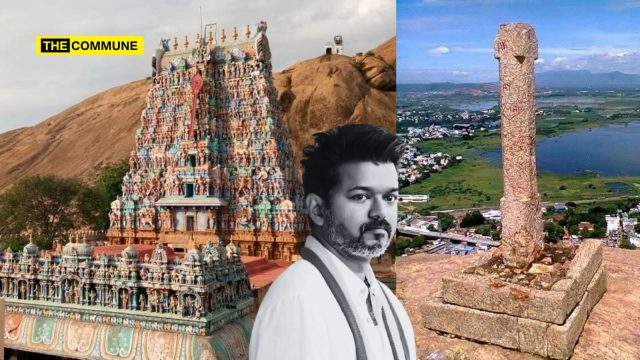
The Hindu Religious and Charitable Endowments (HR&CE) Department under the Joseph Vijay TVK government has told the Supreme Court that courts should not interfere in temple rituals while challenging the Madras High Court’s direction to light the Karthigai Deepam at the Deepathoon on Thirupparankundram Hill, as reported in Bar and Bench.
The submission was made in the Department’s appeal in HR & CE Vs Rama Ravikumar, where it has challenged the Madras High Court’s January 6 order directing the Arulmigu Subramania Swamy Temple Devasthanam to light the annual Karthigai Deepam at the stone pillar (Deepathoon).
According to the appeal, the High Court effectively introduced a religious practice that had no basis in law, custom or temple tradition.
“The impugned judgment creates a new ritual obligation unknown to law by directing that Karthigai Deepam should be lit at Deepathoon… Neither the statutory scheme, nor any established custom, nor any Agama prescription, nor any prior decree mandates such a practice,” the appeal said.
The Department argued that the devotees who sought the change had failed to produce any documentary evidence, including temple records, inscriptions, Agama texts, archival material, HR&CE records or earlier judicial findings, to establish that such a ritual had ever existed.
It further stated that for over 150 years, the Karthigai Deepam has been lit only at the Deepa Mandapam near the Uchi Pillaiyar Temple, situated midway up the Thirupparankundram Hill, and not at the Deepathoon.
The appeal also contends that while devotees enjoy the freedom to worship under Article 25 of the Constitution, that right does not extend to altering rituals observed by a public temple. Invoking Articles 25 and 26, the Department argued that matters relating to temple rituals, festivals and ceremonial practices fall within the autonomy of religious institutions and should not be subject to judicial interference.
The dispute originated after devotee Rama Ravikumar submitted a representation in October 2025 seeking permission to light the Karthigai Deepam at the Deepathoon. The temple administration rejected the request, stating that the festival would continue to be conducted in accordance with the long-standing practice of lighting the lamp near the Uchi Pillaiyar Temple. Ravikumar and other devotees subsequently approached the Madurai Bench of the Madras High Court, which ruled in their favour.
HR&CE’s Stand Faces Questions Over Its Own Role In Temple Rituals
The Tamil Nadu HR&CE Department’s submission before the Supreme Court that courts should not interfere with temple rituals has come under scrutiny over its own interference in religious practices across the State.
The Department which interferes with rituals and practices in temples is now arguing that courts should stay away from temple rituals while it makes administrative interventions in long-standing Agama-based practices and temple customs.
These include attempts to change the date of Tamil New Year, altering the language used in ancient temple rituals, construction of toilets, Annadhana halls and executive offices within temple premises in violation of Agama principles, interfering with Kumbabishekam rituals, permitting commercial establishments inside temple complexes, appointing departmental officials to decide religious matters, altering Agama education and recruitment processes, and diverting temple funds for non-temple purposes.
The HR&CE has also attempted to reduce the 48-day Mandala Pooja at the Sri Dhandayuthapani Swamy Temple before the Madras High Court intervened, damaging heritage structures and ancient murals during renovation works, failing to recover dues from temple lands, restricting special poojas during the Ayodhya Ram Mandir consecration, failing to protect temple properties and water bodies, and not taking action in cases involving missing temple idols, jewellery and cattle.
The alleged diversion of temple revenues, encroachment and loss of temple properties, closure of a Veda Patasala in Rameswaram, and the reported disappearance of thousands of cows donated to the Tiruchendur Temple indicate that these actions are inconsistent with the Department’s stand before the Supreme Court that temple rituals should remain free from outside interference.
This is what the TVK Government told Supreme Court in the Tirupparankundram Deepa Thoon matter:
” Courts should not interfere with ritual”What about this shameless @tnhrcedept violating the law and interfering with temple rituals every day?
This Department which… pic.twitter.com/euyKub9Tdz
— trramesh (@trramesh) August 3, 2026
Subscribe to our channels on WhatsApp, Telegram, Instagram and YouTube to get the best stories of the day delivered to you personally.