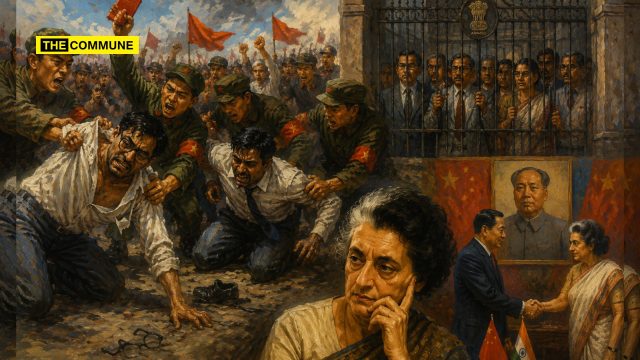
On 14 June 1967, two Indian diplomats stationed in Beijing found themselves at the centre of a diplomatic crisis that would expose the depths of Maoist China’s hostility towards India and raise uncomfortable questions about the response of the Congress government led by Prime Minister Indira Gandhi.
What began as a routine visit to photograph temple architecture ended with Indian diplomats being publicly humiliated, assaulted by Chinese Red Guards, dragged across an airport runway, and ultimately placed under house arrest along with the entire Indian Embassy staff in Beijing.
The episode, largely forgotten in contemporary discussions of India-China relations, unfolded during the height of China’s Cultural Revolution and came just five years after the 1962 Sino-Indian War.
False Espionage Charges Against Indian Diplomats
The incident centred around two Indian diplomats – K. Raghunath, Second Secretary at the Indian Embassy in Beijing, and P. Vijay, Third Secretary.
Chinese authorities accused the two officials of espionage after they were seen photographing temple architecture in the Western Hills area outside Beijing.
According to contemporary reports, the location was neither a military installation nor a prohibited zone. Nevertheless, a group of Chinese youths surrounded the diplomats, seized their camera and film, and accused them of spying.
The accusation soon escalated into a public spectacle.
Chinese authorities organised what amounted to a “people’s trial” in Beijing, placing the Indian diplomats before a hostile crowd estimated at around 15,000 people. The proceedings reflected the revolutionary fervour of Mao’s Cultural Revolution, where public humiliation and denunciation sessions had become routine tools of political intimidation.
Assault At Beijing Airport
The situation deteriorated further when the diplomats were expelled from China.
As the two officials were being deported via Beijing airport, they were attacked by Red Guards in full public view.
Contemporary reports described how the diplomats were physically assaulted, dragged by their necks, stripped of their clothes and subjected to repeated humiliation.
One report stated that Raghunath was struck repeatedly and forced to bow his head to the ground before a hostile crowd.
Vijay reportedly suffered similar treatment. Accounts from the period described him being dragged by the neck and assaulted before being forced onto an aircraft.
Far from being an isolated altercation, the assault appeared to be a deliberate public demonstration organised by Chinese authorities and Red Guard groups.
The images and reports emerging from Beijing shocked many in India.
Parliament Demands Action
The treatment of Indian diplomats sparked outrage across the political spectrum.
Members of Parliament demanded that the government respond strongly to what many saw as a direct attack on India’s sovereignty and dignity.
However, the response from the Congress government was widely criticised as weak and indecisive.
When the matter came up in Parliament, Prime Minister Indira Gandhi stated that it was “not possible at this stage to outline the steps the government might take.”
The statement immediately drew criticism from opposition parties, which accused the government of failing to protect Indian officials serving abroad.
The issue was not merely the assault itself but the apparent inability or unwillingness of New Delhi to impose meaningful diplomatic costs on Beijing.
Jan Sangh Launches Nationwide Protests
Public anger quickly spilled onto the streets.
The Bharatiya Jana Sangh, led by Hardayal Devgun in Delhi, organised large demonstrations outside the Chinese Embassy.
Protesters carried placards, raised anti-China slogans and demanded a stronger response from the government.
One of the most widely reported incidents involved demonstrators pasting notices on the embassy gates carrying a blunt warning: “Apologise or wind up.”
Effigies of Mao Zedong were also burnt during the protests.
Jan Sangh leaders argued that China’s treatment of Indian diplomats represented a grave national insult and accused the Congress government of passivity.
The protests attracted significant public attention and became one of the largest anti-China demonstrations in the country during that period.
China Escalates Further
Rather than de-escalating the dispute, Beijing retaliated.
Chinese authorities reportedly placed the entire Indian Embassy compound in Beijing under a strict form of house arrest.
Indian diplomats and their families were prevented from leaving the premises.
Movement outside the embassy was heavily restricted.
The Chinese action effectively turned the embassy into a diplomatic prison, creating a situation unprecedented in India-China relations.
The siege further intensified criticism of the Congress government, with opposition leaders arguing that New Delhi was failing to protect its own diplomatic personnel.
The Delhi Hospital Incident
Even as tensions mounted, another bizarre episode unfolded in India.
Following the protests in Delhi, Chinese Embassy personnel claimed they had been injured and sought treatment at Willingdon Hospital.
According to reports from the period, Chinese Charge d’Affaires Chen Chao-yuan created a scene at the hospital by demanding that Chinese staff be treated exclusively by a Pakistani doctor.
When hospital authorities refused the request, the Chinese diplomat reportedly protested aggressively and asserted diplomatic privileges.
The incident became another flashpoint in the deteriorating diplomatic relationship between the two countries.
A Pattern That Continued
The 1967 episode is an example of what can be described as a long-standing pattern of softness of the Congress towards China.
Despite the public humiliation of Indian diplomats and the effective siege of the Indian Embassy in Beijing, New Delhi failed to impose serious diplomatic consequences on the Chinese government.
Look at later developments, including the 2008 Memorandum of Understanding signed between the Congress party and the Chinese Communist Party during the UPA era.
The agreement, signed when Sonia Gandhi headed the Congress party, has remained controversial because of its lack of public transparency.
Photographs from the signing ceremony showed senior Congress leaders, including Rahul Gandhi, present during the event.
India must never forget this: on 7 August 2008, the Congress signed a formal MoU with the Communist Party of China, in Beijing. It wasn’t “India to China”. It was a political party in India signing an understanding with the ruling party of an adversarial state.
The document’s… pic.twitter.com/Zp1AukUwYQ
— Mahesh Jethmalani (@JethmalaniM) February 20, 2026
The contrast is striking: from the diplomatic crisis of 1967 to the party-to-party engagement of 2008, they see a continuity in Congress’s approach towards China.
A Forgotten Chapter In India-China Relations
The events of June 1967 occupy a relatively obscure place in public memory despite their significance.
Indian diplomats were falsely accused of espionage, subjected to public humiliation, physically assaulted, and then watched as their embassy came under effective confinement.
The incident unfolded at a time when India was still recovering from the trauma of the 1962 war and trying to redefine its relationship with a hostile neighbour.
Whether one agrees with the political conclusions drawn from the episode or not, the historical record remains clear: in 1967, Indian diplomats faced one of the most humiliating episodes in the history of India’s foreign service, and the incident triggered a debate that continues to resonate in discussions about India’s approach to China even today.
View this post on Instagram
Subscribe to our channels on WhatsApp, Telegram, Instagram and YouTube to get the best stories of the day delivered to you personally.