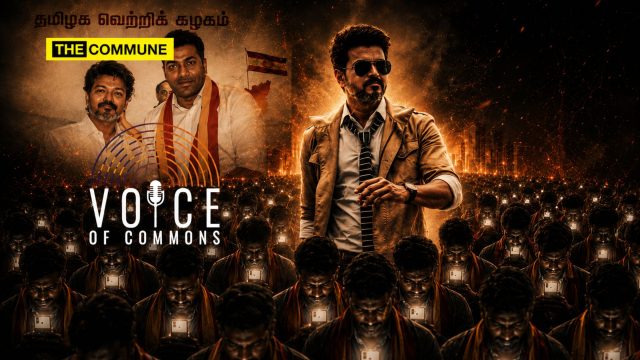
The Commune had earlier reported that there seems to be a meticulously orchestrated social media campaign from Tamil Nadu Chief Minister Joseph Vijay’s team especially through his right-hand man Lottery King’s son-in-law Aadhav Arjuna’s Voice of Commons, and his private secretary’s The Route to systematically project him as a future Prime Minister – this was less than just 60 days into his tenure.
Now, we are seeing a growing number of vox pop reels on Instagram that are pushing the narrative that Joseph Vijay or rather “Vijay Thalapathy” as the best CM and that he is the next PM.
Tamil Nadu Chief Minister Joseph Vijay’s image-building operation has moved on from fabricated achievement claims to a new format: street-corner “vox pop” videos in which random members of the public, filmed in cities across India, are asked who they want as India’s next Prime Minister and answer, near-unanimously, “Vijay Thalapathy.”
The Format
The videos follow a near-identical template. An Instagram handle sends a reporter onto the street with a phone camera. The question is some version of “Who is your next PM?” or “Who would you vote for as PM – Modi or Vijay?” The respondent, almost without exception, picks Vijay. The clip is then overlaid with a scoreboard graphic counting the number of ‘votes’ beside Vijay’s photo against Narendra Modi’s, under the banner “NEXT PM”, turning an ‘unscripted’ street interaction into what looks like a lopsided public verdict.
View this post on Instagram
View this post on Instagram
View this post on Instagram
There are videos also appreciating Vijay with Hindi songs in the background with comments saying “Vijay Thalapathi next PM”
View this post on Instagram
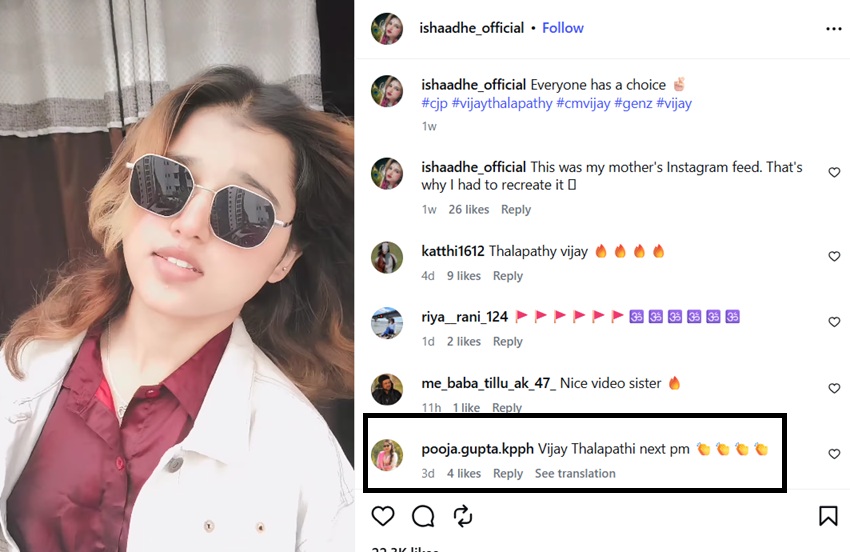 Some videos deliberately show Vijay as the better CM compared to even Yogi Adityanath and these videos specifically come from UP itself.
View this post on Instagram
View this post on Instagram
View this post on Instagram
View this post on Instagram
The locations are deliberately scattered – Varanasi, Mumbai, and other cities far outside Tamil Nadu, where Vijay has no political base, no electoral stake, and limited organic name recognition as a politician rather than a film star. That spread is itself a tell: this is not local sentiment being captured, it is a national narrative being manufactured city by city.
View this post on Instagram
View this post on Instagram
There are some videos though from Tamil Nadu, repeating what happened in the run up to the 2026 polls.
View this post on Instagram
What Doesn’t Add Up
The people being interviewed do not read as organic, politically engaged respondents. Several featured in these clips appear to struggle to name basic facts about Vijay’s own politics, let alone offer a reasoned case for why he should lead the country over an incumbent Prime Minister before switching, on cue, to enthusiastic praise. That mismatch between the confidence of the verdict and the evident lack of political (or even cinematic) familiarity of the person delivering it is the clearest marker that these are not spontaneous street opinions.
This is not a one-off gimmick. Similar videos, run through the same “everyone on the street loves Vijay” format, were already circulating during the 2026 Tamil Nadu Assembly election campaign – meaning the same playbook has now simply been repointed at a national audience and a Prime Ministerial narrative, with the claim being pushed since at least May 2026.
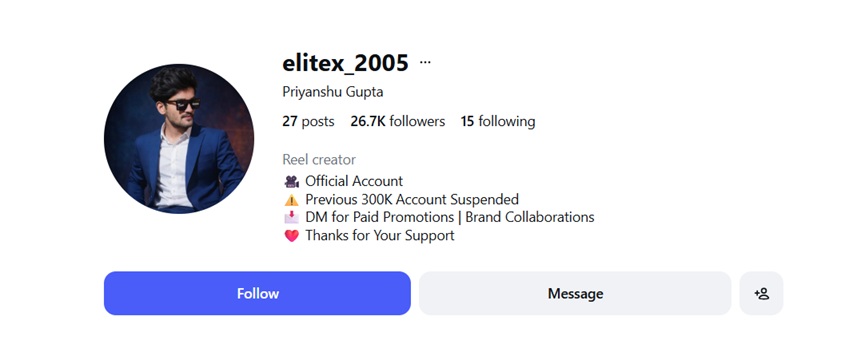
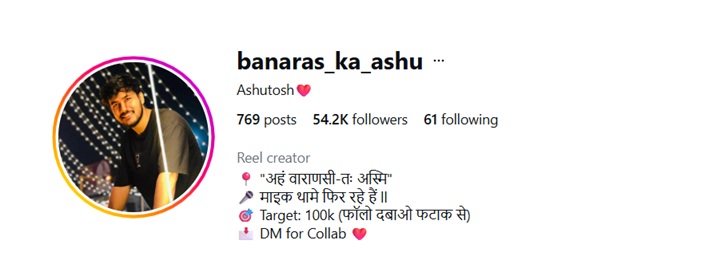
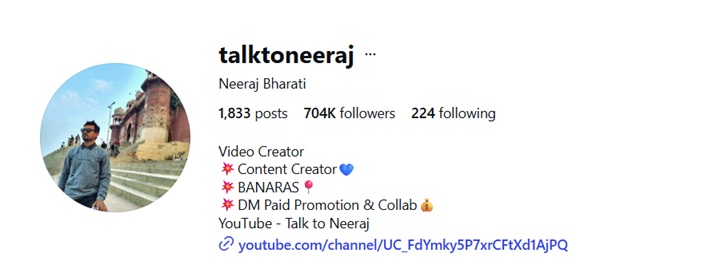
Interestingly, these handles have the “DM for paid collab” or “DM for paid promotions” on their bio. Like with any other brand, Vijay’s team seems to have approached these people with a ‘sizeable’ following to create such staged videos.


Whose Playbook This Is
This slots directly into a pattern already documented. Vijay’s post-election brand-building and image makeover is being run through two channels: his private secretary’s Route Media, and Voice of Commons, the political strategy firm founded by Aadhav Arjuna – TVK’s general secretary for election campaign management, and son-in-law of Santiago “Lottery King” Martin. Voice of Commons is not a fringe operation; it is Arjuna’s own consultancy, who is currently a Minister in Joseph Vijay’s govt.
Can A Sitting Minister Run A Political Strategy Agency?
This also raises a more fundamental question about the role of Voice of Commons in the Vijay government.
Political consultancy firms typically operate as professional organisations, hiring teams on contract to develop messaging, shape narratives and build favourable public perception for political parties and their leaders. Several such firms operate across India. Yet there is an important distinction that stands out: no other sitting cabinet minister in India currently appears to simultaneously hold ministerial office while owning or operating a commercial political consultancy firm.
Several prominent political figures have moved between electoral politics and professional political strategy. Prashant Kishor, one of India’s best-known election strategists, formally distanced himself from commercial consultancy operations such as I-PAC before entering direct electoral politics and launching the Jan Suraaj Party. He does not hold a ministerial portfolio. Sunil Kanugolu, another leading political strategist associated with major Congress electoral campaigns, has served as a Chief Minister’s Advisor, but is an appointed advisor rather than an elected sitting minister or MLA.
That distinction makes the alleged overlap involving Voice of Commons particularly significant. If a person who now holds public office is also involved in running a political strategy operation that is actively working to project his own party leader, Vijay, as a national political figure, how is that dual role reconciled with the responsibilities and expectations of public office?
The question is not merely about political consulting. It is about conflict of interest, institutional credibility and the use of political machinery alongside government office.
More importantly, is the machinery being used to build Vijay’s image actually being matched by governance and measurable work on the ground—or is perception management increasingly being used as a substitute for performance?
If the government has tangible achievements to showcase, why does its political ecosystem appear so heavily focused on manufacturing the appearance of nationwide popularity through staged-looking vox pops, carefully packaged social-media content and campaigns designed to portray Vijay as someone the country is already demanding as its next Prime Minister?
The contrast is difficult to ignore: less emphasis on what the government has actually delivered, and more emphasis on creating the impression that the public has already decided who should lead the country next.
Subscribe to our channels on WhatsApp, Telegram, Instagram and YouTube to get the best stories of the day delivered to you personally.