If you have opened social media lately, you have probably seen alarming headlines screaming “UPI is no longer free!” or “New tax on your digital wallet payments!” or “The charges will be passed to customer”
As a banking professional and worked as a Consultant in Payment Interchange and Settlements, I see these cycles of panic often.
Let’s cut through the noise, look at the actual plumbing behind the screen, and clear up the confusion with real math.
How UPI Operates (Behind the Screen)
When you scan a QR code at a local shop and tap “Pay,” a highly coordinated choreography with many different entities takes place in less than a second.
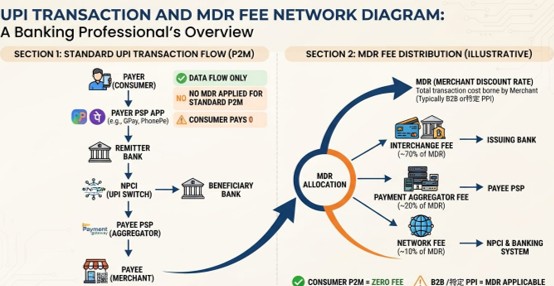
- The Payer (You): The person initiating the payment.
- The Payer PSP App: The application on your phone (e.g., GPay, PhonePe, BHIM).
- The Remitter Bank: Your bank, which holds your money and handles the direct debit.
- NPCI (National Payments Corporation of India): The central clearing house and digital traffic controller.
- The Beneficiary Bank & Payee PSP: The merchant’s bank and their payment aggregator (e.g., Razorpay, Paytm Business) that manages their QR code and credits their account.
Processing electronic transactions requires massive infrastructure, server maintenance, and security protocols. Traditionally, this is funded through a mechanism called MDR.
The Core Issue: What is MDR and Why the Panic?
Merchant Discount Rate (MDR) is the total transaction fee a business pays to accept digital payments. It is an operational cost borne entirely by the business—never a direct fee charged to the consumer.
In traditional credit and debit card systems (like Visa or MasterCard), a standard 2% MDR on a ₹1,000 transaction is split behind the scenes:
* Interchange Fee (~1.5%): Goes to the customer’s card-issuing bank.
* Processor Fee (~0.4%): Goes to the company providing the card swipe machine.
* Network Fee (~0.1%): Goes to the card network (MasterCard, VISA, Diners)
Why Are Consumers Anxious About UPI Fees?
The current anxiety stems from past experiences with card payments and MDR. Historically, many small merchants, fuel pumps, or electronics retailers would illegally demand an extra 2% from customers to “cover swipe card charges,” or deny standard cash discounts if you paid by card.
When the public hears about new regulations like the Payments and Settlement Systems Amendment Bill allowing digital payment fees or adjustments to MDR, they panic. They assume shopkeepers will start adding extra charges onto daily grocery or tea bills.
To prevent this, the Government of India and the Reserve Bank of India (RBI) enforce strict guardrails:
- Zero Consumer Burden: Legally passing on MDR costs to standard retail shoppers is explicitly banned under RBI guidelines.
- Mandatory Free Channels: The government mandates a Zero-MDR policy on core bank-to-bank UPI transfers, subsidizing banks directly to keep daily payments free for ordinary citizens and neighbourhood shopkeepers.
So, worrying that the business entities will charge consumers more stems from the misconceptions or unfair practices by certain Merchant Establishments and not related the recent UPI Transaction fees.
Real Use-Cases: Before vs. After Calculations
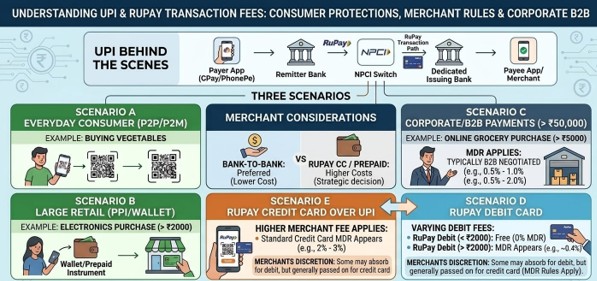
Fees are highly targeted and do not apply to regular retail transactions. Let’s look at exactly how the math works out across different everyday scenarios.
Scenario A: Everyday Consumer (Bank-to-Bank P2P or P2M)
You buy groceries worth ₹5,000 from a neighbourhood vendor using standard bank account routing.
Before: You pay ₹5,000. Vendor receives ₹5,000.
After: You pay ₹5,000. Vendor receives ₹5,000.
Extra Amount Borne: ₹0 by the consumer (Core bank-to-bank transfers remain entirely free).
Scenario B: Prepaid Instrument (PPI Wallet) Transactions
You buy electronics worth ₹3,000 from a major retail merchant using a pre-funded digital wallet or prepaid voucher linked to your UPI app. For wallet transactions over ₹2,000, NPCI permits an interchange fee of up to 1.1%.
Before: The merchant received the full ₹3,000.
After: A 1.1% fee is levied on the transaction.
The Math: Fee = ₹3,000 × 1.1% = ₹33.
Extra Amount Borne: ₹0 by the consumer
You pay exactly ₹3,000. The large merchant receives ₹2,967 (₹3,000 – ₹33), absorbing the cost as a business overhead. Rules strictly prohibit them from adding this ₹33 to your bill.
Scenario C: RuPay Credit Cards Linked to UPI
You buy a premium appliance worth ₹20,000 from a store, choosing your linked RuPay Credit Card as the payment source instead of your bank account.
Before: Early promotion phases completely waived credit-linked MDR.
After: Standard credit card MDR rules apply (typically around 2% for high-value transactions).
The Math: Fee = ₹20,000 × 2% = ₹400.
Extra Amount Borne: ₹0 by the consumer (You pay exactly ₹20,000. The store owner pays ₹400 to the payment network for offering credit convenience)
Scenario D: Business-to-Business (B2B) Transactions
A retail shopkeeper purchases wholesale inventory worth ₹1, 00,000 from a commercial distributor. Historically, many businesses used peer-to-peer (P2P) personal accounts to settle large commercial transactions at zero cost. Moving forward, dedicated commercial B2B channels carry a modest, capped MDR (e.g., 0.3%).
Before: The wholesale distributor received the full ₹1, 00,000 for free.
After: A 0.3% B2B fee applies to the commercial clearing route.
The Math: Fee = ₹1, 00,000 × 0.3% = ₹300.
Extra Amount Borne: The distributor receives ₹99,700, or explicitly includes that ₹300 infrastructure cost into their commercial trade invoice pricing with the retailer.
Why Target B2B Transactions Now?
So, the question is why the GoI is levying a fee for b2B transactions now? Why tweak a system that felt perfectly fine for businesses? There are two primary structural reasons:
System Sustainability:
High-value corporate payments strain the banking network with heavy data bandwidth, complex anti-fraud checks, and rigorous audit trails. Standard corporate banking transfers (like NEFT or RTGS) carry fees; B2B UPI is simply being aligned with those commercial realities to remain financially viable.
Preventing Misuse:
The zero-fee pipeline was built to pull ordinary citizens and micro-vendors away from cash. It was never intended to let multi-crore corporate distributors bypass standard commercial banking costs.
The Bottom Line
For Consumers:
Buying vegetables, paying online delivery apps, or sending money to family remains 100% free.
For Small Businesses:
Accepting direct bank payments from customers via standard QR codes remains 100% free.
The updated regulatory framework ensures that massive corporate platforms and high-value B2B transactions fund their own network footprint, keeping the essential consumer network unburdened and free for all of us.
AK is an IT professional with 25+ experience in BFSI sector. He is a Political Analyst and founder of @dharmic_indians. Also serves as Governing committee member of @AalayamKaappom foundation.
Subscribe to our channels on WhatsApp, Telegram, Instagram and YouTube to get the best stories of the day delivered to you personally.