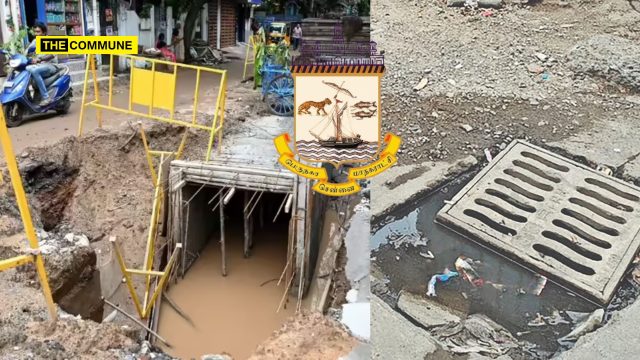
With the northeast monsoon approaching, several parts of Chennai continue to face concerns over incomplete stormwater drain works, damaged roads and unprepared drainage infrastructure, as reported in Times of India.
Stormwater drains remain unfinished and open at multiple locations, with the Greater Chennai Corporation (GCC) yet to complete the construction of silt catch pits in several areas. Several newer neighbourhoods are also expected to remain vulnerable to flooding during the upcoming monsoon.
In Anna Nagar, portions of the stormwater drain along Second Avenue between Thirumangalam and Roundtana remain open. Several key junctions have not yet been connected to the drainage network.
Contractors have reportedly attributed delays in some locations to the failure of the Tamil Nadu Generation and Distribution Corporation Limited (Tangedco) to facilitate the shifting of electrical junction boxes. The GCC has also been criticised for failing to coordinate effectively with the electricity utility.
The concerns come in the wake of the heavy rainfall Chennai experienced between December 3 and 5, 2023, when the city received around 46 cm of rain and several neighbourhoods were inundated.
Several major roads also continue to be affected by ongoing drain and infrastructure works. Arcot Road remains dug up at stretches in Kodambakkam and Valasaravakkam, with work progressing in patches. A similar situation has been reported on PT Rajan Salai in KK Nagar.
In Pulianthope, a section of the road near the KP Park tenements has been cordoned off due to stormwater drain construction.
Chennai currently has three ongoing stormwater drain projects covering a combined 1,093 km. Work has been completed on around 1,045 km, leaving approximately 48 km still pending.
Two of the projects have been underway for nearly five years and were funded by the Asian Development Bank (ADB) and KfW Development Bank. The projects have faced several delays and complications, including funding issues, alleged tendering irregularities, gradient-related problems and coordination issues between government departments.
The remaining work is spread across densely populated areas including Tiruvottiyur, Manali, Madhavaram, Thiru Vi Ka Nagar, Anna Nagar, Alandur, Perungudi and Sholinganallur.
Metro construction on Arcot Road has also affected existing pipelines and stormwater drains at several locations. The GCC is relying heavily on pumps in some of these areas to manage water during heavy rainfall.
Apart from the ongoing project works, missing-link works are yet to be completed at 68 of 105 identified locations. While the pending stretches account for a relatively small portion of the overall drainage network, civic and environmental experts have warned that even a single unconnected section can affect drainage across an entire neighbourhood.
The incomplete drainage network could also limit the effectiveness of the 1,000 dewatering motors procured by the GCC.
The corporation is yet to complete desilting work across at least 500 km of its total 1,682-km stormwater drain network. Only around 59% of the silt catch pits, which serve as entry points for rainwater into the drains, have been desilted.
Former member of the Thiruppugazh flood committee S Janakarajan has raised concerns over the capacity and functioning of Chennai’s stormwater drains. He said the drains often carry sewage, industrial waste and solid waste, which ultimately enter the city’s canals and rivers instead of treatment plants. During heavy rainfall, he said, the drains consequently overflow.
Janakarajan has called for the capacity of the drainage system to be assessed and for stormwater drains to be constructed based on a master plan that maps watersheds and natural slopes.
He also questioned the demolition and reconstruction of existing stormwater drains in narrow streets, describing the practice as unnecessary. According to him, some larger streets have also ended up with drains that have inadequate capacity.
Bhuvana Raj, head of Eco Watch, a volunteer-led environmental monitoring group formed by the Federation of OMR Resident Associations (FOMRRA), has also raised concerns over the use of cut-and-cover drains as a temporary solution for filling missing links.
She questioned how residents could be confident that the new drains were scientifically designed when detailed project reports were not being made publicly available.
Raj has also stressed the need to ensure that stormwater drains are built with adequate capacity instead of waiting for heavy rainfall to expose shortcomings in the system. She further pointed out that several drains are being diverted into the Buckingham Canal, which itself has not been adequately desilted.
Meanwhile, Tamil Nadu Chief Secretary M Sai Kumar has directed officials to complete all works related to the northeast monsoon by 30 September 2026.
Subscribe to our channels on WhatsApp, Telegram, Instagram and YouTube to get the best stories of the day delivered to you personally.