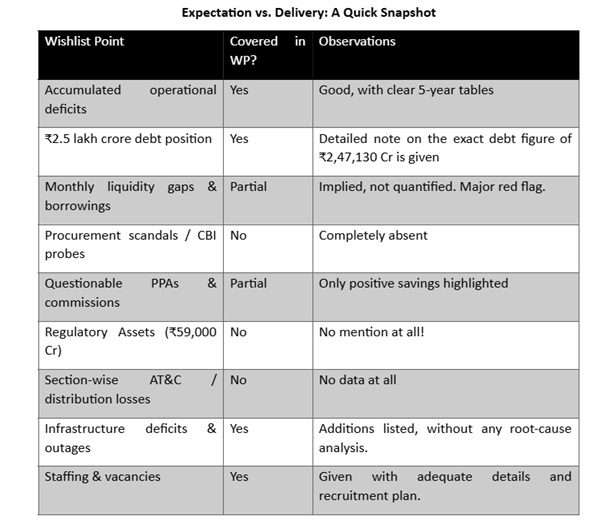
The much-anticipated White Paper on the Tamil Nadu Electricity Board (TNEB), released as of 31 March 2026, was expected to serve as a no-holds-barred diagnostic of the power sector’s chronic woes. In my X post on 24 June 2026, I had articulated a simple wishlist – full disclosure on accumulated deficits, the ₹2.5 lakh crore debt mountain, monthly liquidity crises, procurement scandals under investigation, questionable power purchase agreements (PPAs), regulatory assets, section-wise distribution losses, and the real reasons behind frequent outages.
The 39-page document does deliver on some fundamentals but falls significantly short on depth, candour, and the forensic scrutiny the crisis demands.
The Good: Hard Numbers on Finance and Debt
The White Paper deserves credit for presenting consolidated financials in clear tables. It exposes the staggering accumulated operational gaps (Revenue Receipt minus Expenditure) across five-year blocks. The fifth-year snapshots reveal persistent pressure, though the 2025–26 revised estimate shows a narrowed gap of Rs.933 crore following a 3.16% tariff hike in TNPDCL, towards the fag end of the previous Government. (This amount of Rs.933 Crores deserves a special attention else where for what a farce it is, and I have delved into it separately. Readers may keep track of this.)
Debt figures are equally explicit. As of 31 March 2026, total outstanding debt stands at a massive Rs.2,47,130 crore validating the alarming scale flagged in public discourse. Following the 2024 unbundling, this burden is allocated across entities, with the distribution arm (TNPDCL) carrying the lion’s share at Rs.1,07,365 crore.
These disclosures provide a baseline that earlier, more opaque regimes rarely offered. Recent improvements in gap reduction and long-term procurement savings—projected at Rs.215 crore per month by shifting from expensive short-term market purchases (Rs.8.70/unit) to long-term open access (LTOA / MTOA) deals (Rs.6.63/unit) are highlighted as key achievements.
Infrastructure and Staffing: Quantity Over Quality
Sections on equipment and human resources list massive cumulative additions: 447,603 distribution transformers added over 25 years, thousands of substations, and line kilometres. The document also explicitly details a crippling vacancy crisis: 65,921 posts vacant out of 1,40,635 sanctioned. To address this, a major recruitment drive of 15,058 posts (plus 5,391 pending gangmen approvals) is proposed for 2026–27, alongside plans for 231 new substations costing Rs.15,032 crore.
Yet, these metrics are presented purely as success stories of expansion. The document offers zero engineering analysis of why these massive infrastructure additions continue to result in frequent outages, or how utilisation rates and maintenance quality lag behind asset creation.
Critical Shortfalls: What the White Paper Avoids
This is where my expectations were completely dashed:
Procurement Irregularities: The document is completely silent on collusive tendering, active investigations into transformer procurement (with alleged 30% to 50% bid inflation), or industry reports of steep commissions demanded from solar developers. Procurement is framed entirely through positive future asset additions with zero mention of accountability for past overruns.
Sanitizing Recruitment Irregularities: The document takes a hypocritical, “holier-than-thou” approach to human resources by quietly scheduling the induction of 5,391 Gangmen pending financial clearance. This completely ignores the fact that Electricity Minister CTR Nirmal Kumar himself explicitly alluded to deep-seated corruption and procedural irregularities involved in that very recruitment batch. By framing this as a routine onboarding process, the presentation acts as an administrative laundry machine eager to absorb the personnel numbers into its future workforce projections while completely burying the minister’s own public charges of institutional malfeasance, made right during the presentation (and not some months or weeks back).
The Cloud Audit Failure: In a quiet admission of administrative failure, the report notes that the heavily promoted “Cloud Audit” mechanism was abruptly discontinued on 01.06.2026 and reverted back to conventional physical scrutiny to clear severe payment delays for contract workers.
Distribution Losses vs. Ground Realities: Despite detailed tables on revenue and expenditure, there is no section-wise Aggregate Technical & Commercial (AT&C) loss data, no breakdown of commercial vs. technical losses, and no frank discussion of power theft. These remain convenient black boxes used to justify tariff hikes.
The Missing Regulatory Assets: The looming Rs.59,000 crore Regulatory Asset crisis—which mandates an additional annual recovery burden of roughly Rs.11,800 crore beginning in FY 2026–27—finds absolutely no mention in the document. This item alone warrants a detailed discussion else where.
The Artificial Subsidy Fix: The TNEB presentation proudly boasts a dramatically narrowed annual deficit of just Rs.933 crore for FY 2025–26 RE. However, the Finance Ministry’s macro-level White Paper exposes this as an accounting mirage propped up by unsustainable bailouts. It bluntly points out that pumping over Rs.33,478 crore in annual subsidies and loss-funding grants in FY 2025-26 alone merely creates an illusion of stabilization while draining state resources and crowding out productive infrastructure investments.
What is a Regulatory Asset, and Why Does This Omission Matter?
In utility accounting, a regulatory asset is essentially an approved expenditure (like fuel cost spikes or power purchase inflation) that the utility (TNEB, in our case) incurred but was legally barred from collecting from consumers immediately due to political or regulatory caps on tariff hikes. Instead of taking an immediate loss, the utility creates a “regulatory asset” on its balance sheet, promising to recover these costs through consumer bills at a later date.
In TNEB’s case, this is a ticking fiscal time bomb. These are deferred consumer bills from previous years that must now legally be extracted from the public under judicial mandates. By entirely omitting this ₹59,000 crore liability, the paper presents an artificially smoothed, misleadingly positive picture of future financial health while keeping consumers completely in the dark about upcoming tariff shocks.
And the tragic part is the promise by the Energy Minister Mr. CTR Nirmal Kumar that, in the current year, the Government will not revise the tariff at all! This “policy intent”, coupled with the proposed Rs.50000 Crore spend on infrastructure, would only add to the “Regulatory Asset”. In essence, this Government will continue to involve itself in the accounting jugglery, skipping genuine accountability.
The Structural Deception: A Slideshow Re-labeled as a “White Paper”
Beyond the specific data gaps, the most disappointing aspect of this release is its very format. When a government promises a “White Paper” on a bankrupt state utility, the public expects an exhaustive, multi-chapter forensic diagnostic report filled with structural analysis. Instead, what has been delivered as a White Paper is quite literally just a 39-page summary presentation slide deck.
By passing off a high-level executive slideshow as a complete White Paper, the ministry provides just enough data to look transparent, while holding back the granular details required for true public scrutiny. The “Way Forward” section suffers the most from this format, offering generic corporate bullet points like “Scale Up Storage” and “Smarter Power Procurement” without a single page of economic modeling, binding timelines, or enforceable policy frameworks. It reads less like an official state recovery plan and more like an aspirational pitch deck.
A Partial Step Forward
The Tamil Nadu government has taken a welcome stride toward transparency by publishing audited-style financial summaries and clear debt positions that were long overdue. For that, credit is due.
However, by omitting procurement scandals, granular loss data, regulatory asset burdens, and independent scrutiny mechanisms, the White Paper fails to meet the higher bar of accountability set by public discourse. True reform requires not just listing problems, but dissecting failures especially those involving systemic inefficiencies and alleged irregularities.
The people of Tamil Nadu deserve a much fuller reckoning.
G Saimukundhan is a Chartered Accountant.
Subscribe to our channels on WhatsApp, Telegram, Instagram and YouTube to get the best stories of the day delivered to you personally.