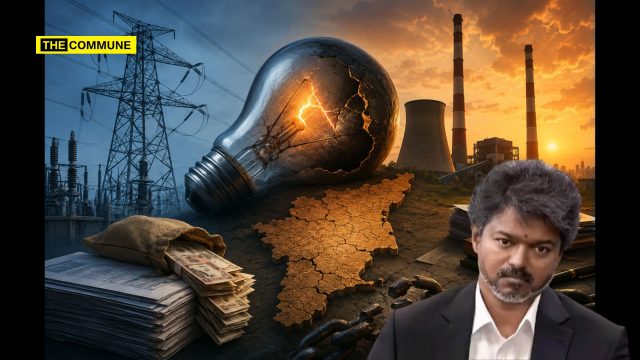
The long-overdue White Paper on Tamil Nadu’s shattered power sector, promised by Electricity Minister CTR Nirmal Kumar, should not limit itself to be a standard policy review, it should be a damning indictment of decades of structural plunder. For years, the public was fed a carefully constructed myth of Tamil Nadu as a frictionless industrial powerhouse. The reality, which this document must systematically unmask, is a state energy utility that has been weaponized as an off-balance-sheet vehicle for reckless populist spending, institutional corruption, and systemic administrative paralysis.
If this White Paper settles for polite financial bookkeeping or sanitized diplomatic language, it will be an insult to the taxpaying public. Tamil Nadu does not need another list of generic numbers; it needs an honest naming of the political choices, specific actors, and flawed administrative policies that brought our power infrastructure to its knees.
Documenting the Ruin: An Autopsy of a ₹2.5 Lakh Crore Debt Pile
The most vital function of this White Paper is to serve as a strict financial autopsy, tracing exactly how TNEB’s toxic debt spiralled to an astronomical ₹2.5 lakh crore. This figure is the direct result of a structural cash shortfall of ₹2,500 crore per month, EVERY SINGLE MONTH, aggravated by systemic corruption. For years, successive ministries kept masking deep operational rot by piling on high-interest short-term debt, indefinitely delaying payments to power producers, and starving critical field infrastructure of basic maintenance capital.
More importantly, the paper must expose the complete failure of the state’s multi-billion-rupee bailouts. The state treasury injected over ₹33,000 crore annually in subsidies and loss-funding grants. Where did that money go? At some stage, a pointed and specific answer to this question should be given, and the public deserves that. The persistent gap between the Average Cost of Supply (ACS) and Average Revenue Realized (ARR) shows that massive state subsidies were used as an expensive band-aid to bury deep institutional leaks rather than fixing them.
The most alarming structural crisis demanding absolute transparency is the ₹59,000 crore ticking time bomb in deferred “Regulatory Assets.” This massive liability represents years of unrecovered costs kicked down the road by regulators to avoid political fallout. Now, backed by non-negotiable judicial mandates, not less than the Supreme Court itself, the state faces a staggering ₹11,800 crore annual liability beginning in FY 2026-27. The White Paper must plainly state who deferred these costs, who profited from the delay, and exactly how much this political cowardice will cost ordinary consumers in upcoming tariff revisions.
Exposing the Procurement Cartels and Tender Rigging
A courageous White Paper cannot dance around the core issue: the entrenched corruption that has defined power procurement in Tamil Nadu. The public ledger must move past passive phrases like “allegations of irregularities” and name the specific mechanics of systemic leakage. The common man can allege. The Government cannot. It should use the hammer and stop using chisels.
The document must address the transformer procurement scams currently under central investigation. It should also highlight the alleged cartelization where bidders operating from identical IP addresses submitted inflated quotes, successfully locking in contracts 30% to 50% above market rates at the expense of the public exchequer.
Furthermore, the paper needs to conduct a ruthless, retrospective review of long-term private Power Purchase Agreements (PPAs) signed over the last decade. These legacy contracts locked the state into paying inflated fixed costs for private power while state-owned generation assets were left underutilized. It should directly address the issue of commission / bribe of Rs.70 Crore per power plant per year.
View this post on Instagram
The White Paper must show the exact difference between these expensive private contracts and cheaper market alternatives, exposing who signed them and why.
Dismantling the Extortion Tollbooths in Green Energy
Tamil Nadu’s fall from grace as a renewable energy leader is not an accident of geography, it is a direct consequence of institutional corruption. While the state once set national benchmarks for wind and solar deployment during the period of Late J Jayalalitha, developers have been driven away by severe bureaucratic delays and systemic rent-seeking.
The White Paper must directly confront the industry’s open secret: allegations that renewable energy developers faced systematic demands for unofficial payments reaching up to ₹25 lakh per megawatt simply to secure basic grid connectivity, administrative clearances, and evacuation approvals. The document must layout how the administrative structure was intentionally complicated to create these extortion tollbooths, and how the new single-window digital portal will permanently bypass them.
Confronting the Physical and Personnel Deficit
The final cost of this financial mismanagement is paid by ordinary citizens through erratic power supply and frequent outages in major urban and industrial centers like Chennai and Coimbatore. The White Paper must move past broad averages and present a blunt, localized age-profile analysis of the physical grid. It needs to expose how capital expenditure for substations and high-voltage transmission lines dropped significantly even as peak demand hit record highs.
This infrastructure deficit is worsened by a deliberate staffing crisis. The operations of the newly formed TNPDCL are being run by a severely depleted workforce, with a staggering 70,000 vacant posts across essential field maintenance and engineering lines. The paper must explain why permanent hiring was frozen, forcing a dangerous reliance on poorly equipped short-term contract workers to handle critical, high-risk repairs during grid failures.
At one end, we have overstaffed State Transportation Units, and at the other end, we have understaffed Electricity Department. It takes a special level of sinister agenda to push critical public infra departments to such trenches.
The true value of this upcoming White Paper will be measured by its courage. If the TVK-led ministry uses this document merely to score cheap political points before moving on, it will be another empty exercise in political theater.
The findings must be used to build an unassailable public case for deep structural overhaul. This means enforcing complete transparency through digitized procurement networks, implementing real-time tracking of private power supply, automating green energy clearances, and establishing strict anti-corruption guardrails. Tamil Nadu’s industrial future can no longer be sacrificed to protect compromised cartels and cover up bad balance sheets. The time for political maneuvering is over; the time for a thorough structural cleanup is now. If these are not addressed, then this White Paper will be another pusillanimous attempt at governance virtue signalling. Nothing more.
G Saimukundhan is a Chartered Accountant.
Subscribe to our channels on WhatsApp, Telegram, Instagram and YouTube to get the best stories of the day delivered to you personally.