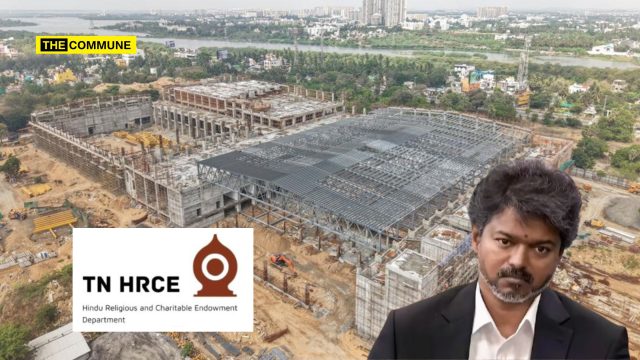
The Tamil Nadu government’s ambitious ₹525-crore Kalaignar International Convention Centre at Muttukadu has entered its final phase of construction. However, even before the project is completed, fresh concerns erupted over reports that an additional 7.62 acres of land under the control of the Hindu Religious and Charitable Endowments (HR&CE) Department is proposed to be transferred to facilitate ancillary infrastructure for the project.
The development has reignited long-standing concerns over the State government’s treatment of Hindu temple properties and raised uncomfortable questions about why lands belonging to Hindu religious institutions are repeatedly viewed as a readily available resource for government infrastructure projects.
Project Conceived Under DMK, Nearing Completion Under TVK Government
The Kalaignar International Convention Centre was announced during the previous DMK regime as a flagship infrastructure project intended to transform Chennai into a global destination for conventions, exhibitions and business summits.
Spread across nearly 37.99 acres on East Coast Road at Muttukadu, the project carries an estimated cost of ₹525 crore. The foundation stone was laid in May 2025, and nearly 60% of the structural work has now been completed, as reported in The Hindu.
The project is being executed by the Public Works Department and is expected to be completed by December 2026 or early 2027.
While conceived during the DMK government, the project is now being completed under the TVK government headed by Chief Minister Vijay.
Adding another political dimension, the State government is also reportedly examining whether the convention centre could eventually serve as Tamil Nadu’s new Legislative Assembly complex, easing space constraints at Fort St. George. Officials have reportedly indicated that next year’s Governor’s Address and Assembly sittings could potentially be held there, subject to the Chief Minister’s approval.
View this post on Instagram
Massive Convention Complex Taking Shape
The convention centre is designed as one of the largest such facilities in South India.
The 5.12 lakh sq. ft. complex will include:
An exhibition hall capable of accommodating nearly 15,000 people, featuring a 71.5-metre column-free steel-truss roof.
A convention hall with seating for 5,000 delegates.
A 1,500-seat auditorium.
Four banquet halls spread across the ground and first floors.
Parking for 1,706 cars and nearly 1,700 two-wheelers.
Solar-powered infrastructure and an 800 KLD sewage treatment plant.
The government is also planning to lease land within the campus for the development of a luxury hotel.
The Questionable 7.62 Acres
The controversy centres on a statement by Public Works Department officials that work on several components of the project including landscaping, roads, compound wall and a grand entrance arch with traditional sthapathy work can commence only after 7.62 acres of land is transferred from the HR&CE Department.
The report did not specify the exact nature or ownership history of the land.
However, if the land is indeed under the control of the HR&CE Department, it is reasonable to infer that it constitutes land belonging to Hindu temples or Hindu religious endowments administered by the department.
This has led to sharp criticism from activists who question why temple lands are once again being diverted for a government infrastructure project unrelated to the religious institutions that own them.
Temple Lands Are Not Government Property to Be Diverted at Will
The proposal to transfer 7.62 acres of land from the HR&CE Department raises serious questions about how the Tamil Nadu government continues to treat lands belonging to Hindu temples and religious endowments.
The convention centre itself is already nearing completion, with nearly 60% of the structural work finished. The additional land is reportedly required not for the main building, but for landscaping, approach roads, compound walls and a grand entrance arch.
There is no justification for alienating temple lands for such ancillary works. Lands donated to Hindu temples over centuries were endowed for religious, charitable and community purposes. They were never meant to serve as a reserve land bank for government infrastructure projects or beautification works.
If the State requires land for roads, landscaping or an entrance plaza, it should identify and utilise government-owned land instead of appropriating property belonging to Hindu religious institutions. The repeated reliance on temple assets for secular government projects reinforces the perception that temple properties are treated as the government’s to dispose of whenever convenient.
A convention centre named “Kalaignar Arivalayam” being built at a cost Rs. 550 Crores near Mahabalipuram.
Public Works Department of TN Government is building it. Former Chief Minister @mkstalin inspected the ongoing works two days ago – in what capacity – I do not know.… pic.twitter.com/DSMXGlmwOR— trramesh (@trramesh) June 25, 2026
Temple lands are trust properties held for the benefit of the deity and devotees – not surplus government land that can be transferred to facilitate expansion of a convention centre, irrespective of how prestigious the project may be.
Subscribe to our channels on WhatsApp, Telegram, Instagram and YouTube to get the best stories of the day delivered to you personally.