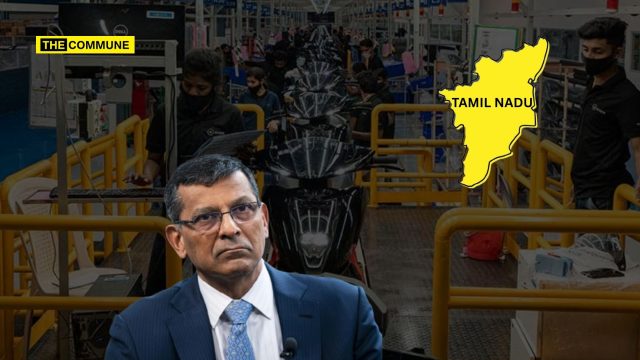
Former RBI Governor Raghuram Rajan has questioned whether Tamil Nadu’s manufacturing push is creating the kind of well-paying jobs India needs, pointing to the relatively low wages offered in factories involved in product assembly.
Speaking to Frontline, Rajan said manufacturing should not be opposed but argued that India must focus on creating better-paying employment rather than merely increasing the number of factory jobs.
“Take Tamil Nadu. What kind of manufacturing jobs are you getting? The pay in the enterprises that assemble products and all that is not that different from the pay the driver gets or a house help gets in Chennai. It’s Rs.20,000 per month. It’s not that great. We need to figure out how we can get better jobs,” Rajan said.
His comments come amid India’s renewed push to expand manufacturing through initiatives such as the Production Linked Incentive (PLI) scheme. Rajan, however, said India should not assume that manufacturing can generate jobs on the scale required to absorb the country’s growing workforce.
He pointed to increasing automation and competition from countries such as China and Vietnam as major challenges for India’s manufacturing ambitions.
“You are no longer competing with the US or Europe for those jobs, you are competing with China and Vietnam, and the wages there are no higher than they are here,” Rajan said.
Rajan acknowledged that manufacturing could create employment and said India should continue to encourage it. However, he cautioned against relying on manufacturing alone to address the country’s employment crisis.
He cited the expansion of Apple’s supplier ecosystem in Tamil Nadu and Karnataka, which has created more than 2 lakh factory jobs, but said the figure remains tiny compared with India’s overall employment requirements.
“2,00,000 jobs? That’s a pimple on the dimple of India’s jobs requirement. It is minuscule,” he said.
Rajan also pointed to the fact that the share of employment in manufacturing has not increased significantly despite the government’s sustained emphasis on the sector.
“The share of employment in manufacturing is shrinking. It hasn’t gone up in the last 10 years since we have been emphasising on manufacturing,” he said.
Instead, Rajan argued that India should look beyond traditional factory employment and expand moderately skilled jobs in sectors such as healthcare, education, repairs, tourism and other services.
He said India’s service sector has already been responsible for much of the employment growth, but the focus should move beyond high-skilled jobs in IT, consulting and global capability centres.
According to Rajan, upgrading the skills of workers in existing informal occupations could create a large pool of more stable and better-paying jobs.
He also stressed the need for India to improve the quality of education and build stronger universities capable of driving research, innovation and industry linkages.
Rajan’s broader argument is that India cannot afford to focus exclusively on manufacturing as its route to prosperity. While he supports manufacturing where it makes economic and strategic sense, he believes India needs to create an ecosystem that produces higher-value and more productive employment.
For Tamil Nadu, which has emerged as a major manufacturing hub and a key destination for electronics and automobile investments, his remarks raise a larger question: Is the state’s manufacturing expansion creating enough high-quality, well-paying jobs or simply more low-wage factory employment?
Subscribe to our channels on WhatsApp, Telegram, Instagram and YouTube to get the best stories of the day delivered to you personally.