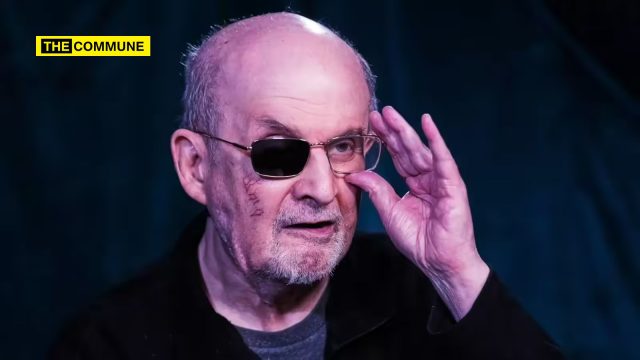
Salman Rushdie has spent decades living under the shadow of Islamist extremism.
His book The Satanic Verses was banned in India by the Rajiv Gandhi government. Ayatollah Ruhollah Khomeini later issued a fatwa calling for his death. Rushdie lived under threat for years. In 2022, he was attacked and repeatedly stabbed by Hadi Matar at an event in New York. The attack left Rushdie blind in one eye.
One would expect that experience to produce a particularly clear understanding of the ideology that made him a target.
Instead, Rushdie now appears far more comfortable lecturing India about Hindu nationalism and attacking Prime Minister Narendra Modi.
In a recent interview with PBS, Rushdie was asked whether Modi should be described as a “war criminal” over the 2002 Gujarat riots as labelled by NYC Mayor Zohran Mamdani.
Rushdie stopped short of calling Modi a war criminal, acknowledging that “it wasn’t a war.” But he then questioned the legal process that cleared Modi.
“we have to say that they were he was exonerated. But whether what does that mean? And who did the exonerating?”
He went further.
“If I had to say, I would say that I believe him to have been partly responsible for some of that violence. I don’t know whether that’s a war criminal cuz it wasn’t a war. But I think he has a very brutal side.”
That raises an obvious question.
If India’s judicial process examined the allegations and reached a conclusion, on what basis does Rushdie substitute his personal belief for the findings of the institutions of the country?
The issue becomes even more striking when Rushdie turns to Hindu nationalism.
Asked about the RSS and its growing influence among Indian Americans, Rushdie said:
“I think it is unfortunately the case that a lot of Indian Americans, Hindu Indian Americans are attracted to the ideas of Hindu nationalism. And you could compare it if you want to the way in which Irish Americans used to support the IRA. It’s I think it’s very regrettable, but it’s there’s no question that it’s happening.”
So here is the extraordinary inversion.
A man whose life was threatened by an ideology rooted in religious extremism is now directing his sharpest warnings at Hindu nationalism.
A man who knows what it means to have his freedom of expression threatened in the name of religion is now questioning the legitimacy of institutions that reached conclusions he does not agree with.
And a man who was himself targeted by an Islamist extremist is apparently more willing to publicly condemn Hindu nationalism than to confront Islamist extremism with the same political ferocity.
That contrast is difficult to ignore.
One can criticise Modi, the RSS, or disagree with Hindu nationalism. But there is a difference between criticism and selectively applying standards.
Rushdie is entitled to his political opinions. He is entitled to believe Modi bears responsibility for the Gujarat violence. But acknowledging that Modi was exonerated and then immediately asking “who did the exonerating?” risks reducing a judicial finding to something that can simply be dismissed because it does not conform to one’s preferred conclusion.
The larger irony is hard to miss.
Rushdie knows better than most what religious extremism can do when it becomes intolerant of dissent. He knows what it means to be threatened, hunted and attacked because of words.
Yet his latest intervention places Hindu nationalism at the centre of his warning about India, while his own extraordinary history with Islamist extremism barely figures in the argument.
Salman Rushdie lost an eye to an Islamist attacker. One would hope he did not lose perspective with it.
Perhaps he has now calculated that attacking PM Modi is safer than attacking the ideology that actually tried to kill him.
Criticise PM Modi, earn applause from the same… https://t.co/mF39x05lBK
— Mahesh Jethmalani (@JethmalaniM) September 9, 2026
Subscribe to our channels on WhatsApp, Telegram, Instagram and YouTube to get the best stories of the day delivered to you personally.