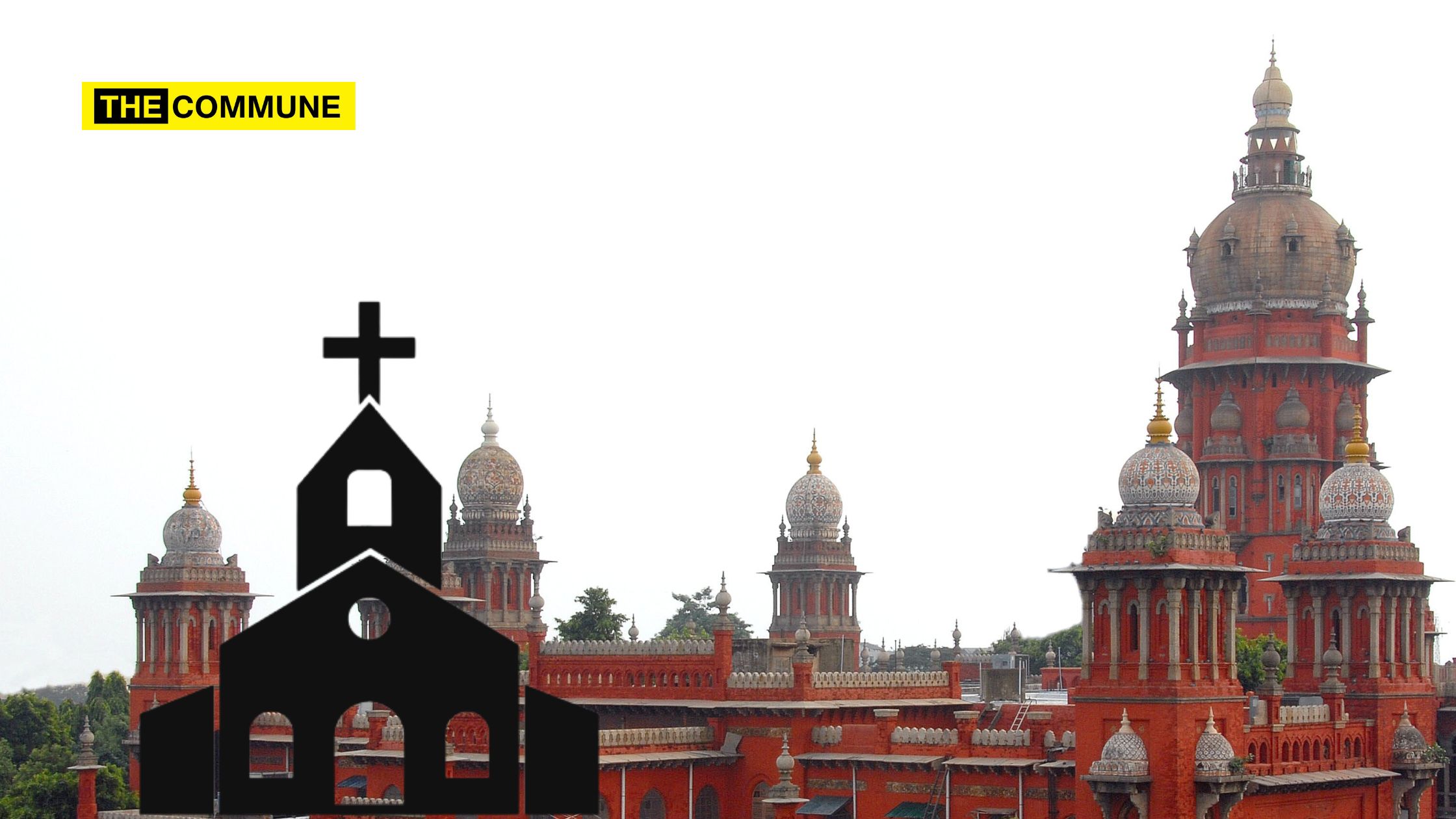
The Madras High Court has granted an interim injunction restraining the president of the CSI Christ King Church on Kalapatti Main Road in Coimbatore city from constructing a church in close proximity to a Mariamman Temple and on a piece of land classified as a public road in revenue records, as reported in The Hindu.
A Division Bench comprising Justices GR Swaminathan and V. Lakshminarayanan made the observations while hearing a writ petition filed by N. Balasubramaniyam challenging orders issued by district authorities in connection with the proposed church construction.
In its order, the Bench observed, “If a large church is proposed to be constructed in the vicinity of a temple, mala fide intentions cannot be ruled out. Since India is a secular nation and a pluralistic society, religious amity has to be preserved, especially when an overwhelming majority of Hindus oppose the construction of a church in close proximity to the temple.”
The court also recorded submissions made by the petitioner’s counsel, D. Baskar, during the course of arguments. According to the order, the counsel claimed that “certain fundamentalist organisations have become emboldened” following the change of government headed by Chief Minister Joseph Vijay and that posters had appeared across the State calling for the construction of churches in every village.
The counsel further submitted that Legislative Assembly Speaker JCD Prabhakar, who claims to have distributed thousands of free copies of the Bible, quoted biblical verses in his inaugural address to the Legislative Assembly. He also pointed out that the ruling Tamilaga Vettri Kazhagam (TVK) did not object when Leader of the Opposition Udhayanidhi Stalin called for “the annihilation of Sanatana Dharma” during his address in the Assembly.
Referring to these submissions, the Bench stated. “Since there has been a disruption in the political ecosystem, according to the petitioner’s counsel, the construction of a church which was put on hold has been resumed recently… The political scenario may change. But so long as the position of law remains what it is, it is our duty to give effect to the same.”
The Bench noted that the Mariamman Temple in Kalapatti has existed for more than 100 years. It recorded that of the nearly 1,000 families residing in the locality, around 950 are Hindus, 15 are Muslims, and only a very small number are Christians.
The dispute traces back to 2010 when the Coimbatore Collector granted permission for the construction of a church on land situated close to the existing temple. In response, temple worshippers filed a civil suit before the Coimbatore District Munsif Court in 2011 challenging the proposed construction.
While the civil suit remained pending, the Coimbatore Collector and the Coimbatore North Revenue Divisional Officer issued orders in May 2023 granting police protection for the construction work. However, after law and order concerns emerged, the Collector issued a stop-construction order in June 2023.
Subsequently, the Church of South India (CSI) approached the High Court in 2024 challenging the Collector’s order. On 28 April 2026, Justice M. Dhandapani disposed of the writ petition and granted liberty to CSI to file a fresh application seeking permission for construction after the disposal of the 2011 civil suit.
Following that order, N Balasubramaniyam filed the present writ petition in May 2026 challenging the 2023 orders issued by the Collector and the Revenue Divisional Officer.
In his order, Justice GR Swaminathan emphasised that the constitutional right to practise, profess and propagate religion is subject to public order considerations.
The judge observed, “Coimbatore is a communally sensitive city. It witnessed bomb blasts and bloody religious riots. The proposed church would come up within a stone’s throwaway distance from the existing Mariamman Temple. There are only a handful of Christian families. If a large church is proposed to be constructed in the vicinity of the Mariamman Temple, mala fide intentions cannot be ruled out.”
He further stated, “The counsel for the petitioner hints at the possibility of the new building being a centre of conversion activity. We are a secular nation. We are a pluralist society. Religious amity has to be preserved. If a religious right is established, then it is the duty of the State to aid in its enforcement… When Hindus constitute an overwhelming majority and they vigorously oppose the construction of a church in the immediate vicinity of the temple, then the authority must not casually brush the objection aside.”
The Bench also clarified that the circumstances of the present case were unique and influenced by multiple factors.
The judges noted, “The considerations could have been different if the construction were on patta (private) land whose title is beyond dispute and there is no religious structure belonging to other communities in the immediate vicinity or if there is no opposition. In the case on hand, the revenue record indicates that the site is a public road. The location is too close to an old temple. There is also vigorous opposition.”
At the same time, the court cautioned that opposition alone cannot be the basis for denying a religious right.
The Bench said, “We should not be understood as holding that if there is opposition, the State must submit to it. Far from it. If right is established or if the opposition is found to be unreasonable, then the State should go to any extent to uphold the right.”
Subscribe to our channels on WhatsApp, Telegram, Instagram and YouTube to get the best stories of the day delivered to you personally.