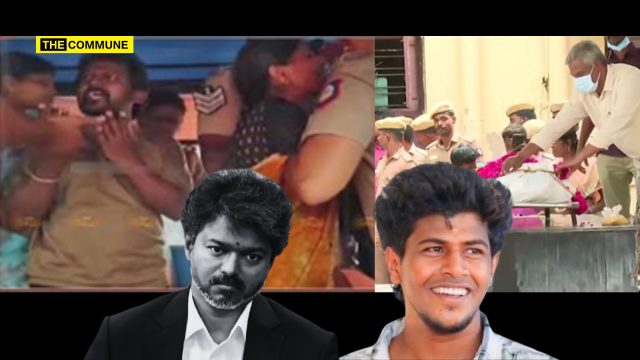
The cremation of 26-year-old Dalit youth Akash Delison under police protection on Wednesday, 17 June 2026, has emerged as one of the most controversial law-and-order issues confronting Chief Minister Joseph Vijay’s Tamilaga Vettri Kazhagam (TVK) government, with the administration failing to deliver justice to a family alleging custodial murder, as reported in DT Next.
More than 100 days after Akash’s death, his body was finally cremated at an electric crematorium following directions issued by the Madurai Bench of the Madras High Court. The final rites were conducted amid tight security and emotional scenes, with family members continuing to insist that justice had not been served.
As police officials carried out the court’s order, Akash’s grieving mother reportedly threw a handful of soil towards the policemen and cursed those she held responsible for her son’s death, underscoring the anguish that has defined the family’s struggle over the past three months.
Akash, a resident of Manamadurai in Sivaganga district, was arrested by local police on March 6 in connection with an assault case. Police initially claimed that he sustained a leg fracture while attempting to escape from custody.
However, according to reports, Akash later gave a statement before a judicial magistrate alleging that police personnel had brutally assaulted him and broken his leg while in custody. He died on 8 March 2026 while undergoing treatment at the Government Rajaji Hospital in Madurai.
The controversy deepened after the post-mortem examination reportedly found around 28 injuries on his body, raising serious questions about the circumstances leading to his death.
Following public outrage, the investigation was transferred to the Crime Branch-CID on 9 March 2026. Six police personnel, including an inspector and a sub-inspector, were subsequently placed under suspension.
The Madras High Court took suo motu cognisance of the matter and, on 13 March 2026, directed the CB-CID to register a murder case and invoke relevant provisions of the Scheduled Castes and Scheduled Tribes (Prevention of Atrocities) Act against the accused police personnel.
Despite the court’s intervention, the victim’s family maintained that justice remained incomplete. Akash’s father, Rajesh Kannan, approached the High Court seeking ₹50 lakh compensation and the immediate arrest of all 16 police personnel allegedly connected to the custodial death.
The family also staged a continuous protest near the old bus stand in Manamadurai, refusing to receive the body until all those responsible were arrested.
The prolonged standoff eventually prompted judicial intervention. On 15 June 2026, the Madurai Bench directed that if the family failed to accept the body by 5 p.m. on the same day, the district administration should proceed with a dignified disposal of the remains.
When the family continued its refusal, authorities moved ahead with the cremation process under heavy police deployment.
The episode has now triggered criticism of the TVK government, which came to power promising transparent governance and a people-centric administration. While the custodial death itself occurred before the current government’s tenure, the handling of the aftermath falls squarely within its responsibility.
The family’s primary demand was the arrest of all police personnel allegedly involved in the custodial death. Instead, the administration allowed the situation to drag on for months before ultimately deploying police personnel to enforce the court-ordered cremation.
The image of grieving parents protesting for over 100 days and watching their son’s body cremated without their consent has become a symbol of the state’s failure to provide timely accountability in a custodial death case.
Subscribe to our channels on WhatsApp, Telegram, Instagram and YouTube to get the best stories of the day delivered to you personally.