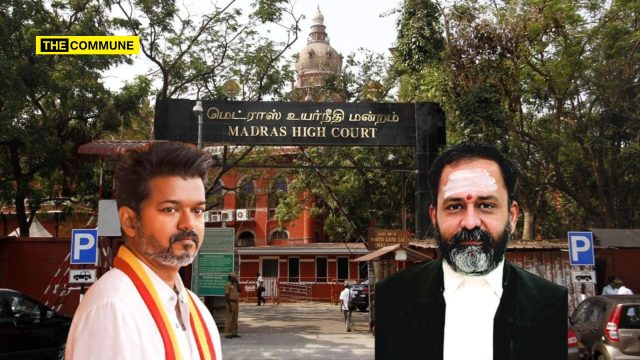
The Madras High Court on Friday (29 May 2026) took up for consideration a public interest litigation petition concerning Tamilaga Vettri Kazhagam (TVK) chief and Chief Minister C. Joseph Vijay’s appeal to children to persuade adults in their households to vote for his party during the 2026 Tamil Nadu Assembly elections, as reported in The Hindu.
Hearing the matter as part of a summer vacation Bench along with Justice V. Lakshminarayanan, Justice GR Swaminathan referred to a personal experience to explain why the issue merited examination.
Addressing senior counsel S. Muralidhar, a former Chief Justice appearing for TVK, Justice Swaminathan recalled that he had visited his family doctor in Madurai about three weeks earlier after falling ill.
“He (the doctor) said that when he was about to go for voting, his grandchild said, Thatha you must vote only for…”
Mr. Muralidhar responded in a lighter vein, stating: “We have in our tradition, children advising the father. Your Lordship’s name also symbolises that.”
The remark was a reference to the name Swaminathan, another name associated with Lord Murugan, who in Hindu tradition is believed to have assumed the role of a teacher to his father, Lord Shiva.
The exchange took place after the Bench indicated its intention to admit the petition filed by Cuddalore-based advocate L. Vasuki and grant time to TVK to submit its counter affidavit. Objecting to the matter being admitted as a public interest litigation petition, Mr. Muralidhar requested that the case be adjourned to enable him to examine the legal issues involved before filing a response.
“The petition is entirely based on news reports. Your Lordships may permit a proper reply or response to be filed because it involves very interesting questions of law on the powers of the Election Commission of India (EC),” he submitted.
The senior counsel argued that the Election Commission’s authority to examine violations of the Model Code of Conduct exists only during the electoral process and not after election results have been declared.
“Once the election gets over, the EC goes out of the picture. Any allegation of electoral corrupt practice raised, thereafter, could be dealt with only in individual election petitions. So, the question here really is what are the powers of the ECI, after the conclusion of the elections, to conduct an inquiry as sought by the present petitioner,” he told the court.
Referring to Section 123 of the Representation of the People Act, 1951, which categorises “undue influence” as a corrupt electoral practice, Mr. Muralidhar further argued, “The adjective used in the Act is ‘undue.’ Now what can constitute undue influence would have to be tested vis-a-vis the election of individual candidates because there is no concept of disqualifying a party. There’s only a consequence of derecognition of party.”
He requested additional time to study the legal questions raised in the petition and assist the court on the issue.
Senior counsel N.R. Elango and S.R. Rajagopal, appearing for the Dravida Munnetra Kazhagam (DMK) and the All India Anna Dravida Munnetra Kazhagam (AIADMK), respectively, informed the court that the allegations made against their parties were distinct from those levelled against TVK.
They contended that the accusations concerning alleged voter bribery in the Alangulam, Mylapore and Thirumangalam constituencies could only be challenged through election petitions and not by way of a public interest litigation.
During the hearing, Justice Swaminathan remarked: “Mr. Rajagopal, I think you must sail with him (Mr. Elango).”
The Division Bench subsequently granted time to all respondents to place their counter affidavits on record and adjourned the matter to 1 July 2026.
Subscribe to our channels on WhatsApp, Telegram, Instagram and YouTube to get the best stories of the day delivered to you personally.