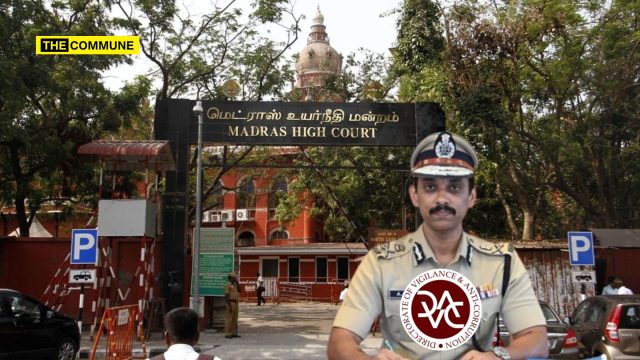
The Madras High Court on Friday (29 May 2026) censured former Chennai Police Commissioner and current Director of the Tamil Nadu Directorate of Vigilance and Anti-Corruption (DVAC), A. Arun IPS, for issuing a preventive detention order against a realtor in an alleged fraud case, as reported by LiveLaw.
While setting aside the detention order, a Division Bench comprising Justices GR Swaminathan and V. Lakshminarayanan concluded that the order had been issued for reasons unrelated to the requirements of preventive detention law. The Bench also observed that Arun had repeatedly passed similar detention orders that were subsequently quashed by the courts.
“The impugned order has been deliberately passed. We would normally not make such remark. But we are constrained to do so because Thiru Arun IPS is habituated to issuing such orders, most of which have come to the notice of this Court and quashed. Even before us, he did not appear to feel that he had passed a wrong order. He strongly justified his conduct. He ought to be aware that a preventive detention order cannot be passed recklessly as it has serious implications on the detenu’s liberty. The detention order has been passed for extraneous reasons. We censure Thiru Arun IPS., for having passed the impugned detention order,” the court said.
A censure is a formal expression of strong disapproval by a court or other authority. While it does not by itself amount to a criminal penalty or removal from office, it places on record the court’s condemnation of a person’s conduct and can carry significant reputational consequences.
The case arose from a habeas corpus petition challenging the detention of real estate developer Santosh Sharma under the Tamil Nadu Goondas Act. Sharma had been accused of selling apartments to purchasers and subsequently executing additional documents in favour of other accused persons. The petition was filed by Sharma’s daughter.
It was argued before the court that the cases pending against Sharma could have been dealt with under ordinary criminal law and that there was no justification for invoking preventive detention provisions. Counsel also contended that even if the allegations were accepted as true, they related to a private civil and criminal dispute between individuals and therefore concerned “law and order” rather than any threat to “public order.”
When the matter was first heard, the Bench observed that the detention order had shocked its judicial conscience. The judges then summoned Arun, who was serving as Chennai Police Commissioner when the detention order was issued.
The court noted that Arun has since been appointed Director of the Tamil Nadu Directorate of Vigilance and Anti-Corruption.
During a subsequent hearing on 27 May 2026, the Bench expressed displeasure over the manner in which a court bailiff had allegedly been made to wait for nearly two hours while attempting to serve summons at the IPS officer’s office. The judges directed the office staff responsible for making the bailiff wait to appear before the court and instructed Arun to remain present until then.
After the staff member appeared, the Bench censured him and stated that action would be taken. The court also referred to an instance where the Bombay High Court had initiated contempt proceedings after a court bailiff was disrespected by office staff. The judges clarified that Arun had been summoned in order to provide him an opportunity to explain his actions before any directions were issued.
In the order quashing the detention, the court observed that while Sharma may have deliberately violated contractual obligations and could be prosecuted in accordance with law, his conduct did not pose a threat to public safety.
“Cases such as the one on hand are registered routinely all over the State. We are more than satisfied that the ground case as well as the adverse cases do not have the potential to disturb public order. It is ridiculous to claim that they will disturb the even tempo of social life. There is absolutely no warrant for invoking the draconian law of preventive detention for such cases,” the court said.
The Bench further noted that the ground case and adverse cases relied upon by the detaining authority related to incidents between 2020 and 2023 and lacked any live or proximate connection with Sharma’s present conduct. It therefore concluded that there was no urgent necessity to invoke preventive detention.
The judges also observed that Arun, as a direct recruit IPS officer with 28 years of experience, would have been fully aware that the allegations did not fall within the category of public order offences.
“The detaining authority knew fully well that the case on hand does not fall within the category of public order. He also knew that he was placing reliance on events that had taken place not less than two years earlier. The detaining authority is not a novice. He is a direct recruit to I.P.S. He has served in various capacities. If with 28 years of experience such an order can be passed, it would only mean that it was done deliberately and with full knowledge of law and the facts involved,” the court said.
The Bench also referred to detention orders previously issued against journalists Savukku Shankar and Varaaki, both of which were later quashed. The judges observed that this was not the first occasion on which Arun’s actions as a detaining authority had attracted judicial scrutiny.
Subscribe to our channels on WhatsApp, Telegram, Instagram and YouTube to get the best stories of the day delivered to you personally.