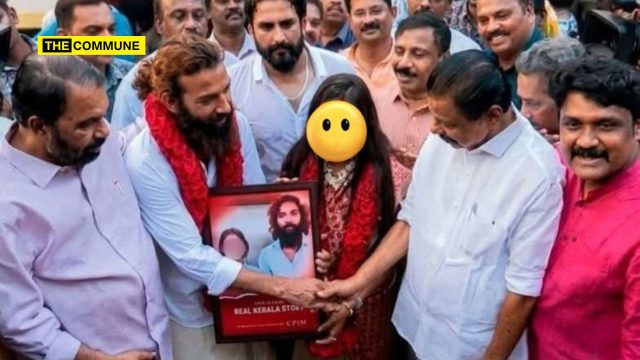
Madhya Pradesh Police informed the Kerala High Court on Friday (29 May 2026) that an offence under the Scheduled Castes and Scheduled Tribes (Prevention of Atrocities) Act, 1989 had been incorporated against Farmaan, the husband of the viral Kumbh Mela star, and therefore the anticipatory bail plea moved by the couple was not maintainable, as reported in LiveLaw.
The submission was made by Additional Solicitor General S.V. Raju, appearing for the Madhya Pradesh government, before Justice Kauser Edappagath, who was hearing the couple’s plea seeking pre-arrest bail in a case registered after the girl’s father lodged a complaint with Madhya Pradesh Police alleging that his daughter had been abducted.
The couple had also filed an amendment application seeking to amend the pleadings in the anticipatory bail petition, and the same was taken up for hearing by the court.
During the hearing, the ASG submitted that an offence under Section 3(2)(v) of the SC/ST Act had been invoked against Farmaan.
“The offence falls under the Atrocities Act. S. 3(2)(v) is invoked. Because of S.18 of the SC/ST Act, the anticipatory bail is not maintainable. Victim belongs to the Schedule Tribe. The 1st petitioner is not belonging to SC/ST community,” he argued.
Under Section 3(2)(v) of the Act, a person committing an IPC offence punishable with imprisonment of ten years or more against a person belonging to a Scheduled Caste or Scheduled Tribe is punishable with imprisonment for life and fine. Section 18 of the Act bars the application of anticipatory bail provisions in cases involving offences under the Act.
After hearing the parties, the court observed that it would extend the interim order protecting the couple from arrest until Tuesday (June 2) and would hear further arguments if it decided to allow the amendment application.
During the proceedings, the ASG opposed the amendment application filed by the couple. He argued that after his submissions in the previous hearing, the petitioners had been expected to file a reply but had instead moved an amendment application containing averments intended to address deficiencies pointed out by him.
Justice Kauser Edappagath remarked, “Already there was sufficient pleadings but exact wording was not there.”
Last week, the Madhya Pradesh government had challenged the maintainability of the plea on the ground that a regular anticipatory bail application could be filed only before courts in the State where the criminal case had been registered. According to the State, since the couple had sought regular anticipatory bail in Kerala in connection with a crime registered in Madhya Pradesh, the petition was not maintainable.
Meanwhile, Advocate Sasindran, appearing for the couple, submitted that the anticipatory bail application had been moved before the Kerala High Court because the couple feared danger due to their interfaith marriage.
Referring to the Supreme Court’s decision in S.R. Sukumar v. S. Sunaad Raghuram (2015), he argued that amendments could be permitted even immediately before judgment. He further submitted that the power under Section 528 of the Bharatiya Nagarik Suraksha Sanhita (BNSS), which deals with the inherent powers of the High Court, was intended to ensure substantial justice.
“The very reason for filing the bail application is that I cannot go to Madhya Pradesh. Today, I have produced photographs. Our marriage photographs are burning and beating with shoes by the fundamentalists. That is the reason why I have filed the bail application. I cannot go to Madhya Pradesh. Even I cannot move in Kerala also. Even after getting your Lordships order, realising that the order is only against arrest, they registered a case under Child Marriage Act. As if I, the 2nd petitioner, is a victim. The fact is that there is a threat. We cannot move to MP. We have not gone to MP. We filed the writ petition in MP by approaching a lawyer from Kerala only, not in MP,” he submitted.
Opposing the amendment application, the ASG argued that the facts sought to be introduced were not subsequent developments but facts already known to the petitioners before filing the bail petition.
“These are not subsequent events. These are events, which are known to him prior to the filing of the bail application. These are not fact which has arisen after the filing of the bail application. It’s a fact, which was known to him. He has not stated that in his petition. It amounts to suppression. Amendment should not be allowed. After I made my submissions (on) what is required and I pointed out that necessary averments are not there, he has filed the amendment, instead of replying, to overcome the lacunae. To fill in the lacunae, amendment can’t be allowed….He has stated wrong facts. He has stated that he can’t go to Madhya Pradesh…It is an admitted fact that he has filed a writ petition in MP High Court after his bail application was filed…There is no requirement to go to MP physically to file a pre-arrest bail application. He can swear and send it there. Therefore, his saying that I am not safe in MP is of no consequence here.”
Advocate Sasindran clarified that the affidavit filed in the writ petition before the Madhya Pradesh High Court had been sworn in Kerala.
The ASG also reiterated that the offence under Section 3(2)(v) of the SC/ST Act had been incorporated against Farmaan, who does not belong to the SC/ST community.
At this stage, the court observed that if it decided to allow the amendment application, further arguments would be heard on June 2.
The ASG then urged the court not to extend the interim protection granted to the couple. The court, however, extended the protection until Tuesday.
“He cannot get unlimited extension. SC said it is a temporary relief, if at all, it has to be filed,” the ASG argued.
The court thereafter reserved orders on the amendment application.
The young woman, popularly known as the “viral Kumbh Mela star”, came to national attention during the Maha Kumbh celebrations last year after videos of her selling rudraksha garlands at the mela went viral on social media.
In March 2026, while in Kerala for a film shoot, she sought police protection alleging that her family opposed her marriage to Farmaan. The couple later got married.
The controversy escalated after the National Commission for Scheduled Tribes (NCST) stated that the girl was allegedly a minor, around 16 years old at the time of the marriage, and that forged documents may have been used to facilitate the wedding. Based on those findings, Madhya Pradesh Police subsequently registered a case against Farmaan under the POCSO Act.
Subscribe to our channels on WhatsApp, Telegram, Instagram and YouTube to get the best stories of the day delivered to you personally.