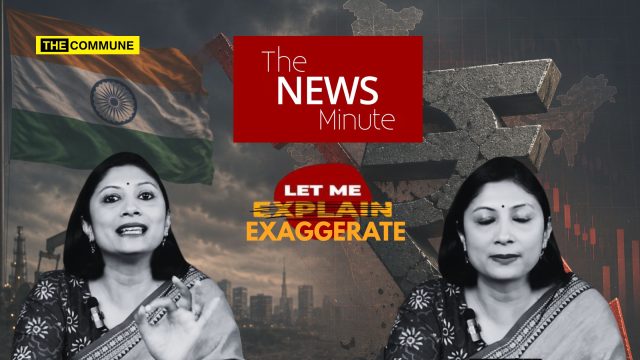
The News Minute’s Let Me Explain series by Pooja Prasanna doesn’t explain, it exaggerates, it pushes propaganda and blatantly lies. Whether it is Tamil Nadu vs Gujarat economic comparisons, the Dharmasthala issue, or any politically loaded subject, the pattern remains the same: selective framing, ideological spin and outright misinformation packaged as journalism.
For years, The News Minute operated like an unofficial media mouthpiece of the Dravida Munnetra Kazhagam ecosystem. Now, with shifting political equations, its focus appears increasingly directed toward attacking PM Modi and the central government at every opportunity. The branding may say “Let Me Explain,” but the content is, in reality, exaggerations – propaganda disguised as analysis.
Pooja pushes a narrative that India is sliding into an economic crisis, with the rupee on the brink and growth exposed as hollow. This latest video on the “rupee crisis” is a case study in making a mountain out of a molehill: inflating numbers, cherry‑picking experts and ignoring basic context.
If you actually look at the data – and at what serious economists like Gita Gopinath are saying – the picture is not exactly what Pooja and TNM are trying to portray. India is under pressure like every oil‑importing economy, but there is no macroeconomic collapse, no currency free‑fall, and no justification for the panic‑laden tone TNM is trying to manufacture.
The 1% Myth: When 0.05 Becomes “Almost 1”
Anchor Pooja Prasanna claims that, according to economist Neelkanth Mishra, “every 1 dollar increase in oil prices costs India nearly 1% of our GDP.” That is not a minor slip; it is off by roughly a factor of twenty.
In multiple interviews this year, Mishra’s estimate is that a sustained 10‑dollar increase in crude prices shaves about 0.4-0.5 percentage points off India’s GDP growth, which is nowhere near the claim that a $1 increase wipes out ‘almost 1% of GDP.’ A 1‑dollar move is uncomfortable, but it is not the macro‑earthquake TNM insinuates.
Inflating a 0.05% impact into “nearly 1%” is not analysis; it is scaremongering. It converts a manageable external shock, something the economy has handled repeatedly, into a faux apocalypse.
The Rupee “Crisis” That No One Is Worried About
Pooja repeatedly talks of a “rupee crisis,” panic, and “fear itself weakening the currency further,” claiming the rupee has crashed to around 96-97 per dollar and suggesting India is sliding towards 2013‑style turmoil. Yet the hard facts point the opposite way.
India’s foreign‑exchange reserves are near historic highs, fluctuating around 700–730 billion dollars in recent weeks. That is one of the largest reserve buffers in the world, and far above 2013 levels. You do not stockpile three‑quarters of a trillion dollars of FX if you are on the brink of a balance‑of‑payments meltdown.
Gita Gopinath, former IMF Chief Economist and till recently its First Deputy Managing Director, has just given multiple interviews on this very issue. Her view is unambiguous:
With reserves of around 700 billion dollars, India has a strong buffer and should be prudent in using it, not blow it trying to artificially hold the rupee at a particular number.
A gradual depreciation in response to higher oil and a stronger dollar is normal adjustment, not evidence of financial instability. There is “nothing in the data” right now that points to unanchored inflation or systemic risk in the banking system or markets.
“What policymakers should care about is what’s happening with jobs in the country, consumer price inflation in the country, and what’s happening with output. The exchange rate is one factor that goes into each of these variables. So, you pay attention to the exchange rate because… pic.twitter.com/EkbaqgurjE
— IndiaToday (@IndiaToday) May 20, 2026
In other words: the person who has actually sat inside the IMF looking at crisis economies does not see India in that bracket today. She treats the rupee’s slide as something to manage carefully, not something to panic about.
TNM never tells you this. They use the rupee’s level as a horror graphic, then quietly concede that reserves are huge – without admitting that those facts sit uneasily with TNM’s near-apocalyptic ‘crisis’ framing.
It gets worse. The script claims the rupee has “significantly fallen against Sri Lankan and Pakistani rupees and Bangladeshi taka,” when, over the last decade, the opposite is true: INR has strengthened massively against currencies of countries that actually faced IMF bailouts and sovereign stress. To pretend India’s currency is doing worse than Pakistan’s or Sri Lanka’s is not just flimsy; it is misleading.
Growth: IMF vs “Everything is Collapsing”
TNM sketches India as an economy where headline growth is a mirage and the “real story” is stagnation and impending breakdown. But even after the West Asia war and the oil spike, global institutions that have no reason to flatter New Delhi are still not describing an economy on the brink.
In its April 2026 World Economic Outlook update – published after factoring in the conflict and higher energy prices – the IMF trims global growth but still projects India growing around 6.5–7% over the next year or two, with a baseline FY27 forecast of about 6.5%. Global growth for 2026 has been cut to roughly 3.1%, meaning India is still expected to expand at more than double the world average despite the oil shock. That is not how you describe a system on the verge of failure.
Yes, the IMF now clearly flags oil as the key downside risk: in a prolonged $120+ or $140 oil scenario, India’s growth could slow further into the low‑6% range and inflation would be higher. But even in that adverse case, the IMF’s own stress tests show India slowing, not collapsing – and still outgrowing most large economies.
Gita Gopinath’s recent comments point in the same direction. She has warned that if crude spikes toward $140 and stays there, India will face tougher choices on fuel prices and inflation and will need targeted support for poorer households and small businesses. Yet she is equally clear that this is an external shock layered on top of an economy with strong buffers: sizeable forex reserves, solid services exports and still‑robust growth momentum.
During her IMF stint, she explicitly said she found no evidence that India’s GDP numbers were systematically cooked or that the statistical framework was fundamentally broken. You cannot cite her every time she is critical of policy and ignore her when she says, plainly, that the underlying data and macro picture are broadly sound.
None of this means India has no problems. MSMEs are under strain and job creation still lags aspirations – pressures that a long oil shock will worsen. But a serious outlet has to hold two ideas together: even after the war‑driven oil spike, the macro picture remains relatively strong by global standards, and distributional problems exist within that aggregate strength. TNM chooses one half of the story, strips it of time‑line and context, and then markets the whole edifice as a “crisis.”
From Structural Issues to Political Spin
Some of Pooja’s points about structural weaknesses are familiar: a K‑shaped recovery, informal employment, stress in small industries, rural wage stagnation. These are legitimate concerns – and they long pre‑date the current oil spike or West Asia conflict.
But Pooja uses them in a sleight of hand:
Take long‑running problems that every government has struggled with.
Add a global oil shock and strong‑dollar cycle that every importer is facing.
Then present the combination as a uniquely self‑inflicted “Modi‑made” crisis the moment state election results are out.
That is not “explaining,” it is political scripting. It carefully omits counter‑weights that complicate the narrative: record‑high direct benefit transfers, expanded free‑food coverage, a formalisation surge in GST and EPFO numbers, and India’s continued outperformance on growth versus most peers. A balanced explainer would put both sides on the table; TNM picks only the pieces that support a sense of impending doom.
Austerity, Credibility, And a Double Standard
Pooja lambasts the Prime Minister’s call for citizens to reduce discretionary fuel use, postpone foreign holidays and cut gold purchases, framing it as proof that “everything was not under control” and that the government had been lying about the economy’s health.
But in the same breath, she criticises the government for being too upbeat earlier and for not warning people in time. You cannot demand early, honest communication about pain and then mock the first visible appeal for restraint as a confession of failure. That is a classic “heads I win, tails you lose” rhetorical trick.
She also complains that while citizens are asked to tighten belts, political rallies and roadshows continue. The hypocrisy is obvious: the very media ecosystem that thrives on wall‑to‑wall election coverage and viral clips now scolds politicians for holding events – without any self‑reflection about its own incentive structure. If austerity is the new moral benchmark, surely ad‑funded saturation coverage of those same roadshows deserves scrutiny too.
What a Real Crisis Looks Like, And Why This Isn’t One
Pooja and The News Minute want viewers to believe India is heading into uncharted danger. But compare the current situation to actual crisis episodes:
In true currency panics, you see free‑falling reserves, emergency interest‑rate hikes, capital controls and urgent IMF programmes. India today has near‑record reserves between 700 and 730 billion dollars, inflation that remains broadly anchored, and no signs of banking‑sector stress.
In real growth collapses, forecasts are slashed across the board, credit growth implodes, and unemployment spikes sharply. Today, the IMF and World Bank are raising India’s growth projections while cutting those of many advanced economies and other emerging markets.
Gita Gopinath’s core message captures this nuance: the rupee’s weakness is a serious adjustment that must be managed carefully, but she has indicated there is no sign at present of unanchored inflation or systemic financial instability, and letting the rupee adjust gradually is the rational response given India’s large but finite reserves.
That is the opposite of the hysterical picture “Let Me Explain” paints. There is stress, yes; there is no systemic breakdown.
The Real Story TNM Won’t Tell
India’s economy faces three simultaneous challenges: a global oil shock, a strong‑dollar cycle, and long‑standing domestic issues around jobs and economic inequality. None of these are trivial. But they also do not add up to the all‑caps “crisis” TNM is selling.
What TNM is really exposing is not the “fundamental weakness” of India’s macroeconomy, but the weakness of a certain kind of commentary – one that cannot live without the drama of imminent collapse, even when the world’s top macroeconomists, the IMF’s numbers, and India’s own reserve position simply do not support that storyline.
Subscribe to our channels on WhatsApp, Telegram, Instagram and YouTube to get the best stories of the day delivered to you personally.