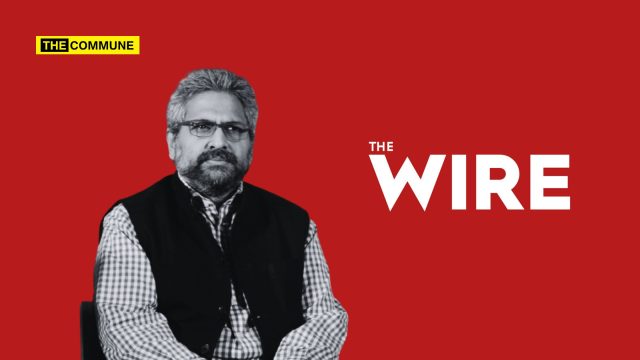
The legal battle surrounding The Wire founding editor Siddharth Varadarajan’s Overseas Citizen of India (OCI) application has taken a dramatic turn after the senior journalist tendered an unconditional apology before the Delhi High Court and sought pardon over his failure to disclose a crucial judicial order in his earlier petition, as reported in OpIndia.
The controversy erupted after the Union government informed the Delhi High Court that Varadarajan had failed to disclose a 15 May 2020 order passed by the Allahabad High Court while seeking relief against the Centre’s decision denying him OCI status.
The undisclosed order was passed in connection with a criminal case registered against Varadarajan in Ayodhya and had imposed a restriction preventing him from leaving India without obtaining permission from the trial court during the continuation of proceedings.
The matter came under scrutiny before Justice Purushaindra Kumar Kaurav, who earlier this month recalled the Court’s own May 12 order that had quashed the Centre’s rejection of Varadarajan’s OCI application and directed authorities to reconsider the case.
While recalling the earlier relief, the Court observed that Varadarajan appeared prima facie guilty of suppressing material facts and warned that such conduct could invite “very serious consequences.”
The Court subsequently directed him to file an affidavit explaining why the Allahabad High Court’s conditions had not been disclosed earlier.
In his affidavit dated May 22, Varadarajan attempted to justify the omission, claiming that the Allahabad High Court order had effectively “faded from memory due to the passage of time” and the peculiar circumstances of the case.
According to the affidavit, the order had been passed nearly six years ago during the COVID-19 pandemic and, since then, there had been no meaningful progress in the criminal proceedings. Varadarajan stated that no summons had ever been issued to him after the anticipatory bail order.
He further argued that the Allahabad High Court’s direction requiring prior trial court permission before foreign travel was tied specifically to the “currency of trial.” Since charges had not yet been framed and the trial itself had not commenced, he claimed that the condition had never practically come into operation.
Varadarajan also pointed out that most of the offences against him were bailable. He stated that the remaining offence under Section 505 IPC carried a maximum punishment of three years and fell within warrant trial procedure.
“It is in these circumstances and during the long passage of time without any notification of the case that the said order… slipped the deponent’s mind,” the affidavit stated.
The senior journalist further contended that neither the Uttar Pradesh government nor the Central government had objected to his foreign travel in the intervening years, which, according to him, reinforced his understanding that the condition was not operational.
He also insisted there had been no deliberate attempt to suppress facts from the Court.
The affidavit further stated that the pendency and status of the Ayodhya criminal case had already been disclosed to the Central government during the OCI application process. Varadarajan maintained that he never intended to disregard judicial directions.
When the matter was taken up again on Monday, the Central government sought additional time to respond to the affidavit filed by Varadarajan. Justice Kaurav accepted the request and adjourned the matter to July 15.
The litigation itself arises from Varadarajan’s immigration status. A United States citizen, he currently possesses a Person of Indian Origin (PIO) card.
However, after the Government of India merged the PIO and OCI schemes, PIO cards ceased to remain valid after 31 December 2025.
Varadarajan has argued before the Court that although his PIO card technically remains valid until 2032, it has become effectively unusable because the PIO scheme no longer exists and the card is no longer machine-readable. He therefore sought conversion to OCI status.
The Centre rejected the request, triggering the present legal challenge.
With the Delhi High Court now examining whether the non-disclosure amounted to an innocent oversight or suppression of material facts before a constitutional court, the case has expanded beyond an immigration dispute into a larger legal question concerning disclosure obligations and candour before the judiciary.
The proceedings scheduled for July 15 are expected to determine the next course of action in the matter.
Subscribe to our channels on WhatsApp, Telegram, Instagram and YouTube to get the best stories of the day delivered to you personally.