A secessionist plot disguised as a student march to Parliament has been uncovered, with coordination messages circulating in JNU-linked WhatsApp groups revealing that anti-national elements are being advised to download Bitchat, a Bluetooth-based encrypted messaging app designed to operate without mobile networks or internet, to evade law enforcement and coordinate a regime-change operation.
The move mirrors tactics used by Gen Z protesters in Nepal, who successfully coordinated mass demonstrations earlier this year using the same app after the government imposed a social media ban.
Nepal’s protests, which led to the resignation of Prime Minister Khadga Prasad Oli, saw Bitchat downloads surge with over 48,000 installations in a single day.
Bitchat: The Regime-Change Communication Tool
Bitchat, co-founded by former Twitter CEO Jack Dorsey, uses Bluetooth mesh networking to enable peer-to-peer messaging without internet or cellular connectivity. Messages can travel up to 30 metres between devices and up to 300 metres using relay nodes ensuring communication remains possible even during network shutdowns.
The app requires no signup, no phone number, and no profile. Messages are end-to-end encrypted and vanish after reading by default, with a panic mode that wipes all data instantly on triple-tapping the logo.
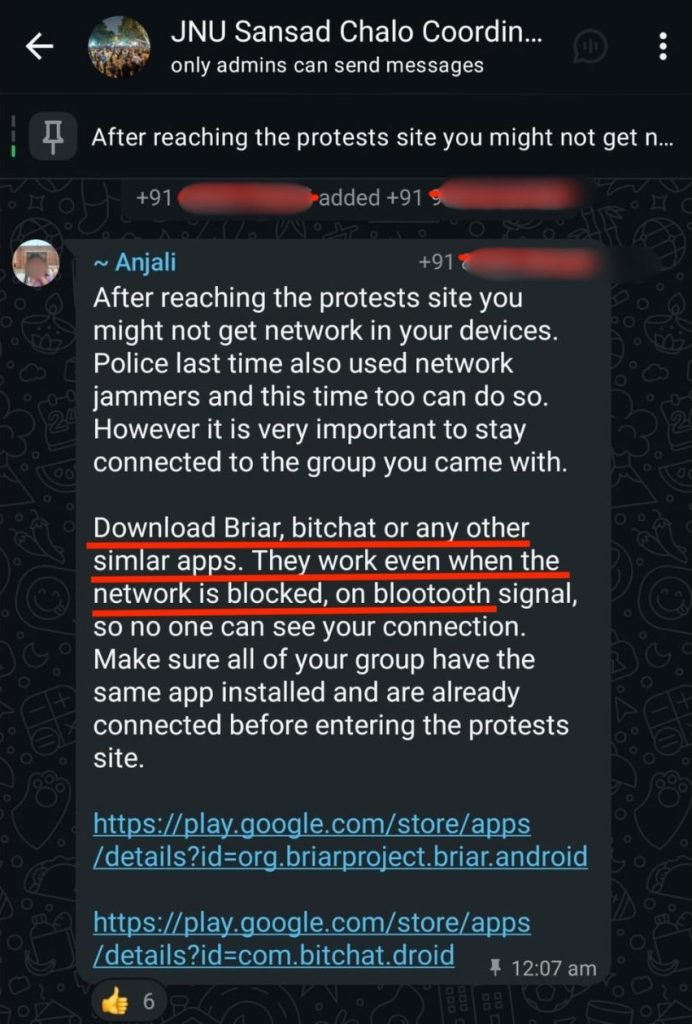
A message circulated in a JNU coordination group states, “Police last time also used network jammers and this time too can do so. However it is very important to stay connected to the group you came with. Download Briar, Bitchat or any other similar apps. They work even when the network is blocked, on bluetooth signal so no one can see your connection.”
Nepal’s Playbook Replicated
During Nepal’s Gen Z protests in September 2025, the government imposed a nationwide ban on more than 20 social media platforms including Facebook, Instagram, YouTube, and WhatsApp. Protesters bypassed restrictions using VPNs and coordinated through Discord servers with over 145,000 members, while Bitchat enabled offline communication during internet blackouts.
The protests, sparked by corruption allegations and a social media crackdown, resulted in at least 51 deaths and the eventual resignation of the prime minister.
JNU activists have now adopted the same blueprint.
‘Kal Modi Sarkar Ka Last Day Hoga’
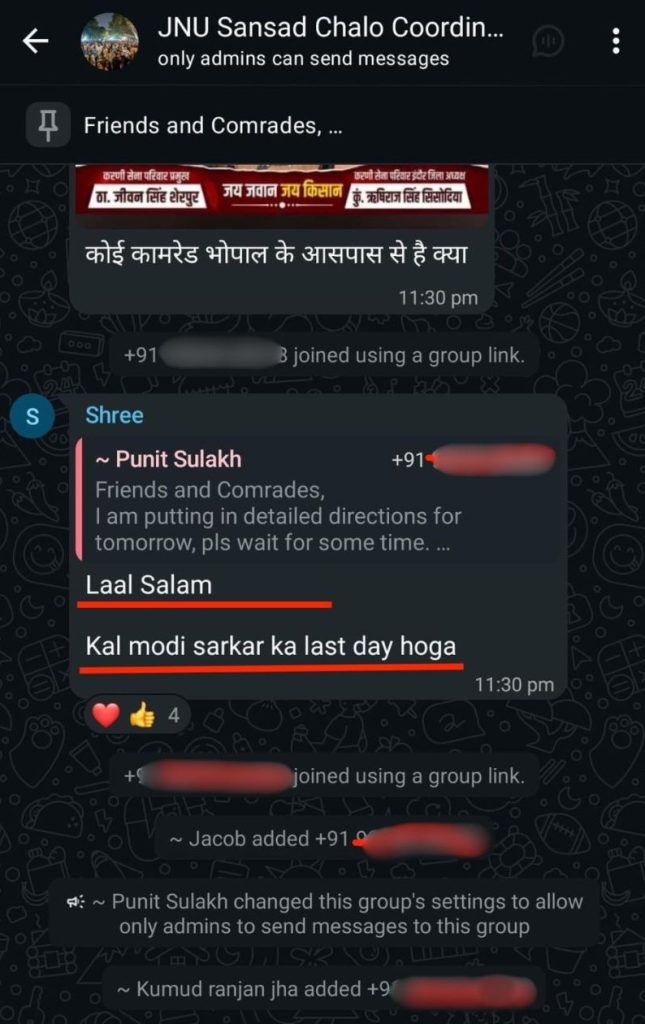
Disturbing messages within the group suggest an intent to force political change. One message read, “Kal Modi sarkar ka last day hoga” (Tomorrow will be the last day of the Modi government).
This rhetoric echoes the Nepal protests, where youth organisers used platforms like TikTok and Discord to coordinate demonstrations, ultimately forcing the government to lift restrictions and leading to political instability.
Historical Context and Concerns
JNU has a long history of being a hub for political activism. Recent campus events, including the organisation of a “Student Parliament” in February 2026, have drawn students from across the country to discuss issues including education policy, academic freedom, and student rights.
However, authorities have previously raised concerns about activities on the campus, including controversial sloganeering during protests in January 2026, which led to disciplinary action against several students.
It is noteworthy that JNU has been the centre of several seditious slogans being raised by its ‘students’ – the Azadi slogan was commonly heard there.
Alert!
I request @PMOIndia @HMOIndia to look into this as a priority.
Marxists of JNU have planned exactly the same as in Nepal.
They are using Bitchat. This app doesn’t require a mobile network or internet. It works on Bluetooth.
In recent years, it’s been widely used by… pic.twitter.com/EqmnoV9sP0
— Office Of Vijay Patel (@VijayGajeraO) July 20, 2026
Some of the admins of the group include the below:
This person, Punit Sulakh, is one of the admins of this WhatsApp group where they are planning to topple the democratically elected government.
I request @DelhiPolice @HMOIndia to look into this. https://t.co/7J7Uc6FuWj pic.twitter.com/Jgup4mmkXc
— Office Of Vijay Patel (@VijayGajeraO) July 20, 2026
Here is Anjali, who is plotting and planning to topple the Indian government.
JNU must be cleansed of such people @DelhiPolice https://t.co/7J7Uc6FuWj pic.twitter.com/7HROv32lJu
— Office Of Vijay Patel (@VijayGajeraO) July 20, 2026
Security Implications
The use of Bitchat poses significant challenges for law enforcement. Since the app operates on Bluetooth rather than cellular networks, it is immune to network jammers that authorities have deployed during previous protests. The app’s encryption and self-destructing messages make monitoring difficult.
Bitchat has previously seen surges in downloads during protests in Madagascar, Uganda, Indonesia, and Iran, establishing it as a preferred tool for regime-change movements globally.
Delhi Police Responds
The Delhi Police seemed to have taken note of the developing situation and the people involved. On their X handle, they wrote, “The Delhi Police appeals to all protesters to exercise restraint and cooperate with the police in maintaining peace and law and order. All protesters are requested to conduct their demonstrations peacefully. They should not engage in any illegal or violent activities and must comply with the legal instructions given by police personnel deployed on duty. The public is advised not to believe or spread rumors, misinformation, or unverified information through any social media platforms. Citizens are requested to rely only on credible sources of information and to cooperate with the Delhi Police in maintaining peace, harmony, and law and order.”
दिल्ली पुलिस सभी प्रदर्शनकारियों से संयम बरतने और शांति व कानून-व्यवस्था बनाए रखने में पुलिस का सहयोग करने की अपील करती है। सभी प्रदर्शनकारियों से अनुरोध है कि वे शांतिपूर्ण ढंग से प्रदर्शन करें । किसी भी गैर-कानूनी या हिंसक गतिविधि में शामिल न हों और ड्यूटी पर तैनात… pic.twitter.com/kfqh2gaTbI
— Delhi Police (@DelhiPolice) July 20, 2026
Subscribe to our channels on WhatsApp, Telegram, Instagram and YouTube to get the best stories of the day delivered to you personally.