Leftist propaganda rag The News Minute (TNM) recently shared an ‘investigation’ on the funding surrounding the Rashtriya Swayamsevak Sangh. Ever since Priyank Kharge wrote an open letter to Sarsanghchalak Mohan Bhagwat in June 2026, TNM made it their life mission to ‘expose’ the Sangh and its finances. The result? A lengthy exercise in guilt-by-association that proves exactly nothing except that TNM either cannot read the Companies Act or simply does not want to.
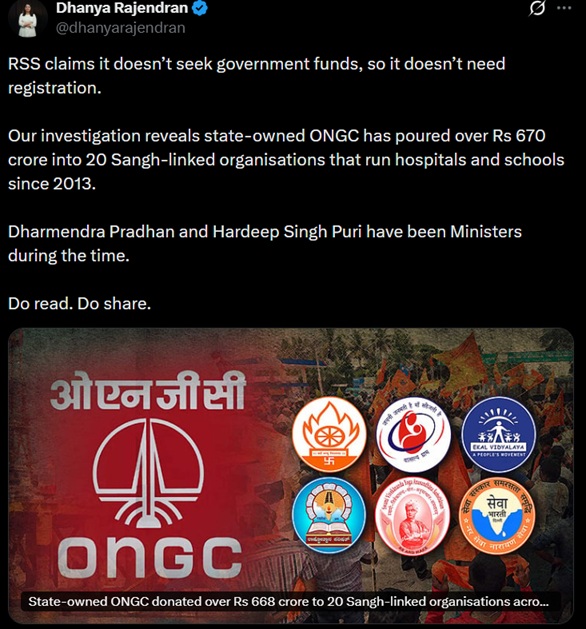
On 19 July 2026, the portal’s Editor-in-Chief Dhanya Rajendran shared the ‘report’ stating, “RSS claims it doesn’t seek government funds, so it doesn’t need registration. Our investigation reveals state-owned ONGC has poured over Rs 670 crore into 20 Sangh-linked organisations that run hospitals and schools since 2013. Dharmendra Pradhan and Hardeep Singh Puri have been Ministers during the time. Do read. Do share.”
The News Minute wants you to believe that ONGC funding a 300-bed hospital in Assam is a smoking gun for RSS capture of public money. It isn’t. It’s a Public Sector Undertaking spending its legally mandated CSR budget on hospitals, cancer centres and school hostels and TNM knows the difference between funding a registered public trust and funding the RSS. It just chose not to tell you.
The trick is in the label, not the money
Twenty organisations. One umbrella term: “RSS-linked.” TNM never asks whether that term can bear the weight it’s putting on it, because if it did, the investigation collapses.
A registered charitable trust is a separate legal person under Indian law. A hospital board, a school society, a cancer institute – these are distinct corporate entities with their own registrations, their own PAN numbers, their own audited accounts, their own governing bodies. Funding one of them is not, legally or factually, the same as funding the unregistered RSS. TNM’s own reporting concedes the RSS has no bank account to fund in the first place; that’s precisely why Bhagwat can say the Sangh needs no registration. You cannot simultaneously argue the RSS is an untraceable body with no formal financial existence and then claim ₹670 crore reached it. Pick one.
What The Money Was Used For
Strip away the ideology-spotting and look at where the funds went.
Swargadew Siu-Ka-Pha Hospital: 300 beds, 21 specialities, empanelled under Ayushman Bharat, general ward beds at ₹800, a 40% discount for BPL patients.
The National Cancer Institute in Nagpur: 470 beds, built on 25 acres, co-conceived by a man who lost his wife to cancer. These are not ideological training camps. They are hospitals treating whoever walks through the door, funded through a CSR mechanism that exists precisely so PSUs put money into healthcare and education.
The details have already been made public.
Your reporting lacks depth and appears to be yellow journalism.
This relates to another alleged case from Dharmasthala. pic.twitter.com/YyLGmvEO5Y— Rajesh S 🇮🇳 (@srajesh_ngd) July 19, 2026
TNM had a real story sitting in its own numbers: public money building forty-plus crore worth of hospital infrastructure and buried it under guilt by association because “PSU funds hospital” doesn’t sell like “PSU funds RSS.”
Six Degrees of Sangh
Look at how thin the “link” gets by the time you reach organisation twenty.
Vivekanand Medical Research Trust is flagged because its founder, decades ago, was an RSS worker who went on to become a BJP chief minister. That’s it. That’s the link.

Nine of the twenty organisations are tagged this way, not because they operate as RSS fronts today, but because someone who once ran them, or started them, had a Sangh background at some point in their life. By that standard, half of India’s civic institutions founded before 1990 are “linked” to something. A court would laugh this argument out of the room; TNM built a headline out of it instead.
Audited Money Doesn’t Leak Into Thin Air
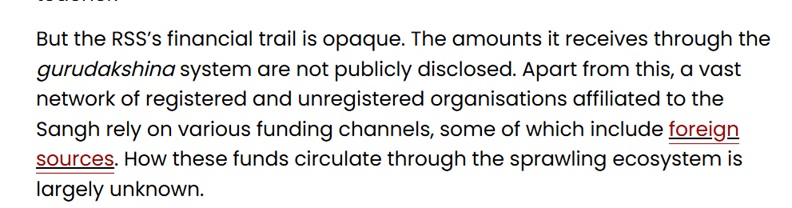
ONGC is a state-owned PSU. Its CSR spending is governed by the Companies Act, disclosed in annual reports, and subject to independent audit. Money for the Nagpur cancer institute went to a bank account for a specific, verified construction project – not into some ideological slush fund. TNM’s entire opacity narrative rests on the word “unknown” doing enormous work: how funds “circulate through the sprawling ecosystem is largely unknown,” it says, then spends four thousand words implying it knows anyway.
If the audit trail shows money reaching a hospital and building a hospital, the story is that the hospital got built. Everything else is inference dressed up as investigation.
The One Real Finding, Buried
Ironically, TNM’s report contains an actual scandal and undersells it: the CAG pulling up ONGC and other oil PSUs for funding the Statue of Unity, explicitly ruling it didn’t qualify as CSR spending because it wasn’t a “heritage asset.”

That’s a government auditor calling out a specific, documented misuse of CSR funds. It’s the one part of this entire piece built on hard evidence rather than a research group’s affiliation map. TNM mentions it in passing and moves on, because it doesn’t fit the RSS-conspiracy frame nearly as well as a hospital chairman’s LinkedIn post about attending a shakha.
What TNM Is Actually Alleging
Read closely and the real claim isn’t financial impropriety – it’s that individuals with RSS backgrounds occupy trustee positions at institutions receiving public CSR funds, and that this constitutes the Sangh “raising funds through government sources.”

That is a claim about personnel, not about money laundering. It deserves to be reported as what it is: RSS-affiliated citizens running public-facing charitable institutions that qualify for, and receive, CSR funding like thousands of other trusts do. Dressing that up as “the Sangh’s financial trail” is the sleight of hand at the centre of this entire investigation.
Ultimate bad journalism is pretending that public welfare becomes illegitimate simply because you dislike the ideological leanings of the volunteers delivering it.
The latest attempt to sensationalize ONGC’s CSR allocations is a textbook example of shifting the goalposts. Let’s look at the facts instead of the headlines.
First of all, the basic premise itself is flawed –
The RSS is not a registered group. It does not have a bank account. It cannot receive money. The groups TNM talks about, Sewa Bharati, Ekal Vidyalaya and others are not the RSS. They are separate registered trusts. They have their own PAN cards, their own boards, their own audited accounts. They are legal bodies that can receive CSR money. TNM knows this. It just doesn’t want to say it.
Second, this is not secret funding. This is CSR spending under the Companies Act. ONGC is a government-owned company. It has to follow strict rules. Every project is approved in advance. Every rupee is tracked. Every year, the accounts are audited. If any money had been stolen or misused, the auditors would have caught it years ago. They have not. Because there is nothing to find.
Third, check what the money was exactly used for.
In Assam, it built a 300-bed hospital, it is a real hospital and not one on paper. It treats real patients. It is part of Ayushman Bharat. Tea garden workers, tribal families, poor villagers, they all get treated there. Other money goes to Ekal Vidyalaya, which runs schools in remote tribal areas. And to Sewa Bharati, which runs hostels for poor students, health centres, and disaster relief work.
These are real results. Children are going to school. Patients are getting treatment. Families in far-off villages are getting help that they never had before. TNM’s report does not say any of this is false. It just does not want to talk about it.
Why PSUs Partner With These Organisations
PSUs partner with organisations like Sewa Bharati and Ekal Vidyalaya because these groups have been working in rural and tribal areas for decades. They have local staff, existing infrastructure, and community trust. Government agencies and international donors have also worked with them on development projects.
All CSR spending by ONGC is governed by the Companies Act. Projects are approved, monitored, and audited. The funds are not given to the RSS, which has no bank account or legal status as a recipient. They are given to registered trusts with their own PAN numbers, governing boards, and audited accounts.
The organisations in question run hospitals, schools, and health centres. These facilities treat patients and educate children in areas where government services are limited.
Ultimate bad journalism is pretending that public welfare becomes illegitimate simply because you dislike the ideological leanings of the volunteers delivering it.
The latest attempt to sensationalize ONGC’s CSR allocations is a textbook example of shifting the goalposts. Let’s… https://t.co/anypBUHj9v
— Rashmi Samant (@RashmiDVS) July 19, 2026
The Bottom Line
TNM’s investigation is not an exposé. It is a hit job dressed in a spreadsheet. It takes legally compliant, independently audited, publicly beneficial CSR spending and twists it into a conspiracy theory because the word “Sangh” sells more clicks than “hospital.” It ignores the CAG’s actual finding of CSR misuse (the Statue of Unity) because that doesn’t fit the narrative. It inflates tenuous biographical links into institutional conspiracies. And it asks its readers to believe that hospitals treating the poor and schools educating tribal children are somehow a threat to the nation.
Subscribe to our channels on WhatsApp, Telegram, Instagram and YouTube to get the best stories of the day delivered to you personally.