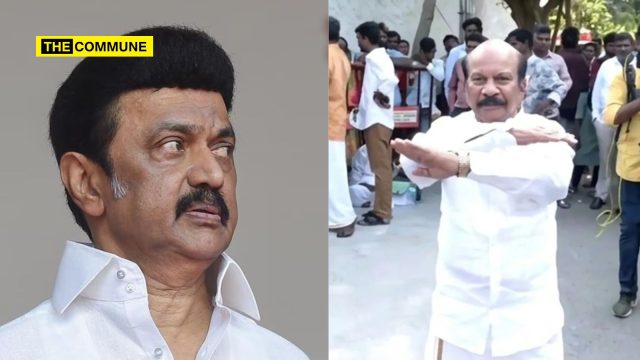
The Madras High Court on Thursday, September 3, dismissed as not maintainable a writ petition filed by DMK president MK Stalin seeking 100% counting of VVPAT slips in the Kolathur Assembly constituency and a declaration that he be elected by nullifying the victory of TVK MLA VS Babu, as reported in The Hindu.
A First Division Bench comprising Chief Justice Sushrut Arvind Dharmadhikari and Justice G. Arul Murugan, however, granted Stalin liberty to pursue other remedies available under law. This includes filing an election petition before the competent election tribunal and seeking condonation of the delay in filing it.
Stalin had approached the High Court seeking 100% counting of VVPAT slips after alleging anomalies in the verification of EVMs used in the constituency.
Court: Writ Petition Cannot Bypass Constitutional Bar
The Bench agreed with the submissions of senior counsel G. Rajagopalan and Dama Seshadri Naidu, appearing for the Election Commission of India (ECI), that a writ petition could not be entertained to circumvent the constitutional bar against challenging the election of a parliamentary or Assembly constituency except through an election petition.
The court noted that allowing such writ petitions could open a “pandora’s box”.
“There is substance in the apprehension. If every such anomaly, as pleaded in this writ petition, is made a basis for filing a writ petition seeking to unseat the returned candidate and to declare the runner-up elected, the statutory scheme of election petitions, hedged as it is with limitation, verified pleadings, security for costs and recrimination, would be rendered wholly illusory,” the Bench wrote.
Stalin Relied On EVM Verification
According to the court, Stalin sought 100% VVPAT counting based on alleged anomalies noticed by his representative, senior counsel NR Elango, during the checking and verification of the burnt memory/microcontroller in 5% of the EVMs used in the Kolathur constituency.
The verification covered 14 of the 286 EVMs used in the constituency and was carried out by engineers from the EVM manufacturers.
The Bench held that determining whether the alleged anomalies were genuine would require a detailed examination of technical evidence.
“An inquiry into such alleged anomalies could not be undertaken on the basis of affidavits filed before a writ court since it requires a full-fledged trial, including expert evidence on the technical functioning of the EVM and VVPAT units,” the court observed.
According to the Bench, such a trial could be conducted only before an election tribunal.
Delay In EVM Verification Raised By Stalin
During the hearing, senior counsel Kapil Sibal, appearing for Stalin, pointed out that the petitioner had applied for verification of 5% of the EVMs on May 7, 2026, within three days of the election results being declared on May 4.
However, the ECI commenced the verification process only on July 29 and completed it on August 5.
By then, the 45-day limitation period for filing an election petition had expired.
The High Court, however, held that the delay could not confer writ jurisdiction on the court in view of the constitutional bar under Article 329(b).
“This Court is not persuaded that this circumstance can enlarge the jurisdiction of this Court under Article 226 (writ jurisdiction) of the Constitution in the face of the express constitutional bar under Article 329(b)… Suffice it to observe that a difficulty of this kind, even where genuine, is not a ground on which the constitutional bar can be circumvented. It is, at best, a ground to be urged before the forum vested with jurisdiction to try the dispute.”
5% EVM Verification Not A Substitute For Election Petition
The Bench further observed that the 5% EVM verification mechanism introduced as an additional safeguard by the Supreme Court did not replace the existing legal remedy of an election petition.
“If any material was gathered during such verification, it would go to strengthen the evidentiary foundation of an election petition, rather than furnish an independent cause of action in writ jurisdiction,” the judges observed.
The court therefore held that any material arising from the EVM verification could be relied upon in an election petition rather than being used as the basis for a writ petition seeking to overturn the election result.
Stalin Given Liberty To Pursue Other Legal Remedies
While dismissing the writ petition, the Bench did not rule on whether Stalin could seek relief against the delay in filing an election petition.
The judges said that the issue would have to be considered by the election tribunal if Stalin chose to pursue that remedy.
“Whether, and to what extent, the delay occasioned by the verification process hinges on the computation of limitation under the provisions of the Representation of the People Act, 1951, and whether any relief in that regard is available to the petitioner, are matters that are to be examined by the Election Tribunal in the first instance, upon an election petition being presented, and this Court expresses no opinion on that question one way or the other.”
Senior counsel V. Raghavachari, assisted by advocate Pranjal Agarwal, appeared for TVK MLA V.S. Babu and opposed Stalin’s writ petition.
The High Court had earlier reserved its orders on Stalin’s plea seeking to be declared elected from Kolathur after the completion of arguments.
Subscribe to our channels on WhatsApp, Telegram, Instagram and YouTube to get the best stories of the day delivered to you personally.