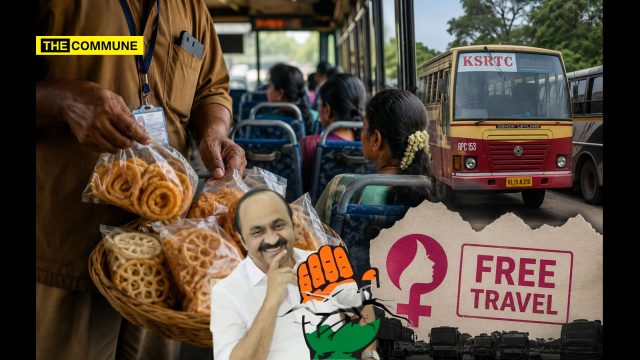
Private bus conductors across Kerala have begun selling snacks such as murukku, achappam and kuzhalappam to passengers in an attempt to supplement falling incomes, as the state’s private bus industry struggles with mounting financial losses following the implementation of the Priyadarshini free travel scheme for women and transgender persons. The practice, first reported from Pathanamthitta, has since spread to several districts, with operators describing it as a desperate measure to keep buses on the road, as reported in South First.
Bus employees have indicated that selling locally made snacks has become one of the few practical ways to generate additional income to meet operational expenses such as fuel costs. The initiative also follows Transport Minister CP John’s suggestion that private bus operators explore alternative sources of revenue, including advertising, instead of relying solely on ticket collections. Conductors have maintained that snack sales represent the only realistic alternative available to many operators.
Priyadarshini Scheme Alters Passenger Traffic
The Priyadarshini scheme, one of the UDF government’s flagship welfare initiatives under the Indira Guarantees, was launched on 15 June, allowing women and transgender persons to travel free on ordinary Kerala State Road Transport Corporation (KSRTC) buses. While the government has projected the scheme as a measure to improve women’s mobility and reduce household expenses, private bus operators contend that it has significantly eroded their passenger base.
Operators argue that women traditionally constituted the backbone of private bus ridership, particularly on short-distance and town routes. According to them, free travel on KSRTC buses has prompted a large-scale migration of passengers, with entire families increasingly opting for KSRTC services. Transport Department data also indicates that the passenger shift has been most significant on routes where private buses and KSRTC operate in parallel.
Mounting Losses Push Buses Off The Road
Private bus owners in Pathanamthitta have reported that daily collections have dropped to less than half of pre-scheme levels. Operators in Ernakulam estimate losses ranging from ₹2,000 to ₹5,000 per bus every day, while those in Kasaragod claim daily losses of around ₹3,000 per vehicle. Many operators say they are finding it increasingly difficult to meet even basic operating expenses, with several services now running at a loss.
The financial strain has already begun affecting services. Around 150 private bus owners have reportedly submitted G Forms seeking permission to suspend operations temporarily. In Ernakulam district alone, nearly 30 buses have already been taken off the road, while operators in other districts have warned that more services could be withdrawn unless the government introduces relief measures. Some owners have also expressed willingness to lease their buses to KSRTC if independent operations become commercially unviable.
Government Defends Welfare Scheme
The Kerala government has maintained that the Priyadarshini scheme has substantially improved women’s access to public transport. Female ridership on KSRTC buses has reportedly increased from around 10 lakh to nearly 15 lakh passengers daily, resulting in an additional expenditure of approximately ₹2.5 crore for the state transport corporation each day. However, the Transport Department has argued that the scheme transfers more than ₹7 crore in daily financial benefits directly to women by eliminating travel expenses and improving their disposable income and economic participation.
Transport Minister CP John has acknowledged in the Assembly that many private buses have experienced daily revenue losses ranging from ₹1,500 to ₹2,500 after the scheme’s implementation. He has stated that the government has taken the concerns seriously and will examine appropriate corrective measures while reiterating that private bus operators remain an important component of Kerala’s public transport network.
Tax Relief Fails To Convince Operators
The state government has announced a 50 per cent reduction in quarterly motor vehicle tax for private buses in an effort to ease the burden on operators. However, bus associations have rejected the concession as inadequate, pointing out that the annual savings amount to roughly ₹50,000 per bus, or about ₹130 a day, which they say offsets only a fraction of the losses caused by declining passenger numbers. They continue to demand meaningful compensation, route rationalisation and policy changes on routes where KSRTC and private buses compete directly.
Operators Intensify Protest
The growing financial crisis has prompted transport associations to step up their agitation. A joint meeting of private bus operators, auto-taxi unions and tourist vehicle associations in Thiruvananthapuram resolved to convene a larger convention to finalise plans for a statewide motor strike. Separately, the Bus Operators Federation Central Committee has announced a six-day relay dharna in front of the Secretariat from 20 to 25 July to press for government intervention.
The associations have maintained that their protest is not directed against free travel for women but against the absence of measures to protect the viability of the private bus sector, which continues to provide a substantial share of Kerala’s public transport services.
Government Orders Review
Amid mounting pressure, the Kerala government has initiated a review of the Priyadarshini scheme’s impact on private bus operations. The Transport Minister has announced a comprehensive mapping of routes where KSRTC and private buses operate simultaneously to identify corridors where operators have been adversely affected. He has indicated that the impact of the scheme is not uniform across the state and is largely confined to overlapping routes.
The government has also decided to constitute an expert committee to study the broader implications of the scheme on Kerala’s public transport network. The panel will analyse passenger movement, operational data and the financial condition of private operators before recommending policy measures. In addition, the government has scheduled discussions with representatives of private bus owners on 13 July to consider their demands. Chief Minister VD Satheesan has assured that the government recognises the role of private buses in Kerala’s transport system and is conscious of the challenges being faced by operators and employees while evaluating the way forward.
Subscribe to our channels on WhatsApp, Telegram, Instagram and YouTube to get the best stories of the day delivered to you personally.