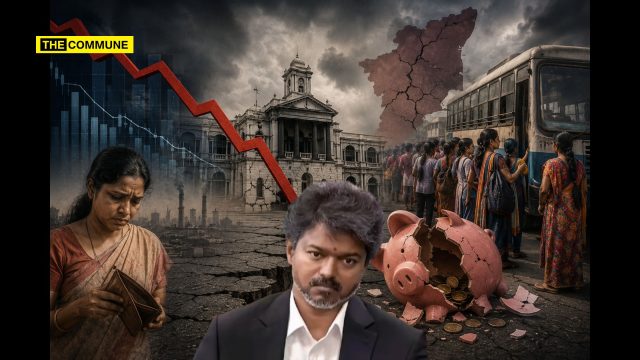
TVK Finance Minister N. Marie Wilson has indicated that the state government may face difficulties in introducing major new welfare schemes unless additional sources of revenue are identified, citing the challenging fiscal position outlined in the TVK government’s recently released White Paper on state finances, as reported in The Print.
Speaking after the release of the White Paper on Tuesday, 16 June 2026, Wilson said existing welfare programmes would not be discontinued but acknowledged that launching new schemes would be difficult without strengthening the state’s revenue base.
The remarks come amid public expectations surrounding several key promises made by the Tamilaga Vettri Kazhagam (TVK) ahead of the 2026 Assembly elections, including the proposed monthly assistance of ₹2,500 for women and the extension of free bus travel for women across all categories of government buses.
ஏமாற்றமளிக்கும் அறிவிப்பு#DisappointingAnnouncement | #Minister | #MarieWilson | #Newsupdate | #TamilJanam pic.twitter.com/nwUX9kqagh
— Tamil Janam (@TamilJanamNews) June 16, 2026
According to the White Paper, Tamil Nadu’s fiscal position deteriorated significantly during the five-year period between 2021-22 and 2025-26. The document stated that the state’s outstanding liabilities nearly doubled from ₹5.13 lakh crore to around ₹10 lakh crore, while per-capita debt increased from ₹77,819 to ₹1,28,934.
The report also noted that the revenue deficit rose to a record ₹78,324 crore in 2025-26, while the fiscal deficit touched ₹1.33 lakh crore, equivalent to 3.77 per cent of Gross State Domestic Product (GSDP). State Own Tax Revenue as a share of GSDP reportedly fell from 5.93 per cent in 2021-22 to 5.45 per cent in 2025-26, which the White Paper described as the lowest level in the state’s history.
Interest payments on debt increased from ₹41,564 crore to ₹67,050 crore during the same period, with more than one-third of the state’s own tax revenue now being used to service existing debt obligations. The White Paper further stated that interest payments had exceeded capital expenditure for the first time, indicating that more resources were being spent on servicing past borrowings than on creating future assets.
The document projected that, under current trends, Tamil Nadu’s financial situation could remain under pressure in both the short and medium term. It nevertheless argued that improvements could be achieved through stronger revenue mobilisation, plugging tax leakages, reducing corruption, rationalising expenditure, reforming public sector undertakings and improving governance.
The White Paper makes clear that the government’s ability to introduce new large-scale welfare schemes will depend heavily on its success in increasing revenue collections and improving the state’s fiscal position in the coming years.
Subscribe to our channels on WhatsApp, Telegram, Instagram and YouTube to get the best stories of the day delivered to you personally.