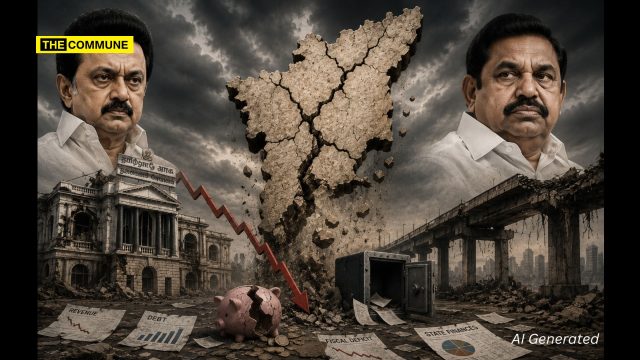
The Tamil Nadu government on Tuesday released a White Paper on the State’s fiscal management, claiming that Tamil Nadu’s “own-tax effort has collapsed” and warning of a sustained decline in revenue mobilisation despite the State’s economic potential, as reported in The Hindu.
The White Paper, presented by Finance Minister N. Marie Wilson examined the performance of Tamil Nadu’s State Own Tax Revenue (SOTR) over the last five years and compared it with that of three peer States – Maharashtra, Gujarat and Karnataka. The document stated that SOTR was the largest component of revenue directly under the State government’s control and served as the most reliable indicator of fiscal effort.
According to the report, Tamil Nadu’s own-tax revenue is derived from five principal sources: commercial taxes under the Goods and Services Tax (GST) regime, Value Added Tax (VAT) on petroleum products, State Excise and VAT on liquor, Stamps and Registration, Motor Vehicle Tax and other taxes. Within commercial taxes, GST accounted for approximately 53% of collections, VAT on liquor contributed 28%, while VAT on petroleum products made up 19%.
The White Paper stated that commercial tax revenue as a proportion of Gross State Domestic Product (GSDP) had declined from around 4.53% in 2021-22 to approximately 3.89% in 2025-26. It noted that a similar decline had not been witnessed in any of the benchmarked States.
The report further stated that Total Revenue Receipts (TRR) had fallen from around 10% of GSDP in 2021-22, which marked the beginning of the post-COVID recovery period, to 8.32% in 2025-26. During the same period, the State Own Tax Revenue-to-GSDP ratio reportedly declined from 5.93% to 5.45%, which the White Paper described as the lowest level in Tamil Nadu’s history and the steepest decline among the peer States examined.
The document noted that Tamil Nadu’s SOTR-to-GSDP ratio had reached a peak of 8.94% in 2006-07. It estimated that the cumulative decline from that historical peak translated into approximately ₹1.23 lakh crore in annual revenue foregone, an amount equivalent to nearly 90% of the State’s provisional fiscal deficit for 2025-26.
The White Paper stated that the decline was visible across all major tax heads, including GST, VAT on petroleum products, State Excise, Stamp Duty and Motor Vehicle Tax. It argued that a significant portion of the decline could be attributed to leakages and systemic corruption within revenue-collecting departments rather than structural economic disadvantages.
Comparing Tamil Nadu’s performance with other major States, the report stated that Maharashtra’s SOTR-to-GSDP ratio had increased by one percentage point between 2021-22 and 2025-26, while Gujarat and Karnataka had largely maintained their ratios. Tamil Nadu, however, was the only State among the peer group to record a decline during the same period, falling from 5.93% to 5.45%.
The White Paper also highlighted the growing burden of debt servicing. It stated that the ratio of interest payments as a share of State Own Tax Revenue had increased from 33.83% in 2021-22 to 34.83% in 2025-26 on a provisional basis. As a result, more than one-third of every rupee raised through the State’s own taxation efforts was being used to service past debt obligations, the report noted.
The government document also identified mining revenue as one of the most striking examples of stagnation in Tamil Nadu’s non-tax income. While mining revenue increased from ₹1,942 crore in 2024-25 to ₹4,433 crore in 2025-26 following the introduction of the Mineral Bearing Land Tax, the report stated that collections had remained broadly flat throughout the post-COVID period.
According to the White Paper, mining revenue accounted for only around 1.5% of total revenue receipts despite Tamil Nadu possessing substantial reserves of granite, limestone, sand, quartz, vermiculite and several other minor minerals. Royalties, rents and seigniorage fees on minor minerals constituted the major components of mining revenue.
The report argued that the current level of mining revenue did not reflect the State’s actual resource potential and asserted that collections could be significantly higher. It attributed the shortfall to several factors, including the failure to periodically revise fees, leakages in the assessment of minor mineral extraction, delays in processing applications for extraneous reasons, inadequate enforcement against illegal mining activities and the slow modernisation of departmental systems.
The White Paper forms part of the TVK government’s broader assessment of Tamil Nadu’s fiscal position and identifies revenue mobilisation, tax administration and mining sector reforms as key areas requiring corrective action.
Subscribe to our channels on WhatsApp, Telegram, Instagram and YouTube to get the best stories of the day delivered to you personally.