A few days ago, DMK-linked drug case accused Dravidianist director Ameer Sultan made a remark.
Speaking to reporters, he said, “If Brahmins have been given two ministerial positions after 40 years, I do not think that alone should be viewed with suspicion. They too are part of this society. There is nothing wrong in giving them two minister posts. But my question is this: if Muslims constitute 13% of the population, why were they given only one ministerial position? I think that is a fair question to raise. At the same time, if the Hindu Religious and Charitable Endowments Department had been given to a Dalit minister, it would have been an even greater example of social justice for not just Tamil Nadu, but the whole of India. That is my wish and my opinion.”
At first glance, one can dismiss this as just another political comment about representation. But look a little bit more closely at what he is actually saying.
The logic is simple: count the population of a community, then decide how many ministerial posts that community should get. In other words, politics should work like community-wise seat distribution.
And that is exactly the problem.
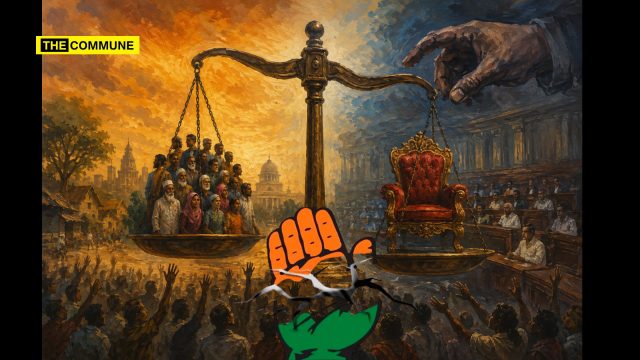
Because once politics starts functioning like a population calculator, everything else slowly becomes secondary – merit, governance, capability, performance, even electoral mandate. The conversation stops being “Who can govern well?” and becomes “How many posts belong to which community?”
This is not some new political thinking suddenly invented by Ameer Sultan. This language has been normalised for years.
Congress has repeatedly pushed this kind of population-based entitlement politics. Rahul Gandhi has openly argued that power structures should reflect population proportions and has repeatedly linked caste census data to redistribution of power and resources – In August 2024, he said 90% of the country was outside the system and tied policy to caste census.
His slogan, “jitni aabadi, utna haq,” may sound catchy during elections, but its core message is straightforward: larger population should mean larger political share.
Before Rahul Gandhi, Manmohan Singh too made a controversial statement in 2006 saying minorities, especially Muslims, should have the “first claim” on resources. That line created massive political debate at the time, but it also revealed something deeper – the growing tendency to see communities as separate political claimants competing for shares of state power.
Now that same style of politics is becoming common everywhere.
That is why Ameer Sultan’s remark matters.
Forget for a moment whether Muslims are actually 13% in Tamil Nadu or not. Even that figure itself is questionable. According to the 2011 Census, Muslims make up around 5.86% of Tamil Nadu’s population, not 13%. Christians are around 6.12%.
But the bigger issue is not the number. The bigger issue is the thinking behind the statement.
A minister’s job is not to represent a religion inside the cabinet like some kind of ambassador. Ministers are supposed to govern the entire state. But identity politics increasingly treats cabinet formation like a community quota chart where every caste and religion must negotiate its numerical share.
And once that mindset becomes normal, where does it stop?
Tomorrow one group will ask for ministries based on population. Another will ask for IAS posts. Another will ask for judiciary representation. Another will ask for police positions. Politics then becomes a permanent competition between communities over “our share” and “their share.”
That is not healthy democracy. That is communal bargaining.
And this trend is no longer limited to fringe voices. Earlier this year, in February 2026, Muslim organisations in Tamil Nadu openly urged parties to field more Muslim candidates in elections by arguing that their population share was higher than their assembly representation. Again, the same argument: population should directly translate into political share.
This is how identity arithmetic slowly becomes mainstream.
There is obviously nothing wrong with any community participating in politics or holding office. That is normal in a democracy. But there is a huge difference between equal opportunity and demographic entitlement.
One says every citizen deserves equal rights. The other says every community deserves a fixed slice of power based on numbers.
Those are not the same thing.
And once governments start thinking entirely in terms of caste percentages, religious percentages and community calculations, politics stops uniting society and starts slicing it into voting blocs constantly negotiating for shares. That is the danger in remarks like Ameer Sultan’s.
Not because one filmmaker made one statement. But because this kind of thinking is becoming increasingly acceptable in mainstream political discourse.
And once identity arithmetic becomes the centre of politics, governance eventually becomes secondary. Everything becomes about balancing communities, appeasing blocs and maintaining vote banks.
That may help politicians during elections. But it slowly weakens the idea of equal citizenship itself.
Subscribe to our channels on WhatsApp, Telegram, Instagram and YouTube to get the best stories of the day delivered to you personally.