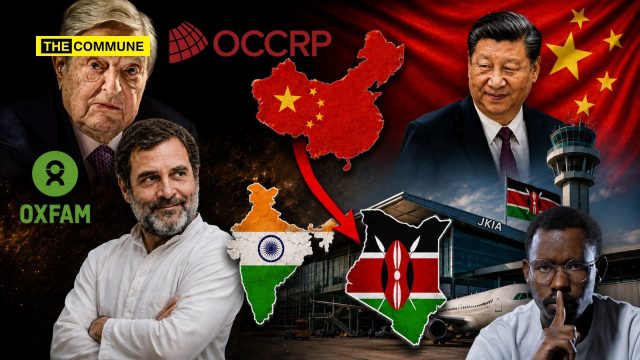
The Kenyan government’s decision to award a $2.9 billion contract for the expansion of Nairobi’s Jomo Kenyatta International Airport (JKIA) to a Chinese state-owned enterprise has reignited debate over the cancellation of an earlier proposal by India’s Adani Group and the role played by political and activist campaigns that targeted the Indian conglomerate, as reported in OpIndia.
According to reports, Kenya has selected China Communications Construction Co. (CCCC), a Chinese state-owned infrastructure giant, to undertake a major overhaul of the country’s busiest airport. The engineering, procurement and construction (EPC) contract includes terminal expansion, construction of a new 4.5-kilometre runway and upgrades aimed at increasing annual passenger handling capacity to 12 million by 2045.
The development comes less than two years after Kenya scrapped a proposed $2 billion public-private partnership (PPP) agreement with Adani Group for the modernisation and long-term operation of the same airport. The new Chinese-backed project carries a price tag approximately 50% higher than the cancelled Adani proposal, raising questions about the financial implications for Kenyan taxpayers.
The original contract with Adani was $1.8 billion to upgrade JKIA.
But now they will pay $2.9 billion to a Chinese firm, and all activist groups will disappear.
Why @amenya_nelson is silent now? pic.twitter.com/zs8NuCwwfT
— Office Of Vijay Patel (@VijayGajeraO) June 11, 2026
Adani’s PPP Proposal And Its Collapse
Between 2022 and 2024, Adani Group was engaged in discussions with the Kenyan government to modernise JKIA through a PPP model. Under the proposal, the Indian company would have financed and operated major airport upgrades, including terminal modernisation and runway improvements, with limited immediate fiscal burden on the Kenyan government.
The project was seen as a significant opportunity for an Indian private-sector infrastructure company to establish a strategic presence in East Africa.
However, the proposal became increasingly controversial within Kenya.
A campaign against the project gained momentum through social media and activist networks, most notably led by France-based Kenyan whistleblower and influencer Nelson Amenya. Amenya published documents and raised allegations regarding the procurement process, claiming that the airport concession lacked transparency and adequate stakeholder consultation.
Among the concerns raised were allegations that the project had bypassed public tender procedures, ignored consultation requirements under Kenyan law, granted favourable tax concessions to the concessionaire and could eventually lead to increased airport charges for passengers.
The Kenya Aviation Workers Union also emerged as a vocal opponent of the proposal, organising protests and threatening industrial action over concerns related to job security and the privatisation of a strategic national asset.
Amid mounting public pressure, Kenyan President William Ruto eventually cancelled the procurement process in November 2024. The decision was also linked to allegations facing Adani Group in the United States at the time, although the company consistently denied wrongdoing and maintained that those allegations were unrelated to the Kenya airport project.
Who Is Nelson Amenya?
Nelson Amenya is a Kenyan activist, whistleblower, and MBA graduate who rose to prominence in 2024 by leaking and publicising internal documents about the Adani-JKIA deal. While studying in France, he became the face of the campaign against the Indian proposal, framing it as lacking transparency and harmful to Kenyan interests.
Amenya previously participated in a China-funded Africa Technology Challenge sponsored by AVIC International (a Chinese company) in 2015. He received a scholarship and briefly studied at Beihang University in Beijing, gaining exposure to Chinese business and technical training programs.

He later pursued and completed an MBA at HEC Paris (graduating in 2025 as valedictorian). HEC Paris is a founding member of CEMS (Global Alliance in Management Education). CEMS counts Transparency International among its official Social Partners and receives funding/support from it. Transparency International, in turn, has received funding from Open Society Foundations (George Soros’ primary philanthropic vehicle).
Congress Amplified The Anti-Adani Narrative
The controversy was not confined to Kenya.
India’s Congress party repeatedly highlighted the JKIA issue and amplified criticism of the Adani proposal during the period when opposition to the project was gathering momentum.
On 3 September 2024, Congress leader Jairam Ramesh referenced the Kenyan protests in a post on X, warning that public anger surrounding the airport project could evolve into resentment towards India itself.
The Adani Group’s proposed takeover of the airport in Nairobi, Kenya, has led to widespread protests in the country, with the Kenya Aviation Workers Union calling for a strike to demonstrate its opposition. This is a matter of grave concern for India, because the non-biological…
— Jairam Ramesh (@Jairam_Ramesh) September 3, 2024
Ramesh linked the issue to Prime Minister Narendra Modi’s relationship with Adani Group chairman Gautam Adani and compared the Kenyan controversy to debates surrounding Adani-linked projects in Sri Lanka and Bangladesh. He argued that India’s foreign policy and international standing should not become intertwined with the interests of a single corporate group.
After Kenya formally terminated the process, Congress leaders described the outcome as predictable and reiterated their criticism of what they characterised as the government’s close association with the Adani Group.
Adani had reportedly outcompeted several Chinese firms for the airport project and sustained attacks on the company ultimately weakened India’s position while benefiting Chinese interests.
The controversy also witnessed the circulation of a fabricated press release falsely attributed to Adani Group. The fake statement purportedly threatened to expose alleged recipients of bribes in Kenya and was widely circulated on social media.
Adani Group categorically rejected the document, describing it as fraudulent and confirming that no such statement had ever been issued by the company.
How Soros-Funded Anti-Adani OCCRP Added Fuel To The Fire
The Organized Crime and Corruption Reporting Project (OCCRP), a global investigative journalism network heavily funded by George Soros’ Open Society Foundations (along with other Western donors), played a significant role in internationalising and amplifying the campaign against the Adani proposal.
In July 2024, shortly after Nelson Amenya leaked the documents, OCCRP published detailed exposés based on the same internal files. Their reports highlighted alleged lack of transparency, the privately-initiated proposal route, and criticised the Kenyan government for bypassing open tenders. These stories were widely picked up by international media and lent institutional credibility to the local protests.OCCRP’s coverage coincided with the peak of airport worker strikes and civil society pressure, further intensifying scrutiny on the deal. OCCRP’s consistent pattern of targeting Adani Group projects (in India and abroad) reflects the influence of its funding sources, including Soros-linked organisations.
This external amplification turned a Kenyan procurement controversy into a global narrative that ultimately contributed to the cancellation of the Indian proposal — paving the way for the more expensive Chinese contract.
China Steps In With A More Expensive Proposal
With the Adani proposal abandoned, the Kenyan government has now moved ahead with a Chinese alternative.
Unlike the earlier PPP arrangement, the CCCC project is structured as a state-funded EPC contract, meaning the Kenyan government will directly bear the cost of implementation.
The shift from a privately financed concession model to a government-funded project has triggered debate in Kenya regarding value for money, public debt obligations and transparency in infrastructure procurement.
While CCCC has been involved in several major infrastructure projects across Africa, including Kenya’s Standard Gauge Railway, critics have questioned why a project that was previously expected to cost around $2 billion is now projected to cost $2.9 billion.
The issue has fuelled discussion over whether concerns about sovereignty and foreign concessions have ultimately resulted in Kenyan taxpayers carrying a significantly larger financial burden.
The Oxfam Thread
The Oxfam connection runs through India. India’s Income Tax Department and CBI found that Oxfam India. whose FCRA licence was cancelled by the Indian government in 2022, allegedly used foreign funds and coordinated with partner NGOs to stall Adani Group’s coal and infrastructure projects in India.
Meanwhile, Oxfam International had relocated its global secretariat to Nairobi, Kenya, giving it deep roots in Kenyan civil society. As mentioned above, in Kenya, a France-based Kenyan student named Nelson Amenya led the whistleblower campaign against the Adani airport deal, framing it as opaque and against public interest – a campaign that found fertile ground in Kenya’s NGO-heavy civil society ecosystem.
By the way, the MOU partner of the China and Indian leftist cartel has also played their role! https://t.co/hDLTVrX6Av pic.twitter.com/Zqtz5hwzxw
— Office Of Vijay Patel (@VijayGajeraO) June 11, 2026
Who Really Won?
The US DoJ dropped the Adani bribery case later, citing lack of conclusive evidence, meaning the very charge that triggered the cancellation was ultimately unproven. China, which already controls Kenya’s railway, stadium, toll road, and convention centre through Belt and Road investments, now adds the country’s main international airport to its portfolio. The pattern – NGO pressure in India, civil society mobilisation in Kenya, a timely US indictment, and a sudden Chinese beneficiary has fuelled a sharp political debate in India about whether coordinated international pressure effectively cleared the field for Beijing, costing Kenya more money and India significant strategic influence in East Africa.
Subscribe to our channels on WhatsApp, Telegram, Instagram and YouTube to get the best stories of the day delivered to you personally.