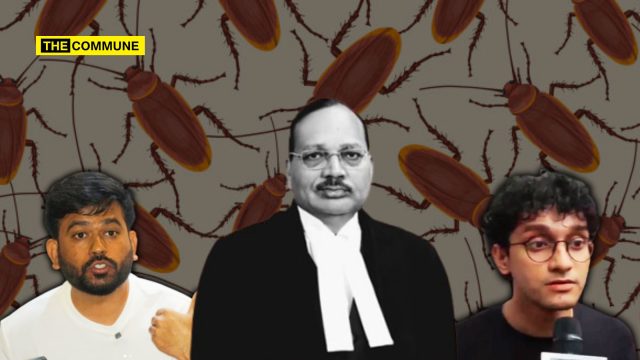
In one of the most ironic political developments of the year, the very movement born out of a claim that Chief Justice of India (CJI) Surya Kant had branded unemployed youth as “cockroaches” has now approached the Supreme Court seeking protection – with the same CJI stepping in to grant interim relief.
The sequence of events traces back to a controversy that began in May 2026 and eventually snowballed into nationwide protests, the formation of the Cockroach Janta Party (CJP), the resignation of the Union Education Minister, and finally a plea before the Supreme Court itself.
The Remark That Sparked A Movement
The controversy originated during a Supreme Court hearing on 15 May 2026, concerning fake law degrees and frivolous litigation.
During the hearing, CJI Surya Kant orally observed that certain individuals exploiting the judicial system were behaving like “parasites” and “cockroaches.” However, sections of the media and social media users widely circulated the remark as though the Chief Justice had referred to India’s unemployed youth as “cockroaches.”
The interpretation spread rapidly online, fuelling public outrage despite the observation having been made in the context of fake degree holders and abuse of the legal system.
Capitalising on the viral controversy, activist Abhijeet Dipke launched the satirical Cockroach Janta Party (CJP), adopting the very label that many believed had been used against unemployed youth.
From Satire To A Nationwide Protest
What began as internet satire soon evolved into one of the country’s largest youth-led protest movements.
The CJP mobilised students and unemployed youth across the country, demanding sweeping reforms to India’s education and examination systems. Demonstrations at Delhi’s Jantar Mantar gradually expanded into a massive “Sansad Chalo” march towards Parliament.
The agitation eventually gathered enough political momentum to culminate in the resignation of Union Education Minister Dharmendra Pradhan.
CJI Clarified His Words Were Misquoted
As the controversy intensified, CJI Surya Kant publicly clarified that his remarks had been taken completely out of context.
In interactions with Bar & Bench, the Chief Justice stated that his observations were directed exclusively at individuals practising law with fake degrees and those undermining the judicial process – not unemployed youth or student protesters.
He also reportedly called for greater responsibility in the reporting of oral courtroom observations to prevent similar controversies.
Despite the clarification, the “cockroach” narrative had already become the defining slogan of the protest movement.
Full Circle: ‘Cockroaches’ Seek Relief From The Same CJI
The irony reached its peak on 28 July 2026.
Following violent clashes between protesters and Delhi Police during the CJP’s march to Parliament, the organisation approached the Supreme Court alleging police excesses, illegal detention of students, baton charges, and use of excessive force.
The petition came before a Bench headed by none other than CJI Surya Kant – the very judge whom the movement had accused of insulting unemployed youth months earlier.
Chief Justice of India, all our Honourable Judges – our children are being brutalised on the streets by the very state who should protect them. Take cognisance, please. History will not forget how an entire generation was treated like cockroaches .
— Mahua Moitra (@MahuaMoitra) July 20, 2026
Far from dismissing the plea, the Bench extended significant interim protection to the protesters.
The Supreme Court ordered the immediate release of detained minor students, directed police not to take coercive action against peaceful student protesters, and instructed authorities to preserve CCTV footage, drone recordings, and body-camera evidence while considering the appointment of an independent Special Investigation Team (SIT) to examine allegations of police excesses.
A Political Narrative Built On A Disputed Interpretation
The episode underscores the unusual trajectory of the CJP movement.
It was born from a widely circulated interpretation of an oral courtroom remark that the Chief Justice later said had been completely misrepresented. Yet that interpretation became the foundation of a nationwide political campaign, eventually forcing a Cabinet minister’s resignation.
Months later, when protesters claimed their own constitutional rights had been violated, they turned to the very institution and the very Chief Justice, they had earlier portrayed as the source of their grievance.
The same Supreme Court that the movement accused of triggering the controversy ultimately became the institution that intervened to safeguard the protesters’ rights, bringing the episode full circle.
Subscribe to our channels on WhatsApp, Telegram, Instagram and YouTube to get the best stories of the day delivered to you personally.