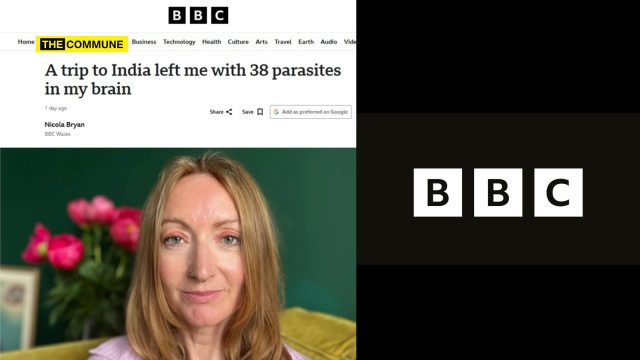
A Welsh woman Lowri Denman suffers an exceptionally rare illness after travelling abroad in the late 2000s. She survives. She rebuilds her life. She returns to work. The medical episode ends years ago. Then, in 2026, the far-left British propaganda media BBC suddenly decides this forgotten story deserves front-page attention – not because of a new scientific discovery, not because of a fresh outbreak, not because the World Health Organization has issued a warning, but because it can be packaged under one irresistible headline: “A trip to India left me with 38 parasites in my brain.”
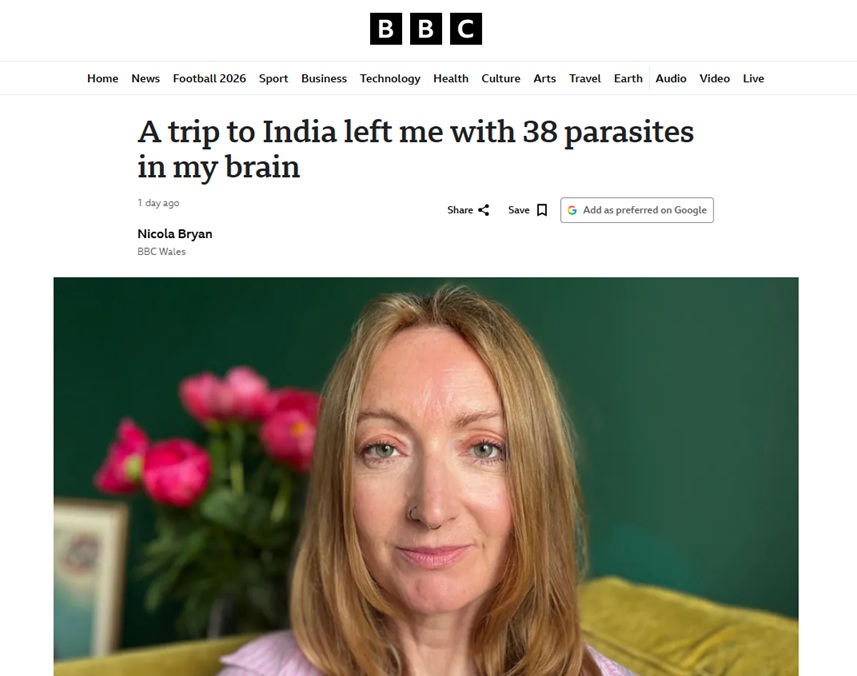
BBC does not mention “a rare parasitic infection” or “how one tapeworm changed a life” in the title. It was – India. Front and centre. The subject of the sentence. The nation itself, apparently, is what did this to her.
So, here’s what the report says. Lowri Denman travelled to India in 2007. She avoided meat specifically to protect her health. Her doctor’s own account is that she “inadvertently” – his word – ate pork containing tapeworm eggs. That is not an indictment of a country. That is the story of someone doing everything right and still encountering bad luck, the same bad luck that exists in every country on earth where pork is farmed, sold, and eaten without perfect biosecurity, including the United Kingdom itself.
The tapeworm surfaced in 2010. The seizures began in 2011. The diagnosis came later still. By the BBC’s own reporting, doctors aren’t even certain when or where the infection was picked up — India is presented as where her doctor “believes” it happened, which is a hypothesis, not a finding. And the piece itself calls the condition exceptionally rare in the UK, occurring almost exclusively in people who’ve migrated from regions where it’s endemic. That’s a fact about global disease patterns, not a scandal. It’s also a fact conveniently placed several paragraphs down, well after the headline has already done its work.
So why run this now? Why dust off an eighteen-year-old holiday and turn it into a horror story with a country’s name as the villain? There’s no new medical breakthrough here, no fresh outbreak, no public health warning. It’s one woman’s personal, sympathetic, genuinely difficult health journey – turned into content by attaching the word “India” to the top of it, because that’s what gets clicks and confirms a narrative BBC’s audience has been fed for decades: India as dirty, dangerous, a place you return from damaged.
If the same illness had been traced to undercooked pork eaten in rural France or a farmers’ market in Ohio, does anyone believe the headline would have named the country? Or would it have quietly said “abroad,” or not mentioned geography at all, and let the human story speak for itself? But that will not fit into their agenda. This is how BBC has been building an anti-India narrative over the decades.
Not The First Time
Here are some of the propaganda articles BBC has made over the years.
BBC Downplays Anti-Hindu Violence In Bangladesh
In 2024, the BBC downplayed the targeted violence against Hindus in Bangladesh by focusing on debunking selected social media posts instead of addressing the scale of the attacks. BBC framed much of the violence as politically driven and highlighted claims that Awami League supporters were the primary targets. This narrative sidelined the religious dimension of the attacks, despite widespread reports of Hindu temples, businesses and homes being targeted. The report also drew criticism for concentrating on Indian “far-right” influencers for ‘spreading fake news’ while giving comparatively less attention to the persecution faced by Bangladesh’s Hindu minority.
Glorifies Western Nudity While Mocking Hindu Sadhus
In January 2025, the BBC resorted to contrasting treatment of nudity in different cultural contexts. Its initial headline on the Maha Kumbh Mela foregrounded “naked” Hindu ascetics and described the event as a “bathing spectacle,” reducing a centuries-old spiritual tradition to an exotic curiosity before later revising the headline following backlash. By contrast, its coverage of Western Pride events has generally framed public nudity within the language of rights, identity and inclusion rather than sensationalism. This reflected a clear double standard: sacred nudity rooted in Hindu renunciation is exoticized and trivialized, while comparable nudity in Western contexts is treated with dignity and cultural sensitivity.
BBC’s Reporting Repeatedly Smeared India’s Sovereignty
The BBC has been long accused of framing issues central to India’s sovereignty through a selective and adversarial lens. Its reporting on the Citizenship (Amendment) Act, the abrogation of Article 370, the Delhi riots, Khalistan, and Kashmir has been criticised for amplifying narratives hostile to the Indian government’s position while giving comparatively less weight to official explanations, judicial findings, and security concerns. BBC also published questionable documentaries and carried out biased election coverage that sought to influence international perceptions of India’s democratic institutions.
BBC Amplified Congress’ Fake Electoral Narrative
In September 2025, the BBC’s report on alleged voter list irregularities in Karnataka’s Aland constituency was swiftly used by the Congress party to reinforce its claims of “vote theft” and question the credibility of India’s electoral process. By highlighting the allegations before any conclusive institutional findings, the broadcaster lent international visibility to a politically contested narrative. The report was subsequently cited as independent validation of charges against the Election Commission of India.
BBC Hindi Tried To Push Lies On India’s Oil Security
BBC Hindi published a report highlighting only India’s five-day Strategic Petroleum Reserve while omitting the country’s much larger overall petroleum buffer comprising strategic reserves, refinery stocks, crude in transit and inventories. Presenting the emergency reserve in isolation created a misleading impression of India’s energy security during heightened geopolitical tensions. The Press Information Bureau subsequently labelled the claim misleading, stating that India had around 60 days of available stock against a total buffer capacity of about 74 days. The report was later deleted, but only after the claim had circulated widely across social media.
BBC Tried To Instigate Youth Unrest In India
The BBC framed the absence of large-scale youth protests in India as a puzzle rather than examining alternative forms of civic participation. In the process, it tried to instigate protests and GenZ uprising in India by comparing India’s Gen Z with protest movements in neighbouring countries. The report implied that street agitation is the primary measure of democratic engagement. It downplayed entrepreneurship, electoral participation, education and innovation among Indian youth while giving disproportionate emphasis to narratives of fear, dissent and political unrest. The article also overlooked the violence associated with some past protests while portraying public mobilisation as the preferred expression of youth activism.
A Pattern, Not A Coincidence
The question is no longer whether the BBC occasionally gets India wrong. The question is why it has been so consistently pointing in the same direction. Across politics, religion, national security, elections, energy, and culture, India is repeatedly framed through suspicion, conflict, and crisis, while context, nuance, and contrary facts are either missing or minimal. One report may be dismissed as an oversight. Two may be coincidence. But when similar patterns recur over years, they create suspicion and scrutiny. The BBC calls itself an impartial public broadcaster; its coverage of India increasingly reflects a persistent bias.
Subscribe to our channels on WhatsApp, Telegram, Instagram and YouTube to get the best stories of the day delivered to you personally.