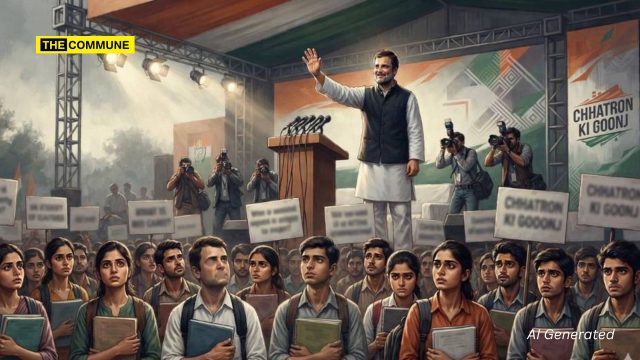
The Indian National Congress has launched “Chhatron Ki Goonj” as a campaign in non-congress ruled states around paper leaks, examination irregularities, rising education costs, unemployment and the larger problems confronting students. Congress boasts it as a movement for students and has called for an overhaul of the Indian education system. The party announced a campaign across multiple cities in non-Congress ruled states and has placed Rahul Gandhi as the poster boy for this PR exercise.
That fact alone exposes the basic character of this campaign. When a supposedly student-led movement is formally led and politically projected around the Leader of Opposition, it is nothing but a political PR exercise to re-launch Mr. Rahul Gandhi’s political image among Indian.
For NSUI, the student wing of the Congress, this campaign is just a sub-contract to act as an event manager. Its organisational purpose is not to raise student grievances, but to promote the political image of Rahul Gandhi. Congress has already used many such youth campaigns and Rahul Gandhi’s public re-appearances to build a good political career for him.
The question is simple, why Congress is hiding behind Students to make Rahul Gandhi’s political career better?
Students or Political Foot Soldiers?
Students should never become political foot soldiers for any individual or political leader. Yet the branding of “Chhatron Ki Goonj” repeatedly places Rahul Gandhi at the centre. The Congress website itself describes the movement as being led by him, while Congress’s official communications continue to highlight his appearances at its programmes.
The campaign is less an independent student mobilisation and more like a political public-relations exercise. Even NSUI cannot attempt to give this campaign the language of student empowerment. The political destination remains Congress politics. The ultimate ambition of any Congress youth mobilisation is naturally to strengthen Congress and the political image of Rahul Gandhi. From a common man’s perspective, this matters greatly.
ABVP believes that students are not merely future voters for one political party. They are today’s citizens and nation-builders. That is the fundamental difference between NSUI & ABVP.
Selective Outrage Is Not Student Activism
Congress wants students across India to believe that every education problem originates from the Central government. But a genuine student’s movement cannot operate with selective political outrage and accountability.
Congress governs Karnataka and Telangana and has political alliances with parties ruling other important states like Jharkhand.
Yet where is the equivalent “Chhatron Ki Goonj” when students face problems under those governments?
In Karnataka, students and job aspirants have protested over government vacancies and delays in recruitment under the Congress government.
Telangana too has faced continuing concerns regarding vacancies and problems in the education system. In the Congress ruled Telangana, the state government owes an estimate of Rs.12,000 crore to Rs.15,000 crore in pending fee reimbursement dues. But still the Rahul Gandhi is demanding national accountability while avoiding the same on governments where Congress itself in power.
In Jharkhand, students have staged massive protests demanding the immediate rollout of a transparent, corruption-free state job calendar to fill lakhs of vacant government posts. They are also demanding a complete overhaul of the state selection commission (JSSC) following repeated paper leaks and cancellation of major exams like the JSSC-CGL.
A movement that becomes loud only when the people’s welfare comes over party patronage.
Students need one standard of accountability, not a different standard for the BJP, Congress and Congress allies.
Creating Political Unrest Is Not Education Reform.
There is also a larger danger in the Congress strategy. Every genuine grievance on a campus can become an opportunity for political mobilisation for the INC. Every administrative problem can be converted into a national confrontation by the opposition. Every disagreement can become another headline.
The recent developments surrounding the Pune programme illustrate how quickly this political atmosphere can become confrontational. Ahead of Rahul Gandhi’s “Chhatron Ki Goonj” programme, NSUI members involved in rioting and assaulted the students of COEP Technological University. Police subsequently registered a case involving NSUI and Youth Congress workers following the confrontation. The incident shows the political motivation of the campaign.
A student movement should reduce tensions and create solutions. But NSUI turned it into a battlefield of partisan politics.
India’s campuses are already facing enough administrative challenges. Students do not need political parties importing electoral conflict into university life.
Where Is the Policy?
The “Chhatron Ki Goonj” campaign is a political mobilisation appears to receive greater attention than a comprehensive dialogue of education policy.
Where is the detailed Congress roadmap for examination security?
Where is the institutional reform plan for universities?
Where is the measurable framework for recruitment transparency?
Where is the plan to improve employability and skill development?
Where is the reform proposal for government colleges?
Where is the accountability framework for Congress-ruled and alliance-ruled states?
Instead, the campaign is heavily centred on rallies, political speeches and Rahul Gandhi’s public appearances. Congress can organise as many rallies as it wants, but rallies do not reform examination systems, policy does. India needs policy, institutional capacity and accountable governance.
NSUI’s Rahul Gandhi First Approach vs ABVP’s Nation First Approach
The ideological contrast between NSUI and ABVP is much deeper than one student organisation supporting one political party and another supporting another.
NSUI is institutionally connected to the Congress political ecosystem. Its political relevance ultimately depends on strengthening the political image of Rahul Gandhi, Congress organisation and its leadership. In practical terms, that means mobilising students for a larger party project, with Rahul Gandhi as its most visible national face.
ABVP’s approach is fundamentally different from other student’s organization. Its emphasis is on nationalism, student leadership, character-building and preparing students for nation-building. The student is not viewed merely as an electoral resource but as a citizen with responsibilities towards society and the nation.
The question before India’s youth is not merely which party can organise the biggest rally. The question is what kind of student activism India needs, either politics disguised as activism that turns students into crowds for political campaigns or student activism that develops knowledge, character, unity and national responsibility?
Students Must Ask Congress One Question
Congress has every democratic right to organise protests and criticise the government. But it cannot expect students to accept political rebranding of Rahul Gandhi as independent activism. The real test for “Chhatron Ki Goonj” is simple, will NSUI question Congress governments with the same intensity? Will it question Congress’s political allies? Will Rahul Gandhi personally demand accountability from governments supported by Congress? Will the campaign publish a detailed, nationwide education reform blueprint? Or will the movement remain primarily a platform for relaunching 56 years old youth leader Rahul Gandhi to Indians?
Until Congress answers these questions, “Chhatron Ki Goonj” deserves to be viewed as a political PR exercise.
India’s students are not the property of the Congress party. They are not an audience to be assembled for the political relaunch of Rahul Gandhi. They are citizens of India.
The future of student activism should not be about making one individual Prime Minister. It should be about making India’s youth capable, responsible and committed to the nation. That is the difference between a political PR exercise and genuine student activism.
Karthik HP is an entrepreneur and ABVP activist.
Subscribe to our channels on WhatsApp, Telegram, Instagram and YouTube to get the best stories of the day delivered to you personally.