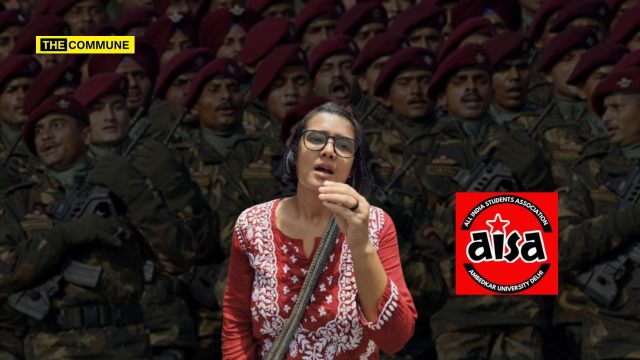
Neha Bora, president of the communist organisation, All India Students’ Association (AISA), also the face of the Cockroach protests in Jantar Mantar – who came out glowing after the 21-day hunger strike, recently participated in the “Secular Fest” organised by Desheeya Manavika Vedi as part of its third anniversary celebrations in Kerala, where she spoke about her upbringing in an Army family and the influence her father, a former Army officer, had on her political outlook.
During the interaction, Bora was asked whether her parents played a role in shaping her and helping her overcome challenges.
Bora responded by discussing her father’s Army background and what she claimed she had learnt from observing the military system.
Neha Bora Describes Army’s Rank Structure As ‘Proper Segregation’
Responding to the question, she said, “So, I can tell you what not to do, from experience of my parents. My family is much like many other North Indian middle-class families – BJP supporting family. My father served in the Army, so patriotism is a huge deal for us; in my home, jingoism is equated with patriotism. But apart from these broad brush strokes that my family has painted itself around, when I was young—and I think this conversation is turning towards the Army now—I think what parents teach the young people who look up to them and they are their entire world, so whatever they say is accepted as absolute truth. I think there is a lot parents can do. For instance, consider the fact that—well, my father was an Army officer, and there is a very gradient inequality between Army officers and other ORs—what are known as ‘Other Ranks’ officials in the Army. There is a very graded inequality in that. What would happen is—in fact, the residential complexes for officers in the army are separate and the residential complexes of ORs families are separate. Even swimming pool timings are also separate; from what to what time an officer’s family could use the pool and from what to what time an OR’s family could use it. That’s also different. The housing complexes are different, and the mess lines in which you bill the things you have bought, they are different. So, it’s proper segregation that happens in the Army. And it is a very common part of the Army, and people don’t really question it, people think that this is how it should be. Even if you go to the hospital, if an officer or an officer’s family member comes to talk to a doctor or get a consultation of a doctor, no matter how long the line is in the OR section, an officer’s family can just go in and get themselves a consultation. So, this is proper segregation that happens in the Army. And, despite all of this, what my father taught me from a very early age was that he did not agree with this practice. I didn’t find this understanding in other, my friends; they didn’t think that this was a problem or that this was such a big thing, actually. But my father said that this was not okay. He didn’t do anything about it, he didn’t say that oh no, if he entered a hospital, he would let the other people go, he didn’t do that—but he used to say he wasn’t okay with this. He used to constantly assert that standing up to even your seniors, and hierarchy—is very important in the Army, so standing up to even your CO, or the Commanding Officer of your unit, is important if he is saying something wrong. That is something my father used to constantly, I used to constantly hear from my father; these were not lessons he used to teach me, these were just things he used to boast about, about being not afraid of his seniors, about thinking that he, about being different from the rest of the people that he did not believe in this segregation. So, in doing all of this, he taught me some other things. He did not know that this is what I would make out of it but what I make out of it is that you should stand up to power. Just because somebody is more powerful than you or just because a system has existed before you did and things have been continuing…”
Bora’s description, however, treats several established features of military administration as if they were evidence of discrimination.
Rank-Based Housing Is A Military Requirement, Not An Arbitrary Social Divide
The distinction between accommodation for officers and personnel below officer rank is a standard feature of military organisation.
The Armed Forces operate through a defined command hierarchy. Officers, Junior Commissioned Officers and Other Ranks have different responsibilities, authorities and duties. Rank-based housing reflects this organisational structure and is intended to preserve command hierarchy, operational discipline and the privacy required by personnel occupying different levels of command.
Such arrangements are not unique to the Indian military and cannot, by themselves, be characterised as discriminatory.
The structure also does not mean that personnel below officer rank are permanently locked into their existing position. Jawans have multiple avenues for career progression, including internal competitive routes such as the Army Cadet College (ACC) entry through which eligible serving personnel can compete for commissioning as officers.
Separate Swimming Pool Timings Serve A Practical Purpose
Bora also cites separate swimming pool timings for officers’ families and families of Other Ranks as evidence of “proper segregation”.
However, separate or staggered timings for recreational facilities can serve a practical purpose within a military environment.
The Armed Forces function on strict protocols governing interaction between superior officers and subordinates while on duty. Personnel below officer rank are expected to observe military etiquette in their interactions with superior officers.
Providing separate recreational timings can therefore allow jawans and non-commissioned personnel to use facilities in a more relaxed environment, socialise among their peers and unwind without the formal hierarchy that governs their professional interactions.
The existence of separate timings, therefore, does not by itself establish that one category is considered inferior to another.
The Welfare Of Jawans Is A Command Responsibility
The picture of officers and jawans presented solely through differences in accommodation and facilities also leaves out the extensive responsibilities officers have towards personnel under their command.
Commanding officers and subordinate officers are expected to monitor the health, physical fitness and overall well-being of the personnel serving under them.
This responsibility extends to basic living conditions, food, leave and welfare.
In military stations and units, a Duty Officer is detailed on a daily basis, with responsibilities that include inspecting kitchens, checking hygiene and personally tasting food prepared in the jawans’ mess to ensure that the food being served meets the required standards.
This is part of the larger command responsibility of ensuring that personnel under command are properly looked after.
Officers Are Responsible For Leave And Domestic Welfare Too
The welfare responsibilities of officers do not stop at the unit premises.
Officers are required to manage leave rosters and ensure that jawans receive and utilise their mandated annual leave. The purpose is not merely administrative. Ensuring that personnel receive adequate leave is an important part of preventing burnout and enabling them to maintain their family and domestic responsibilities.
This creates a system in which officers are accountable for the welfare of the men serving under them, rather than a structure in which the lives of jawans are simply left to their own devices.
Military Families Have Dedicated Welfare Organisations
The claim that military structures are simply designed around privilege also overlooks the extensive welfare network created for service personnel and their families.
The Army Women’s Welfare Association (AWWA), the Navy Wives Welfare Association (NWWA) and the Air Force Wives Welfare Association (AFWWA) form part of the welfare ecosystem supporting military families.
AWWA, for instance, works for the welfare of Veer Naris, widows, families of serving and retired soldiers and children with special needs. Its official material lists initiatives covering healthcare, education, vocational training, financial assistance, counselling and rehabilitation.
Its welfare mechanisms include financial assistance for families of deceased soldiers, educational scholarships, vocational training, support for widows and assistance for children with special needs.
AWWA also operates mechanisms such as Field Area Family Accommodation, designed to provide families of personnel serving in difficult areas with security, healthcare, education and other basic amenities.
These systems demonstrate that military welfare is not confined to officers. Welfare mechanisms explicitly cover personnel and families across ranks.
Welfare Mechanisms Extend To Officers And JCOs/ORs
The official AWWA welfare framework also includes financial assistance and healthcare-related initiatives covering officers as well as JCOs and Other Ranks. Its current list of welfare initiatives includes financial assistance related schemes specifically identified for “Officers & JCOs/OR” and healthcare initiatives for Army personnel and their families.
AWWA’s current welfare programmes also include assistance for education, financial security, rehabilitation and family support.
The institutional approach is therefore considerably broader than the picture of a rigid officer-versus-jawan divide suggested by Bora.
Pension Rules Also Reflect Different Service Structures
The distinction between officers and personnel below officer rank also extends to service conditions.
Under the applicable Ministry of Defence pension framework, Personnel Below Officer Rank (PBOR) become eligible for a lifelong service pension after completing the prescribed minimum qualifying service of 15 years. Commissioned officers, by comparison, generally require 20 years of qualifying service for service pension.
The difference reflects different service structures and career conditions rather than establishing that one category is simply entitled to benefits while another is denied them.
Dimagi Naxal Neha Bora spreading Fake News about Armed Forces
Let me burst her lies completely
1. Residential Complexes – It is as per the rank & this is a perk which is followed in every field & in every country. There is no discrimination. Men get number of chances to qualify… pic.twitter.com/NbRbQ4IoFt
— Flt Lt Anoop Verma (Retd.) 🇮🇳 (@FltLtAnoopVerma) August 25, 2026
Standing Up To Power Is One Thing; Understanding Military Hierarchy Is Another
Bora says that her father taught her to question authority and stand up to seniors when they were wrong. She says she ultimately took from his views the lesson that “you should stand up to power.”
That is a political conclusion she is entitled to draw from her upbringing.
But her description of the Army’s rank-based accommodation, facilities and institutional hierarchy as “proper segregation” presents only one side of how the military functions.
The Indian Armed Forces are built around hierarchy because command, discipline and accountability are fundamental to military operations. Officers have greater authority precisely because they also carry greater command responsibilities towards the personnel placed under them.
The existence of different accommodation, facility arrangements, mess structures and service conditions is therefore not, by itself, evidence of discrimination.
More importantly, the Army has an extensive institutional welfare structure covering the health, food, leave, families, education, rehabilitation and financial security of its personnel.
Bora’s account focuses on the distinctions between ranks. The larger institutional picture shows why those distinctions exist — and the responsibilities that accompany them.
Subscribe to our channels on WhatsApp, Telegram, Instagram and YouTube to get the best stories of the day delivered to you personally.