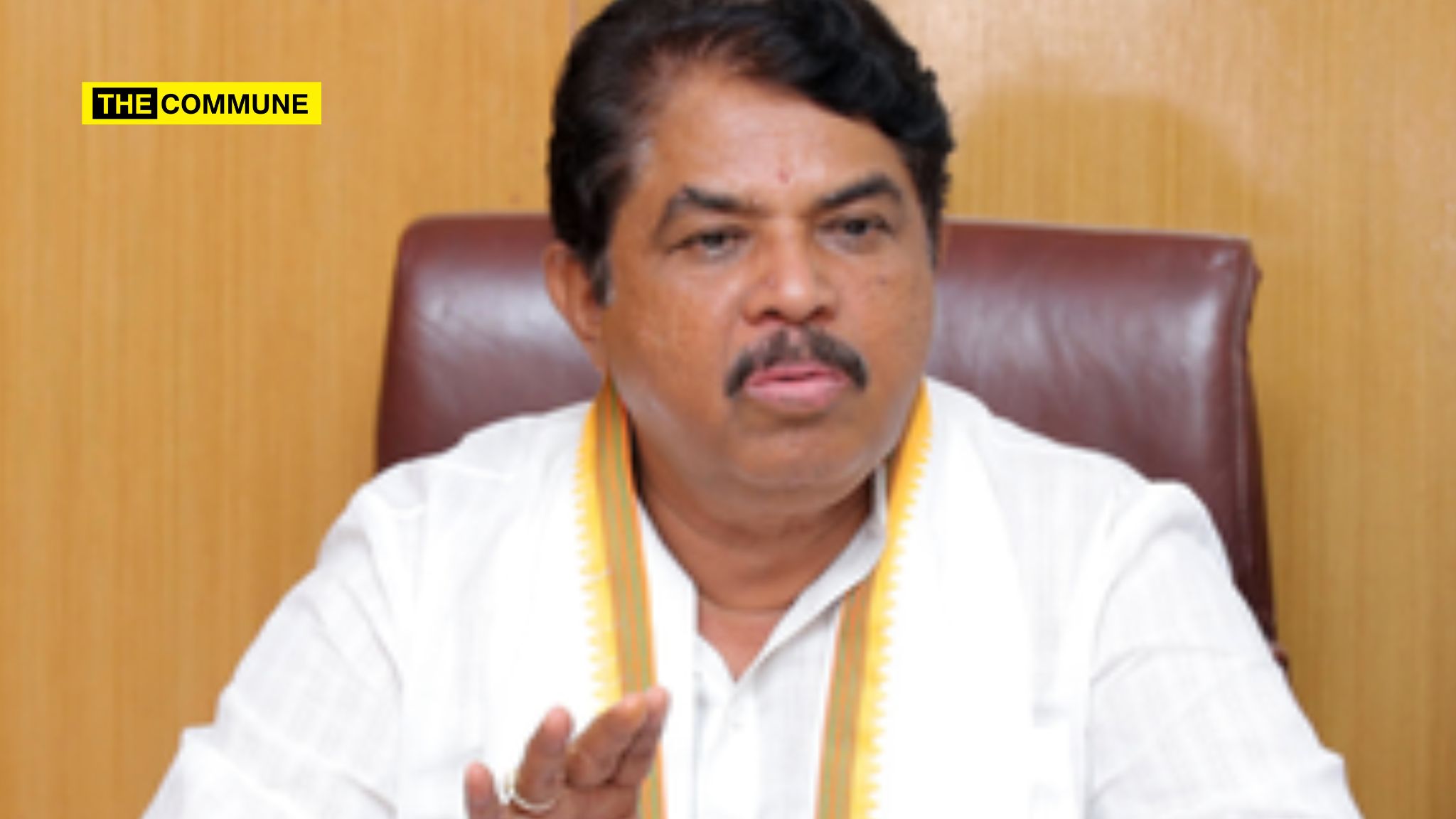
Karnataka BJP claimed on Wednesday that the state government has cancelled at least 11 lakh Below Poverty Line (BPL) ration cards. “11 lakh BPL ration cards have been revoked by the state government. They are planning to cancel 14 lakh more cards. The government has not even issued notices before revoking these cards. If the cancellation process is not stopped, the BJP will lock down all the government offices across the state,” said Karnataka Leader of the Opposition R. Ashoka while interacting with families whose BPL cards had been cancelled in the Vrushabhavathi Nagar and Nandini Layout localities of Mahalaxmi Layout Assembly constituency in Bengaluru.
He added that the state government, which is “supposed” to feed the people, is “snatching” away their food, adding that the government should have empathy to ensure no one dies of hunger. He said that Chief Minister Siddaramaiah, who has presented 14 budgets, seems to have no understanding of how the state economy works, alleging that without conducting field visits, the state government has cancelled ration cards. “The families who lost their BPL cards are not rich and they don’t own cars. A mother of a two-year-old child cannot work in a garment factory. A physically disabled man selling snacks on the roadside is unable to work due to health issues. Such families are being victimised by Chief Minister Siddaramaiah,” he alleged. He also criticised the state government for lacking funds for development and using the available funds for “bribery”. “MLAs themselves are complaining about a lack of grants. Cancelling 25 lakh cards can generate Rs 20,000 crore, which can be used to appease MLAs. This is the real intention behind the card cancellations,” he alleged.
He further stated that the government’s actions would prevent the poor from availing benefits of any welfare schemes, including financial assistance. “Under no circumstances should BPL cards be cancelled. The BJP will strongly oppose this and launch statewide protests. If ration cards are not reissued, we will lock government offices and hold the government accountable. If the government has the courage, it should act against those who approved bogus cards,” he demanded.
Ashoka expressed concern that the government might cancel other welfare schemes as well. “Deputy Chief Minister D.K. Shivakumar has hinted at scrapping the free bus travel scheme for women. Next, the free electricity scheme might also be cancelled. With no funds for MLAs, they are on the verge of revolting,” he declared.
–IANS
Subscribe to our channels onTelegram, WhatsApp, and Instagram and get the best stories of the day delivered to you personally.
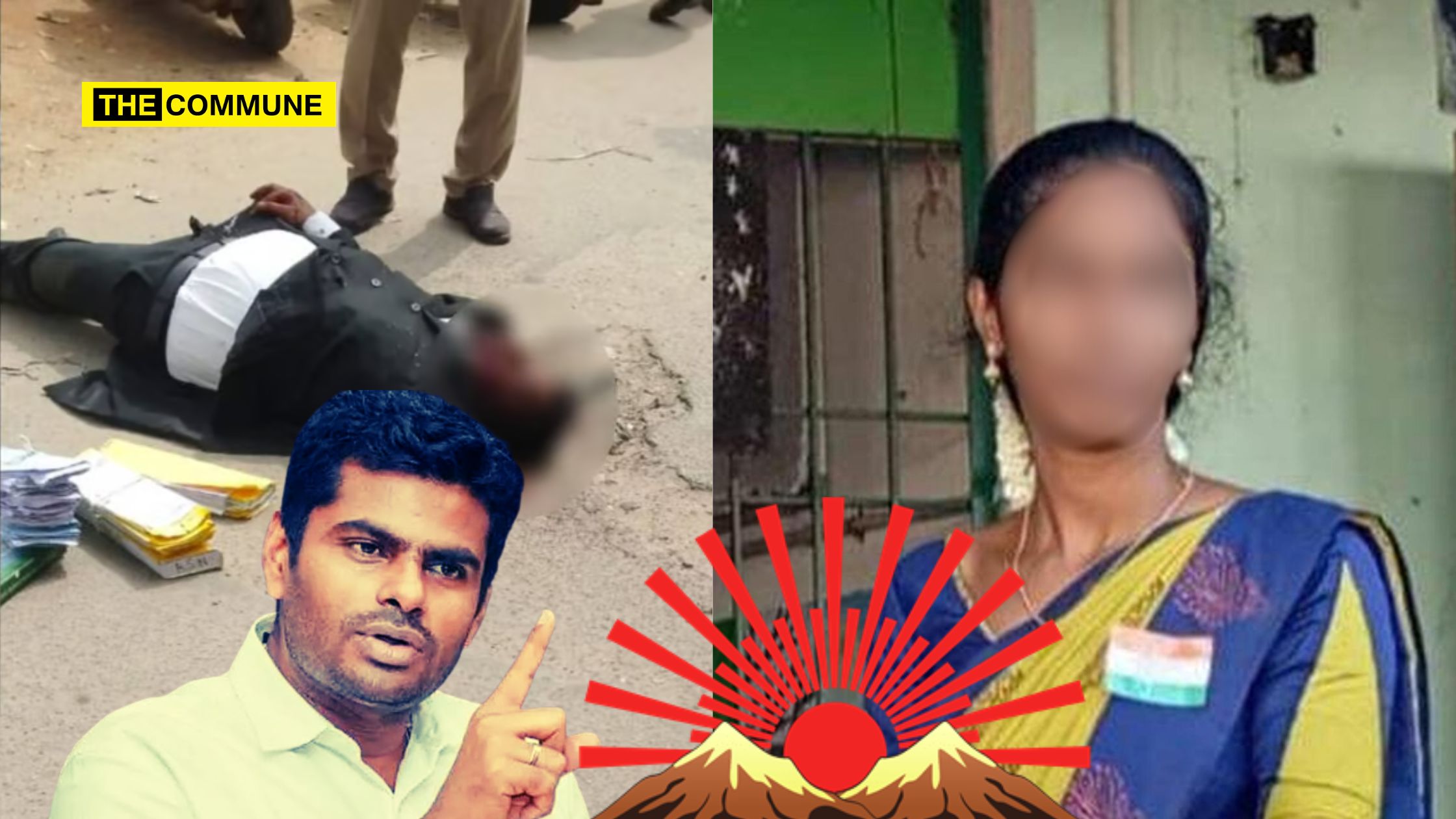
The day saw a double murder occur in broad daylight in Tamil Nadu, bringing back the question of the state of law and order here.
On 20 November 2024 morning, a tragic event unfolded at a government school in Mallipattinam, Thanjavur district, where a female teacher was brutally murdered.
According to police reports, 26-year-old Ramani from Chinnamanai village had been working as a temporary Tamil teacher for grades 6 to 9 for the past five months. The incident occurred near the staff room while Ramani was conversing with S. Madan, a 30-year-old man from her village. During their discussion, a dispute escalated, and Madan allegedly stabbed Ramani multiple times in the neck and abdomen in front of her colleagues.
As Ramani lost consciousness, Madan attempted to flee but was quickly detained by the school staff. The severely injured teacher was rushed to Pattukkottai Government Hospital, where she was pronounced dead by medical personnel.
Superintendent of Police Ashish Rawat and his team arrived at the scene to conduct investigations. Initial findings suggest that Ramani and Madan were in a relationship, but her family opposed their marriage despite both being from the same community. Police reports indicate that Ramani had informed Madan she could not go against her family’s wishes, which allegedly led to Madan attacking her in a fit of rage. The Sethubavachathiram police have registered a murder case, and further investigations are ongoing.
In another horrifying incident, on the afternoon of 20 November 2024, a violent attack occurred within the premises of the combined court building in Hosur, where a 39-year-old man assaulted a 30-year-old advocate.
The victim, Kannan from Hosur, is a junior advocate working under another lawyer, Sathya Narayanan. He had a longstanding dispute with Anandakumar, a 39-year-old resident of Hosur. During the incident on today afternoon, Anandakumar attacked Kannan within the court premises. Kannan was swiftly taken to a private hospital in Hosur, where he is currently undergoing treatment.
Police reports indicate that Anandakumar later surrendered at the Hosur Judicial Magistrate Court – II. The Hosur town police are actively investigating the case.
BJP TN Chief Annamalai Slams DMK Govt For Lawlessness In State
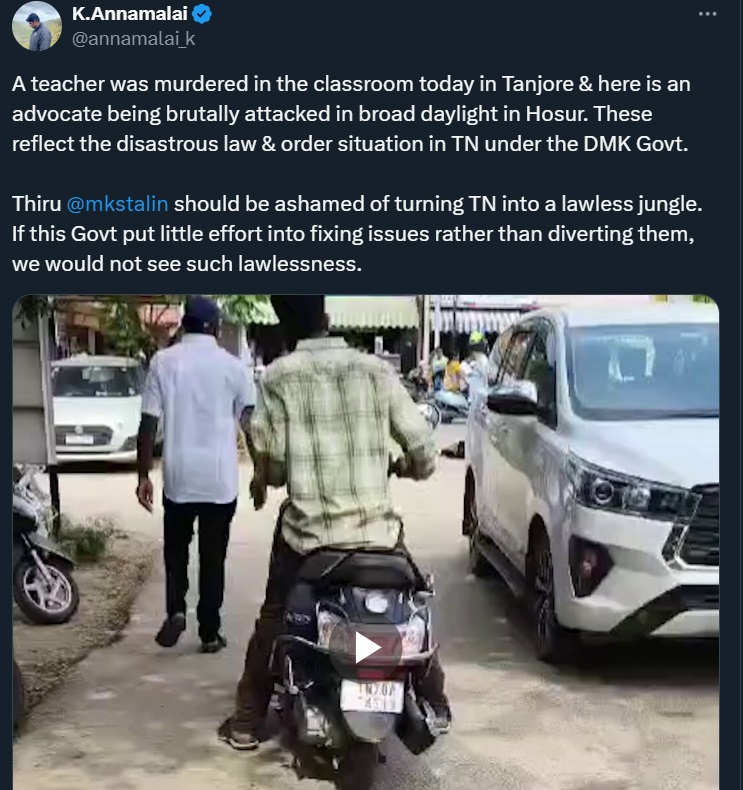
Tamil Nadu BJP President K. Annamalai has criticized the ruling DMK and Chief Minister MK Stalin for the worsening law and order situation in the state. He pointed to a series of brazen daylight murders in various districts, such as the killing of a teacher in Tanjore and the brutal attack on a junior advocate in Hosur. Annamalai condemned the state’s growing lawlessness, describing it as a “lawless jungle.”
In a statement posted on his official X account on 20 November 2024, Annamalai said, “A teacher was murdered in the classroom today in Tanjore & here is an advocate being brutally attacked in broad daylight in Hosur. These reflect the disastrous law & order situation in TN under the DMK Govt. Thiru @mkstalin should be ashamed of turning TN into a lawless jungle. If this Govt put little effort into fixing issues rather than diverting them, we would not see such lawlessness.”
Subscribe to our channels onTelegram, WhatsApp, and Instagram and get the best stories of the day delivered to you personally.
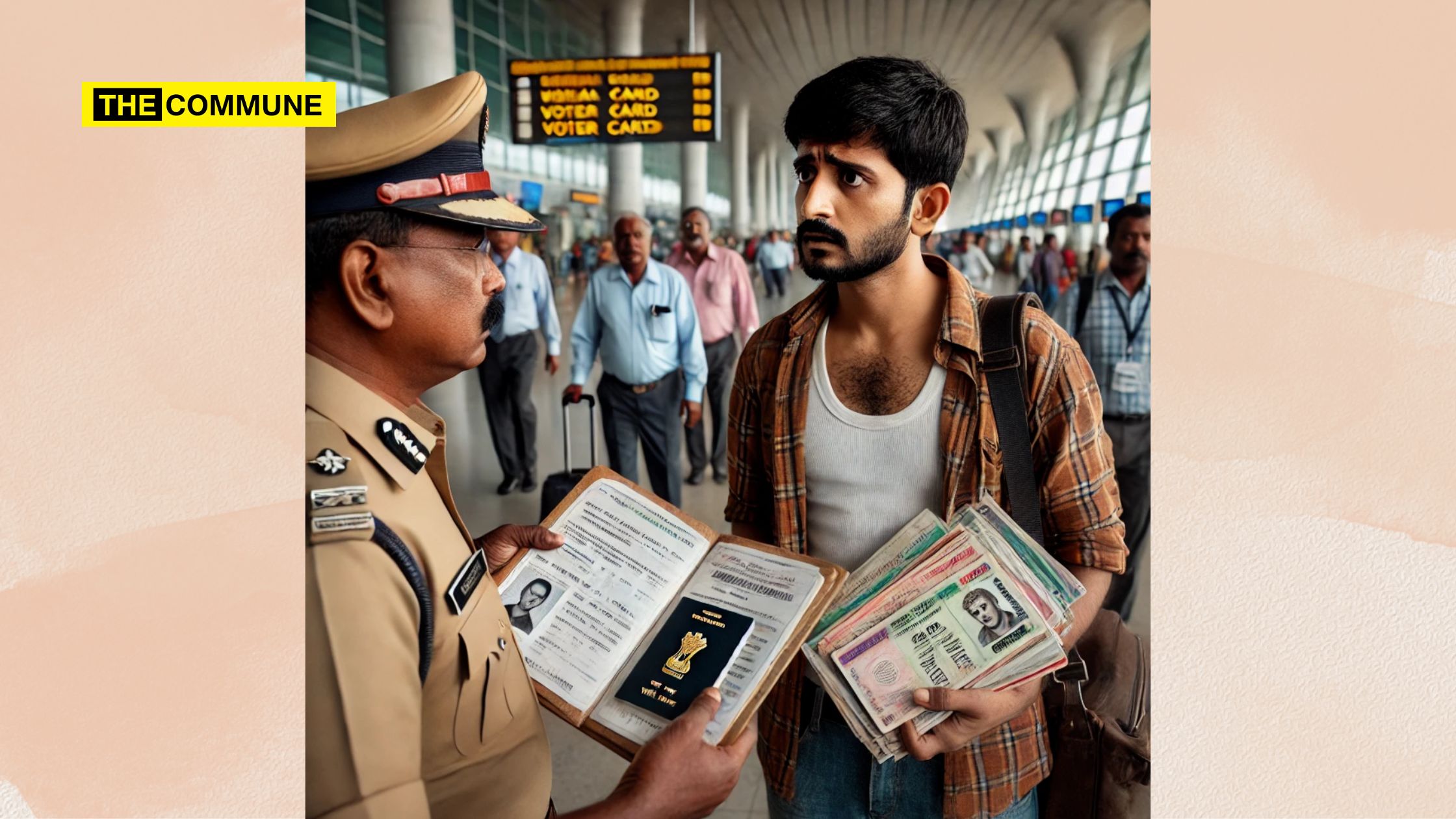
A Bangladeshi national, who had been residing in India for 15 years using forged identification documents, was apprehended by immigration authorities at Chennai International Airport on Monday, officials reported.
The individual, identified as 38-year-old Moseep Hossen, was detained as he attempted to board an AirAsia flight to Malaysia around 8 a.m. using a fraudulently obtained Indian passport. He was subsequently handed over to the Central Crime Branch (CCB) of Chennai Police for further investigation.
Authorities revealed that Hossen had illegally crossed into India from Bangladesh via the Tripura border in 2009. Initially, he worked at eateries in Tripura and managed to procure fake Indian identity documents, including an Aadhaar card, voter ID, and birth certificate, through local contacts.
After hearing about better job prospects in Tamil Nadu, he relocated to Chennai a few years later. In Chennai, Hossen found employment in various well-known hotels located in areas such as Nungambakkam, Vandalur, and Tambaram.
Through his professional network, Hossen became aware of lucrative opportunities in the hospitality sector in Southeast Asian countries like Malaysia and Singapore. In 2017, he used forged documents to obtain an Indian passport from the Regional Passport Office (RPO) in Tambaram. Officials noted that the passport was issued based on falsified police verification reports.
Hossen planned to travel to Malaysia on a tourist visa and eventually settle there for work. However, his plan was thwarted when an immigration official flagged inconsistencies during the boarding process, leading to further questioning and his subsequent arrest.
The CCB’s forgery investigation wing has taken over the case and seized key documents, including Hossen’s passport, Aadhaar card, voter ID, and birth certificate. Officials are investigating how the forged documents were created and whether others were involved in facilitating the illegal activities.
This arrest comes shortly after another incident in September, where three Pakistani nationals were caught at Chennai airport with fake Indian passports and Aadhaar cards upon arrival from Dhaka. Subsequent investigations uncovered 18 Pakistanis living in Bengaluru under false identities, leading to their arrest.
The incidents have raised concerns about the effectiveness of document verification processes and the potential security risks posed by individuals using fake identification to reside and travel in India.
The Madras High Court has ordered a Central Bureau of Investigation (CBI) probe into the Kallakurichi hooch tragedy, which claimed the lives of approximately 67 people after they consumed illicitly brewed arrack. The tragedy has brought renewed attention to the recurring issue of spurious liquor sales in Tamil Nadu.
The directive was issued by a bench comprising Justice D. Krishnakumar and Justice P.B. Balaji. They instructed the CBI to expedite its investigation and directed the Crime Branch-Criminal Investigation Department (CB-CID) to transfer all case files and provide full cooperation to the central agency. The order was delivered in response to multiple petitions seeking a CBI inquiry into the incident.
The petitioners argued that the Kallakurichi incident exposed systemic failures in preventing the sale and consumption of spurious liquor. They contended that such hooch tragedies are not new in Tamil Nadu and that the state machinery, including the police and revenue authorities, had failed to act effectively.
Citing public dissatisfaction, the petitioners pointed to the transfer of the district collector and the suspension of the Commissioner of Police as indicators of deeper issues within the system.“The people have lost faith in the investigating agency and the State itself,“they argued.
Concerns were also raised about inter-state implications, with Methanol—the chemical responsible for the tragedy—allegedly sourced from Puducherry. The petitioners insisted that this required an investigation beyond state borders, making the CBI the appropriate agency to handle the case.
The Advocate General (AG) opposed the CBI probe, asserting that the state government had already taken extensive measures to address the tragedy. The AG highlighted that senior officials, including the Superintendent of Police, had been suspended, and the Additional Director General of Police (Enforcement) was removed from their post.
To further investigate the matter, the state government appointed a one-man commission led by Justice (Retd.) B. Gokuldas.“The investigation has been transferred to the CB-CID, which has completed significant progress,” the AG informed the court.
The AG revealed that 24 individuals had been arrested, the Methanol source had been traced, and witnesses were examined.“The CB-CID is awaiting serology and toxicology reports before filing a charge sheet,“the AG stated, arguing that transferring the case to the CBI at this stage would force the investigation to restart from scratch.
Petitioners criticized the CB-CID’s handling of previous hooch tragedies, describing their investigations as inadequate and contributing to public frustration. They argued that transferring the case to the CBI would ensure impartiality and prevent a repeat of past investigative failures.
The Kallakurichi tragedy has reignited debates about the state’s persistent challenges in curbing the sale of spurious liquor. Tamil Nadu has witnessed multiple incidents of methanol-laced alcohol causing mass casualties, raising questions about enforcement and accountability in tackling the problem.
As the CBI takes over the investigation, the central agency’s findings and actions will likely play a critical role in addressing these systemic issues and ensuring justice for the victims of the Kallakurichi tragedy.
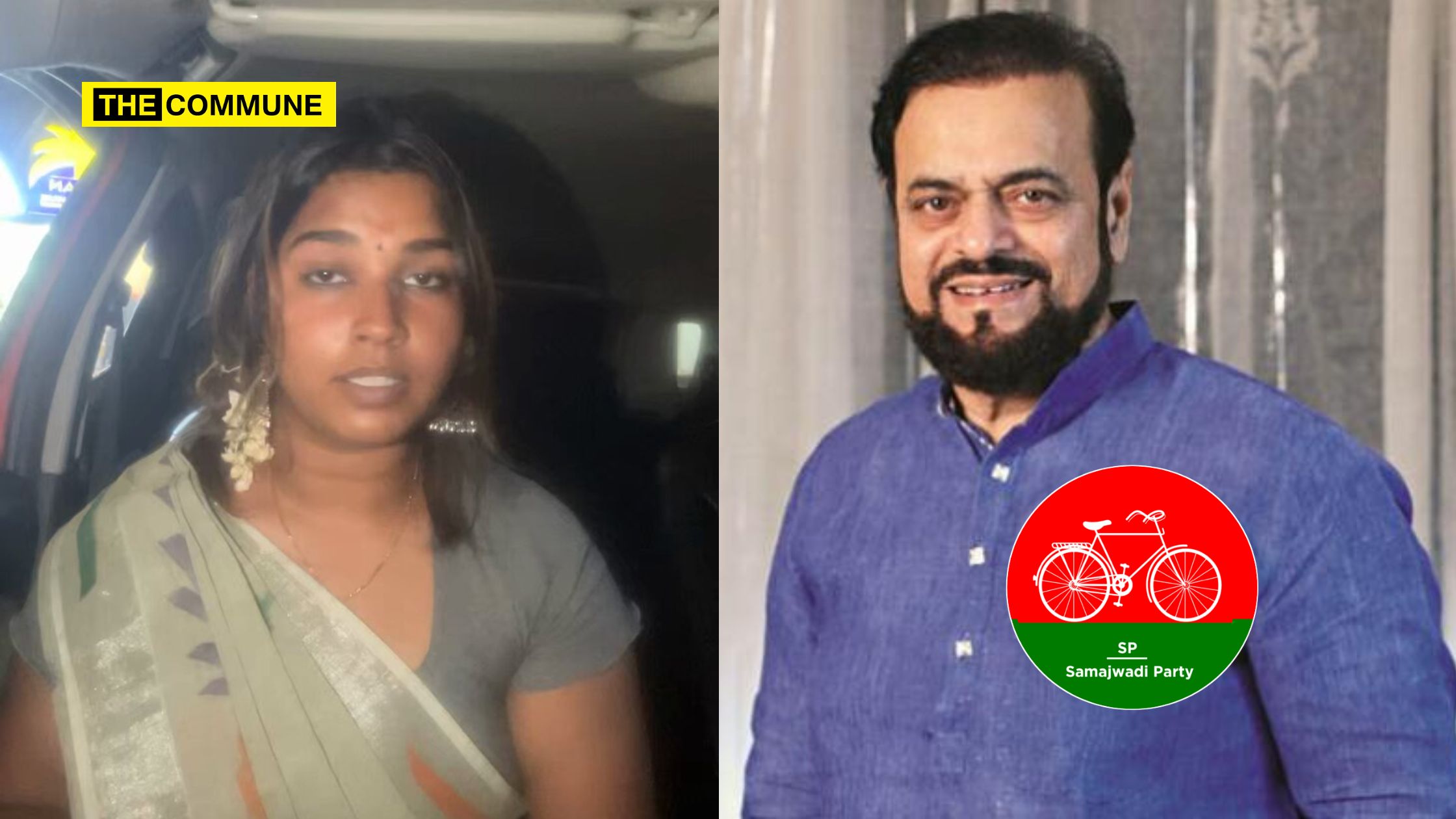
Shamita Yadav, popularly known as ‘Ranting Gola,‘ a content creator and alleged social media influencer, has become embroiled in controversy after a video targeting Samajwadi Party MLA Abu Asim Azmi went viral. In the video, Yadav accused Azmi of ignoring critical issues in his Govandi constituency, sparking heated reactions online. Yadav has since released a clarification, asserting that the video was scripted and not meant for public dissemination.
What Was The Viral Video About?
The contentious video, which quickly spread across social media, features Yadav delivering a sharp critique of Azmi’s alleged inaction on issues such as drug-related crimes and environmental hazards.“Drug-related problems have been worsening for 15 years, and during this time, Abu Asim Azmi has remained a constant. He hasn’t even filed a single letter to police seeking drug investigations. If you can’t fulfill your responsibilities, step aside,” Yadav said in the video.
She also accused Azmi of complacency in tackling Govandi’s environmental challenges, saying,“Govandi has turned into a graveyard for biomedical waste. Smoke from SMS companies is choking residents, and most of Mumbai’s TB patients come from here. If you can’t resolve these issues, burn your shame along with the next batch of waste.”
In a final plea to voters, she urged,“This election, don’t vote for politicians. Vote for your safety and your family’s future.”
Yadav’s U-Turn
As the video drew widespread attention—garnering both support and criticism—Yadav released a statement claiming the videowas never intended for public release.“The video that has gone viral was a trial recording based on a script provided to me. These are not my personal views, nor have I verified the information presented. It was not posted on any of my platforms,” she said, hinting that the clip may have been allegedly leaked without her consent.
This is liberal's darling, you-go-gal, more-pawa-to-u @therantinggola.
Govandi, a suburb of Mumbai, has long grappled with issues such as drug trafficking and pollution. The area’s high incidence of tuberculosis and its reputation as a biomedical waste dumping ground have made it a focal point of public health concerns.
Yadav’s video has reignited discussions on these issues, with critics accusing her of irresponsibility in releasing unverified claims.Azmi’s supporters have dismissed the video as a political ploy, while others see it as a bold critique of governance failures.
The controversy comes as Maharashtra voters head to the polls today, 20 November 2024 for the assembly elections. Voting is underway across 288 constituencies. Results are set to be announced on 23 November 2024.
The elections feature a face-off between the ruling BJP-led Mahayuti alliance, which includes the Shiv Sena and NCP, and the Opposition’s Maha Vikas Aghadi (MVA), comprising the Congress, Shiv Sena (UBT), and NCP (SP).
It was hilarious to watch Yadav make the U-turn especially after the allegedly leaked video went viral. It is noteworthy that Yadav has made several Hinduphobic comments in the past.
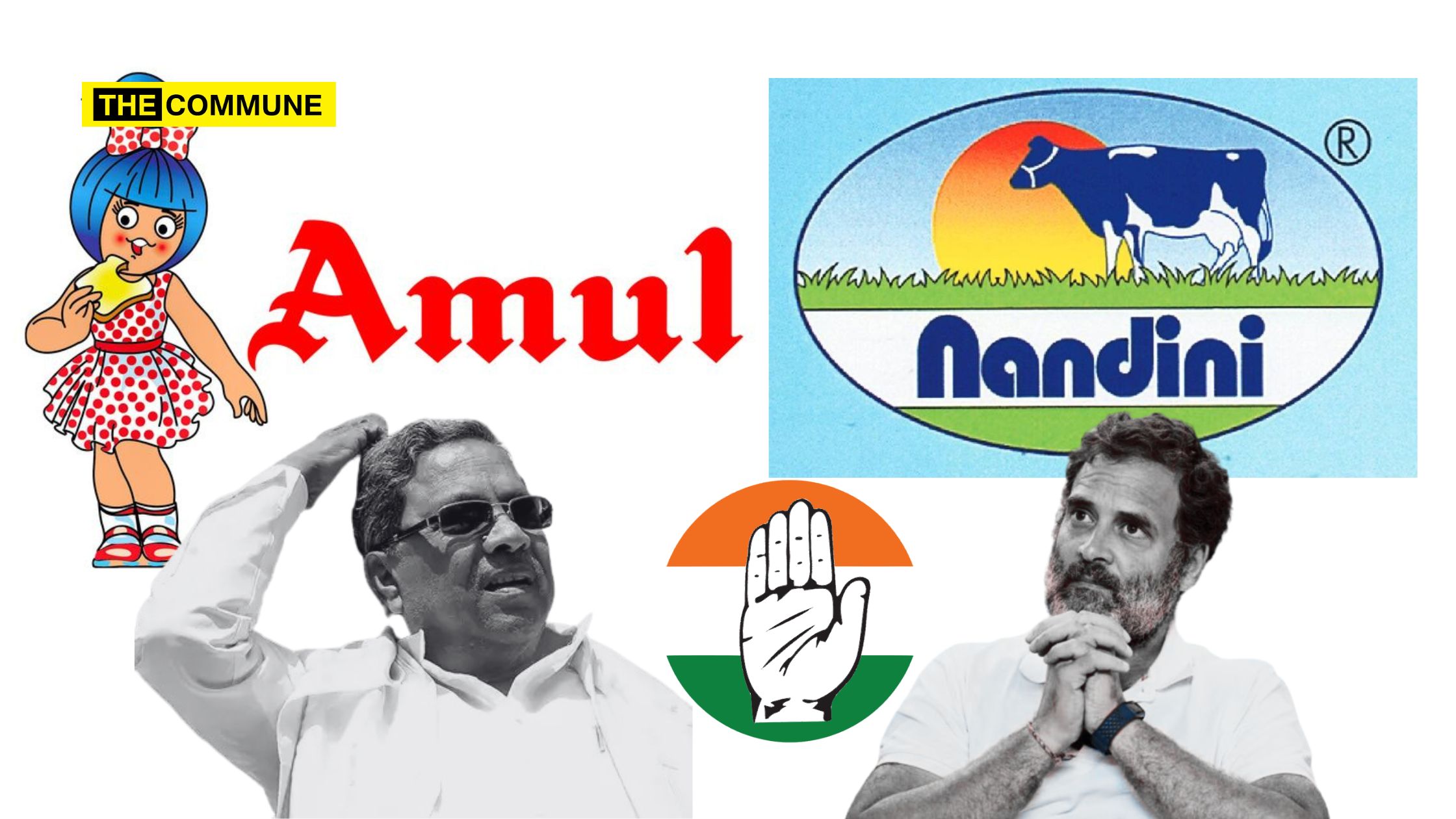
The Karnataka Milk Federation (KMF), under the leadership of Chief Minister Siddaramaiah, is poised to expand its flagship dairy brand Nandinito the national capital, New Delhi. However, the announcement has reignited debates about the Karnataka Congress’s previous opposition to Amul’s entry into the state, sparking allegations of political double standards. This development comes months after a high-profile controversy over Amul’s entry into Karnataka, which saw political parties and cultural groups fiercely opposing the Gujarat-based cooperative’s expansion into the state.
While the Congress-led Karnataka government seeks to expand Nandini’s footprint into new markets, protests against its entry into Kerala have further complicated the narrative, highlighting the intersection of politics, business, and identity in India’s cooperative dairy sector.
Nandini’s Expansion Amid Past Controversy
Nandini’s entry into the competitive North Indian dairy market has been welcomed as a bold business move. The Karnataka government aims to increase the brand’s visibility and market share across India by offering fresh products such as milk and curd in Delhi. Karnataka Milk Federation (KMF) plans to introduce Nandini’s fresh dairy products, such as milk and curd, to the Delhi market. This marks the brand’s first major foray into North India, positioning it in direct competition with the Gujarat Cooperative Milk Marketing Federation’s (GCMMF) Amul brand.
This ambitious plan comes just a year after the Congress-led Karnataka government fiercely opposed Amul’s entry into Karnataka. The opposition turned into a statewide campaign, positioning the issue as a matter of Kannada pride. Congress leaders, including Chief Minister Siddaramaiah and Deputy Chief Minister D.K. Shivakumar, argued that Amul’s expansion would harm Nandini, which they described as an emotional symbol for the people of Karnataka.
At the time, protests led by the Karnataka Rakshana Vedike (KRV), a group promoting Kannada identity, further escalated the controversy. Videos of activists protesting against Amul milk outside stores went viral, with slogans demanding the preservation of Nandini’s dominance in the state. The Congress accused the Bharatiya Janata Party (BJP)-led central government of facilitating Amul’s entry to undermine Karnataka’s dairy industry.
#WATCH | Bengaluru: Karnataka Rakshana Vedike protests to oppose the sale of Amul milk in Karnataka & encourage Nandini products. pic.twitter.com/LQThDsaswY
The same leaders who once decried Amul’s entry into Karnataka as an existential threat to Nandini now advocate for Nandini’s national expansion. Critics have pointed out the apparent double standard, asking whether the same concerns about protecting local brands will apply as Nandini enters new territories. Observers argue that politicizing Amul’s entry in 2023 was a calculated electoral strategy aimed at leveraging Kannadiga pride ahead of the state assembly elections.
The Amul-Nandini Controversy
The roots of the Amul-Nandini row can be traced to a statement made by Union Home Minister Amit Shah in December 2022 during the inauguration of a dairy in Mandya, Karnataka. Let’s take a look at the timeline of the Amul-Nandini controversy:
December 2022: Union Home Minister Amit Shah, during the inauguration of a Mandya Mega Dairy, suggested collaboration between Amul and Nandini to enhance dairy infrastructure across India. This statement was misinterpreted as a potential merger, sparking fears about Nandini’s independence.
April 2023: Amul announced plans to introduce fresh dairy products in Bengaluru, prompting protests from Congress leaders and cultural groups like Karnataka Rakshana Vedike (KRV). Campaigns like “Save Nandini” and “Go Back Amul” trended on social media.
May 2023: Congress, riding on the wave of Kannadiga pride, won the Karnataka Assembly elections. The Nandini-Amul controversy became a focal point of its campaign.
November 2024: KMF announced plans to expand Nandini into Delhi. Simultaneously, Kerala’s cooperative Milma strongly opposed Nandini’s entry, citing potential harm to local dairy farmers.
Price Wars And Market Dynamics
One of Nandini’skey advantages in Karnataka is its competitive pricing. Nandini’s toned milk, for instance, costs ₹39 per litre in Bengaluru, compared to ₹52 for Amul’s toned milk in Gujarat. Similarly, full-cream milk from Nandini is priced at ₹50 per litre, significantly lower than Amul’s ₹66 per litre. This pricing strategy has helped Nandini maintain a near-monopoly in Karnataka’s dairy market.
Amul, however, clarified that its entry into Karnataka was not intended to compete with Nandini. According to Jayen Mehta, Managing Director of Gujarat Cooperative Milk Marketing Federation (GCMMF), Amul had been selling its products in northern Karnataka since 2015 and had collaborated with Nandini on multiple occasions. Amul ice cream, for instance, is manufactured using milk sourced from Karnataka farmers.
Nandini Faces Resistance In Kerala
As Nandini prepares for its expansion beyond Karnataka, it is noteworthy to remember that in 2023, it had encountered resistance in Kerala. The Kerala State Milk Cooperative Federation, Milma, opposed Nandini’s entry, citing concerns about market disruption.
Milma, the state milk cooperative federation in Kerala, strongly opposed the arrival of Nandini in the state.
Watch the video to know how Rahul Gandhi’s so-called "Mohabbat Ki Dukaan" became poison for Karnataka’s homegrown brand #Nandinipic.twitter.com/U5pZ8UJUGU
Kerala’s CPI(M) government even lodged a complaint with the National Dairy Development Board to address the issue, further complicating Nandini’s plans. Milma’s resistance mirrors the very arguments Karnataka leaders made against Amul’s entry, highlighting how regional politics often supersede cooperative ideals. Ironically, Wayanad was previously represented in Parliament by Congress leader Rahul Gandhi, who had publicly supported Nandini during the Karnataka elections.
While expanding Nandini to other states is a commendable step towards boosting Karnataka’s dairy sector, the Congress’s contradictory stances have fueled criticism. The politicization of the Amul issue in Karnataka, followed by Nandini’s national ambitions, highlights the hypocrisy of the Congress. While Congress used the controversy to consolidate its position in Karnataka, its critics now accuse it of hypocrisy as Nandini expands into other states.
For consumers and farmers, such disputes could have broader implications. Restricting the entry of competing brands limits consumer choice and may hinder farmers from accessing broader markets. Conversely, aggressive expansion strategies could disrupt local economies, as seen in Kerala.
Nandini’s entry and subsequent reception in regions beyond the south will be a litmus test for the cooperative’s long-term vision.
A video of Dravidianist actor Suriya and director Siva visiting the Sri Yoga Narasimha Swamy Temple in Sholingar, near Ranipet has gone viral, following the intense backlash from fans after the release of Suriya’s recent movie ‘Kanguva’, which received severe criticism and widespread trolling from all corners of the country.
The actor’s sudden visit to the temple, follows reports of theatre shows for the movie ‘Kanguva’ getting cancelled due to poor ticket sales. Despite the earlier screening of ‘Amaran’, which emerged as a rival to ‘Kanguva’ with a smaller budget, the movie continues to draw a full house even after two weeks of screening.
Social media users took issue with the actor’s visit, questioning the contrast between his family’s previous statements—where they had urged citizens, particularly Hindus, to direct their donations away from temples and instead contribute to schools and hospitals. Many saw the actor’s actions as hypocritical, given the recent public stance on charity.
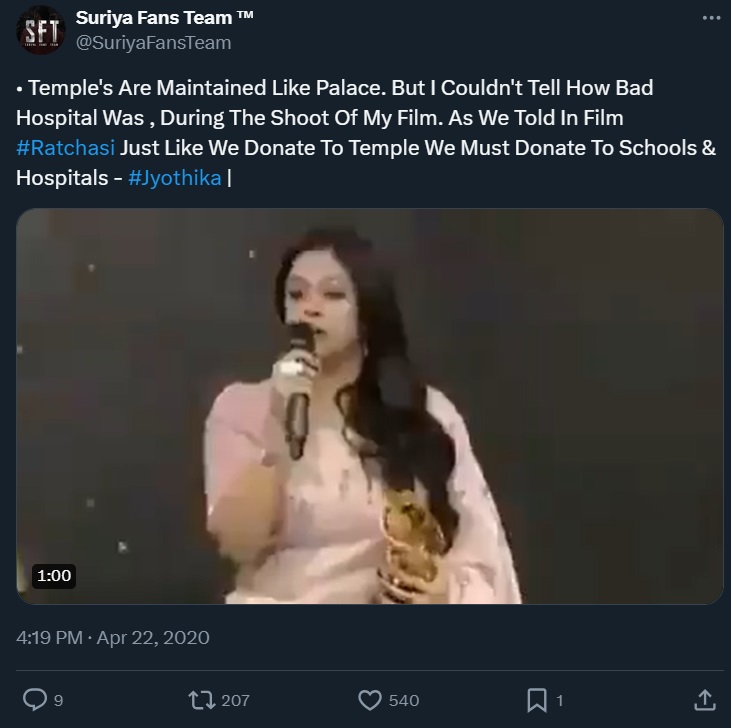
The ridicule and trolling directed at actor Suriya stem from his wife, Jyothika’s statement at a 2020 awards ceremony, where she emphasized the importance of donating to schools and hospitals instead of temples. She had compared the grandeur of the Brihadeeshwara temple to Udaipur’s palaces, but her experience with a poorly maintained hospital during her filming led her to advocate for prioritizing donations to educational and healthcare institutions.
Instead of criticizing the state for its handling of health services, she subtly used the platform to urge the public to direct their charitable contributions toward schools and hospitals, asserting that these sectors are more, deserving of support.
Even this time, when ‘Kanguva’ being heavily criticized for its weak plot and poor execution, Jyotika, actor Suriya’s wife, took to social media to defend the film, calling out the harsh backlash. She expressed her disappointment at the “unfair” criticism, emphasizing that she was speaking as a cinema lover, not just as Suriya’s wife. Jyotika acknowledged the film’s flaws, particularly the first half-hour and jarring sound, but argued that these are common in large-scale, experimental films. She praised the movie for its unique cinematic experience, highlighting its visuals, camera work, and emotional storyline.
Jyotika also criticized the disproportionate negativity the film received compared to other big-budget Tamil movies, which often feature problematic tropes but aren’t subjected to the same scrutiny. She suggested that the backlash might have been part of a targeted campaign against the film, urging the ‘Kanguva’ team to remain proud of their work.
However, her defense of the film drew more criticism, with many pointing out the contradiction in her past statements about directing donations away from temples to schools and hospitals. Critics also took issue with her urging people to support the film, despite it being widely panned, as a way to sustain the extravagant lifestyle of the film’s cast and crew.
A Virtue-Signalling Family
Suriya and his family, particularly his wife Jyothika and brother Karthi havemany a time indulged in virtue-signaling to peddle DMK propaganda. He was one of the frontrunners in peddling anti-NEET rhetoric and making comments against the National Education Policy 2020. His brother Karthi had called for the boycott of the three farm laws that were implemented by the Modi Government ignorant of the fact that such laws were already in place in Tamil Nadu.
After the DMK came to power, Suriya along with his family moved to Mumbai and currently lives in a sea-view house allegedly worth ₹70 crore. Despite Suriya residing with his family in Mumbai, armed policemen continue to guard his Chennai residence, courtesy of the DMK government in Tamil Nadu.
Furthermore, Suriya runs a “non-profit” organization called the Agaram Foundation and has resorted to virtue-signalling by being vocal for causes espoused by the ruling DMK. He is known for his anti-NEET stance when he claimed it filters away those aspiring to study medicine butSuriya’s hypocrisy shines through his teeth when one looks at the selection process for students seeking financial help for higher education through Agaram Foundation run by the actor. According to the Agaram Foundation’s website, they have a rigorous scoring system in place to identify ‘deserving’ students. This requirement contradicts the stated mission of promoting education and social equality.
Subscribe to our channels onTelegram, WhatsApp, and Instagram and get the best stories of the day delivered to you personally.
The Tamil Film Active Producers Council has issued a strong statement blaming audience reviews and film critics for the underwhelming box office performance of recent Tamil films, including Kanguva, Vettaiyan, and Indian 2. The council has called for stricter measures against YouTube channels conducting public reviews immediately after theatrical screenings, citing their detrimental impact on the industry.
Backlash Over Kanguva
The controversy follows the release of Suriya’s Kanguva, which faced heavy criticism for what audiences described as a lacklustre storyline with loud jarring sounds all through the film. Despite significant pre-release hype, the film struggled to perform at the box office, earning less than ₹90 crore in its first six days. Negative reviews on social media and YouTube reportedly played a key role in the film’s slow collection, with audiences expressing disappointment over the execution and narrative.
Producers Council Speaks Out
In a letter written in Tamil and later translated, the council condemned what it called “tasteless and hostile” reviews that have harmed major releases in 2024. The council highlighted a troubling trend of personal attacks disguised as film criticism, urging reviewers to focus on the films themselves rather than targeting producers, directors, or actors.
“Our association strongly condemns the recent trend of personal attacks and incitement of violence under the guise of film reviews,”the letter stated.“Critics have the right to point out the strengths and weaknesses of a film, but this must not translate into spreading hatred or hostility on public platforms.”
Tamil Film Active Producers Council condemns tasteless movie reviews. They also request theater owners to not allow YouTube channels to cover public reviews inside theater premises. In 2024, Indian 2, Vettaiyan and Kanguva are affected by such reviews, say the council pic.twitter.com/tGDLFrKOJa
The council took particular issue with the practice of conducting “public reviews” outside theatre premises during premiere screenings and first-day-first-show events. They accused YouTubers of using clickbait headlines and sensationalist commentary to attract attention, which they argued has significantly damaged films like Kanguva, Vettaiyan, and Indian 2.
“No one reviews a restaurant by declaring their life has been ruined by one bad meal. If such extreme comments were made, those restaurants would take strong action,”the council remarked, drawing a parallel between the impact of exaggerated criticism in different industries.
While acknowledging the right to critique films, the council called for reviews to be constructive and balanced, avoiding personal attacks or baseless negativity.“Critics have the full right to express their views, but this must not translate into spreading hatred on public platforms out of personal vendettas,”the letter noted.
The producers also pointed out that while honest criticism is valuable, the growing trend of negativity and sensationalism has led to undue hostility toward filmmakers and actors.
Subscribe to our channels onTelegram, WhatsApp, and Instagram and get the best stories of the day delivered to you personally.
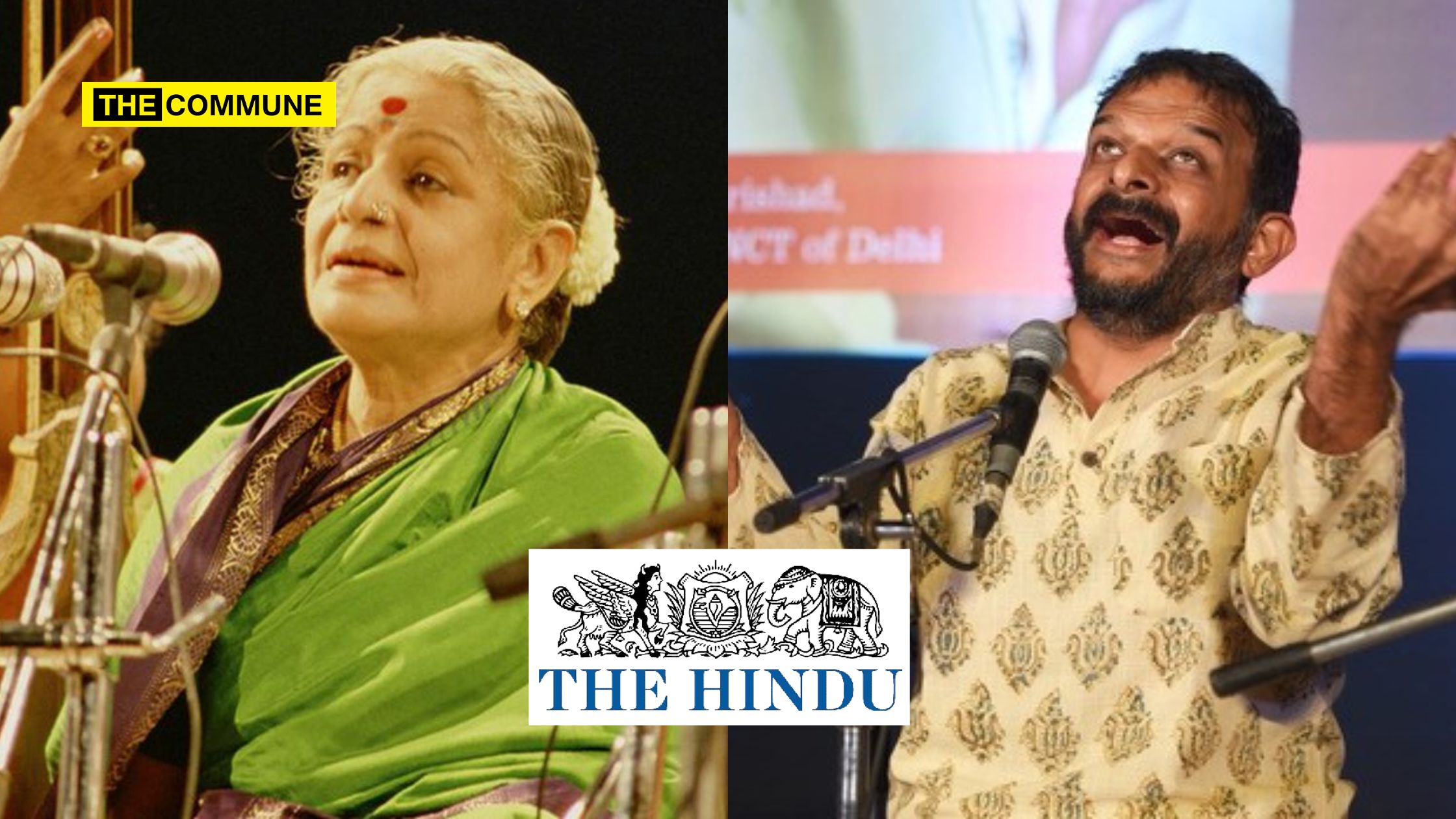
The recent legal proceedings surrounding the Sangita Kalanidhi award and its associated cash prize have not only upheld the late M.S. Subbulakshmi’s explicit wishes but also exposed a troubling editorial stance by The Hindu. In its affidavit and subsequent reporting, the publication has cast unwarranted doubt on the familial ties between Subbulakshmi and her daughter Radha Vishwanathan’s son, V Shrinivasan, trivializing their profound relationship.
Shrinivasan filed a civil suit opposing the naming of a cash prize instituted by The Hindu after Subbulakshmi, citing her 1997 will that explicitly prohibited memorials in her name. While the court affirmed the sanctity of Subbulakshmi’s will and clarified that the cash prize could be awarded without using her name, The Hindu’s actions—both in the courtroom and in its coverage—have raised ethical questions.
The publication’s description of Shrinivasan as someone who “claimed to be the grandson of Subbulakshmi” is an attempt to deride and shove its animosity towards Mr. Shrinivasan, which seems to be a deliberate editorial choice.
The Hindu continues to play mischief by insinuation. In its affidavit, it wanted Radha Vishwanathan's son to prove that he is indeed MS' grandson. And in its report today, it continues to asterisk him, as it were. It basically trivialises MS-Radha mother-daughter relationship. pic.twitter.com/TwQAiZqVNl
This language reflects The Hindu’s courtroom strategy, where it demanded that Radha Vishwanathan’s son prove his lineage—an unnecessary and disrespectful attack on the integrity of one of Carnatic music’s most revered families. The court, in contrast, had no doubts about Shrinivasan’s standing, recognizing his locus standi in the case and the validity of his claims.
Such insinuations by The Hindu appear especially problematic given the close ties between its leadership and the Music Academy, whose president is N. Murali, brother of leftist journalist N. Ram. This raises questions about whether vested interests are at play in the publication’s editorial stance.
Yes, it is a known fact that MS Subbulakshmi was not Radha’s biological mother, but this does not justify The Hindu’s disparaging conduct. By focusing on insinuations rather than addressing the broader ethical issue of respecting Subbulakshmi’s wishes, the publication diverts attention from the true matter at hand: honouring the legacy of one of India’sgreatest musicians.
In its eagerness to defend its position, The Hindu has disrespected not only MS Subbulakshmi’s family but also her legacy. If the publication truly valued her contributions, it would align its actions and reporting with the dignity that her memory demands.
Subscribe to our channels onTelegram, WhatsApp, and Instagram and get the best stories of the day delivered to you personally.
The Dravidian media operates with two faces; one diverts attention from real issues to protect their political master, by focusing on trivial matters, while the other indulges in the unethical and damaging act of defaming the opposition. However, the second approach is far more insidious, as it damages the reputation of the accused, even when the allegations are proven false.
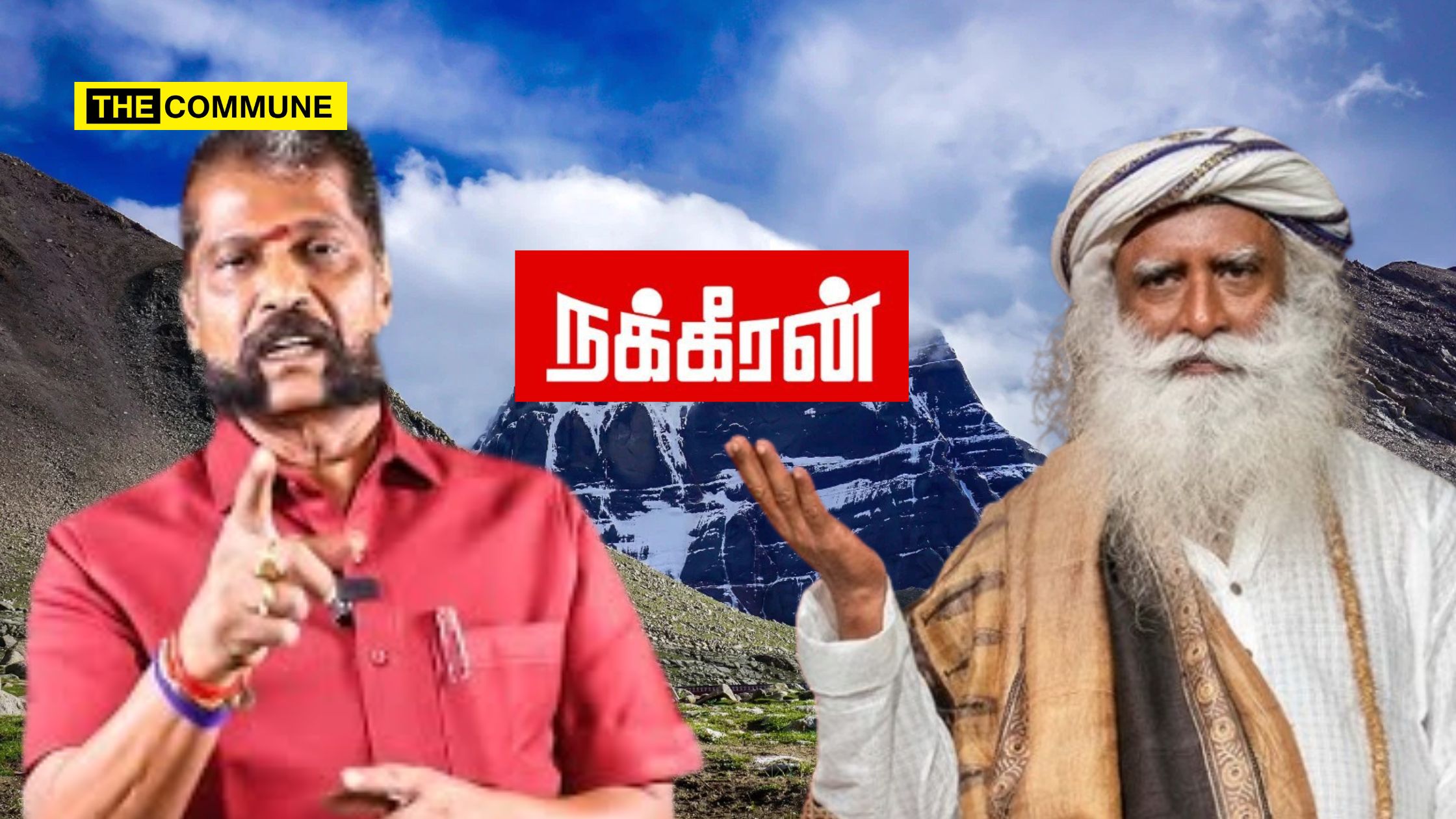
One such example is ‘Nakkheeran’, a rag run by Gopal that focuses more on sleaze than substance. It has repeatedly launched baseless attacks on Isha Foundation and its founder, Sadhguru Jaggi Vasudev. This time, Gopal has made an unfounded claim that female devotees at Isha were sexually harassed and inappropriately touched during yoga sessions, even releasing a video on his YouTube channel to support his allegations.
However, the so-called “investigative journalist” Gopal, in his eagerness to defame, has shown no shame in spreading such false content. The video he released was actually a video that was published by Isha Foundation. As usual, Gopal has resorted to his manipulative tactics of editing and distorting the truth to fit his sensational narrative, all in the name of attracting views for his channel.
In a bizarre and sensational video, titled “Half-Nude Deeksha in Jaggi’s Ashram! Video proof! Nakkheeran Gopal Exclusive | Jaggi Vasudev Isha,” Gopal, the self-proclaimed investigative journalist, simply spins an erotic tale from his own imagination. He invents a new name ‘Ma Pradyuta’ and claims that woman had sent an email to Sadhguru, the founder of Isha Foundation, accusing the ashram of mistreating women particularly minors. However, what’s truly baffling is why this woman, if her allegations were genuine, didn’t go to the police but instead chose to reach out to a questionable journalist like Gopal.
Despite claiming to have video evidence, Gopal who labels himself as a investigative journalist won’t take this so-called proof to court. Instead, he peddles allegations through YouTube for profit. Interestingly, the ruling government seems indifferent to his claims, perhaps because Gopal is a faithful supporter of their ideology, often promoting anti-Hindu sentiments and targeting the Isha Foundation. In one laughable moment, he even says, “This evidence is enough to bring down the Isha Foundation,” a strange rant that only he seems to find amusing.
After the fabricated email story, Gopal proceeded to sell a cleverly edited video featuring Isha. He falsely narrated that Sadhguru was molesting a women inappropriately with his legs and fingers. However, this was untrue.
Here’s why the video appears to be more about generating sensational headlines and peddling conspiracy theories rather than offering credible journalism.
In the original video from the Isha Foundation’s DVD ‘Mystical Journeys: Kailash Manasarovar Yatra’, both Sadhguru and the woman discussed their experience in a straightforward yogic manner. Sadhguru did not touch her inappropriately; rather, his feet were positioned above her, contrary to Gopal’s misleading portrayal in his edited version.
In the video, Sadhguru explains how the place, Mansarovar, carries such immense energy, belonging to beings that are not of this world. He shares that these beings have been here for a long time, and while he had previously experienced such energy, never before had he encountered it in such volume and variety. So, he allowed the woman devotee who was with him at Mansarovar to experience the energy, guiding her to feel it passing through her.
The woman who spoke about her experience said, “Whatever happened here is beyond words. I’m generally never short of words; I can always explain things in my own way. I was asked to lie down in Savasana, and after that, it felt like 1,000 watts of electricity passing through me in one shot, passing through me, shooting through my body. The most incredible thing here was that I’ve been in many processes where certain aspects of the chakras can be energized depending on the process you are doing or involved in, but here, at the same time having extremely active Swadhisthana and Ajna is something which I have never earlier encountered with such speed and power. After that, I felt something placed on my head, but I don’t know what it was. I really had no idea, but it was extremely hot to the point of discomfort—like burnt coal, red-hot iron, or water boiling at the highest possible temperature. I’m very puzzled by all this, and I’m waiting for Sadhguru to explain as what actually happened.”
She then continued, “I don’t know why he used the term “guinea pig,” and I never felt like his guinea pig at any moment.At this moment, I feel very fortunate to be here, open to whatever elements are present, which were made possible by my master. I bow down to him, and if I have to be his guinea pig any time, any day, I will.”
In the video, the devotee explains that she felt the energy through her guru and was ready to experience more of the mystic force present in Mansarovar. However, Nakkheeran Gopal spreads lies, and it is clear that this is a blatant fabrication. Unfortunately, in Tamil Nadu, such miscreants who openly defame Hindus, Hindu beliefs, Hindu gods, and, for the sake of content, tarnish the dignity of women, are allowed to move freely under the guise of freedom of speech. Such individuals should be held accountable by the courts through suo motu actions and severely punished, so that others may learn a valuable lesson from it.