The Union Ministry of Education (MoE) has strongly refuted Congress leader Sam Pitroda’s claim that his virtual lecture at ‘IIT-Ranchi’ was hacked, calling the assertion baseless and misleading. The Ministry clarified that there is no Indian Institute of Technology (IIT) in Ranchi and stated that Pitroda’s comments were not only factually incorrect but also an attempt to malign the reputation of premier educational institutions in India.
The Ministry, in an official statement on 26 February 2025, said that it had verified with the Indian Institute of Information Technology (IIIT), Ranchi, which confirmed that Pitroda was not invited for any seminar or conference, either in-person or virtually. The Education Ministry condemned Pitroda’s remarks, stating, “Such a reckless statement seems to be an attempt to malign the image of an extremely reputed institution of the country. Unlike such an uninformed person, IITs’ reputation is built on the merit, hard work, and achievement of many students, teachers, and academia.”
Clarification on the recent remarks made by Shri Sam Pitroda in his webcast
It has come to the notice that Shri Sam Pitroda shared a video on his “X” handle on 22nd Feb 2025. He made a statement in that video that he was speaking at the IIT Ranchi to several hundred students,…
The Ministry also warned of legal repercussions against any attempt to tarnish the reputation of India’s premier institutions.
Pitroda’s Claim
On 22 February 2025, Pitroda posted a video on his X handle, speaking on the “Relevance of Gandhi in these turbulent times.” In the video, he claimed, “Recently I was speaking at Ranchi IIT to several hundred students and someone hacked in and started showing pornography and (we) had to turn it (the video stream) off. Now is that democracy? Is that fair? I don’t think so… I think institutional independence is at the core of democracy where people can do normal things without worrying about interference,” Pitroda questioned, suggesting that such disruptions were an attack on institutional independence in a democracy.
Pitroda, a close aide to former Prime Minister Rajiv Gandhi and a mentor to Congress MP Rahul Gandhi, is no stranger to controversy. This latest claim follows a series of remarks that have sparked political outrage.
Recently, Pitroda stirred controversy with his statements on India’s approach to China. He urged India to change its “confrontational approach” towards Beijing and to stop assuming China as an enemy, leading to a sharp backlash from the Bharatiya Janata Party (BJP). The BJP called his statement a “deep blow to India’s sovereignty” and accused the Congress of having an “understanding” with China. BJP spokesperson Pradeep Bhandari linked Pitroda’s remarks to the Congress’ foreign policy stance, arguing that the party was prioritizing China’s interests over India’s security concerns.
In response, Congress distanced itself from Pitroda’s statement, with party communications head Jairam Ramesh clarifying, “The views reported by Sam Pitroda on China are certainly not the views of the Indian National Congress. China remains our biggest foreign policy, external security, and economic challenge.”
The views reportedly expressed by Mr. Sam Pitroda on China are most definitely NOT the views of the Indian National Congress.
China remains our foremost foreign policy, external security, as well as economic challenge. The INC has repeatedly raised questions on the Modi Govt’s… pic.twitter.com/vVjjc9pQbT
Pitroda had also faced backlash in the past over remarks on diversity, which were widely perceived as racially insensitive. The controversy led to his temporary removal from the post of Congress’ overseas unit chief. Though he was later reinstated, Pitroda assured the party that he would be more cautious in the future to avoid controversies. However, this latest incident has again put the Congress in an awkward position, with the party yet to issue a formal response to the ‘IIT-Ranchi’ claim debacle.
Under the leadership of the DMK, the Greater Chennai Corporation (GCC) has been systematically siphoning off taxpayer money through a massive scam involving a toilet maintenance contract, exploiting a tender process conveniently swept under the rug.
A case in the Royapuram zone serves as a prime example of how the system has been exploited. Between January 2022 and April 2023, GCC managed 1,431 toilet seats at a cost of ₹16.62 lakh, averaging ₹3.18 per seat per day. Despite this seemingly low cost, the toilets were in poor condition—filthy and unusable.
Then, from February to August 2023, GCC privatized the maintenance of 2,519 public toilet seats, including e-toilets and booth toilets, in the same area. The cost per seat jumped to ₹78 per day, a 24.5-fold increase, with the total tender amounting to ₹3.58 crore.
As if this wasn’t alarming enough, the maintenance cost for each toilet seat in Royapuram, Thiru Vi Ka Nagar, and Marina Beach was raised to ₹363.9 per day, a staggering 115 times the previous amount when GCC managed the toilets directly. The total cost of the project reached an astonishing ₹430 crore over eight years, which also included ₹82 crore allocated for building 662 new toilet seats. The tender was prepared in September 2022, and the contractor, DRRSB Infra, was given the go-ahead in February 2023. GCC is now planning to expand this contract citywide, with a projected cost of ₹1,167 crore.
In just eight months, the maintenance cost per toilet seat soared from ₹3.18 to ₹363.9. For context, commercial establishments like Slam Fitness, Naturalz, Vummudi Bangaru Jewellers, and Tony and Guy spend no more than ₹100 per day per toilet seat.
Despite the hefty budget, the toilets remain in poor condition, dirty, and often unusable. GCC has issued several show-cause notices but has not taken strong action against the contractor. According to RTI responses obtained by TOI, the first notice, sent on 27 October 2023, highlighted the contractor’s failure to meet project milestones, leaving toilets with broken tiles and inadequate sanitation. A second notice on 22 December 2023, pointed to the use of substandard construction materials and a lack of cleaning staff. By 2 January 2024, the zonal officer reported that the contractor had failed to supply the necessary cleaning equipment at Marina Beach, and had not addressed the issues despite repeated warnings.
On 8 February 2024, GCC issued a pre-termination notice, citing poor work execution, failure to meet performance targets, and non-compliance with meetings. An RTI response in January 2025 revealed that the contractor had installed only 37 CCTV cameras, far short of the 372 required, making it impossible to monitor staff performance effectively. Despite these violations, GCC has already paid the contractor ₹24 crore.
Experts in the industry argue that ₹364 per seat per day is an exorbitant cost. Sharshad Baniyandi, the founder-director of Penda Private Limited, which manages housekeeping for events at Chepauk Stadium, says even at the highest standards, toilet maintenance should cost no more than ₹100 per seat daily. This includes labor (₹86 per seat) and chemicals (₹20), with e-toilets costing around ₹150. Water is typically free from tanks.
RSB Infra, the contractor, was supposed to construct 662 new toilet seats in the first year for ₹82 crore, including GST. The remaining budget was allocated for maintenance over the eight-year period. However, the contractor has failed to meet essential requirements like installing CCTV cameras, ensuring cleanliness, and providing necessary labor and cleaning supplies. Despite these breaches, GCC has not taken any significant action.
Rs 430-crore ‘Loo’T: Who’s benefitting?
Is a scam worth multi-hundred crores of rupees possible in a seemingly humble and innocuous toilet maintenance contract? A scrutiny of the Greater Chennai Corporation’s (GCC) tender papers reveals a big ‘yes’.
How? A study of toilets in… pic.twitter.com/3dUjK31hts
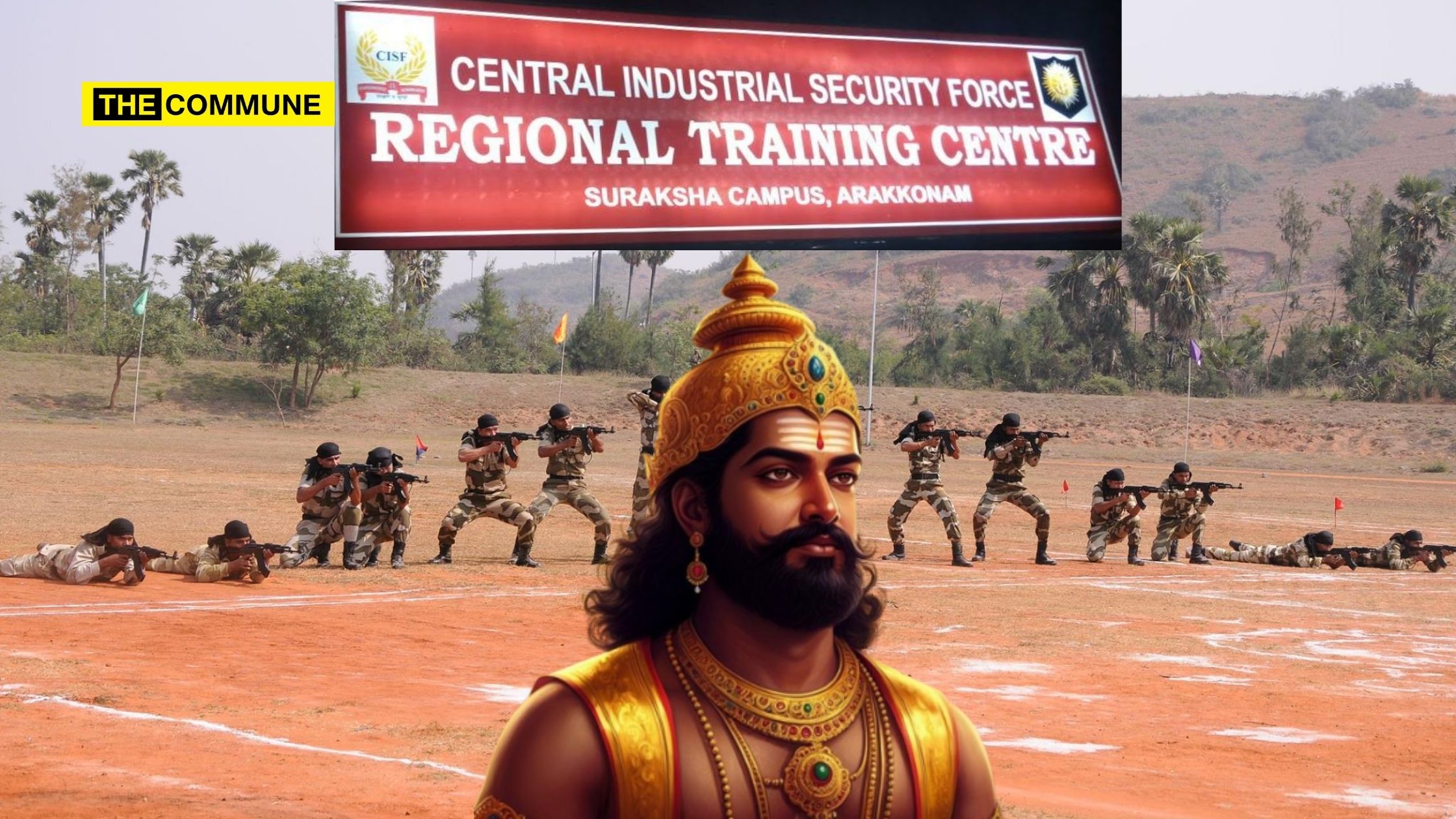
The Recruits Training Centre (RTC) of the Central Industrial Security Force (CISF) in Arakkonam has been renamed Rajaditya Cholan (RTC), Thakkolam, in memory of the Chola prince Rajaditya, who was killed in the Battle of Thakkolam in 949 CE. The name change was ordered by Rajwinder Singh Bhatti, Director General of CISF, on 24 February 2025.
The Legacy Of Rajaditya Chola
Rajaditya, the son of Parantaka I, met his heroic end during the battle between the Cholas and the Rashtrakutas. He was slain by an arrow from the Ganga prince Butuga, an ally of the Rashtrakutas. His bravery earned him the title ‘Yanaimel Thunjiya Devar’ (The king who died on the back of an elephant), as recorded in Chola inscriptions at Kumbakonam and Thirunageswaram.
Renowned historian K.A. Nilakanta Sastri documented the battle, noting that Rajaditya’s forces fought fiercely but ultimately lost due to the well-aimed arrow of Butuga. Citing the Thiruvalangadu plates, Sastri described Rajaditya as “the heroic ornament of the solar race,” who, despite shaking the enemy forces with his sharp arrows, was fatally pierced in the heart while atop a large elephant.
Commemoration Of A Warrior
The decision to rename the CISF training center highlights Rajaditya’s enduring influence on Tamil history. Dr. R. Kalaikkovan, director of the Dr. M. Rajamanikkanar Centre for Historical Research, emphasized that Rajaditya was not only a skilled warrior but also an able administrator. His father, Parantaka I, had stationed him at Thirunavalur to guard against potential Rashtrakuta invasions, where he also led socio-cultural advancements, including the construction of temples and the conversion of fallow land into cultivable areas.
The Battle of Thakkolam was a significant moment in Chola history. Though the Cholas lost the battle, Rajaditya’s heroic death left a lasting impact, and the Chola empire continued to expand for another 250 years. Successors of Parantaka I, including Gandaraditya and Arinjaya, attempted to restore Chola dominance, but it was under Sundara Chola and later Rajaraja I that the dynasty regained its imperial status.
A stone inscription at the Thiyagarajaswamy temple in Tiruvottiyur, Chennai, narrates the story of Vallabha alias Vellangumaran, a close friend of Rajaditya. He had been meant to fight alongside Rajaditya at Thakkolam but failed to do so. Overcome with guilt, he later became an ascetic as atonement for his absence in battle.
The renaming of the CISF training center serves as a tribute to Rajaditya’s valor and his place in Tamil military history, ensuring that his legacy continues to inspire future generations.
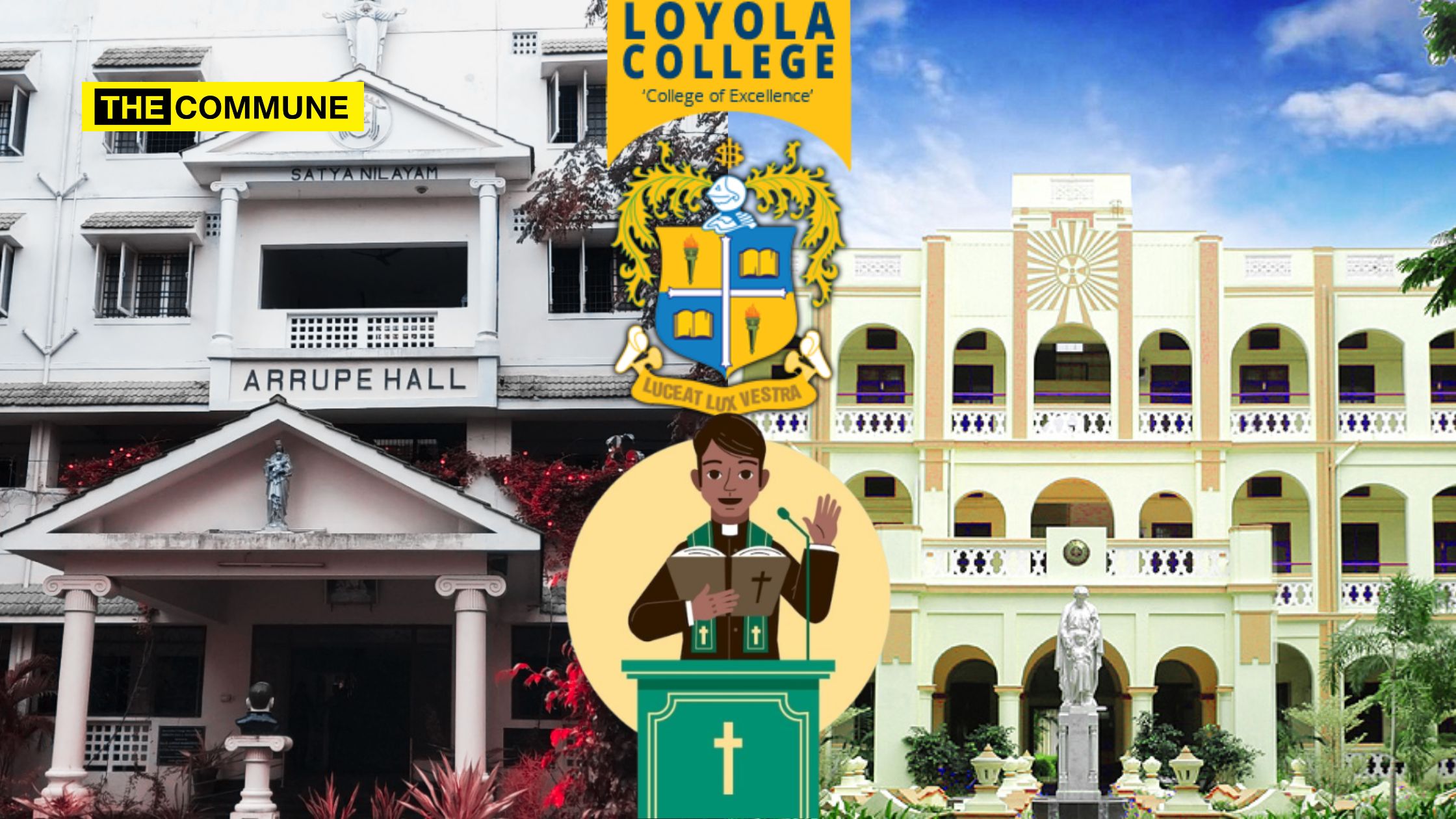
A formal complaint has been lodged against Loyola College, Chennai, alleging severe violations of University of Madras affiliation rules and academic malpractices. The Legal Rights Protection Forum (LRPF) has submitted a petition to the Governor of Tamil Nadu, who also serves as the Chancellor of the University of Madras, urging immediate action, including the revocation of the college’s autonomous status and university affiliation.
According to the complaint, Loyola College has been conducting its M.A. Philosophyprogramme at an unauthorized off-campus facility named ‘Satya Nilayam’ in Thiruvanmiyur, approximately 12 kilometers from its approved campus. The petition claims that this facility is operated by Jesuit missionaries under a separate legal entity, ‘The Society of Sacred Heart College—Satya Nilayam,’ and has been functioning as an extension of Loyola College without the necessary approvals from the University of Madras.
Allegations Of Academic Fraud And Discriminatory Admissions
Loyola College has been accused of misrepresenting academic credentials by enrolling students in an unauthorized off-campus program while issuing degrees under the Loyola College name. The petition states that ‘Satya Nilayam’ primarily serves as a theological training center for aspiring Catholic priests from various countries, including India, Nepal, Sri Lanka, Bangladesh, Kenya, and several Western nations.
The complaint also alleges that the program is exclusively catering to Jesuit students and denies non-Christian students equal opportunity for admission, violating the principles of secular education. Documents submitted as evidence reportedly show that students enrolled in the M.A. Philosophy course list ‘Satya Nilayam’ as both their present and guardian address, reinforcing claims of misrepresentation.
The official website of ‘Satya Nilayam’ states that its Philosophy programme is affiliated with Loyola College, further raising concerns about its legitimacy under the University of Madras’ regulatory framework.
Calls For Government And University Action
In response to these allegations, the LRPF has urged authorities to:
Launch an investigation into the unauthorized operation of the M.A. Philosophy program at ‘Satya Nilayam.’
Revoke the autonomous status of Loyola College for violating university norms.
Cancel the University of Madras affiliation for the program conducted at ‘Satya Nilayam.’
Take legal action against Loyola College and ‘Satya Nilayam’ for alleged academic fraud and discriminatory admission policies.
Ensure that all affiliated programs operate strictly within the approved campus with merit-based admissions.
The petition warns that failure to act against these violations could set a dangerous precedent, allowing other private institutions to manipulate affiliation rules and undermine the credibility of higher education in Tamil Nadu.
Subscribe to our channels on Telegram, WhatsApp, and Instagram and get the best stories of the day delivered to you personally.
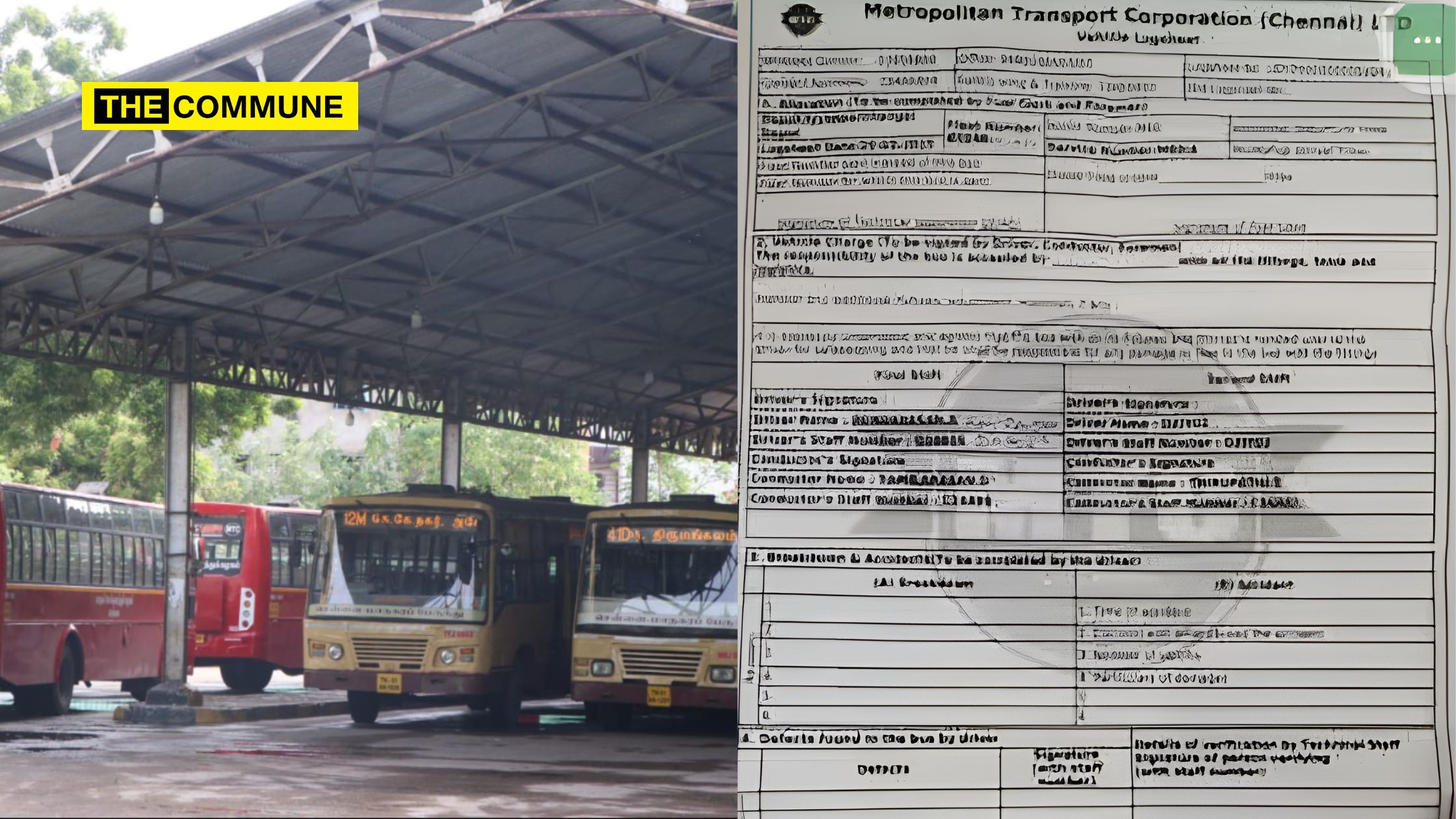
The Chennai Metropolitan Transport Corporation’s recent decision to issue the government bus logbook form in English for drivers and conductors to fill out has come as a surprise and shock to transport workers.
The Chennai Metropolitan Transport Corporation operates over 3,200 buses on more than 600 routes, employing more than 15,000 drivers and conductors. Each day, when a bus departs from the depot, the driver and conductor are given a form known as the “Vehicle Logbook” by the depot’s branch manager.
The form includes details such as the bus route number, departure and arrival times, and the names of the driver and conductor. It also requires reporting of any accidents that occur during the trip. If the bus has any defects or requires repairs, these issues must be clearly noted and submitted to the authorities.
For many years, this logbook was provided in Tamil. However, it is now being distributed in English in workshops such as the Central Workshop and Anna Nagar in Chennai, leaving transport workers shocked.
Some workers have raised concerns with transport officials, questioning why the DMK government, which has historically opposed Hindi, is now changing the logbook from Tamil to English.
Ramamoorthy, state vice-president of the Netaji Transport Workers Union, expressed his discontent, stating that most drivers and conductors have studied only up to the 12th grade and find it difficult to read and understand the form in English, especially when raising complaints about bus repairs.
He condemned the administration’s move and insisted that the vehicle record form should be issued in Tamil once again.
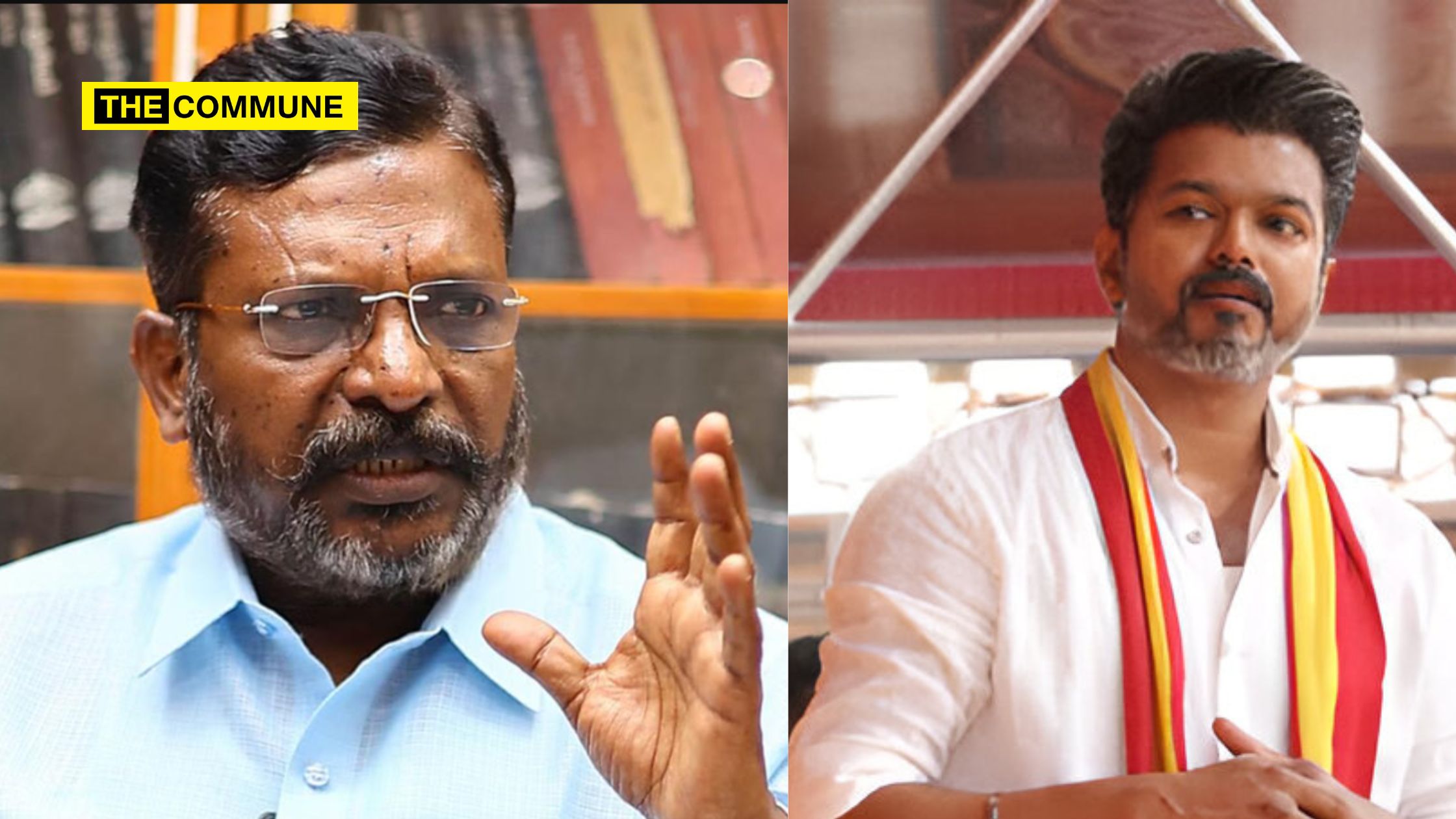
Viduthalai Chiruthaigal Katchi (VCK) chief Thirumavalavan has sharply criticized Tamilaga Vettri Kazhagam (TVK) leader Vijay, mocking his political journey by comparing it to his own. Thirumavalavan said, “After 35 years of hard work, we have earned recognition as a state party. Some people spend their lives acting in cinema until they’re in their 50s or 60s, seeking wealth, happiness, and luxury, and when their film careers are over, they jump into politics and gain recognition.”
This comment came after Thirumavalavan met with the families of victims from a cracker factory explosion on 24 February 2025, in Boothinatham, near Kambainallur in Dharmapuri district, offering condolences and financial assistance of one lakh rupees to each family.
During the memorial meeting, Thirumavalavan continued, “They make money through cinema, enjoy a comfortable life, and then enter politics. They don’t need to travel from town to town, giving speeches. They can start a party and gain power right away. But I’ve reached where I am after dedicating the last 35 years of my life—sacrificing sleep, food, and youth. I’ve faced tremendous loss to be recognized as a state party, all while following the principles of leaders like Ambedkar, Periyar, and Marx.”
Thirumavalavan emphasized his clarity of principles, asserting that no one could buy him. He added, “If I were an average politician, this party wouldn’t have received recognition. There will be no political movement in the 2026 assembly elections without VCK. I’m not saying this out of arrogance; this is what political experts are predicting.”
It is noteworthy that during the inaugural conference of Tamilaga Vettri Kazhagam (TVK) on 27 October 2024, party chief Vijay announced his willingness to share power with alliance partners who support him. This issue had been raised by Viduthalai Chiruthaigal Katchi (VCK) leader Thirumavalavan.
Actor-turned-politician Vijay’s Tamilaga Vettri Kazhagam (TVK) party has entered its second year, still appearing immature and resorting to the same political tactics as the DMK. To gain media traction, TVK has roped in Prashant Kishor, a political strategist who played a significant role in DMK’s electoral success in 2021.
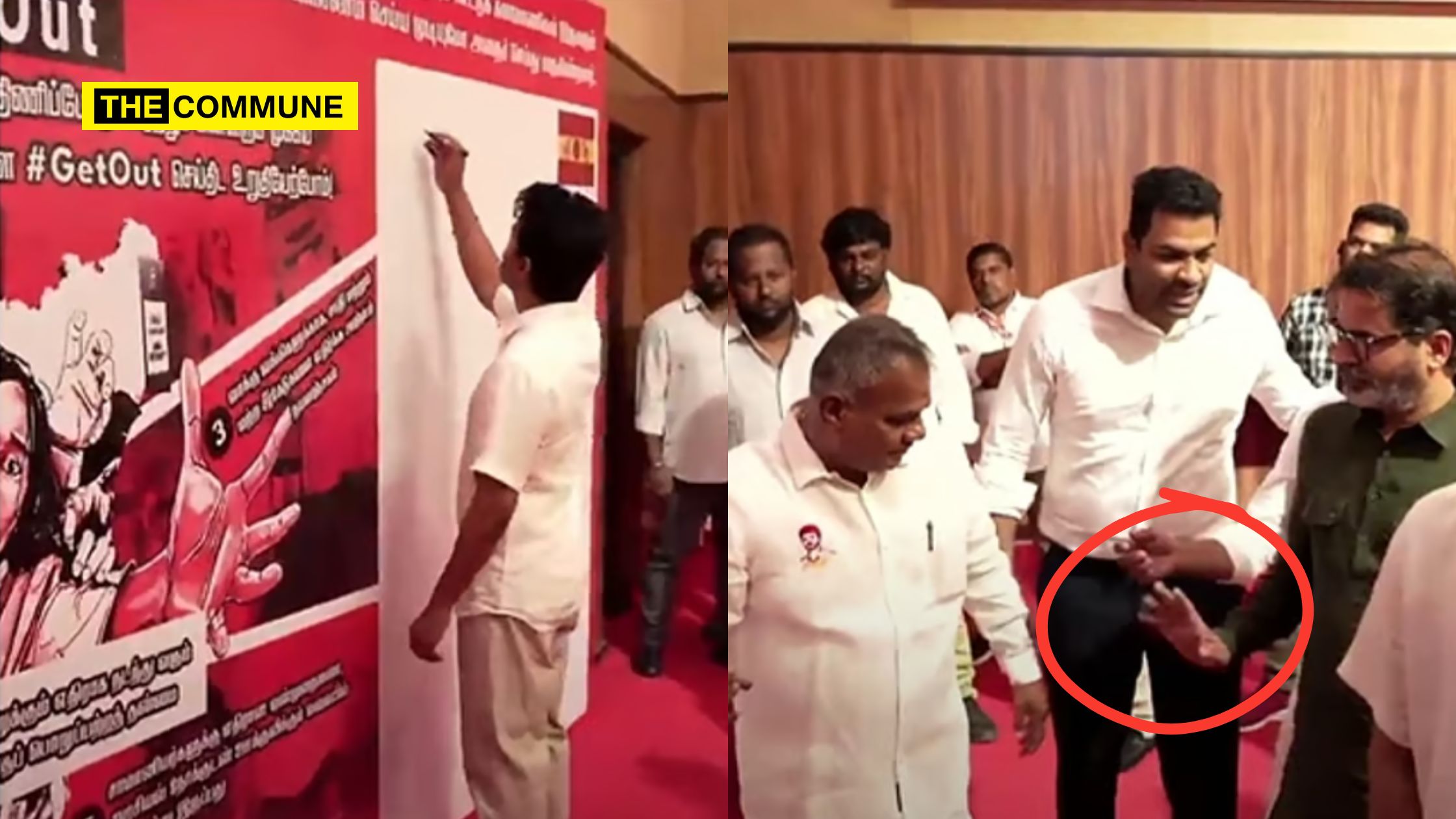
On 26 February 2025, TVK celebrated its anniversary at a star-studded hotel in Poonchery, near Mamallapuram. During the event, TVK again attempted to position itself as a potential alternative to the Dravidian major parties and the BJP, launching the #GetOut signature campaign. Vijay stated that the campaign was a direct response to what he called the anti-people policies of both the DMK-led Tamil Nadu government and the BJP-led central government.
However, when leaders were invited to sign the board set up for the campaign, the sequence of events took an unexpected turn. Vijay signed first, followed by General Secretary Bussy Anand. Then, Aadhav Arjuna, the son-in-law of lottery Martin and a new member of TVK, called upon Prashant Kishor to sign the board. In a surprising move, Kishor declined and gave a dismissive gesture to Aadhav, signaling his refusal to participate.
The banner displayed at the event featured five points slamming the DMK government’s inefficiency in the state, with first two sentence particularly targeting the central governments policy. It read, “We should take a vow to reject the new National Education Policy and the imposition of the three-language policy, among others.” This prompted political critics to label Vijay as nothing more than a shadow of the DMK, recalling its previous campaign against NEET. During that campaign, DMK pledged that if elected, party would abolish NEET. However, in a later assembly session, the Chief Minister admitted that the state government did not have the power to do so, as the central government held the authority.
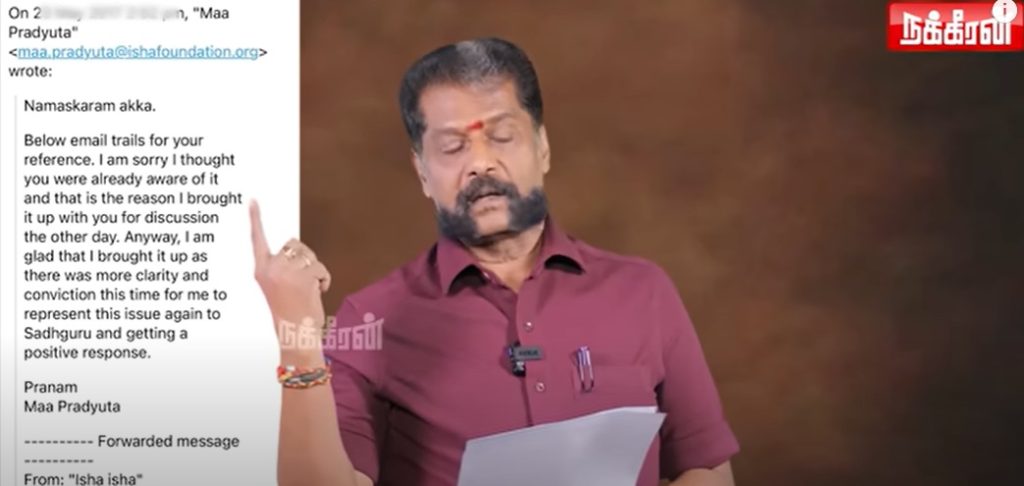
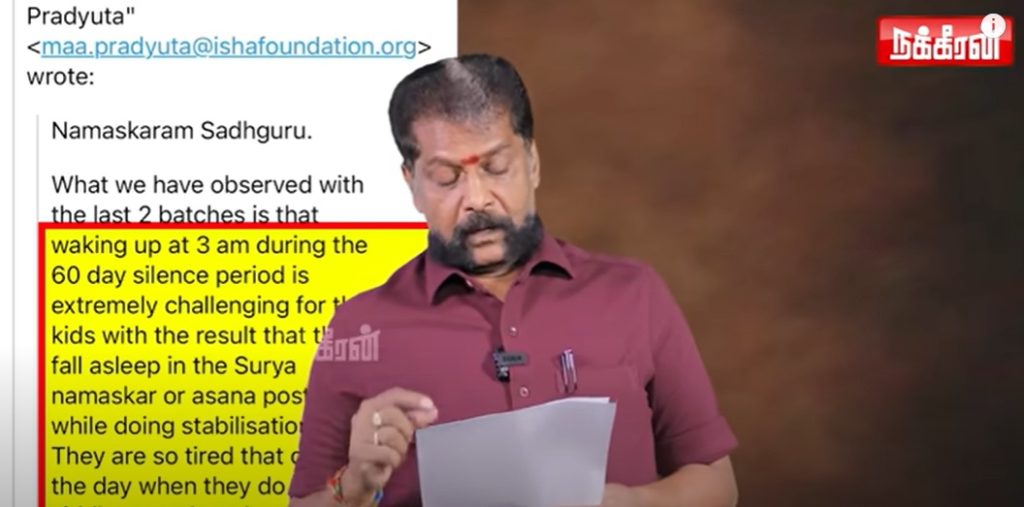
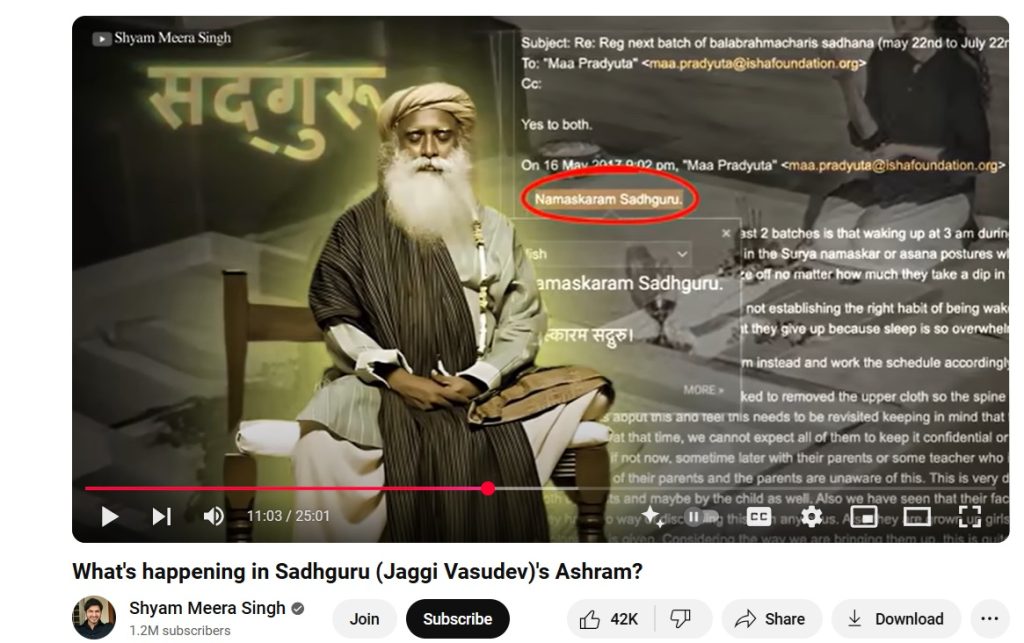
As the 2025 Mahashivratri celebrations at the Isha Yoga Centre in Coimbatore began, a well-timed smear campaign resurfaced against Sadhguru and the Isha Foundation. On 24 February 2025, self-proclaimed journalist Shyam Meera Singh released a sensationalist video making serious allegations, eerily mirroring claims from a fabricated email previously propagated by Nakkeeran Gopal in October 2024. This smear campaign video has been amplified by the likes of Dhruv Rathee, Prashant Bhushan and other usual suspects comprising of Congress, AAP and leftists.
Old Lies, New Packaging
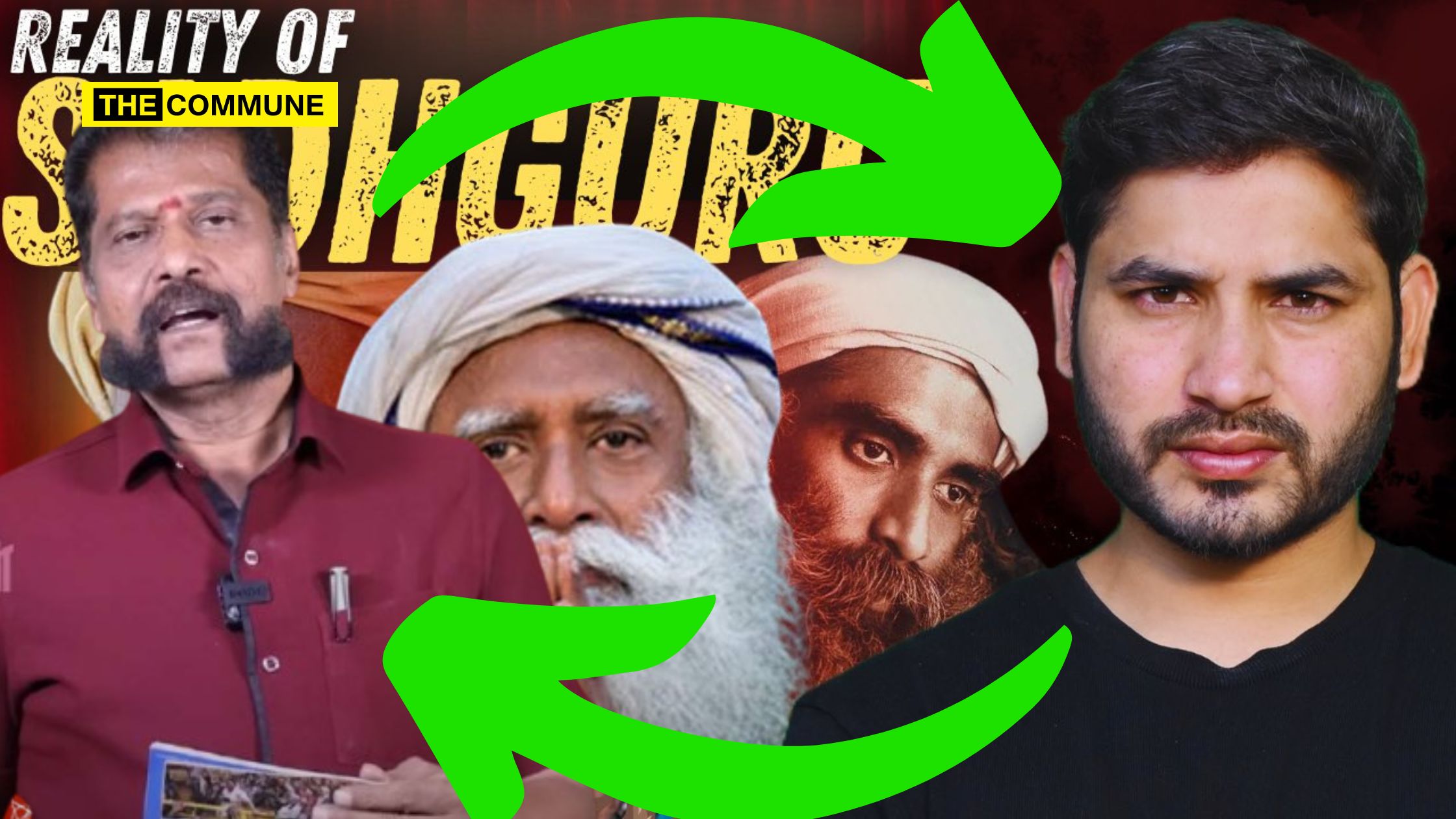
Singh’s video, titled ‘What’s Happening in Sadhguru’s Ashram?’, asserts possession of leaked internal emails that supposedly expose controversial initiation rituals at Isha. However, Singh conveniently refuses to share these emails publicly. The so-called explosive revelations are nothing, but a rehash of debunked allegations first introduced by Gopal in his October 2024 video ‘Half-Nude Deeksha in Jaggi’s Ashram! Video proof!’—a piece widely criticized for its blatant misinformation.
Singh echoes Gopal’s bizarre claims about an alleged email from a fictitious board member, Maa Pradyuta, who supposedly wrote to Sadhguru in 2017, raising concerns over the treatment of minor girls. Yet, glaring inconsistencies expose the email as a fabrication. The text, riddled with grammatical errors and spelling mistakes, also confuses fundamental details—such as mistakenly claiming that young girls bathe in Suryakund instead of Chandrakund, an error that no actual Isha member would make.
It is noteworthy that Suryakund is for men and Chandrakund is for women, especially for anyone who has visited the yoga center even once.
Let’s compare the emails from Singh’s and Nakkheeran Gopal’s video.
Reviving Debunked Accusations
Singh’s video also revisits multiple allegations that have already been dismissed:
A doctor’s arrest (September 2024):
Singh cites this case as evidence of wrongdoing within Isha, yet fails to mention that Isha itself condemned the alleged crime and fully cooperated with authorities. He mentions the arrest of a doctor associated with Isha’s mobile outreach in September 2024. The foundation had already issued a statement at the time, condemning the actions of the individual and cooperating fully with the police investigation.
Former staff member Yamini Ragini’s claims (October 2024):
Singh revives claims made by Yamini Ragini, a former Isha Home School staff member, about her son being sexually abused by another student at Isha Home School. But he conveniently ignores the fact that the child continued to study there for years after the alleged incident, and that Yamini herself remained employed at Isha before being dismissed for inefficiency.
Thisincidentwas promptly addressed bytheschool, with the accused student expelled and the matter resolved internally.
Anonymous 2008 sexual assault claim:
Singh also references an alleged sexual assault case from 2008, which was first brought up during Yamini Ragini’s press conference in October 2024. Despite the sensational claims, no evidence or credible testimony has emerged to substantiate these allegations. The fact that the supposed victim’s family has remained anonymous and has not filed a formal police complaint further undermines the credibility of these claims.
2021 rape case:
Singh misleadingly portrays this case as an institutional failure when, in reality, the matter was investigated by police and the complaint was withdrawn by the alleged victim.
A Pattern Of Targeted Attacks
The timing of Singh’s video, released just before Mahashivratri, raises suspicions of a coordinated effort to disrupt the celebrations. This pattern is not new. Over the past few years, attacks on Sadhguru and the Isha Foundation have intensified, particularly around major events. These attacks often originate from individuals and groups with a history of promoting anti-Hindu sentiments and targeting Hindu spiritual leaders.
The tactics are clear—manufacture controversy, amplify it through social media, and attempt to discredit a revered institution. Yet, time and again, these allegations crumble under scrutiny.
Nakkheeran Gopal, whose work Singh appears to be echoing, has a well-documented history of spreading misinformation and defaming Hindu institutions. His October 2024 video was widely criticized for its baseless claims and sensationalism. By recycling Gopal’s debunked allegations, Singh is perpetuating a dangerous and misleading narrative.
The Real Agenda
Despite claiming to uphold journalistic integrity, neither Singh nor Gopal has taken their so-called “proof” to the courts. Instead, they thrive on spreading misinformation through YouTube, profiting from sensationalized narratives. Their consistent targeting of Hindu organizations raises serious questions about their true motives.
When the same video is shared by the usual suspects like Dhruv Rathee, Prashant Bhushan etc, one must understand the nature of the video.
Conclusion
The liberals are spending a great deal of time attacking Sadhguru and the Isha Foundation. It’s also interesting to see how these attacks by the left-liberal ecosystem are carefully coordinated. Within a few hours, all those known for posting propaganda began posting… pic.twitter.com/W7oDwxPNgp
It is high time that such serial defamers are held accountable. Freedom of speech does not grant one the right to spread baseless accusations under the guise of journalism. The courts must take suo motu action against such miscreants, ensuring that Hindu institutions are not repeatedly subjected to these politically motivated smear campaigns.
Actor and part-time politician and Tamilaga Vettri Kazhagam (TVK) chief Vijay marked his party’s first anniversary with a grand public meeting in Mahabalipuram, setting the stage for an intense political battle ahead of Tamil Nadu’s 2026 elections.
Sharing the stage with election strategist Prashant Kishor, the event hinted at a strategic shift in TVK’s approach as it prepares to challenge the state’s dominant Dravidian parties.
Kishor’s presence at the event highlights a calculated electoral game plan. Renowned for orchestrating successful campaigns across India, he is believed to be shaping TVK’s strategy, signaling a more structured and data-driven political push.
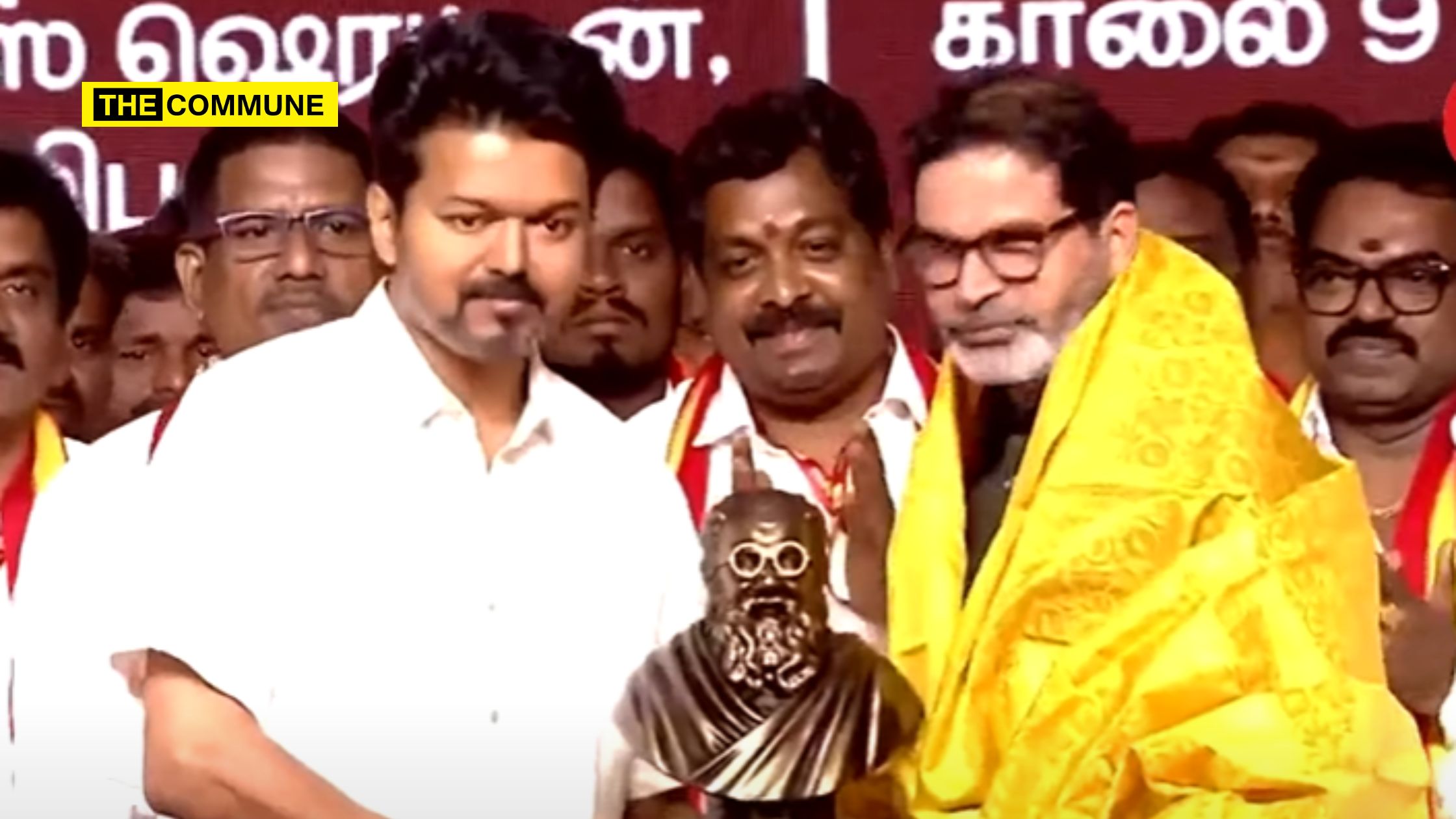
But what is perplexing is that a Bihari Prashant Kishor and a Brahmin at that, was gifted a bust of the rabid anti-Hindu, anti-Brahmin, anti-Hindi, anti-Indian EVR by Vijay at the event.
Prashant Kishor, a Brahmin by birth, cannot erase his background. Accepting the anti-Brahmin EVR’s bust as a gift on the stage can spell disaster for his political career, especially for his Jan Suraaj Party. It is noteworthy that the Dravidianists who consider EVR to be their ideological father have been caught peddling anti-Hindi propaganda especially demeaning Biharis. EVR was also against Hindi. EVR associated Hindi with Brahminism, asserting that the language was a tool for propagating the Brahminical religion, Hinduism. He also criticized Gandhi, who played a key role in promoting Hindi as a common language
Followers of EVR have addressed all guest workers/migrant workers from Bihar with slurs like “panipuriwala” or “panparagvayan” or “vadakkan“.
EVR And His Brahmin Hate
To jog Prashant Kishor’s memory, here is what EVR (hailed as Periyar by his followers) had to say about Brahmins.
Below are several instances where he openly expressed his animosity towards Brahmins.
Let’s begin with Suba Veerapandian, a prominent advocate of EVR’s ideology, who addressed the audience (specific event name not clear). He elaborated on the reasons behind advocating for the annihilation of Brahmins, “After Anna (Annadurai) parted with Periyar, he began saying, “We are not against Brahmins, but Brahminism” stating this when we inquired if Ayya (EVR) agreed with this statement, EVR responded “it’s right sir, It’s right. I’m also not against the mosquito, Sir. I’m only against the mosquito bite, but how can you get rid of mosquito bite without killing the the mosquito? The reason why I oppose Brahmins is, Brahminism coming from them only, no? Nowadays, many people say things without understanding. You always talk about their Brahminism, but never talk about other castes, Yes, I am not denying that. There is Brahminism alive in other castes too. But what we have to see is, what is the source of both Brahmanism? The Brahmin is the source of both Brahminism, who benefits from both Brahmanism? This comes from ignorance, that Brahminism comes from the arrogance . We should not see both of these as same, but we have to oppose both. I’m not saying both Brahmins should not be opposed, both should be opposed, but both should not be seen as equal.”
In another instance, Viduthalai magazine published an article regarding a speech delivered by EV Ramasamy Naicker (EVR) on 31 August 1959, in Chidambaram. In this speech, EVR espoused sentiments of hatred, advocating for the removal of Brahmins from society. EVR said, “Do you hate Brahmins? Or Brahminism? Or what is Brahminism? What is the answer to the question? Brahminism came from Brahmins themselves, right? Therefore, I say that the Brahmins should be eradicated. It is because one is a thief, one indulges in thievery. When someone says he hates thievery, it means he hates the thief, too, doesn’t it? Thus, Brahminism grew out of the Brahmins and I am striving to annihilate the root.”
EVR followers are better spinners than Warne – they can turn things to unbelievable levels.
One such spin is – EVR wanted to eradicate Br@hminism and not the Bs. This question was directly raised to EVR and he has answered it clearly in 1959.
The book “Periyar Thought Collection Part 1” records a speech by EVR where he advocated for the killing of Brahmin men and women if the Rajaji government failed to withdraw the Madras scheme of elementary education (Kulakalvi Thittam) in 1953.
EVR says, “If Kulakalvi scheme is not withdrawn in a month, I asked (people) to stab every and any paapaan and [aapaathi (Tambram man and woman).Buy petrol and matchsticks and set fire to all Agraharams. In our protest, if we shoot 10, 20 people and are hung for it, what’s wrong with it?”
That’s why we took this effort. It materialized somewhat. All Tamil Brahmins got afraid and complained to Rajaji that ‘Because of your bad decision, all our Agraharams are in danger. We are afraid to go for our jobs alone. Our women are scared to walk the streets alone’ Which is why Rajaji resigned in 1954 (as CM) and ran away.
Hmm, lets give this guy a new example.
EVR in Srirangam, Feb 1967 recounts his past heroics from 1954:
” If Kulakalvi scheme is not withdrawn in a month, I asked (people) to st@b every and any P@apaan and P@apaathi (TB man and woman).
In another incident, EVR made a direct comparison between Brahmins and Jews, suggesting that Brahmins should be forcibly removed from India. This statement was made in 1938, coinciding with the rise of persecution against Jews in Germany. It is evident that EVR’s intention behind this comparison was to incite prejudice and discrimination against Brahmins. Additionally, he expressed the belief that in order to eliminate caste in India, it was necessary to eradicate God, religion, scriptures, and Brahmins. This rhetoric raises concerns about the promotion of genocide-like sentiments. He states, “The people in India are in a situation where they have to expel the Aryans, just like they expel them saying that they have no right to be in Germany. It is worth noting that the reasons given by the Germans for expelling the Jews fit the Indians for expelling the Aryans.”
3. On Genozide of Bs:
EVR directly compared TBs to Jews & suggested for their forced emigration out of India. This was in 1938, when atrocities against Jews were beginning to take root in Germany.
Its clear what was his intent behind the call for more research comparing Jews… pic.twitter.com/lnMEznZrwK
In a separate address by EVR in Virudhunagar in 1944, he offered guidance to students, proposing that just as the Germans persecuted Jews and rose to power, why shouldn’t we do the same to Aryans?
He stated, “The Germans asked, why should Jews remain in our land? Why should the Jew exploit our country? What business does an alien have in our land? Why should a outsider oppress us? With such passion, they got excited and protested. Because of that Germany today is a super power and other countries are afraid of it. Why should we also not be like that (Germany)? We should think like this.”
1944 speech at virudanagar
Titled :
Advice to students
I quote
“Germans persecuted Jews and became superpowers Why don’t we do the same to Aryans” pic.twitter.com/sgxnduVsvV
In another instance, during his speech in Karaikudi, EVR openly encouraged non-Brahmins to kill Brahmins. EVR said, “They are celebrating festival it seems , he is celebrating Soora Samhaaram, what is it? He (Soorapadman the demon) was someone who said there is no god, they killed him, therefore now we can kill those buggers… that won’t be wrong (if we kill them) may be legally it will be wrong, that legal offence and all are bullshit we cant be bothered that it is legally wrong. We have to come to the conclusion, wherever we see a temple we must go inside and break all the idols inside, wherever we find Paapan (Brahmins) we must kill and destroy him. He has done like this to us, after all he (Tamil Brahmin) has done things like this only to come to this position. We must also do to the him, whatever he has done, what, a few of us have to die, if one Tamil dies for one paapan, means only three of us will die out of every hundreds, balance 94% will still remain.”
Audio clip of EV Ramasamy calling for the total annihilation of brahmins . Had he had his way, there would be no TMKrishna to sing his praises, nor NMurali or NRam to deny the systematic vilification and persecution of their own kin for nearly a centurypic.twitter.com/K2COn4gRxh
So, no matter how much a Bihari Brahmin Prashant Kishor try to pretend to accept EVR as a social reformer, the fact that he instigated violence and annihilation of the Brahmin community is undisputable and Prashant Kishore can never be accepted here in TN for his background. It will only spell doom for his political ambitions, it would be better for PK to rethink his political alignments and strategies if he is in for the long run.
EVR’s Anti-Hindu Hate
In 1953, Periyar organized agitation for the desecration of Ganesha idols. He had elaborated extensively on the motivations behind the breaking of the idols. He had said in a speech in 1953, “We have to eradicate the gods who are responsible for the institution which portrays us as sudras, people of low birth, and some others as Brahmins of high birth. While the former go on toiling, without any education, whereas the latter can remain without exerting themselves. We have to break the idols of these gods. I start with Ganesa because it is he who is worshipped before undertaking any task.”
EVR also claimed that no North Indian Brahmin ever died in the war against Ravana. He had also claimed that Rama had married other women apart from Sita for his sexual pleasure. He had also claimed that Ravana was, in fact, a Dravidian King from South India. None of EVR’s claims about the Ramayana has an ounce of truth to them, of course, but he made them anyway. The origins of most of these claims lie not in the Ramayana but in the virulent hatred that he harboured towards North Indians and Brahmins.
EVR Was Against India
E.V. Ramasamy Naicker is a rabid anti-Hindu bigot known for his pro-British stance when the Indian Freedom Struggle was its peak. He pleaded with the British to not leave India and pledged allegiance to them asking the Madras Presidency to be ruled from London. He even went to the extent of demanding a separate Dravida Naadu and had met Mohammad Ali Jinnah regarding the same.
PK’s Political Suicide
It is the statue of this anti-Hindu, Brahmin genocide-mongering, anti-Indian racist demagogue that Prashant Kishor received as a gift from Vijay.
While Prashant Kishor might try to win hearts in Tamil Nadu with his punchy dialogues and do lip service that he supports TVK’s fight against corruption, communalism, and dynasty politics, he is still a Bihari Brahmin at the end of the day for Dravidianists. He can joke all he wants about competing with Dhoni’s popularity and learning to speak Tamil in 2026 or call Vijay as a symbol of hope and all that jazz, but he will be treated with the same hate that is meted out to the 3% Brahmins in the state and the “vadakkans” living in TN who only can do construction labour (allegedly) according to the DMK MP Raja because they know Hindi.
Receiving EVR’s statue is nothing but a political suicide for him in his home state of Bihar.
Subscribe to our channels on Telegram, WhatsApp, and Instagram and get the best stories of the day delivered to you personally.
The DMK government has been proudly claiming that they have achieved everything in their education system, refusing to consider the National Education Policy (NEP), which was introduced to replace the 34-year-old NEP of 1986. What the DMK boasts about are the goals set 34 years ago, designed for a different era. However, the world has changed significantly, and the 21st century demands a new approach.
The latest NEP is designed to bridge the gap and prepare students for the rapidly evolving world. It emphasizes more than inclusivity, equity, and the importance of grounding education in India’s cultural roots, while also equipping students with the skills needed for the future. The policy outlines a roadmap for universal foundational literacy and numeracy, a holistic curriculum, multilingual learning, and the seamless integration of vocational and academic pathways. However, the DMK remains resistant to change, and they continue to push for a clear divide between government and private schools in Tamil Nadu.
This raises the question: What has the DMK actually done for education since winning the election, particularly in the School Education Department led by Minister Anbil Mahesh Poyyamozhi? The answer seems to be a disaster. Government schools, which are the lifeline for the underprivileged, have been completely neglected—schools that many look to for a chance to escape poverty through education. Since the DMK took power, numerous issues have cropped up, yet no meaningful action has been taken to address them.
Instead, the founder of Udhayanidhi Stalin’s fan club has been more focused on creating drama, posting pictures, and posing for social media, rather than addressing real concerns. There is a lack of infrastructure, a shortage of teachers, and many qualified candidates who have passed the Teacher Eligibility Tests but have not been given jobs. There have also been reports of government school teachers sexually assaulting students, students struggling to read and understand Tamil, and an alarming rise in substance abuse among students, among other issues. Let’s take a look at how the school education department has decayed under DMK minister Anbil Mahesh.
Teacher Shortage & DMK’s Refusal To Recruit
Let’s start with the basics: teachers. Tamil Nadu is facing a critical shortage, with over 1,000 headmaster positions and thousands of teaching roles unfilled in government schools. This lack of teachers has made it increasingly difficult for educators to effectively teach students.
While all government schools fall under the Department of School Education, various wings of the department are responsible for primary and secondary schools. In Tamil Nadu, approximately 25,50,997 students are enrolled in 31,336 primary schools, with around 1,08,537 teachers. In secondary schools, there are 6,218 institutions across the state, with 27,24,256 students and 1,16,863 teachers.
The shortage of teachers and headmasters is creating significant challenges for both educators and students. Despite this, the government has failed to address these vacancies. According to teachers’ unions, more than 1,000 headmaster positions remain vacant in the state’s 37,000 primary, middle, and high schools.
What is even more alarming is the fact that the last recruitment for primary school teachers took place in 2021-2022, filling a mere 14 positions. For secondary schools, 3,043 vacancies were filled in the 2022-2023 academic year. The DMK government, instead of addressing this shortage, has resorted to using temporary staff, allowing the education system to spiral into chaos.
TN Students Struggle In Literacy And Numeracy
The recent ASER 2024 report highlights a disturbing gap in foundational literacy and numeracy across India, with some states showing significant recovery from pandemic disruptions while others, like Tamil Nadu, are lagging behind in key educational indicators. The report compares the progress of various states, and despite Tamil Nadu’s reputation for educational advancements, it has notably fallen short, particularly in government school performance.
Reading Skills
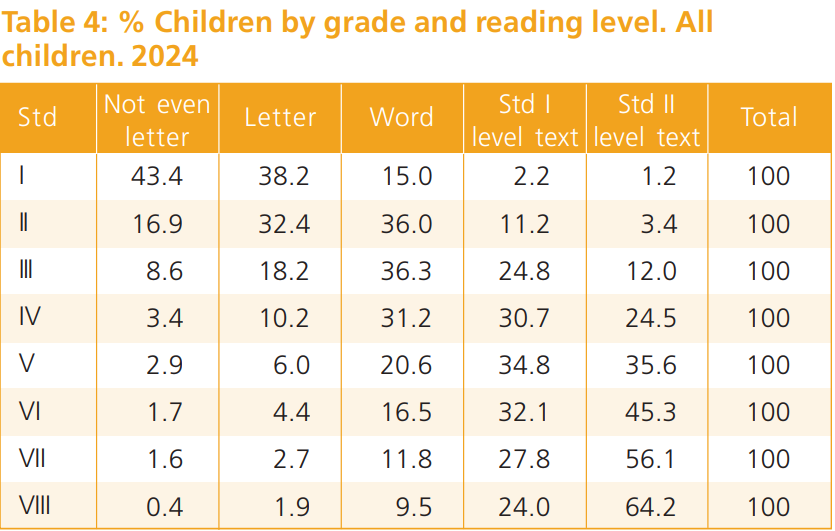
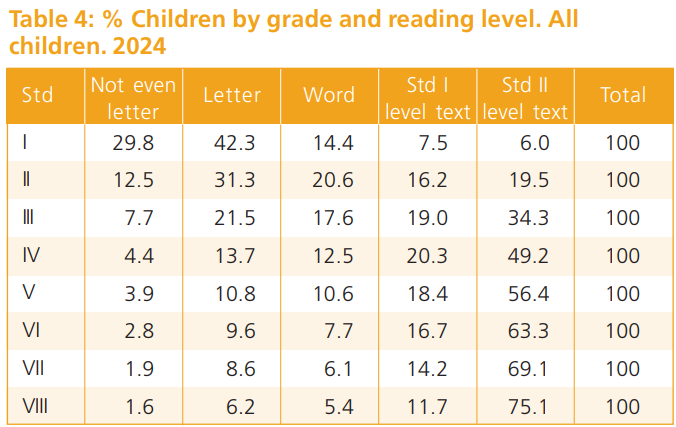
In 2024, when comparing literacy levels between Tamil Nadu and Uttar Pradesh for children in Standard III, Uttar Pradesh has made notable strides, especially for students able to read at the Standard II level. Tamil Nadu’s performance, however, is concerning: 8.6% of children cannot even recognize letters, 18.2% can only read letters but not words, and 36.3% can read words but not Standard I-level text. Only 12% of children can read at a Standard II level. Uttar Pradesh, by comparison, shows better results, with 34.3% of students reading at the Standard II level, a significant improvement over Tamil Nadu, which has traditionally been viewed as an educational leader. More troubling is the situation in higher classes: 45.3% of Class VI students, 56.1% in Class VII, and 64.2% in Class VIII can only read at a Standard II level.
(ASER – Tamil Nadu)
(ASER – Uttar Pradesh)
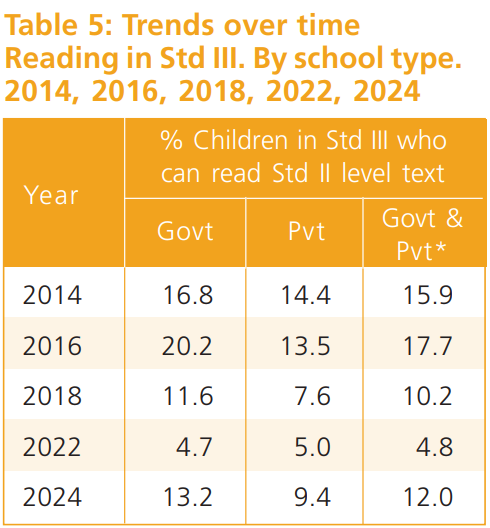
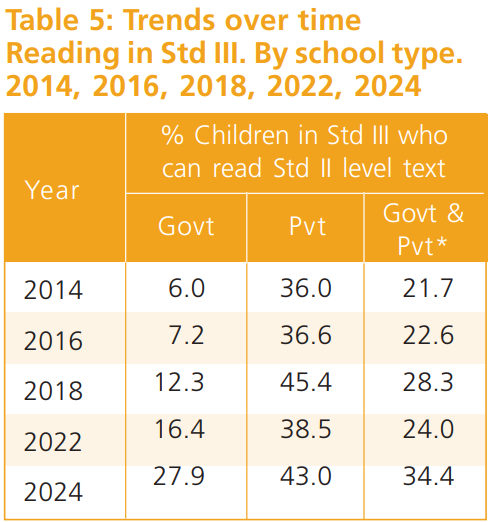
Tamil Nadu’s struggle to maintain or improve its literacy rates is evident. Despite claims by the government of improvements such as the Illam Thedi Kalvi program, literacy rates have not shown significant progress. In fact, in 2022, the percentage of children in Standard III reading at a Standard II level had drastically fallen to just 4.7%, a sharp decline from 16.8% in 2014. On the other hand, Uttar Pradesh, despite having a lower percentage in 2014 (6%), showed continuous improvement, reaching 27.9% in 2024.
(ASER – Tamil Nadu)
(ASER – Uttar Pradesh)
Numeracy Skills
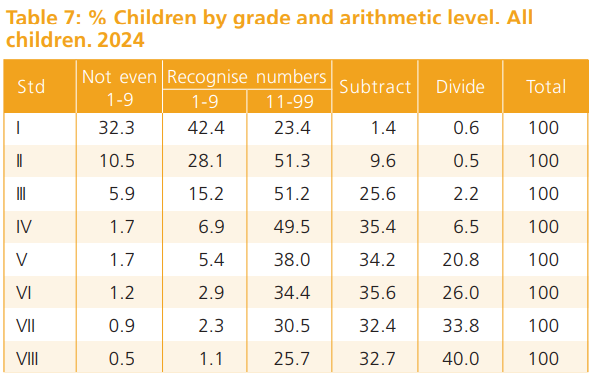
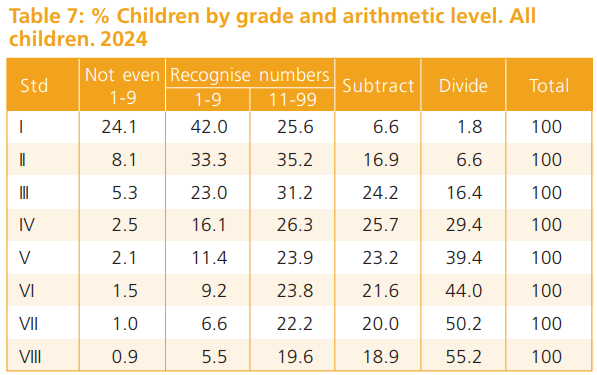
The situation in numeracy is similarly troubling. In Tamil Nadu, the performance of Standard III students in arithmetic shows significant gaps. 5.9% of children cannot recognize numbers from 1 to 9, and 15.2% can recognize numbers up to 9 but struggle with numbers up to 99. 51.2% of students can recognize numbers up to 99 but cannot perform subtraction, while only 2.2% can perform division. Uttar Pradesh, although still facing challenges, shows better performance in numeracy, with 16.4% of children able to perform division, compared to just 2.2% in Tamil Nadu.
The trend analysis for Standard III students performing subtraction from 2014 to 2024 reveals fluctuating performance in Tamil Nadu, with a sharp decline seen in 2022, likely due to the pandemic. However, by 2024, the percentage of students able to perform subtraction has increased to 27.6%, still behind Uttar Pradesh, which has steadily improved over the years. In contrast, Uttar Pradesh’s progress in numeracy is more consistent. The state showed remarkable improvement, reaching 31.6% in 2024, surpassing Tamil Nadu’s performance.
(ASER – Tamil Nadu)
(ASER – Uttar Pradesh)
The performance in higher classes also highlights a concerning trend for Tamil Nadu. In Standard V, the percentage of children who can perform division has decreased from 25.6% in 2014 to 20.2% in 2024. Meanwhile, Uttar Pradesh has made significant strides, with the number of children performing division rising from 12.1% in 2014 to 31.8% in 2024.
In Standard VIII, Tamil Nadu’s ability to perform division has also declined, with 37.8% of children being able to perform division in 2024 compared to 39.6% in 2014. Uttar Pradesh, however, has shown a notable improvement, jumping from 30.5% in 2014 to 45.6% in 2024, surpassing both Tamil Nadu’s performance and its own previous figures.
Substance Abuse
A Chennai school in Kalyanapuram, Vyasarpadi, has become a hotspot for underage substance abuse, with students as young as pre-teens consuming beer and tobacco. A report on 23 August 2024, revealed a Class IX girl drinking beer in the classroom on her birthday, with her Class VII brother purchasing it, while three Class X boys were caught smoking Beedis. These incidents highlight a disturbing trend of substance abuse among students at the school.
Other Administrative Failures
Let’s take a look at how the administration has deteriorated over the past few years under the DMK government.
On 9 November 2024, a government-aided girls’ school in VK Puram, near Ambasamudram, screened Tamil films such as Vijay’s ‘GOAT’ to senior students and Rajinikanth’s ‘Vettaiyan’ to younger students, with charges of ₹25 and ₹10 per student, respectively.
The government secondary school in Theethipalayam, Coimbatore, faced a severe classroom shortage, leading to a decline in student admissions and forcing existing students to attend classes under trees and in the parking area. Despite ongoing construction, about 100 students in classes 8 and 9 are left without proper facilities.
On 27 August 2024, three students were injured when a section of the ceiling plaster fell on them during class at a government-run school in Krishnagiri. The accident raised significant concerns about the safety and structural integrity of the building, which had only been opened two months ago with MPLADS fund. In another similar incident July 2024, a ceiling of a newly constructed Panchayat Union Middle School near Kanchipuram collapsed, wher the building, completed three months prior.
On August 2024, anotherceiling of a classroom at a government school in Thiruporur collapsed, injuring five female students and sparking protests from parents who questioned the quality of the construction.
On 12 June 2024, the administration of St. Paul’s Girls’ Higher Secondary School in Mayiladuthurai forced students to clean their classrooms to “instill” discipline, a practice exposed when a ninth-grade student refused and was slapped by a teacher.
The Government Higher Secondary School in Mogappair, Chennai, became a site of student distress due to poor conditions, including unhygienic facilities and unsafe infrastructure. Girl students raised alarming concerns that they were subjected to verbal harassment and forced cleaning duties, with teachers complicit in the mistreatment.
In 2023, a disturbing video went viral showing mentally challenged students at a Tamil Nadu government-aided school, run by the Church of South India (CSI), being forced to clean toilets. The students, attending the CSI School for the Mentally Challenged in Sivakasi, were reportedly made to perform this task as part of their school routine. The incident, involving over 100 students, sparked outrage after the video was shared on social media.
Proselytization Attempts At Govt Schools
So far, we only saw the regular failures. Did you know that government schools even became a targt for proselytization? Take a look at the number of times this happened.
In October 2024, the headmistress of Government High School in Diwanshah Pudur allowed Friday Namaz to be held on school premises, disrupting the secular environment. The prayers have been conducted regularly such practices may cause religious discord and mental distress as the school serves a diverse student body
In August 2023, protests erupted in Acchankuttam village, Tenkasi, over concerns that a government-aided Christian school was engaging in proselytization. The Tahsildar filed a complaint, leading to police action against 12 individuals accused of inciting communal unrest by mobilizing Hindu parents to withdraw their children from the school. The case stems from fears of religious conversion within the school.
In 2022, Beatrice Thangam, a tailoring teacher at a government school in Kanyakumari district, Tamil Nadu, was accused of making objectionable remarks about Hindus and attempting to preach Christianity to her students. A Class 6 student revealed in a video that Thangam referred to Hindus as “sathaan” (devil), forced students to read the Bible, and even made them kneel and recite Christian prayers. The teacher allegedly pressured Hindu students to stitch Christian crosses and dismissed the Bhagavad Gita as “bad.”
In 2022, a 17 year old girl studying at Sacred Heart Higher Secondary School in Thirukattupalli near Thanjavur, committed suicide by drinking poison after she was allegedly tortured to convert to Christianity by the school for her to continue her studies.
Caste Pride & Violence
For all the credit that the Dravidianists claim for “eradicating caste”, we have seen a huge surge in caste violence in schools. Here are a few such instances:
A 10th-grade student at a government-aided school in Sripuram, Tirunelveli, was dismissed for carrying weapons, including a sickle and knives, after a student clash. The weapons were discovered during a routine bag check on 18 September 2024. .
On 30 July 2024, two students at the Government Higher Secondary School in Valliyoor, Tirunelveli, were injured in a caste-related clash triggered by derogatory remarks about a specific caste written on a toilet wall.
In December 2023, students from Periyar Government Higher Secondary School in Cheranmahadevi attacked students from a nearby polytechnic college over caste issues, leaving one student stabbed.
On 1 July 2024, another instance of caste-based pride sparked a clash among 12th-grade students at Rosalind Chelliah Government Higher Secondary School in Maruthakulam village, Nanguneri, Tirunelveli.
Sexual Assault/Harassment At Govt Schools Surged
If caste violence and other administrative failures weren’t enough, the government schools also saw sexual assault cases peak under the DMK.
On February 2025, Kumaresan (57), a lab assistant at a government school in Salem, was arrested under the POCSO Act for allegedly sexually harassing female students.
A second-grade student at Podhavur government primary school in Trichy was allegedly sexually assaulted by teacher Jayaraj Susainathan while cleaning the classroom. Following a complaint from the parents, Jayaraj was arrested. It has been revealed that there have been sexual harassment complaints against him for the past decade, with the teacher reportedly threatening the students and their families during this time.
A 58-year-old assistant headmaster of a government high school in Pudukottai was arrested on 17 February 2025 under the Protection of Children from Sexual Offences (POCSO) Act for allegedly sexually harassing multiple girl students.
Sivakumar, a 40-year-old temporary physical education teacher, allegedly sexually harassed the 11th grade student and violated her by making inappropriate comments about her appearance. Following an investigation Omalur All Women Police Station registered a case under the POCSO Act.
3 Govt School Teachers – Arumugam (48), Chinnaswamy (57), and Prakash (37) in Krishnagiri arrested under the POCSO Act for Gang-Raping a 8th grade student resulting in pregnancy and an abortion
Ilayakannu, a 37-year-old teacher from Neyyamali, Bettanayakkanpalayam, Salem district, had been arrested under POCSO act for sexually harassing 10th and 11th grade students at the Yercaud government higher secondary school.
On 3 September 2024, Dr. S. Samson Daniel (31), a government doctor, was arrested under the POCSO Act on sexually assaulting minor girls at a hostel affiliated with a government-aided school in Trichy. His mother, S. Grace Sagayarani (54), who is the headmistress of the school, was also taken into custody for helping to cover up the offenses.
On August 2024, a 13-year-old girl was allegedly sexually assaulted by a Naam Tamizhar Katchi (NTK) functionary named Sivaraman during a fake National Cadet Corps (NCC) camp at a private school near Bargur in Krishnagiri district.
A math teacher Sundara Vadivelu working at a corporation school at Noyyal Road in Tiruppur was arrested for sexually harassing multiple students, and allegedly targeted seventh-grade students over the past few months. Sources indicate that more than ten children have come forward with complaints so far.
Suresh, a Tamil teacher at Ariyalur Government School, was arrested under the POCSO Act for sexually harassing a 6th-grade student. He threatened the student’s life to keep it secret, but she informed her parents, who then filed a police complaint.
The state of education in Tamil Nadu under the DMK government, particularly in the School Education Department led by Minister Anbil Mahesh Poyyamozhi, paints a grim picture of systemic neglect and administrative failure. Despite the DMK’s claims of progress and pride in their education system, the reality on the ground reveals a stark contrast.
The above-mentioned problems in government schools further expose the deep-rooted issues plaguing the system. These problems are compounded by the administration’s focus on superficial measures and social media optics rather than addressing the real concerns of students, parents, and educators.
Subscribe to our channels on Telegram, WhatsApp, and Instagram and get the best stories of the day delivered to you personally.